Online Notary for Businesses in the UK: A Practical Guide
By Jeremy Arhab, Founder · Published 1 November 2026 · Updated 1 November 2026
How UK businesses can notarise company documents online by video call: what is notarised, what to prepare, signatories in several places, apostilles and timing.

A business can have documents notarised online through a live video session with a commissioned notary. The company uploads the document, the signatory proves their identity with a passport, and the notary witnesses the signature and applies a seal. You do not travel and you do not wait for an office appointment. This guide explains which business documents usually need notarisation, how to prepare them, where electronic signing has limits, and what to do afterwards if the document is going abroad.
TL;DR
- Notarisation gives a document an independent check of who signed it, and often of the signer's authority, so a recipient abroad can rely on it more readily.
- Company documents such as powers of attorney, board resolutions, certificates of incorporation and certified copies are the most common requests.
- Online notarisation runs by video: upload, passport identity check, recorded session, notary seal, same-day delivery.
- Deeds have their own rules: a witness must be physically present, so check the document type before choosing a remote route.
- If the document is used abroad, ask the receiving party early whether it needs an apostille or a certified translation as well.
Table of Contents
- What notarisation does for a business
- Which business documents are commonly notarised
- Ask the recipient what they need first
- How online notarisation works step by step
- Preparing the document and proving authority
- Electronic signatures and the limits of remote signing
- Documents signed by people in different places
- After notarisation: apostille and translation
- What affects cost and turnaround
- Our perspective
- Start your business notarisation online
- FAQ
- Sources
What notarisation does for a business
Notarisation is a formal step in which a commissioned notary confirms certain facts about a document. Depending on the document, that can mean confirming that a signature belongs to a named person, that a copy matches an original, or that a person holds the role they claim to hold in a company.
It differs from simple certification or witnessing in what it adds. A friend or colleague who witnesses a signature confirms only that they saw it. A notary identifies the signer against official identity documents, records what was checked, and signs and seals a notarial certificate. That certificate is what a bank, registry or authority in another country is usually looking for.
For a business, the practical effect is trust at a distance. A foreign counterparty cannot easily check a UK director's signature. A sealed certificate from a commissioned notary gives them a record of the identity check, which supports the document's use in their own process.
We cannot promise that any particular recipient will accept a document. Acceptance is decided by the person or body receiving it. What we can do is make the notarisation itself clear, complete and well documented.
Which business documents are commonly notarised
UK guidance on legalising documents says overseas recipients may require originals or certified copies, and may specify that a document is signed by a notary. Its examples include powers of attorney, contracts and qualification certificates. In practice, business requests tend to fall into a handful of groups:
- Corporate records: certificates of incorporation, articles of association, certificates of good standing and registers of directors or shareholders, usually as certified copies.
- Authority documents: powers of attorney, board resolutions and signing authority letters that let a named person act for the company abroad.
- Declarations: statutory declarations, beneficial owner declarations and affidavits supporting a registration, a bank account or a licence.
- Identity and compliance documents: KYC identity verification forms for directors and shareholders, and proof of residency for individuals linked to the company.
- Commercial and administrative documents: contracts, invoices, licences and letters that a foreign authority asks to see certified.
- Qualification documents: degrees and professional certificates of staff or directors, needed for work permits and visas.
Our corporate document notarisation service covers commercial and administrative papers. For individual directors, our signature notarisation and KYC identity verification services cover the identity side. Staff qualifications can go through degree and diploma certification.
Ask the recipient what they need first
The form a document must take is set by whoever receives it, not by the sender. The same UK guidance advises asking the recipient whether they need an original or a certified copy, and whether a particular official must sign it.
Before you book, send the recipient a short list of questions:
- Do you need the original, a certified copy or an electronically signed PDF?
- Must the document be notarised, or is a certified copy enough?
- Do you need an apostille or further legalisation afterwards?
- Must the document be in a particular language, with a certified translation?
- Is there a maximum age for the document, for example a certificate issued within the last three months?
- Does the document need to name particular people, roles or company numbers?
Writing the answers down saves a second notarisation later. Most delays on business documents come from a recipient who wanted something different from what was supplied.
How online notarisation works step by step
The process is the same for most business documents.
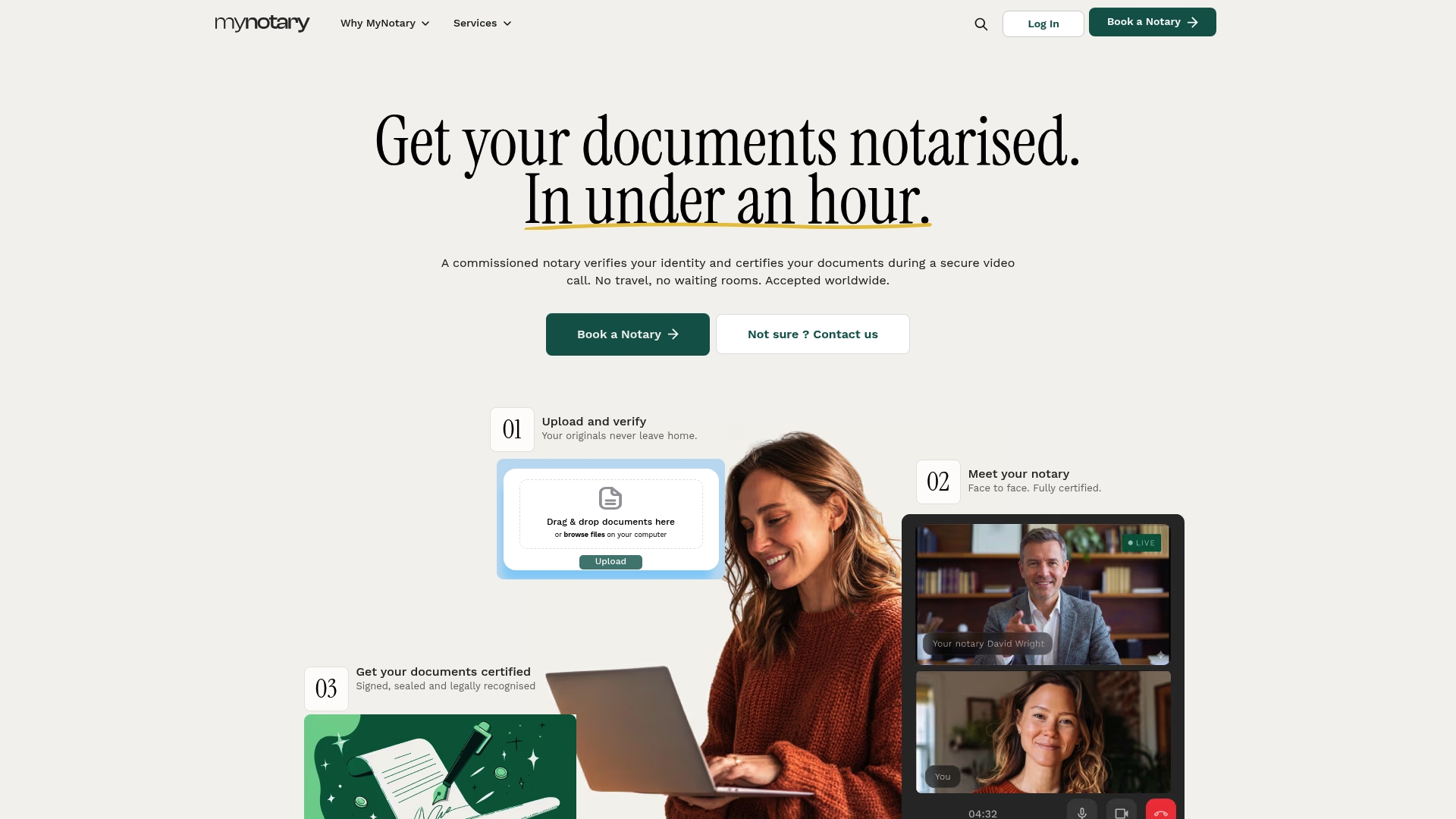
- Upload the document. Provide the final, unsigned version as a PDF. If it is a copy certification, you will need the original to hand in front of the camera, or a document that can be shown in full.
- Verify identity. Each signatory is checked with a passport and a biometric comparison to the person on screen.
- Join the video session. The commissioned notary speaks to the signatory, confirms they understand the document and are signing willingly, and records the session.
- Sign in view. The signatory signs while the notary watches. The document must be unsigned before the session.
- Notary seal and certificate. The notary completes the notarial certificate and applies the seal.
- Delivery. You receive the certified digital document, usually the same day. A physical copy and further services can follow if you need them.
Our platform keeps an audit trail and encrypts the files. We built the process around international AML and KYC standards, because a document that will be read abroad needs a visible record of how identity was checked. Our average turnaround is about one hour, though the time depends on the document and how ready the signatories are.
| Stage | What you do | Typical timing |
|---|---|---|
| Preparation | Gather documents, passports, recipient requirements | Same day for most requests |
| Identity check | Passport and biometric check | A few minutes per signatory |
| Video session | Meet the notary, sign in view | Short, longer for several signatories |
| Delivery | Receive certified digital copy | Often within about an hour |
| Apostille or translation | Optional follow-on services | Depends on the service chosen |
Preparing the document and proving authority
Good preparation matters more than anything else in the session. A notary can only certify what is in front of them.
Check the content first. Names, company numbers and registered addresses must match the public record and each other. A single mismatch between a passport name and a company filing is the most common cause of a rejected document.
Show who the signatory is. The signatory needs a valid passport. For company documents, the notary will also want to understand the person's role.
Show authority to sign. Where someone signs for a company, have evidence ready that they may do so: a board resolution, the articles, or a current register of directors. The notary describes what has been shown, and the recipient can then see on what basis the person signed.
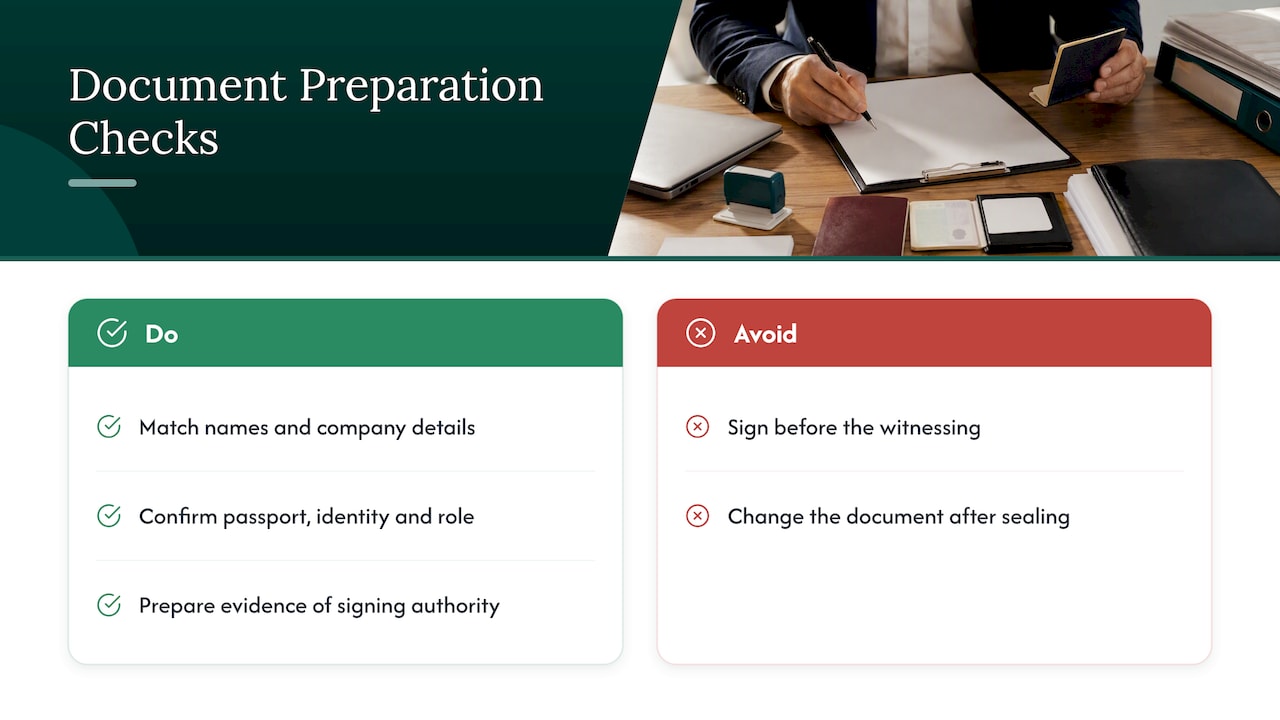
Keep the document unsigned. Signing beforehand defeats the point of the witnessing. If you have already signed, print a clean copy or ask for a fresh version.
Do not alter anything after notarisation. Any change after sealing invalidates the certificate for practical purposes. Fix errors before the session, not after.
Electronic signatures and the limits of remote signing
Electronic signing is well established in England and Wales. The Law Commission's work on this topic concluded that an electronic signature can be used to execute a document, including a deed, provided the signer intends to authenticate it and all other formalities are met.
The formality that catches businesses out is the deed. The same source notes that a deed must be signed in the physical presence of a witness. A video link does not meet that requirement. If your document is a deed, plan for a witness in the room, even if the rest of the process is digital. The Law Society's guidance for virtual executions says the same: a deed's witness must be physically present, and overseas notarisation requirements should be checked with lawyers in the relevant jurisdiction.
For many other business documents, such as declarations, certified copies, powers of attorney used abroad and KYC forms, the main question is not the signing method but what the recipient will accept. For a broader look at how electronic execution works for company agreements, see this overview of electronic execution of business agreements. Our own article on what the 2000 Act does and does not guarantee sets out the legal background in more detail.
Cross-border use adds another layer. A working group report on electronic execution found that different jurisdictions' execution requirements can increase cost, delay and uncertainty for international agreements. When the document is governed by foreign law, ask the recipient or local counsel how it must be signed before you book.
Documents signed by people in different places
Business and family documents often need several signatories, and they are rarely in the same city. A shareholder may be in Dubai, a director in Manchester, and a secretary in Singapore.
There are two workable patterns.
- One session, several participants. Everyone joins the same video call, each is identified by passport, and each signs in view of the notary. This suits short documents and signatories whose time zones overlap.
- Separate sessions on the same document. Each signatory completes their own session, and the signatures are combined into one certified file. This suits people who cannot meet at the same time.
Our platform supports multi-signatory documents. For a company deed, the Law Society's guidance notes that under section 44(2)(a) two authorised signatories may sign in counterparts. The witnessing rule for deeds still applies to each signature, so keep that in mind when you plan.
After notarisation: apostille and translation
A notarised document sometimes needs a further step before it can be used abroad. That step is usually an apostille, a standard certificate defined by the Hague Convention of 1961. The convention replaces the long chain of legalisation with a single Apostille certificate issued by a competent authority in the country where the document originates, and the HCCH reports 130 contracting parties.
Not every country is a party. If the destination is not, a different legalisation route applies, and the destination country decides what it is. Ask the recipient, then plan the sequence: notarise first, then apostille, then translate if needed.
Our guides explain each stage in detail:
- How to get an apostille in the UK, step by step
- E-Apostille: how to get one fast and get it right
- The UK apostille process in one hour
- Apostille costs in the UK
- Skipping up to 25 working days with an e-Apostille
For a wider view of how document flows are organised before an apostille is requested, this guide to the legal document management process is useful for teams handling many files.
Translation is the other common follow-on. Many foreign bodies want a certified translation of the notarised document. We offer notarised translation, and our article on handling translation, notarisation and apostille in one place explains how to avoid coordinating several suppliers. English translations of Welsh-language company forms have their own rules: under the Companies (Welsh Language Forms and Documents) Regulations 1994, a translation may be certified as correct by a notary or by someone they certify as competent.
What affects cost and turnaround
We publish our current prices on the services page. What a business pays and how long it waits depends on a few things:
- The number of documents. Each document is a separate notarial act.
- The number of signatories. More people mean more identity checks and a longer session.
- Document length and complexity. Long contracts take longer to review than a one page declaration.
- Follow-on services. An apostille or certified translation adds a step, and each has its own timing.
- Delivery format. A digital certified copy is immediate. A physical copy by courier takes longer.
- Readiness. Passports to hand and a final unsigned document make the session faster.
The main time saving of the online route comes from removing travel and waiting for an appointment. Where an e-Apostille is available for an eligible electronically signed PDF, it can also avoid the delays of the paper postal route, as described in our article on the UK apostille from abroad.
Our perspective
Businesses rarely have a problem with notarisation itself. They have a problem with delay. A director is travelling, a counterparty abroad is waiting, and the nearest appointment is days away. We built MyNotary to remove that delay without removing the checks. Each signatory is verified by passport and biometrics. The session is recorded. The document is unsigned until the notary watches it being signed. The commissioned notary applies a seal, and the certified file is delivered the same day. For businesses that work across borders, we think the record matters as much as the speed. An audit trail and encrypted storage give the recipient something to inspect, and give your compliance team something to file. Our advice is simple. Ask the recipient what they need, prepare the document properly, and use one platform for notarisation, apostille and translation so nothing is lost between suppliers. Jérémy
Start your business notarisation online
If your company needs a power of attorney, certified corporate records, a declaration or a KYC form notarised, you can upload your document and book a video session. We handle the passport check, the session with a commissioned notary and delivery of the certified file, with apostille and notarised translation available as add-ons.
For corporate records and commercial papers, go straight to corporate document notarisation.
FAQ
Can a company document be notarised entirely online?
Many can. The signatory joins a video call, shows a passport, signs in view of the commissioned notary and receives a sealed digital document. Deeds are the exception to plan for, because a witness must be physically present when a deed is signed.
Will my document be accepted abroad?
We cannot promise acceptance, because the receiving person or authority decides. Ask them in advance whether they need a notarised original, a certified copy, an apostille or a translation. Then prepare the document to those instructions.
Can several directors sign from different countries?
Yes, for documents that do not require a physical witness. Each person is identified by passport and signs in view of the notary, either in one shared session or in separate sessions. Check any special rules for deeds first.
Do I need an apostille as well?
Only if the destination country asks for one. Countries that are party to the Hague Convention of 1961 accept an apostille in place of a longer legalisation chain. Confirm with the recipient and, if needed, add the apostille after notarisation.
How long does it take?
The notarisation itself often takes about an hour from upload to delivery. Apostille and translation add time depending on the service chosen, so build that into your deadline.
Sources
- Get your document legalised: overview, GOV.UK
- Electronic execution of documents, Law Commission
- Electronic Execution of Documents: Industry Working Group final report
- Q&A on electronic signatures and virtual executions, Law Society
- Apostille Section, HCCH
- The Companies (Welsh Language Forms and Documents) Regulations 1994, regulation 5
- Electronic execution of business agreements
- Legal document management process
Recommended
Got questions? We’re on it.
Most questions are answered here, drawn from what people actually ask before booking. If yours isn’t, our team is in chat.
Many can. The signatory joins a video call, shows a passport, signs in view of the commissioned notary and receives a sealed digital document. Deeds are the exception to plan for, because a witness must be physically present when a deed is signed.
Last updated: