Apostille cost in the UK: 2026 complete guide
By Jeremy Arhab, Founder · Published 15 August 2026 · Updated 15 August 2026
Discover the true apostille cost in the UK, with tips on saving money on digital and paper services for your important documents.
Getting an apostille in the UK costs around £35 for a digital e-Apostille or £45 for a traditional paper-based apostille in official government fees only, depending on the route chosen. Factor in return courier charges, any prior notarisation, and an optional agent fee, and the realistic total for a single document can vary from a low-cost DIY e-Apostille to a higher total for a managed, same-day service that includes solicitor certification. The government legalisation service sets those headline fees; the Hague Conference on Private International Law (HCCH) governs which countries accept an apostille; and platforms such as My Notary handle the notarisation step that many private documents require before legalisation can even begin.
The three cost drivers that move your total up or down are:
- Document type: public records (birth, marriage, court orders) often go straight to legalisation; private documents (powers of attorney, affidavits, company certificates) usually need notarisation or solicitor certification first.
- Route chosen: e-Apostille, standard paper service, and an urgent service option where eligible, with fees varying accordingly.
- Return logistics: courier and postage charges are billed separately and vary by destination.
***
Key takeaways
The official government fee for an apostille in the UK is £35 for an e-Apostille or £45 for standard paper legalisation per document, with the total rising to £200 or more when notarisation, courier, and agent fees are included.
| Point | Details |
|---|---|
| Official fee per document | £35 for e-Apostille, £45 for standard paper, £100 for urgent service. |
| Budget for extras | Courier return, notarisation (£100–£200), and agent fees (£50–£150) add to the official fee. |
| Choose e-Apostille carefully | Only select the digital route after written confirmation the receiving authority accepts it. |
| Private documents need certification first | Powers of attorney, affidavits, and company documents require notarisation before legalisation. |
| My Notary for managed notarisation | My Notary provides video-call notarisation in around one hour, covering the certification step before you apply for legalisation. |
***
Table of Contents
- What does an apostille cost in the UK? Official fees and immediate extras
- How to apply: step-by-step for e-Apostille and paper submission
- How long does it take to get an apostille in the UK?
- When does a document need to be notarised or certified before an apostille?
- When does it make sense to pay a specialist for apostille services?
- What to do when the destination country is not a Hague Apostille Convention member
- What should you budget for in total? Two worked examples
- Practitioner insight: when e-Apostille saves time and when it does not
- An editorial view on DIY versus managed apostille routes
- My Notary: online notarisation and apostille support in one place
- Sources
- FAQ
What does an apostille cost in the UK? Official fees and immediate extras
The Consular Fees (Amendment) Order 2023 set the current fee schedule, which took effect from 1 January 2024. The government's fee announcement confirmed the introduction of the digital e-Apostille tier and the urgent service, alongside increases to the standard paper and overseas service fees.
| Service | Fee per document | Notes |
|---|---|---|
| Standard paper legalisation | £45 | Most common route; physical apostille stamp |
| e-Apostille (digital) | £35 | Only where the receiving authority accepts digital legalisation |
| Next-day / business channel | £35 | Available to registered businesses only |
| Urgent service | £100 | Limited availability; not available for all document types |
| Overseas service | £35 | For documents submitted from outside the UK |
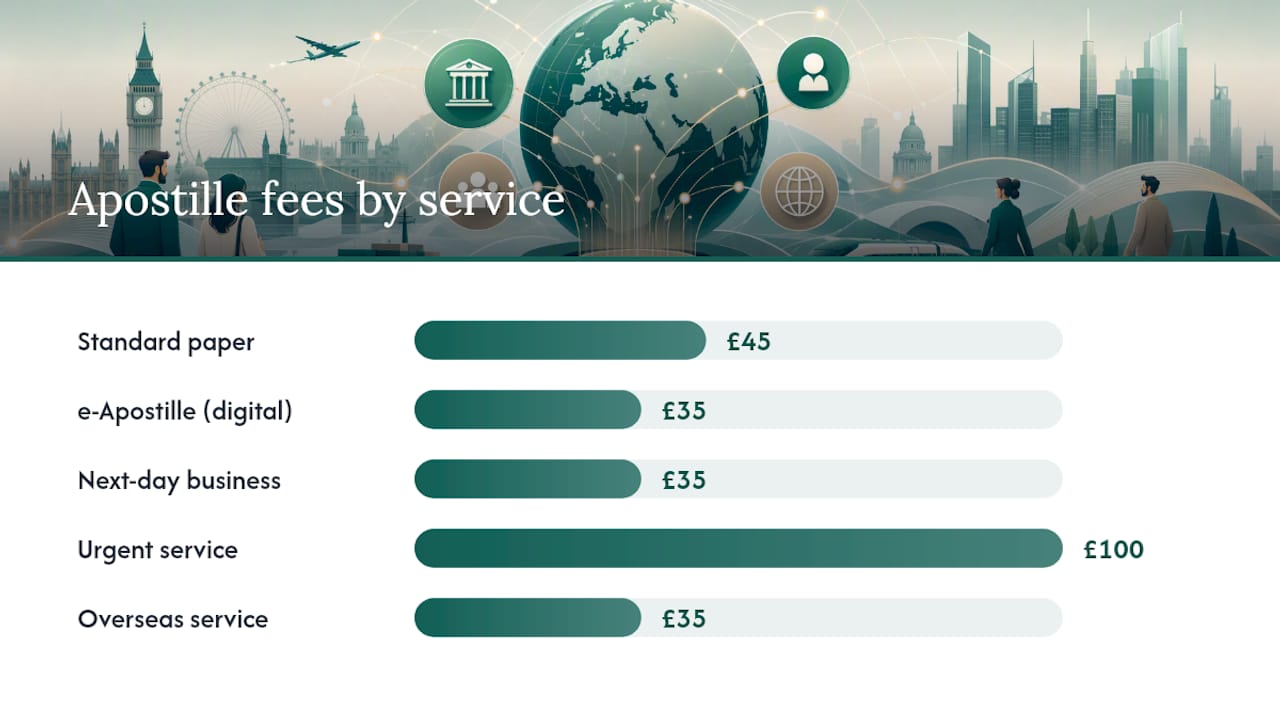
Fees are charged per document and are non-refundable if a document cannot be legalised. The consular services fee guidance confirms all charges are collected in British pounds by card. Return courier and postage costs are billed on top of those figures and vary by destination: UK returns are the least expensive, European returns sit in a mid-range band, and rest-of-world courier charges are the highest. Budget these separately when calculating your total apostille price in the UK.
***
How to apply: step-by-step for e-Apostille and paper submission
The apply-for-legalisation page sets out what you need before you start. Both routes begin online, but the practical steps diverge quickly.
For an e-Apostille:
- Confirm the receiving authority in the destination country explicitly accepts electronic legalisation (see the pro tip below).
- Log in to the government's online legalisation portal and upload a clear scan of your document.
- Pay the £35 fee by credit or debit card.
- Receive the digitally signed e-Apostille by email; no physical return is needed.
For paper-based legalisation:
- Complete the online application form and pay £45 per document by card.
- Post or courier your original document (or certified copy, where required) to the legalisation office.
- Include a pre-paid return envelope or prepaid courier label with your return address clearly stated.
- Wait for the stamped document to be returned by the method you specified.
What to include with a paper application:
- The original document or an acceptable certified copy
- Proof of card payment (reference number from the online form)
- A prepaid return envelope or courier account details
- Any covering letter specifying which document is enclosed
Pro Tip: Before selecting the e-Apostille route, contact the institution or authority that will receive your document and ask in writing whether they accept electronic legalisation. Some foreign courts, banks, and government bodies still require a physical stamp, and the government's own guidance stresses this check. Saving £10 on the fee is not worth a rejected document.
***
How long does it take to get an apostille in the UK?
Processing times vary considerably by route and by how busy the legalisation office is at any given time.
The e-Apostille is the fastest option by a significant margin. Once your document is uploaded and payment confirmed, the digital certificate is typically issued within a few working days, often sooner. Paper-based applications sent by post take longer, with government-published waiting times that can extend during peak periods.
The next-day channel is available only to registered businesses and not to individuals. The urgent service has limited availability and is not offered for every document type.
Factors that commonly delay processing:
- A document that has not been correctly certified or notarised before submission
- Missing return postage or incomplete courier instructions
- Embassy-specific requirements that the legalisation office flags after receipt
- High seasonal demand, particularly July through September
- Discrepancies between the name on the document and the name on the application
The e-Apostille removes postal transit time entirely, which is often the largest variable in a paper application. If the receiving authority accepts digital legalisation, this route is almost always faster and cheaper.
***
When does a document need to be notarised or certified before an apostille?
Not every document goes straight to legalisation. Whether prior certification is needed depends on whether the document is a public record or a privately issued one.
Public documents issued by a UK government body typically do not require prior notarisation. These include:
- GRO birth, death, and marriage certificates
- Court orders and judgments
- Police certificates issued by the Disclosure and Barring Service
- Certain state-issued educational certificates
Private documents almost always require certification by a notary or solicitor before the legalisation office will accept them. Common examples include:
- Powers of attorney (see the apostille for power of attorney guide for a full step-by-step)
- Affidavits and statutory declarations
- Company board resolutions and corporate certificates
- Certified copies of passports or identity documents
A notary's certification confirms the document's authenticity and the signatory's identity. A solicitor can certify true copies of certain documents, though the legalisation office's requirements vary by document type. If you are unsure which applies, the Law Society's find-a-solicitor service can help you locate a qualified practitioner.
Common exceptions to be aware of: a certified copy of a birth certificate made by a solicitor is generally acceptable for legalisation, whereas an original power of attorney signed abroad may require additional processing steps. When in doubt, check the government's legalisation guidance for your specific document type before paying for certification.
***
When does it make sense to pay a specialist for apostille services?
A specialist or managed service adds cost, but for certain situations that cost is justified.
Use a managed service when:
- You are working to a tight deadline and cannot risk postal delays
- Your document requires solicitor certification or notarisation before legalisation, and you want both handled together
- The destination country is not a Hague Convention member and you need embassy legalisation coordinated alongside the apostille
- You are processing multiple documents and want a single point of contact
Typical price bands for managed or express services (excluding the official government fee) vary widely for handling and tracked return on a single document. Services that include solicitor certification or notarisation generally add additional fees depending on the document's complexity. These are market-rate estimates; individual providers set their own fees.
A note on what agents can and cannot guarantee: a reputable specialist will handle your application correctly and track its progress, but no agent can override the government legalisation office's processing queue or guarantee a specific turnaround for standard applications. Embassy delays for non-Hague destinations are similarly outside any agent's control. Confirm what is and is not included in the quoted fee before you commit.
Refunds from the government legalisation service are not issued if a document is rejected. A specialist who reviews your document before submission can reduce that risk, which is one of the less obvious reasons to pay for a managed service when the document's eligibility is uncertain.
***
What to do when the destination country is not a Hague Apostille Convention member
An apostille is only valid in countries that have signed the Hague Apostille Convention. For destinations outside that list, a different and more involved process applies. The complete apostille countries list covers which destinations require embassy legalisation instead.
For non-Hague countries, the typical sequence is:
- Obtain the apostille (or, in some cases, a notarised document without an apostille)
- Submit the document to the relevant embassy or consulate in the UK for their legalisation stamp
- In some cases, the document then needs endorsement by the destination country's Ministry of Foreign Affairs (MOFA) upon arrival
Each step adds cost and time. Embassy fees vary by country and document type, and some embassies require appointments booked weeks in advance. Additional handling charges from a specialist agent are common for this route.
Pro Tip: Before paying for any express or urgent service, confirm the full chain of legalisation steps the destination country requires. Some countries need both an apostille and an embassy stamp even for documents from Hague member states. Contacting the destination country's embassy in London directly, or checking their official consular guidance, is the only reliable way to confirm what is needed.
***
What should you budget for in total? Two worked examples
The table below lists every line item that can contribute to the total cost of apostille services in the UK.
Scenario A — DIY e-Apostille for a birth certificate: You upload a GRO birth certificate, pay £35 online, and receive the digital apostille within a few working days. No courier, no notarisation, no agent. Total: approximately £35, assuming the receiving authority accepts electronic legalisation.
Scenario B — Managed service for a power of attorney: The document is a privately drafted power of attorney that requires notarisation before legalisation. A commissioned notary certifies it (approximately £100–£200), the government legalisation fee is £45, and a specialist agent handles submission and tracked return courier (approximately £50–£150). Total: approximately £195–£395 before any translation.
Processing multiple documents at once can reduce the per-document cost for agent handling, as many providers apply volume pricing from the second document onwards.
***
Practitioner insight: when e-Apostille saves time and when it does not
The e-Apostille is cheaper at £35 versus £45 for paper, and it eliminates postal transit entirely. For straightforward public documents going to a destination that has confirmed it accepts digital legalisation, it is the obvious choice. The government's electronic legalisation announcement makes clear that the receiving authority must explicitly accept the digital format before an applicant chooses this route.
The risk is real. A foreign bank, court, or government ministry may have no formal policy on e-Apostilles, or may have a policy that is not publicly documented. In those cases, submitting a paper application from the outset avoids the cost and delay of having to repeat the process.
The practical rule: treat the e-Apostille as the default for speed and cost savings, but only after written confirmation from the receiving authority. If confirmation is not possible before your deadline, the paper apostille is the safer option. The £10 saving is not worth a rejected document and a second application fee.
Pro Tip: Keep a copy of any written confirmation from the receiving authority that they accept e-Apostilles. If a document is later queried, that confirmation provides a clear paper trail and may support a resolution without reapplying.
***
An editorial view on DIY versus managed apostille routes
The choice between doing it yourself and using a managed service is not really about cost. It is about risk tolerance and time.
For a public document with no prior certification requirement, the DIY route via the government's online portal is straightforward, well-documented, and genuinely cost-effective. Most people who have done it once find it unremarkable. The government's guidance is clear, the fees are fixed, and the process is predictable.
Private documents are a different matter. A power of attorney or affidavit that is incorrectly certified before submission will be rejected, and the government fee is non-refundable. The cost of getting it wrong, in both money and time, often exceeds the cost of a managed service that reviews the document before it is submitted. For time-sensitive situations, that calculus is even clearer.
The readers who benefit most from a managed service are those dealing with private documents, non-Hague destinations, or tight deadlines where a second attempt is not an option. For everyone else, the DIY route is perfectly adequate.
***
My Notary: online notarisation and apostille support in one place
For documents that require notarisation before legalisation, the traditional route means booking an in-person appointment, travelling to a notary's office, and then managing the legalisation application separately. My Notary removes that friction entirely.
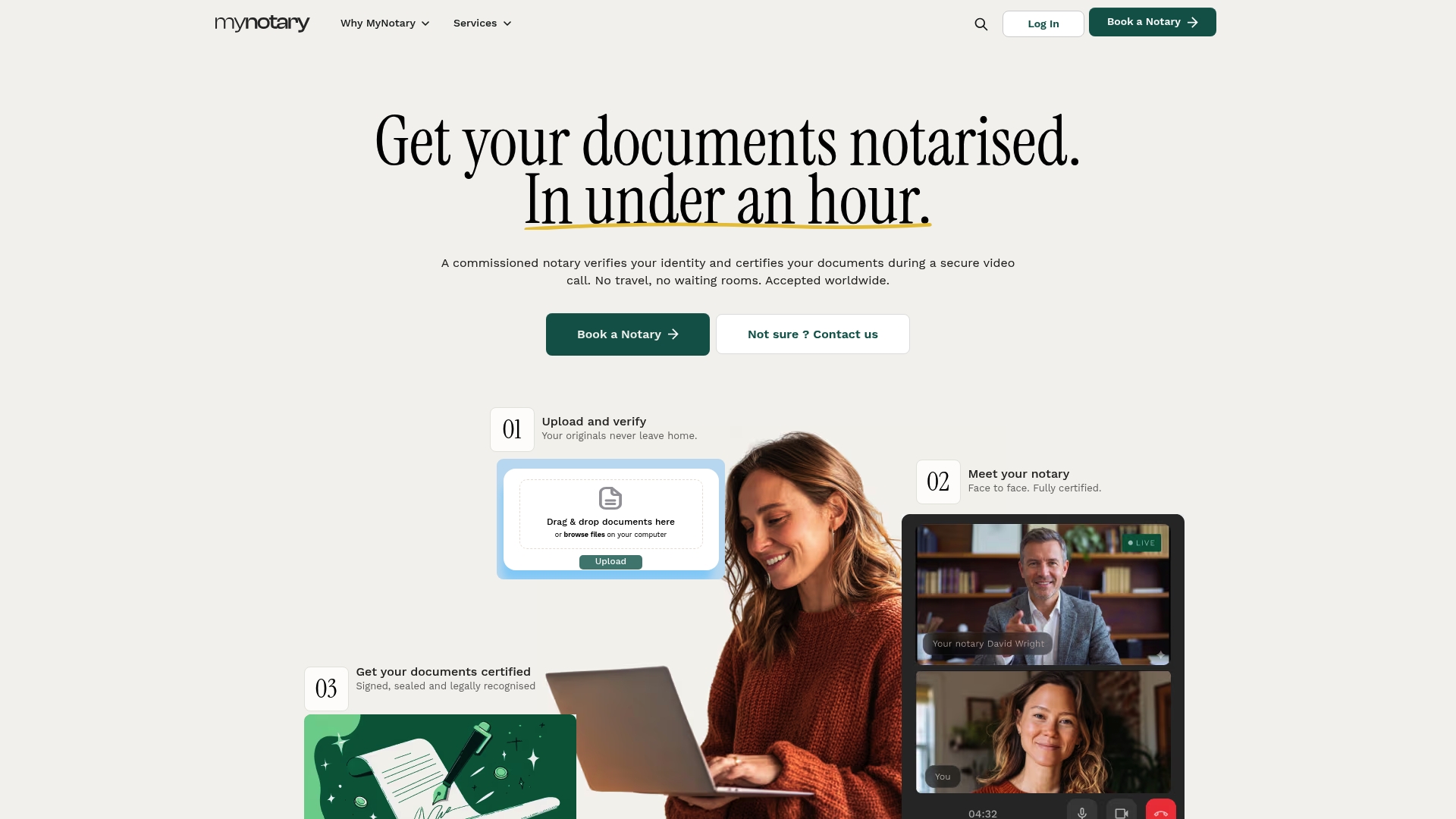
Through My Notary's secure video-call platform, you connect with a commissioned notary, complete biometric identity verification, and receive a certified document, all without leaving your home. The average turnaround for notarised documents is one hour. My Notary supports a wide range of document types, including powers of attorney, corporate documents, affidavits, and certified copies, with electronic signatures recognised in over 180 countries. Once your document is notarised, you can proceed directly to the government legalisation service with a correctly certified document, reducing the risk of rejection. To get started, visit My Notary's online notarisation service and book your appointment today.
***
Sources
Before you apply, verify current fees and processing times directly from official sources, as these can change.
***
FAQ
Can I get an apostille online in the UK?
Yes. The government's legalisation service offers an e-Apostille that is applied for and delivered entirely online, at a fee of £35 per document. You must first confirm that the receiving authority in the destination country accepts electronic legalisation before choosing this route.
Can any solicitor certify a document before an apostille?
A solicitor can certify true copies of certain documents, but not all documents require solicitor certification. Privately drafted documents such as powers of attorney typically require certification by a notary rather than a solicitor; the government's legalisation guidance specifies which type of certification is acceptable for each document type.
How long does it take to get an apostille in the UK?
An e-Apostille is typically issued within a few working days of a successful online application. Paper-based applications take longer and depend on current postal volumes and the legalisation office's queue; the government publishes live waiting times on its legalisation overview page.
Where do I get an apostille stamp in the UK?
The government legalisation service is the only body authorised to issue apostilles for UK public documents. Applications are submitted online via GOV.UK, with paper documents posted to the legalisation office and e-Apostilles delivered digitally.
Do I need a notary before applying for an apostille?
Only for private documents. Public records such as GRO birth, death, and marriage certificates generally go directly to the legalisation service without prior notarisation. Private documents, including powers of attorney and affidavits, require certification by a notary or, in some cases, a solicitor before the legalisation office will accept them.
Recommended
Got questions? We’re on it.
Most questions are answered here, drawn from what people actually ask before booking. If yours isn’t, our team is in chat.
Yes. The government's legalisation service offers an e-Apostille that is applied for and delivered entirely online, at a fee of £35 per document. You must first confirm that the receiving authority in the destination country accepts electronic legalisation before choosing this route.
Last updated: