Stop juggling suppliers: UK translation, notary and apostille online
By Jeremy Arhab, Founder · Published 1 October 2026 · Updated 1 October 2026
Translate and certify UK documents, notarise by video and request a paper or electronic apostille through one integrated online service. Check...

Yes, you can get a document translated and apostilled in the UK: get a certified translation that includes a signed translator statement, then apply for an apostille, paper or electronic, depending on what the recipient needs. If you want one provider to handle translation, notarisation and legalisation together, look for an online service that combines video notarisation with apostille support, which removes the need to coordinate several suppliers yourself.
***
TL;DR: - A UK apostille confirms the authenticity of signatures and seals but does not guarantee document acceptance abroad, especially outside Hague Convention countries. - Certified translations must include a signed declaration, date, full name, and contact details to avoid rejection by the Legalisation Office or the foreign authority. - Completing translation, notarisation (if needed), and apostille application in the correct sequence is crucial to prevent delays or rejection. - Not all documents qualify for electronic apostilles; eligibility varies by document type, and fees depend on the chosen speed and priority service. - An integrated online notarisation service can streamline the process, especially for multiple steps, saving time and reducing the risk of procedural errors.
***
Table of Contents
- What an apostille does and when UK documents need one
- Certified translations: what translators must include for legalisation
- Step by step: translate, certify, notarise and apostille in the UK
- e-Apostille eligibility, timing and typical costs
- Who can certify translations and what notarisation options exist
- Checklist: prepare your documents to avoid delays or rejection
- Why an integrated online notarisation service can save time here
- Common pitfalls and one practical recommendation
- Authoritative UK links to verify rules and fees
- Sources
- FAQ
What an apostille does and when UK documents need one
An apostille confirms that a signature, seal or stamp on a document is genuine. It checks the origin of that signature or seal against official records, but it does not check whether the content of the document is true or whether the recipient will accept it, as Gov. That distinction matters, because many applicants assume an apostille guarantees acceptance abroad when it only confirms authenticity.

Countries that signed the Hague Apostille Convention accept an apostilled document without further steps. Countries outside the Convention usually need an extra round of embassy or consular legalisation after the apostille stage, since the Legalisation Office stamp alone will not satisfy their authorities.
You are likely to need an apostille for:
- Marrying or registering a civil partnership abroad, where the foreign registrar wants proof of your UK civil status
- Applying for a visa, residency or citizenship that requires UK-issued civil documents
- Enrolling at a university overseas that asks for certified academic records
- Buying property or setting up a business abroad, where local authorities require verified UK corporate or personal paperwork
Certified translations: what translators must include for legalisation
Any document not written in English or Welsh generally needs a certified translation before it goes anywhere near an apostille application. The translator must confirm in writing that the translation is accurate, and that statement needs to carry the date, the translator's full name, signature and contact details, as GOV.UK sets out for certifying a document. Without those elements, the Legalisation Office or the receiving authority abroad can reject the paperwork outright.
A translator statement typically needs:
- A clear declaration that the translation is a true and accurate rendering of the original
- The translator's printed name, signature and the date the statement was signed
- Contact details that allow the recipient to verify the translator if questioned
Some receiving authorities set their own formatting rules for the statement, so it is worth checking the recipient's instructions before you commission the work rather than after. Certain recipients also ask for the translation itself to be notarised, not just certified, particularly when the destination country has stricter evidentiary standards.
Pro Tip: Ask the receiving authority whether they want a certified translation, a notarised translation, or both, before you book any service, since redoing a translation to meet a different standard wastes time and money.
Step by step: translate, certify, notarise and apostille in the UK
Getting from a foreign-language document to an accepted, apostilled version follows a fairly fixed order. Missing a step, or doing them out of sequence, is the most common cause of delay.
- Confirm what the recipient actually wants. Ask whether they need a paper apostille or will accept an e-Apostille, and whether they expect one apostille covering the whole bundle or separate apostilles for each document.
- Commission a certified translation. Make sure the translator statement includes the date, full name, signature and contact details required by Gov.
- Decide whether notarisation is required. Some recipients want the translation itself notarised, or want the original document notarised before translation. This can be done in person with a commissioned notary or remotely through online notarisation by video call.
- Apply to the Legalisation Office. Submit the document, and any notarised or certified translation, through the online application for legalisation, choosing either the paper-based apostille or the e-Apostille route depending on what the recipient will accept.
- Arrange embassy legalisation if the destination is outside the Hague Convention. The apostille from the Legalisation Office is not the final step for these countries. You will usually need to submit the apostilled document to the relevant embassy or consulate for an additional legalisation stamp.
For UK documents specifically, the practical detail that trips people up is jurisdiction: a document issued in Scotland or Northern Ireland can involve different registrars than one issued in England and Wales, even though the apostille itself is issued centrally by the Legalisation Office. If your paperwork spans more than one UK jurisdiction, check that each underlying document has been correctly certified in its own jurisdiction before it goes into the apostille application. Our guide on the UK apostille process sets out a faster route through this sequence for readers working to a tight deadline, and our piece on which countries accept apostilles is useful if you are still confirming whether embassy legalisation applies to your destination.
e-Apostille eligibility, timing and typical costs
Not every document qualifies for the electronic route. Birth, marriage, civil partnership and adoption certificates, along with ACRO police certificates and DBS checks, are generally not eligible for e-Apostille and must go through the paper-based process instead. Checking eligibility before you apply saves a rejected application and a second wait.
Processing choices affect how long the whole chain takes, from postal turnaround to next-day options and restricted urgent handling for time-critical cases. The Legalisation Office publishes indicative fees for each route.
These figures set your baseline planning cost before you add translation or notarisation fees, and it is worth confirming the current fee on application since official charges can change.
- Standard postal service: works for any document type, including those excluded from e-Apostille
- e-Apostille service: faster in principle, but restricted to eligible document types
- Restricted urgent service: available only with prior approval, and priced accordingly
Who can certify translations and what notarisation options exist
Any competent translator can, in principle, sign a translator statement, but recipients respond better to translators who can demonstrate verifiable credentials, since a translator with recognised professional standing is less likely to be questioned by a foreign authority. Membership of a recognised translators' body or documented sworn-translator status are useful signals when you are choosing who to instruct.
Notarisation is a separate step from certification and involves a commissioned notary confirming identity, signatures or the authenticity of copies, often adding their own seal to the document. Traditionally this meant an in-person appointment, but online notarisation by video call now offers a practical alternative that avoids travel and reduces waiting time, provided the recipient accepts a remotely notarised document.
- If your recipient explicitly requires an in-person wet-ink notarial act, book a local commissioned notary
- If the recipient accepts electronically signed or digitally notarised documents, online notarisation via video call can be faster and just as valid for their purposes
Our guide to sworn translation in the UK goes into more detail on how certification and notarisation differ and when each is expected.
Checklist: prepare your documents to avoid delays or rejection
Getting the paperwork right the first time avoids a second submission and a second fee. Before you send anything for translation, certification or apostille, check the following:
- Use unlaminated originals wherever possible, since lamination can prevent verification of the underlying seal or signature
- Include clear, unexpired photo ID for every signatory if the document requires identity verification
- Attach the full translator statement with the translation, not just the translated text on its own
- Order and label multiple documents clearly if you are submitting more than one for apostille together
- Scan at high resolution with no cropped edges, so stamps, seals and signatures remain fully visible
Pro Tip: Photograph or scan documents flat, in good light, with the whole page visible, since a cropped stamp or blurred signature is one of the most common reasons an application gets sent back.
Our article on combining translation, notarisation and legalisation covers these pitfalls in more depth if you are handling several documents at once.
Why an integrated online notarisation service can save time here
Coordinating a translator, a notary and the Legalisation Office as three separate suppliers works, but it means three sets of paperwork, three timelines and three points where something can go wrong. MyNotary brings the notarisation part of that chain into one online session, with optional support for the certified translation and apostille steps around it.
The practical offer includes:
- Notarisation via video call with a commissioned notary, recorded for the session
- Identity verification by passport as part of the booking, rather than a separate in-person check
- Document upload so the notary can review your paperwork before the call
- Optional certified translation and apostille handling alongside the notarisation itself
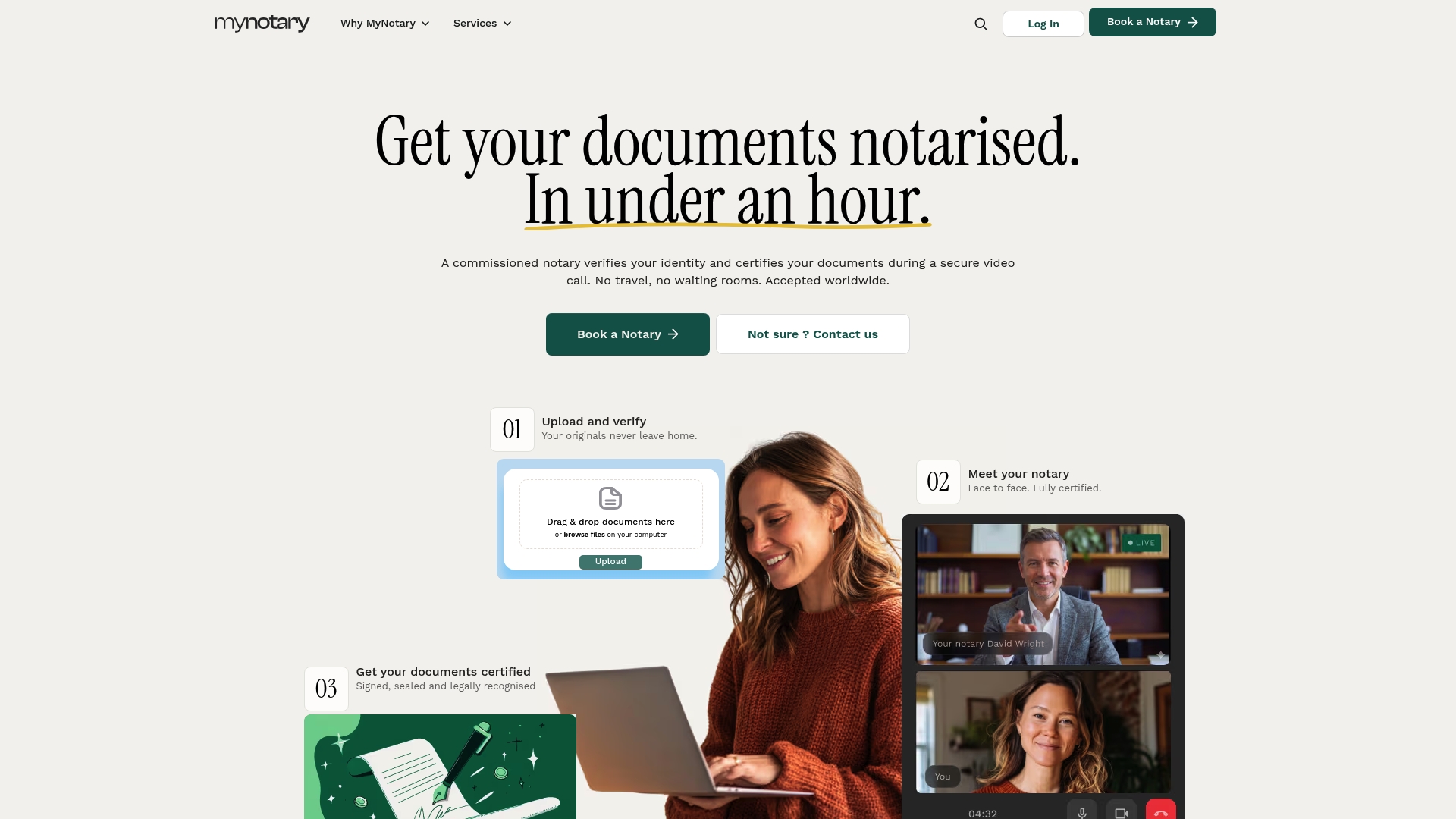
For a reader based in London, Manchester or anywhere else in the UK, the main saving is not having to travel to a notary's office or wait for an appointment slot. Sessions are recorded, and documents are often delivered the same day once the video call is complete, which matters when you are working to a visa deadline or a university submission date.
An integrated service makes most sense when you have several steps to complete and want one point of contact rather than several. If you only need a single notarised signature and your recipient has no strict format requirements, a local notary visit may be just as simple. If you are combining translation, notarisation and an apostille application, handling the notarisation step through MyNotary's online booking keeps that part of the chain on one platform while you sort the translation and Legalisation Office application around it.
Common pitfalls and one practical recommendation
The mistake I see most often is ordering a translation before confirming exactly what the recipient wants: paper apostille or e-Apostille, one document or several, certified translation or notarised translation. Reordering a translation because the format was wrong costs more time than getting the specification right at the start.
My recommendation is simple. Write down the recipient's exact legalisation requirement before you instruct a translator, then work backwards through notarisation and the Legalisation Office application. If your deadline is tight, a combined online service is worth booking early rather than as a last resort.
— Jérémy
Authoritative UK links to verify rules and fees
Check GOV.UK's legalisation application page and the HCCH's UK Legalisation Office entry for current rules and fees. Always confirm the receiving country's own requirements before choosing between a paper apostille and an e-Apostille.
Sources
FAQ
Can you get an apostilled document translated?
Yes, but the usual order is to translate and certify the document first, then apply for the apostille, since the apostille authenticates the signature or seal on the final document you submit. Check with the recipient whether they need the original, the translation, or both apostilled.
How do you apply for an apostille in the United Kingdom?
You apply through GOV.UK's online legalisation service, choosing either a paper-based apostille or an e-Apostille depending on your document type and the recipient's requirements. The Legalisation Office checks the signature, seal or stamp against its records before attaching the apostille.
Can you get an apostille in the UK on the same day?
The Legalisation Office offers a restricted urgent service, but it requires prior approval and is priced at £45 for the postal service or £100 for the urgent route, so same-day turnaround is not guaranteed for every document. Booking an online notarisation session separately can still be completed quickly, often within the same day, while the apostille application itself follows the Legalisation Office's own processing time.
Who can certify a translation in the UK?
Any translator capable of confirming in writing that the translation is accurate can certify it, provided the statement includes their full name, signature, contact details and the date, as GOV.UK requires. Recipients often prefer translators with verifiable professional credentials or sworn-translator status, since this reduces the chance of the translation being questioned.
Does MyNotary handle translation and apostille steps together?
MyNotary's online platform can notarise documents via video call and offers optional support for certified translation and apostille handling as part of the same process. This lets you coordinate notarisation, translation and legalisation through a single provider rather than three separate ones.
Recommended
Got questions? We’re on it.
Most questions are answered here, drawn from what people actually ask before booking. If yours isn’t, our team is in chat.
Yes, but the usual order is to translate and certify the document first, then apply for the apostille, since the apostille authenticates the signature or seal on the final document you submit. Check with the recipient whether they need the original, the translation, or both apostilled.
Last updated: