Choosing an Online Notary in the UK: 8 Checks Before You Book
By Jeremy Arhab, Founder · Published 26 October 2026 · Updated 26 October 2026
How to choose an online notary in the UK: what to check on identity, recording, notary qualifications, delivery and apostille support before you pay for a session.

To choose an online notary, check eight things before you pay: who the notary is, how your identity is verified, whether the session is recorded, what happens to the document, how the notarial seal is applied, how fast delivery is, whether apostille and translation are available, and what the receiving party requires. A provider that answers all eight clearly is usually a safe choice. One that answers vaguely is not.
This guide explains what a notary does, which documents suit a video call, how the process runs, and how to compare the types of service you will find. It is written for individuals, parents, expats, freelancers and businesses who need a document certified for use in the UK or abroad.
TL;DR
- An online notarisation takes place by video call. A commissioned notary checks your passport, watches you sign or confirm the document, and adds a seal.
- Choose a service that records the session, checks identity with your passport and a live comparison, and keeps an audit trail.
- Some documents still need people in the same room. Deeds with witnesses and some oaths are the usual examples, so ask first.
- If the document is going abroad, ask whether an apostille is needed. This depends on the receiving country, and no provider can promise acceptance.
- Compare delivery time and add-ons, not only the headline fee.
Table of Contents
- What a notary does and why people use one online
- Which documents suit an online notary
- Eight checks before you choose
- Comparing the types of online notary service
- How an online notarisation works, step by step
- Apostille and translation for use abroad
- Our view on choosing an online notary
- Start your notarisation with MyNotary
- FAQ
- Sources
What a notary does and why people use one online
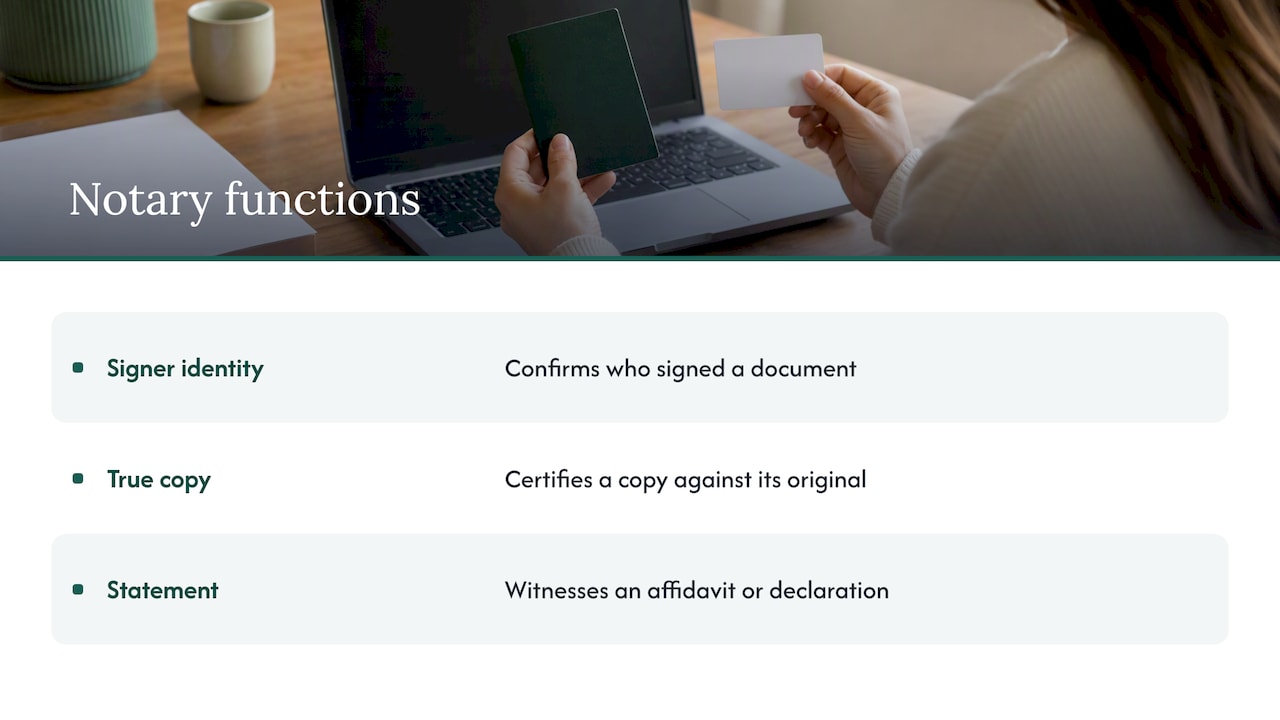
A notary is a person who checks and certifies things that other people will rely on. In practice, that means three jobs. The notary confirms who signed a document. The notary certifies that a copy is a true copy of an original. The notary witnesses a statement, such as an affidavit or a declaration, so that the receiving party can trust it.
Traditionally, you book an appointment, travel to an office, bring original documents and photo ID, and wait. For many people that is the hard part: a parent abroad who needs child travel consent, an expat renewing a visa file, a freelancer with a contract due the same week.
Online notarisation replaces the office visit with a secure video call. You upload the document, verify your identity, and meet a commissioned notary on screen. The legal purpose is the same. Only the setting changes.
If you want the full background, our online notarisation guide for the UK covers the concept in more depth.
Which documents suit an online notary
Most personal and business documents that need a signature check, a certified copy or a sworn statement can be handled on a video call. Typical examples:
- Certified true copies of passports, bank statements and professional certificates
- Degree and diploma certification for visas, study or employment abroad
- Affidavits and statutory declarations
- Child travel consent and parental authority delegation
- Marital status affidavits and certificates of no impediment
- Proof of life and proof of residency
- Power of attorney and signature notarisation
- Deed poll
- Corporate documents and beneficial owner declarations
- Notarised translations
When a video call is not enough
Some legal formalities depend on physical presence. A deed that needs an independent witness to be in the room with the signer is the clearest case. Wills fall in the same category. In some situations a person making a sworn statement must also be physically with the person taking it.
So the first question to ask any provider is simple: for my document, does anything require people to be in the same place? A good provider tells you before you pay, and tells you plainly if the answer is yes.
The receiving party matters just as much. A bank, embassy, university or foreign court sets its own rules. Some accept a remotely notarised document. Some ask for wet ink. Check with them first and, where you can, get the requirement in writing.
Our article on four checks to confirm that an England and Wales online notarisation is accepted sets out how to do that step by step.
Eight checks before you choose
1. Who is the notary?
You should be able to find out who will conduct your session. Ask whether the person is a commissioned notary and where they are based. A provider that cannot tell you who is on the call is not one to trust with a legal document.
Be clear, too, about what the company itself is. Some businesses are notary practices. Others, like MyNotary, are online platforms that connect you with commissioned notaries through a secure video service. Both models exist. What matters is that the description on the website is honest about which one you are using.
2. How is your identity verified?
The core of any notarisation is knowing the signer is who they say they are. Strong online practice has two parts: secure transmission of a photo ID such as a passport, and a live video comparison between your face and the document.
Ask what your provider does. Passport verification with a live check is the standard to look for. Biometric matching adds a further layer. We explain both in KYC for notarisation: the two checks behind UK video ID.
3. Is the session recorded?
A recording is evidence. It shows who was present, what was said and when the document was signed. With your consent, a recorded session creates a record the notary can refer back to if anyone later questions the act.
Check that the provider tells you it records, why, how long it keeps the recording and how it is protected. Encryption and an audit trail are reasonable things to expect.
4. What state is the document in when you join?
The document should be unsigned when the call starts. You sign during the session, in front of the notary, so that the notary can certify the signature as genuine. If a provider asks you to sign beforehand and upload the result, ask why, because that changes what the notary can certify.
For copies, the notary needs to see the original. Check how the provider handles this. Often you hold the original up to the camera and the notary compares it with the uploaded copy.
5. How is the notarial seal applied and delivered?
The finished document carries the notary's seal and signature. Ask in what form you receive it: an electronically signed PDF, a printed original posted to you, or both. Some receiving parties want the digital file. Others insist on paper.
Also ask how quickly delivery happens. A same day digital copy is a real advantage when a visa deadline or a flight is close.
6. How long will it take, start to finish?
Time is the main reason people go online. Compare the whole journey, not only the call. The table below shows the parts that add up.
| Stage | Typical online service | Typical in person visit |
|---|---|---|
| Finding a slot | Often the same day | Days, sometimes longer |
| Travel and waiting | None | Travel plus time in the office |
| Identity check and signing | A short video call | An appointment of around 15 to 30 minutes |
| Receiving the document | Digital copy the same day | Collected or posted |
| Apostille, if needed | Separate step, extra time | Separate step, extra time |
At MyNotary, the average turnaround for a notarised document is about one hour. Apostille processing is a separate step with its own timeline, so plan for it if you need one.
7. Can the provider support apostille and translation?
If your document is going abroad, you may need two extra steps. The first is an apostille. The second is a certified translation. Providers that offer both under one roof save you from chasing separate suppliers and sending papers back and forth.
We cover this in more detail below.
8. Is the pricing clear?
Look for a stated fee for the service, a clear list of add-ons and no hidden charges for the recording or the digital copy. Ask what extra costs apply for apostille, translation or postage. The cheapest headline fee is not always the cheapest finished job.
On our services page you can see each document type and its starting fee before you book.
Comparing the types of online notary service
You will meet several kinds of provider. Here is how to think about them, by type.
| Type of provider | Strengths | Points to check |
|---|---|---|
| Traditional notary office offering remote sessions | Familiar practice, personal relationship | Appointment availability, whether remote sessions cover your document, speed |
| Online notary platform with commissioned notaries | Fast, structured process, recorded sessions, digital delivery | Who the notary is, how identity is checked, delivery format |
| General document or legal services site | Wide range of services | Whether notarisation is done in house or passed on, who is on the call |
| Overseas online notary services | Useful for documents used in that country | Whether the notarial act suits UK use or the country where the document will be used |
There is no single correct choice. A simple affidavit for a visa file suits a platform with fast video sessions. A complex property matter may call for a longer conversation. Our comparison, best online notary services for UK documents, goes through the criteria in more depth.
How an online notarisation works, step by step
The sequence is similar across good providers.
- Choose your document type. Select the service that matches what you need, for example a statutory declaration or a certified true copy.
- Upload the document. Add the unsigned file. Templates are available for common documents.
- Verify your identity. Scan your passport and complete the identity check. This usually includes a live comparison.
- Join the video call. A commissioned notary confirms who you are, checks that you understand the document and watches you sign or confirm it. The session is recorded.
- Receive your notarised document. The notary adds their seal. You get an electronically signed PDF, and a physical copy if you ordered one.
- Add an apostille or translation if required. These are optional extras for documents used abroad.
Our page on how the online notary process works in the UK walks through each stage with more detail.
What to prepare in advance
- A valid passport for each person who will be on the call
- The unsigned document, in PDF form if possible
- The original, if you need a certified copy
- A quiet place with a stable internet connection, and a device with a working camera and microphone
- The name of the organisation that will receive the document, and their requirements
Several signers in different places
Family and business documents often involve more than one person. A good platform lets each signer join from their own location, verifies each identity separately and records the whole session. Check that the provider supports this before you book, and that every signer has a passport ready.
Apostille and translation for use abroad
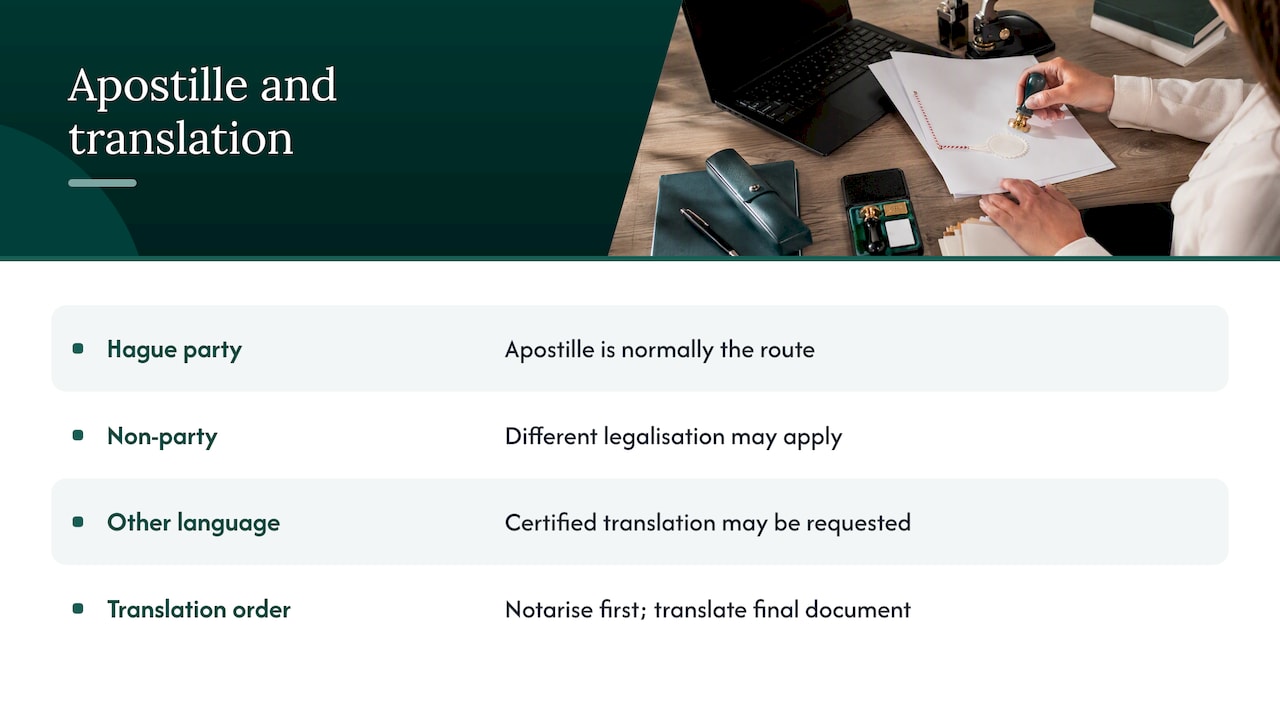
An apostille is a certificate attached to a public document so that another country can recognise it. It comes from the Hague Apostille Convention of 1961, which simplifies how documents are certified between countries that have joined it. For a notarised document, the apostille confirms the authenticity of the notary's seal and signature.
Whether you need one depends on the receiving country. If the country is a party to the convention, an apostille is normally the route. If not, a different legalisation process may apply. Ask the receiving party or an official source for that country before you order.
A certified translation is a separate need. If the receiving authority works in another language, it may ask for the notarised document to be translated by a qualified translator, with the translation itself certified. Order the notarisation first, then the translation, so the translator works from the final document.
Our article on the UK apostille process explains the sequence and what to expect. We cannot promise that any receiving party will accept a document. We can tell you what steps are normally needed and help you complete them correctly.
Our view on choosing an online notary
We built MyNotary because the traditional route asks people to give up half a day for a five minute act. Our view is that the process should be quick, but the checks should not be shorter. That means a passport check, a live video session with a commissioned notary, a recorded session and a clear audit trail.
We also think providers should be plain about their limits. MyNotary is an online notarisation platform. We are not a law firm and we do not give legal advice. If you are unsure whether your document needs people in the same room, or what the receiving party wants, ask before booking. We would rather tell you a video call will not work than take your fee for a document that cannot be finished.
The best test of any provider is whether you can describe, after reading their site, exactly what will happen on the call and what you will receive afterwards. If you can, the provider has done its job.
— Jérémy
Start your notarisation with MyNotary
If you have checked your document and your receiving party, you can book online in a few minutes. MyNotary offers certified true copies, affidavits, statutory declarations, child travel consent, power of attorney, degree certification, corporate document notarisation and notarised translations, each with a starting fee shown on the site. For a simple signature check, see signature notarisation online. To browse everything, visit our services page, or start from MyNotary UK.
FAQ
Is online notarisation legal in the UK?
Online notarisation is used in the UK, with a commissioned notary conducting the act by video and checking identity remotely. Legal validity is one question and acceptance by the recipient is another. Check the requirements of the bank, embassy or authority that will receive the document.
How do I get a document notarised quickly?
Upload the unsigned document, verify your identity with your passport and join a video call with a commissioned notary. Many sessions finish within the hour, and a digital copy can be delivered the same day. Have your passport and any originals ready before you start.
Do I need an apostille as well?
Only if the country receiving the document asks for one. Countries that have joined the Hague Apostille Convention generally use apostilles for public documents. Confirm the requirement with the receiving party first, then add the apostille to your order.
Which documents cannot be notarised online?
Anything that legally requires everyone to be physically present together, such as a deed that needs an in person witness, or a will. Some receiving parties also insist on wet ink originals. Ask your provider before you pay.
Can several people sign the same document from different places?
Yes, on a platform that supports multiple signers. Each person is identified separately with their own passport and joins the same recorded session from their own location. Confirm this when you book.
Sources
Recommended
Got questions? We’re on it.
Most questions are answered here, drawn from what people actually ask before booking. If yours isn’t, our team is in chat.
Online notarisation is used in the UK, with a commissioned notary conducting the act by video and checking identity remotely. Legal validity is one question and acceptance by the recipient is another. Check the requirements of the bank, embassy or authority that will receive the document.
Last updated: