Apostille Without Notarisation: When It Is Possible in the UK
By Jeremy Arhab, Founder · Published 29 October 2026 · Updated 29 October 2026
Can you get a UK apostille without notarisation? Public documents often can. Private ones usually need certifying first. See which route fits your document.
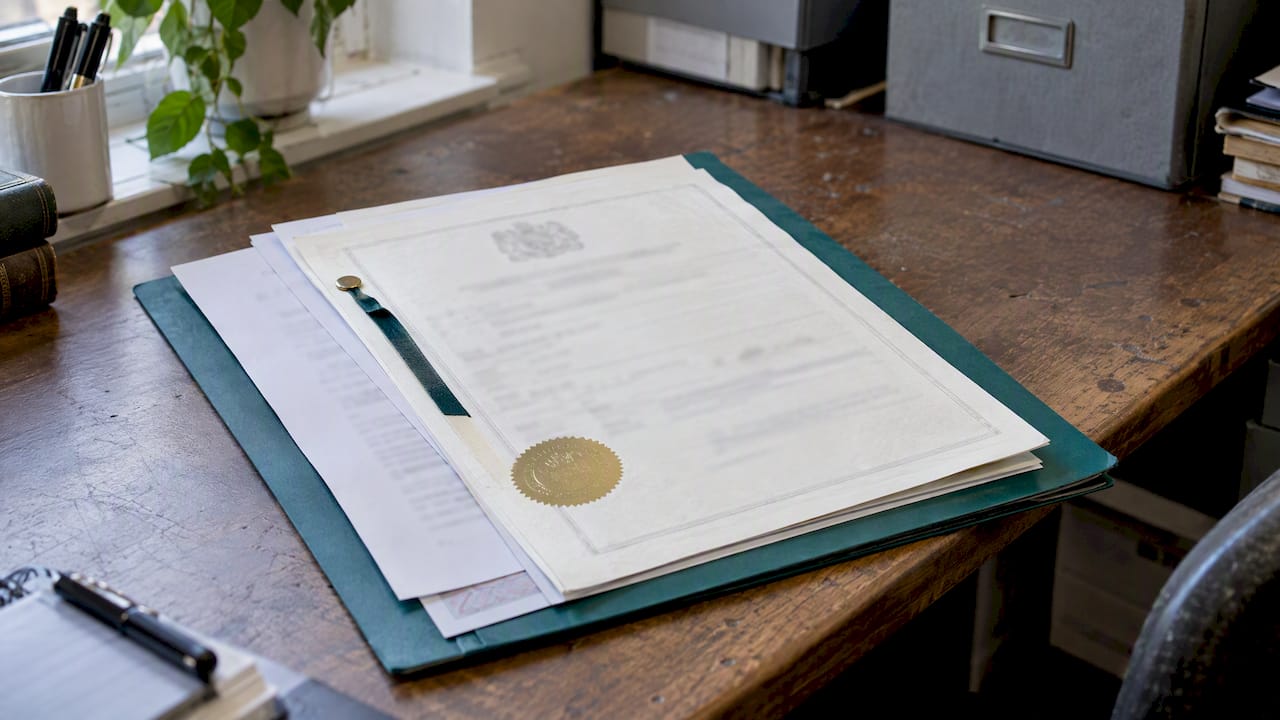
You can get a UK apostille without notarisation only when the document is a public document that already carries the signature or seal of a UK public official. A birth certificate from the General Register Office is a typical example. Private documents, such as a power of attorney, an affidavit, a contract or a certified copy, normally need certifying by a commissioned notary before an apostille can be added. This guide explains where the line falls, what each step is, what it costs and how to work out which route your document needs.
TL;DR
- An apostille confirms who signed or sealed a public document. It does not confirm that the content is true.
- Public documents with an official signature or seal, such as registry certificates and court documents, can often go for an apostille directly.
- Private documents, including powers of attorney, affidavits, contracts and copies of originals, usually need a notary's certification first.
- Government fees from 1 January 2024 are £45 for the standard service, £40 for standard next day, £35 for an electronic apostille and £100 for the urgent service.
- Always ask the overseas recipient what they require before you pay for anything.
Table of Contents
- What an apostille is, and what it is not
- Notarisation and apostille are two different steps
- Documents that can be apostilled without notarisation
- Documents that need a notary first
- What it costs and how long it takes
- How to decide whether you need a notary
- When an apostille is not enough
- Our view: the cheapest route is the one that is right first time
- Notarising online before the apostille
- Common situations
- FAQ
- Sources
What an apostille is, and what it is not
An apostille is a certificate defined by the Hague Convention of 1961. It lets a public document issued in one member country be used in another member country without further authentication by an embassy. The Hague Conference on Private International Law (HCCH) publishes the treaty and its practical guidance at hcch.net.
The limits matter. According to HCCH guidance, an apostille certifies only three things: the authenticity of the signature, the capacity in which the signatory acted, and the identity of the seal or stamp on the document. It does not verify the content of the document. The same guidance warns that the public often misunderstands this limited effect.
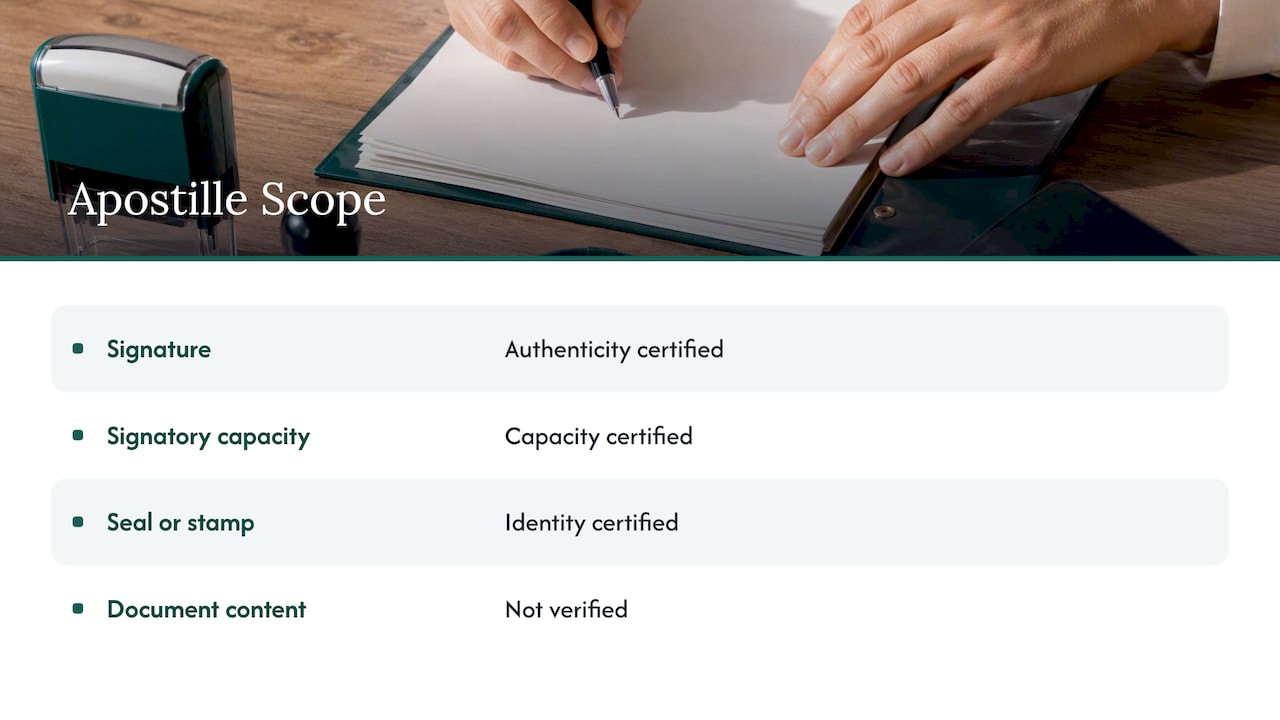
That explains why the question "apostille without notarisation" has two answers. The apostille attaches to a signature or seal that the issuing authority can recognise. If the document does not carry one it can recognise, something has to create that link first. Notarisation is the usual way to do it.
Notarisation and apostille are two different steps
People often treat them as one. They are separate.
- Notarisation is carried out by a commissioned notary. The notary checks who you are, watches you sign or confirms your signature, applies a seal and completes the notarial certificate. For a copy, the notary confirms it matches the original they have seen.
- An apostille is added afterwards by the authority that verifies public officials' signatures and seals. It confirms the notary's signature and seal, or the public official's, are genuine.
A notary does not issue the apostille. A notarised document with no apostille may not be enough abroad, and an apostille cannot be attached to a private document that nobody has certified. If you need a plain-language walk through the sequence, our guide on how to get an apostille in the UK covers it step by step.
Documents that can be apostilled without notarisation
The UK government's legalisation service holds specimen signatures and seals of many public officials. When your document carries one of them, no notary is needed. The government's overview of getting a document legalised is the official reference for the current list, but in practice the documents usually fall into these groups:
- Certificates issued by the General Register Office, such as birth, marriage, civil partnership and death certificates. These must be the official certified copies, not photocopies.
- Court documents bearing an original court seal, such as some divorce decrees and orders.
- Documents issued by government departments, signed by an official whose signature is on file.
The UK has no single legal definition of a public document for the purposes of the Convention. The UK country profile held by HCCH says so directly. In practice this means you should check each document rather than assume. A certificate from a local register office, for example, may be handled differently from one issued by a central body.
If you hold a divorce decree and want to know how the process works from the paperwork side, see our article on a divorce decree apostille in the UK.
Documents that need a notary first
A private document has no official signature on file. Typical examples:
- Power of attorney
- Affidavits and statutory declarations
- Contracts and company documents
- Certified true copies of originals, including copies of degrees, diplomas and bank statements
- Letters of consent, such as child travel consent
- Proof of life, marital status and similar declarations
For these, the government's guidance is that certification by a legal professional such as a notary comes first. The notary's signature and seal are then what the apostille confirms. Our guide on the apostille for a power of attorney shows how this works for one of the most common cases.
Certified translations follow the same logic. According to the Association of Translation Companies guidelines, a certified translation must be notarised before it can be sent for an apostille. If the receiving country wants your document in its own language, plan the translation before the notarisation, so the whole set can be certified together.
A quick way to decide
| Your document | Normally needs a notary first? | Why |
|---|---|---|
| Official birth, marriage or death certificate | No | Carries a registry official's signature |
| Court order with an original seal | No | Carries the court's seal |
| Power of attorney | Yes | Private document signed by you |
| Affidavit or statutory declaration | Yes | Sworn or declared by you, not an official |
| Copy of a degree or diploma | Yes | A copy needs someone to confirm it matches the original |
| Company document or contract | Yes | Private commercial document |
| Certified translation | Yes | Translator's declaration needs certifying |
Treat the table as a starting point. Registries and courts change how they sign and seal documents, and the receiving body may have its own rules.
What it costs and how long it takes
Government fees for legalising UK public documents have applied since 1 January 2024, according to the official fee announcement:
| Service | Fee per document |
|---|---|
| Standard | £45 |
| Standard next day | £40 |
| Electronic apostille | £35 |
| Urgent | £100 |
Postage or courier costs for paper documents come on top. Check the current fee list before paying, because fees can change.
Timing depends on the format. The paper service can take up to 25 working days at standard speed, which is why many people look at the electronic option. Our article on how to skip the long paper wait with an electronic apostille and online notarisation explains the difference, and the page on the electronic apostille in the UK covers when a digital certificate is suitable. Not every receiving body takes a digital apostille, so confirm first.
Notarisation is a separate cost from the government fee. Our own online notarisation prices are on our services page.
How to decide whether you need a notary
Follow these steps in order.
- Ask the recipient. Contact the embassy, employer, university, bank or court asking for the document. Ask exactly what they require: apostille or not, paper or electronic, original or certified copy, and whether a translation is needed. The government states that you are responsible for using the correct legalisation service.
- Check the country. Find out whether the destination is a Hague Convention member. Our apostille countries list is a quick reference.
- Identify who signed the document. If a public official signed or sealed it, it may go straight for an apostille. If you signed it, or it is a copy, it needs a notary.
- Order any translation. Do this before notarisation if the destination requires another language.
- Notarise. Complete the notarisation of private documents.
- Apply for the apostille. Submit the document to the legalisation service using the format the recipient requires.
Embassies, high commissions and consulates abroad cannot legalise documents for you. The government guidance on documents for British people abroad says British missions do not legalise documents of any kind, so do not plan on solving the problem once you have travelled.
When an apostille is not enough
Countries outside the Convention do not recognise an apostille. For those, the government describes a longer chain: legalisation in the UK, then stamping by the destination country's embassy in London, then approval by that country's Ministry of Foreign Affairs. The steps are set out in the guidance on documents for British people abroad.
The Convention also has exclusions. According to HCCH, it does not apply to documents executed by diplomatic or consular agents, or to administrative documents dealing directly with commercial or customs operations. Some regions have their own arrangements too. Our guide on preparing documents for China shows how requirements can differ by destination: paper or electronic apostille, notarise online.
Sometimes the document itself is only the beginning. Buyers preparing paperwork for property abroad, for instance, often need several certified items at once. A guide to Spanish mortgage documents shows how many different papers a single purchase can involve, and why checking each one's certification route early saves time.
Our view: the cheapest route is the one that is right first time
We run an online notarisation platform, so we see the same mistakes repeatedly. They are rarely about the apostille itself. They come from the step before it.
The most common mistake is assuming that because a document looks official, it is a public document. A copy of a degree certificate is a good example. The university issued the original, but a photocopy has no official signature. It needs a notary to confirm it matches the original, and only then can the apostille step follow.
The second mistake is ordering the apostille before asking the recipient what they want. Paying a fee for a document that the recipient did not require, or in the wrong format, is an avoidable cost.
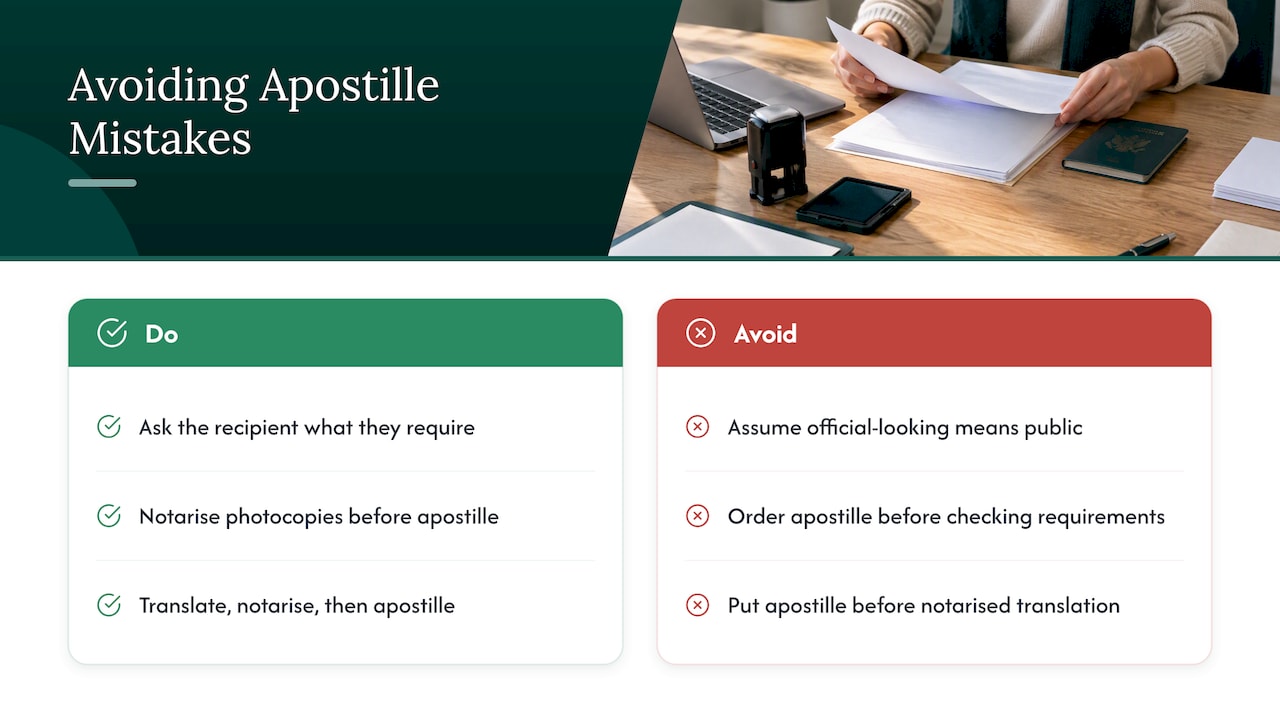
The third is doing the steps in the wrong order, especially with translations. If the translation needs notarising, the order is translation, notarisation, then apostille.
What we do is limited and specific. You join a video call with a commissioned notary. Your identity is checked against your passport. The session is recorded. The notary seals the unsigned document you have prepared and we deliver the result the same day. We do not issue apostilles and we cannot promise how a particular organisation abroad will treat your document. For that, ask the recipient. Our aim is to make the notarisation step quick and clear so the rest of the process is not held up.
— Jérémy
Notarising online before the apostille
If your document is private and needs certifying, you do not have to find an appointment, travel or wait for a queue. MyNotary offers online notarisation by video call for the documents most often sent for an apostille: signature notarisation, certified true copies, affidavits, statutory declarations, powers of attorney, degree and diploma certification and notarised translation.
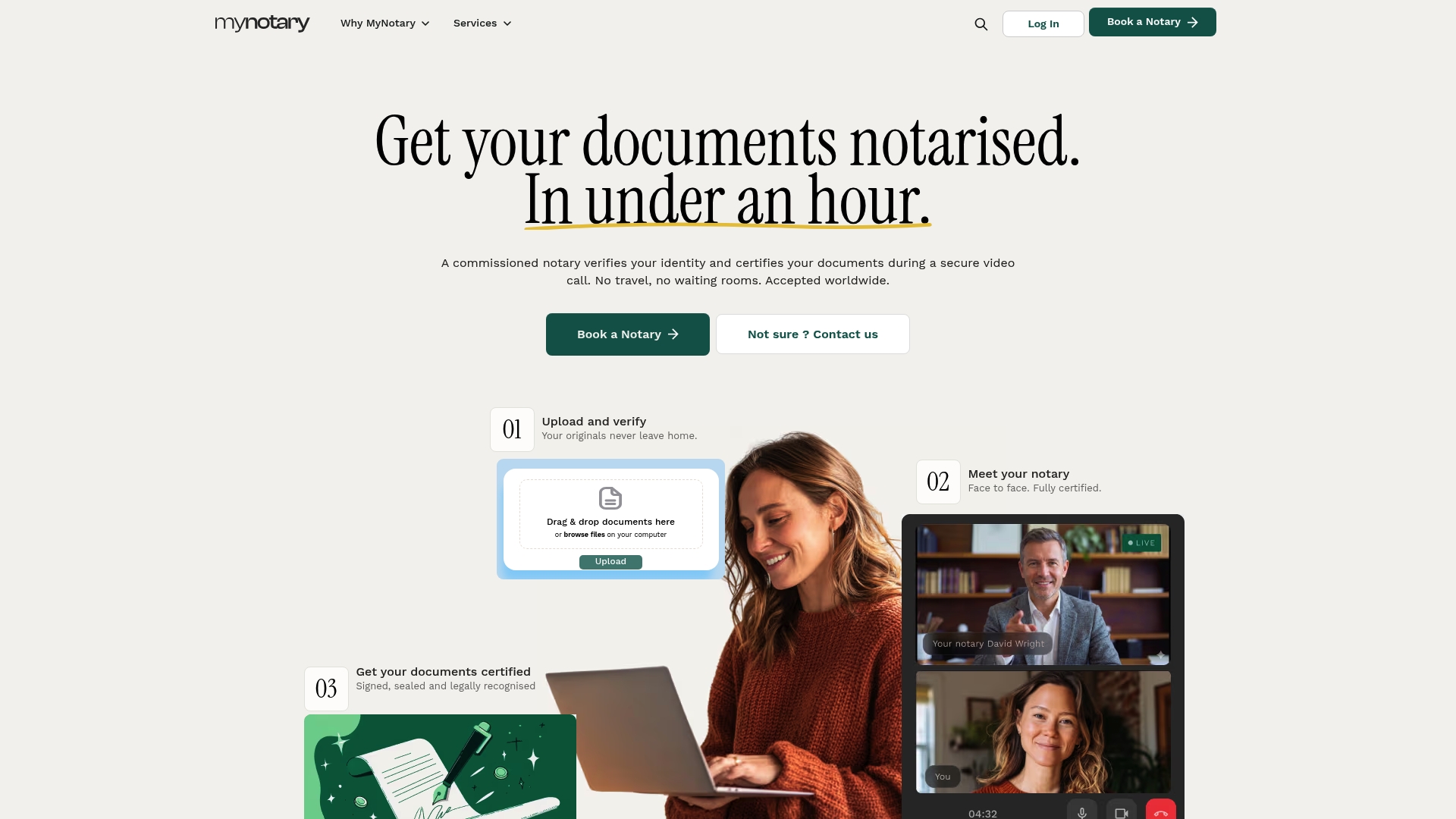
The process is straightforward. Upload the unsigned document, verify your identity with your passport, join the video session with a commissioned notary, and receive the sealed document on the same day. If you are abroad, our guide on preparing a UK apostille from abroad by video explains how the video session works from another country. You can see every document type on our services page.
If you also need a translation, our article on UK translation, notary and apostille online shows how to deal with the whole sequence in one place. For a closer look at timings, read about the UK apostille process in one hour.
Common situations
You hold a UK birth certificate and need it for an overseas visa. This is an official registry certificate, so it may go for an apostille without notarisation. Confirm with the visa authority that the certified copy format is acceptable.
You need a power of attorney for a property abroad. You signed it, so it needs notarisation first. Apostille follows.
You need a degree recognised by an overseas employer. A copy needs certifying. Our degree certification for visa applications service covers this, and the apostille step comes afterwards if required.
You are abroad and need a UK document legalised. The notarisation can be done by video. The apostille application then follows the format the recipient requires.
Your document is a company record. Corporate papers are private documents. See corporate document notarisation online.
FAQ
Can I get a UK apostille without notarisation?
Yes, but only for public documents that carry an official signature or seal on file with the legalisation service, such as General Register Office certificates and court documents with an original seal. Private documents, including affidavits, powers of attorney and copies, need certifying by a notary first. Check the official guidance for the current position on your document type.
Is a notarised document the same as an apostilled one?
No. Notarisation certifies a signature, identity or copy and is done by a commissioned notary. An apostille is a separate certificate confirming that the notary's or public official's signature and seal are genuine. Many private documents need both, in that order.
How much does an apostille cost?
The government fees announced from 1 January 2024 are £45 for standard, £40 for standard next day, £35 for an electronic apostille and £100 for urgent. Postage is extra for paper documents. Notarisation, where needed, is charged separately.
Does every country accept a UK apostille?
No. An apostille works between Hague Convention member countries. For other countries, further legalisation through the destination country's embassy in London and its foreign ministry is usually required. Always ask the recipient what they need.
Can I notarise a document online and then get an apostille?
Yes, in many cases. The notarisation step can be done by video call, and the sealed document can then be submitted for an apostille in the format the recipient requires. Confirm with the recipient that they will take a document notarised this way.
Sources
- HCCH: Apostille Convention practical handbook, substantive issues
- HCCH: United Kingdom country profile
- GOV.UK: Changes to fees for legalising UK public documents
- GOV.UK: Documents for British people abroad
- ATC: Certification stamp guidelines 2024
- Fiesta Properties: Spanish mortgage documents
Recommended
Got questions? We’re on it.
Most questions are answered here, drawn from what people actually ask before booking. If yours isn’t, our team is in chat.
Yes, but only for public documents that carry an official signature or seal on file with the legalisation service, such as General Register Office certificates and court documents with an original seal. Private documents, including affidavits, powers of attorney and copies, need certifying by a notary first. Check the official guidance for the current position on your document type.
Last updated: