How to get an apostille UK: step-by-step guide
By Jeremy Arhab, Founder · Published 17 August 2026 · Updated 17 August 2026
Learn how to get an apostille in the UK with our step-by-step guide. Simplify your application and ensure your documents are accepted globally.

You get an apostille for a UK document by applying to the Legalisation Office, either online for a paper-based apostille or through the e-Apostille service, then submitting your original document or an authorised scanned copy as instructed. Private documents such as powers of attorney or affidavits need certification by a notary before they qualify. Public documents like birth certificates or court orders can usually go straight to the Legalisation Office, provided they are not on the e-Apostille exclusion list.
Before you touch the application form, sort out three things:
- Route: paper apostille or e-Apostille, depending on what the recipient will accept and whether your document type is eligible.
- Certification: private documents need a notary's signature and seal first; public documents typically don't.
- Entry point: the GOV.UK 'Get your document legalised' service is where every application starts, regardless of route.
Pro Tip: Ask the recipient organisation, in writing, whether they need a paper apostille or will accept an e-Apostille before you pay any fees. Many overseas registrars and immigration offices are surprisingly specific about the format, and getting this wrong means paying twice.
Key takeaways
Getting an apostille in the UK means applying to the Legalisation Office, choosing between paper and e-Apostille based on your document's eligibility, and completing any required notarisation before you submit.
| Point | Details |
|---|---|
| Check the recipient first | Confirm whether they need a paper apostille, an e-Apostille, or additional embassy legalisation. |
| Confirm document eligibility | GRO certificates, police checks, and DBS certificates can't use the e-Apostille route. |
| Certify private documents early | Powers of attorney and affidavits need notarisation before the Legalisation Office will process them. |
| Budget beyond the headline fee | Courier, translation, notary, and embassy costs commonly add to the official apostille fee. |
| Use My Notary for pre-apostille certification | Video-call notarisation with identity verification produces a certified document typically within an hour, ready for submission. |
Table of Contents
- What an apostille actually does and when you need one
- Which UK documents need an apostille, and which can't use e-Apostille
- Step-by-step: from checking eligibility to receiving your apostille
- What an apostille costs and how long it takes
- When you need a notary before you can apply for an apostille
- How an online notarisation platform speeds up the pre-apostille stage
- How to verify an apostille and what to do once you have one
- Getting documents legalised for non-Hague Convention countries
- Mistakes that get applications rejected or delayed
- Choosing between GOV.UK yourself and paying for help
- Getting your documents notary-ready before you apply
- Where to check the official details
- Sources
- FAQ
What an apostille actually does and when you need one
An apostille confirms that a signature, stamp, or seal on a UK document is genuine. It says nothing about whether the content of the document is true. That distinction catches people out constantly, because an apostille on a degree certificate confirms the university's seal is real, not that you passed your exams.
You need one whenever a foreign authority, employer, or institution asks for a UK document to be "legalised" for use abroad. Common triggers include:
- A foreign employer asking for a certified degree certificate before issuing a work visa.
- An overseas university requesting apostilled transcripts as part of admissions.
- A foreign registry office needing an apostilled birth or marriage certificate for a marriage, adoption, or residency application.
- A bank or property authority abroad requesting an apostilled power of attorney.
The apostille only works if the destination country is a member of the Hague Apostille Convention. Most countries are, but not all. If you're unsure, check the full list of apostille countries before you spend time or money on an application, because a non-member country needs a different process entirely, covered further down.
Which UK documents need an apostille, and which can't use e-Apostille
Public documents make up the bulk of apostille applications: birth, marriage, and death certificates, court orders, statutory declarations, university degrees and transcripts, and some commercial documents issued by a public body. Private documents, including powers of attorney, personal affidavits, and many commercial agreements, need to be certified by a notary before the Legalisation Office will touch them, because there's no public seal for the office to verify.
Not every document qualifies for the faster e-Apostille route. The Legalisation Office excludes several document categories from electronic processing:
- Birth, death, and marriage certificates issued by the General Register Office (GRO).
- ACRO police certificates.
- DBS (Disclosure and Barring Service) certificates.
- Fingerprint certificates.
- Certain membership certificates.
These documents must go through the paper-based route regardless of how quickly you need them back. If your birth certificate needs an apostille, plan for the slower timeline from the outset rather than discovering the exclusion after you've already selected e-Apostille at checkout.
One detail people often miss: this exclusion list applies UK-wide, but the underlying certificate itself may come from a different registrar depending on where it was issued. A Scottish birth certificate comes from National Records of Scotland, a Northern Irish one from the General Register Office Northern Ireland, and an England and Wales certificate from the GRO. All three still need paper-based apostilles, but you're dealing with three different issuing bodies if you ever need a replacement certificate before applying.
Step-by-step: from checking eligibility to receiving your apostille
You apply for legalisation online, either as a paper application (documents posted to the Legalisation Office) or as an e-Apostille (a signed PDF uploaded through the GOV.UK apply for legalisation service). Here's the sequence that avoids the most common delays.
- Check what the recipient actually wants. Confirm paper or electronic format, and whether they need any additional embassy legalisation on top of the apostille.
- Confirm your document is eligible. Cross-check it against the e-Apostille exclusion list above, and check whether it's a public or private document.
- Get certification if needed. Private documents go to a notary first; public documents usually don't need this step.
- Choose your route. Paper-based for excluded documents or where the recipient insists on physical certification; e-Apostille where speed matters and the document qualifies.
- Apply online through GOV.UK. Fill in the application, pay the fee, and provide a return address for paper submissions.
- Submit your document. Post the original (or authorised certified copy) for paper applications, or upload a signed PDF for e-Apostille.
- Track and receive your document. Paper applications return by post; e-Apostilles are issued digitally, usually much faster.
Before you start, gather: the original document or an authorised certified copy, a payment card, a confirmed return address, and a certified translator's details if the recipient needs the document translated as well as apostilled.
Pro Tip: Write down the exact wording the recipient used when describing what they need. "Apostille" and "legalised" and "certified" get used loosely, and matching their exact phrase when you apply saves a round trip if something comes back wrong.
What an apostille costs and how long it takes
Official fees for legalisation are published on GOV.UK and reviewed periodically, with separate charges for standard consular services depending on the route you choose. The paper-based apostille costs more than the e-Apostille, reflecting the extra handling and postal work involved. On top of the official fee, budget for a few things that catch people out: return courier costs if you want tracked delivery back, notary fees if your document needs certification first, translation costs if the recipient requires a translated version, and embassy legalisation fees if the destination isn't a Hague Convention member. Providers who publish detailed cost breakdowns consistently point out that the total cost of getting a document abroad usually runs well past the headline apostille fee once these extras are added.
| Service option | What it covers | Typical turnaround |
|---|---|---|
| Paper-based apostille | Physical document with attached apostille, returned by post | Several working weeks |
| e-Apostille | Signed PDF processed and returned electronically | A couple of working days, where eligible |
| Notarisation (pre-apostille) | Certification of private documents before submission | Same day to a few days, depending on provider |
| Embassy legalisation (non-Hague) | Additional stamp required after apostille | Varies by embassy, often several weeks |
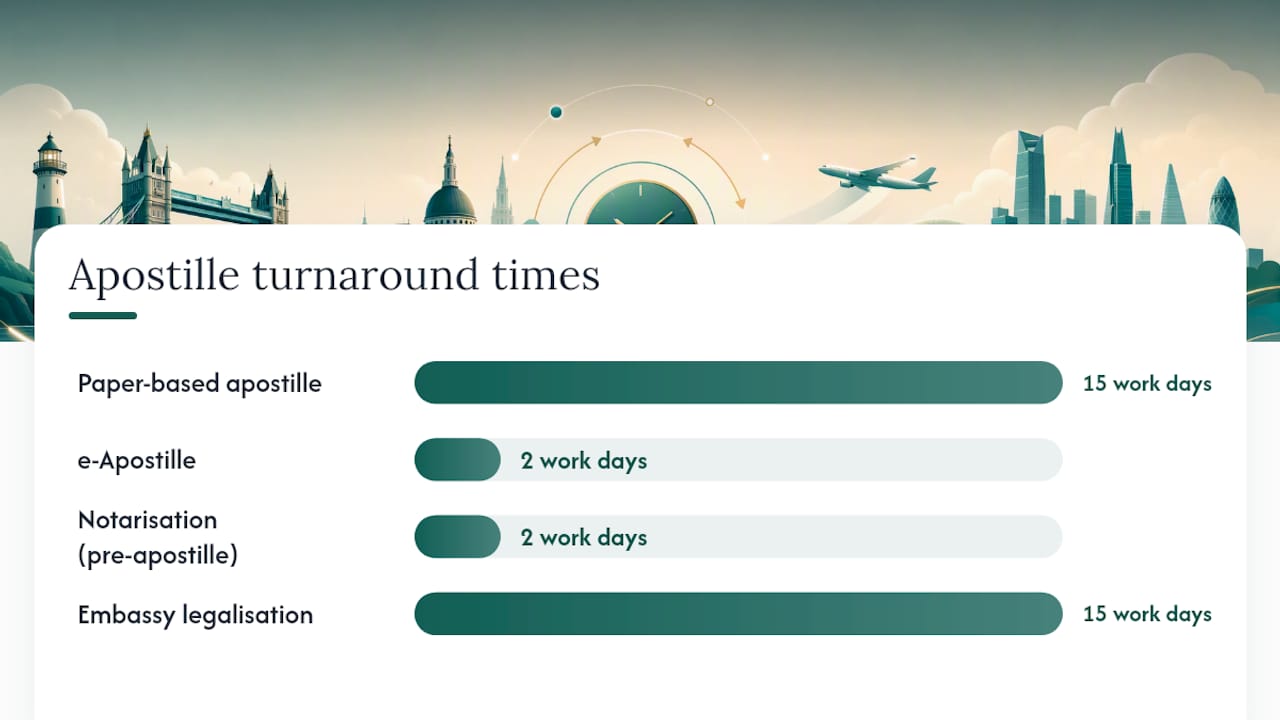
Urgent or next-day processing through the Legalisation Office is generally reserved for registered business users submitting on behalf of clients, not individual applicants applying directly. If you're on a tight deadline as an individual, the e-Apostille route (where your document qualifies) is usually your fastest realistic option rather than hoping for expedited paper processing.
When you need a notary before you can apply for an apostille
Public documents carry their own official seal, so the Legalisation Office can verify them directly. Private documents don't have that built-in authority, which is why a notary needs to certify them first, adding a layer of verified signature that the Legalisation Office can then check against its own records.
Documents that typically need notarisation before apostille include:
- Powers of attorney, particularly those used for property, banking, or tax matters abroad.
- Personal affidavits and statutory declarations drafted for a specific overseas purpose.
- Certified copies of identity documents, such as passports or national ID cards, requested by a foreign authority.
- Some commercial documents, including certain contracts and corporate resolutions.
If you're dealing with a power of attorney that needs an apostille, get the notarisation sorted first. Applying for legalisation before the notary stage is complete is one of the most common reasons paperwork bounces back.
Pro Tip: Ask the notary to confirm the exact wording and format the Legalisation Office expects before they finalise your document. A notary who regularly handles apostille-bound paperwork will already know this; one who doesn't may need you to check with the office directly.
How an online notarisation platform speeds up the pre-apostille stage
A reader preparing a power of attorney for an overseas property purchase typically needs three things done in sequence: identity verification, notarisation of the document, and a certified copy suitable for submission to the Legalisation Office. Doing this the traditional way often means booking an in-person appointment, then waiting for the physical document to be posted on again.
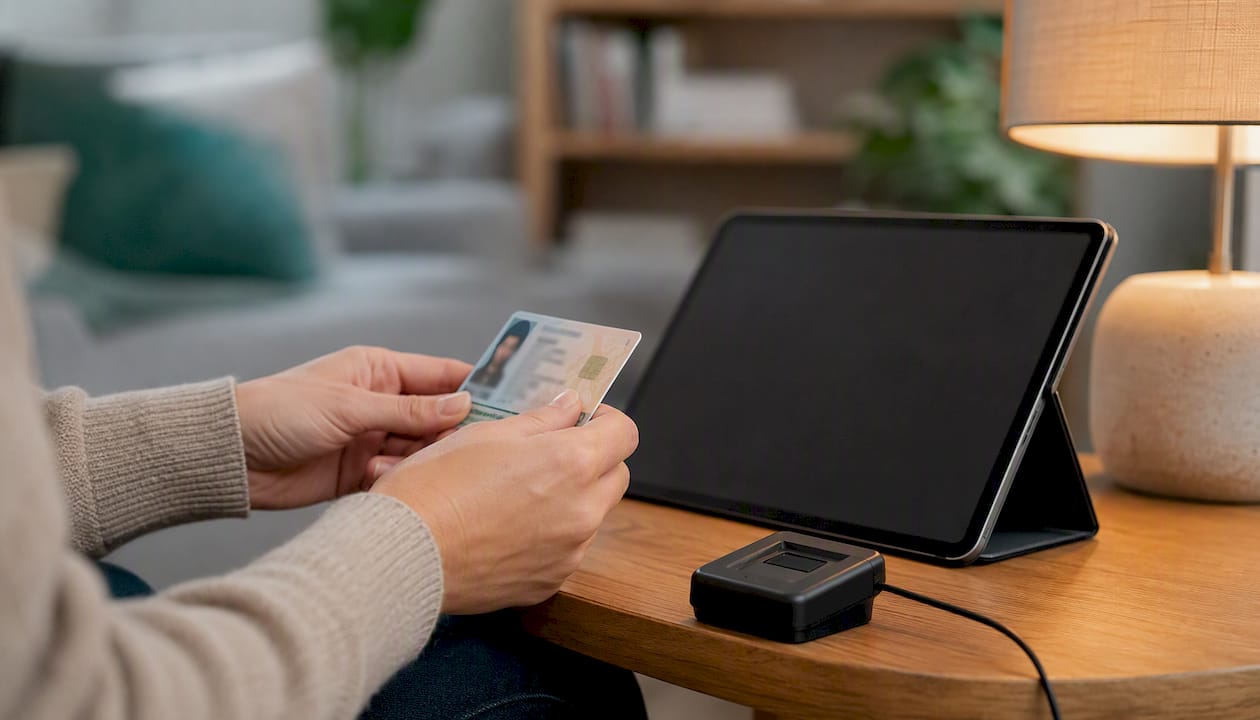
An online notarisation service collapses that into a single session. The applicant uploads the document, completes biometric identity verification, and joins a video call with a notary who certifies the document and issues an electronically signed PDF. That signed PDF can then go straight into the e-Apostille application, provided the underlying document type is eligible for electronic processing.
Before choosing any online notary service, check a few things:
- Turnaround time for the notarisation itself, not just the marketing headline.
- Identity verification method, and whether it meets the standard the recipient country expects.
- Certification format, so it matches what the Legalisation Office requires for that document type.
- Ability to produce a certified digital copy, if you're planning to use the e-Apostille route.
Always confirm with the recipient and the Legalisation Office that online notarisation is acceptable for your specific document and destination before you rely on it. The office remains the final authority on what it will legalise, regardless of how the underlying certification was produced.
How to verify an apostille and what to do once you have one
Once you or the recipient has an apostille in hand, verification is straightforward. The GOV.UK verification service checks a paper or electronic apostille using two details: the issue date and the apostille number printed on the certificate. Anyone, including the receiving institution abroad, can run this check independently.
- Locate the issue date and apostille number on the certificate.
- Enter both into the GOV.UK verification tool.
- Confirm the result matches the document you're presenting.
Once verified, storage and delivery depend on the route you used. E-Apostilles can be shared digitally, which is usually what recipients expect if that's the format they requested. Paper apostilles should travel by secure, trackable courier, particularly if the underlying document (a birth certificate, say) would be difficult or slow to replace.
If an apostille gets rejected by the recipient, the usual causes are: the wrong type of apostille for that jurisdiction, a certification that doesn't match the recipient's expected format, or a document that's since expired or been superseded. Contact the recipient first to confirm exactly what's wrong, check whether the certification underneath the apostille was correct, and reapply only once you've identified the actual fault rather than guessing.
Getting documents legalised for non-Hague Convention countries
An apostille only works because the receiving country recognises the Hague Apostille Convention. If your destination country isn't a member, the apostille alone won't be accepted, and you'll need to go through full legalisation instead.
- Get the document apostilled first. Even for non-Hague countries, the Legalisation Office's apostille is usually the starting point.
- Obtain embassy stamping in London. The destination country's embassy or consulate adds its own authentication on top of the apostille.
- Complete any final steps the destination country requires. Some foreign ministries need an additional layer of approval once the document arrives in-country.
This route takes longer and costs more than a standard apostille, partly because you're dealing with two separate authorities on two separate timelines. Start early if you know your destination sits outside the Hague network, and check the specific embassy's guidance directly, since requirements vary considerably between countries.
Mistakes that get applications rejected or delayed
Most rejections come down to a handful of repeat offenders:
- Submitting a photocopy where an original or an authorised certified copy was required.
- Using the e-Apostille route for a document on the exclusion list.
- Missing or incomplete notarisation on a private document.
- Providing an incorrect or incomplete return address for paper applications.
- Submitting a document with an unsigned or improperly witnessed signature.
If you're hiring a third-party service to handle the process for you, watch for warning signs: no clear stated turnaround time, no tracking for physical documents, or vague answers about what certification format they actually provide. A provider that can't tell you precisely how they'll certify your document isn't one you want holding your birth certificate.
If a mistake does slip through, contact the recipient first to confirm what specifically failed, then get the underlying certification corrected before reapplying. Reissuing an apostille after a rejection is usually faster than the original application, provided the fault has actually been fixed rather than resubmitted unchanged.
Choosing between GOV.UK yourself and paying for help
The honest answer depends on how much slack you have in your timeline and how confident you are with paperwork. If your deadline is weeks away and your document is a straightforward public certificate, applying directly through GOV.UK costs less and isn't complicated. Read the eligibility rules once, fill in the form correctly, and you'll get there.
Where it gets harder is anything involving notarisation, translation, or a destination outside the Hague network. Stack two or three of those together, on a deadline measured in days rather than weeks, and the coordination overhead becomes the real cost, not the apostille fee itself. A power of attorney needing notarisation, translation into a foreign language, and use in a non-Hague country is three separate processes running in parallel, and a missed step in any one of them resets the clock on all three.
My practical rule: if you have time and a single, uncomplicated public document, do it yourself through GOV.UK. If you're short on time, dealing with a private document that needs certifying first, or juggling cross-border translation on top of everything else, use a service built to handle the certification stage cleanly, so the only thing left for the Legalisation Office to check is a document that's already correctly prepared. Either way, the Legalisation Office remains the only body that actually issues the apostille, and the recipient's stated requirements are what determine whether you've done the job right.
Getting your documents notary-ready before you apply
My Notary shortens the part of the process most people find genuinely confusing: getting a private document properly certified before it ever reaches the Legalisation Office. Instead of booking an in-person notary appointment and waiting days for a physical signature, you upload your document, complete identity verification with biometric checks, and connect with a commissioned notary over video call, with the certified PDF typically ready within an hour.
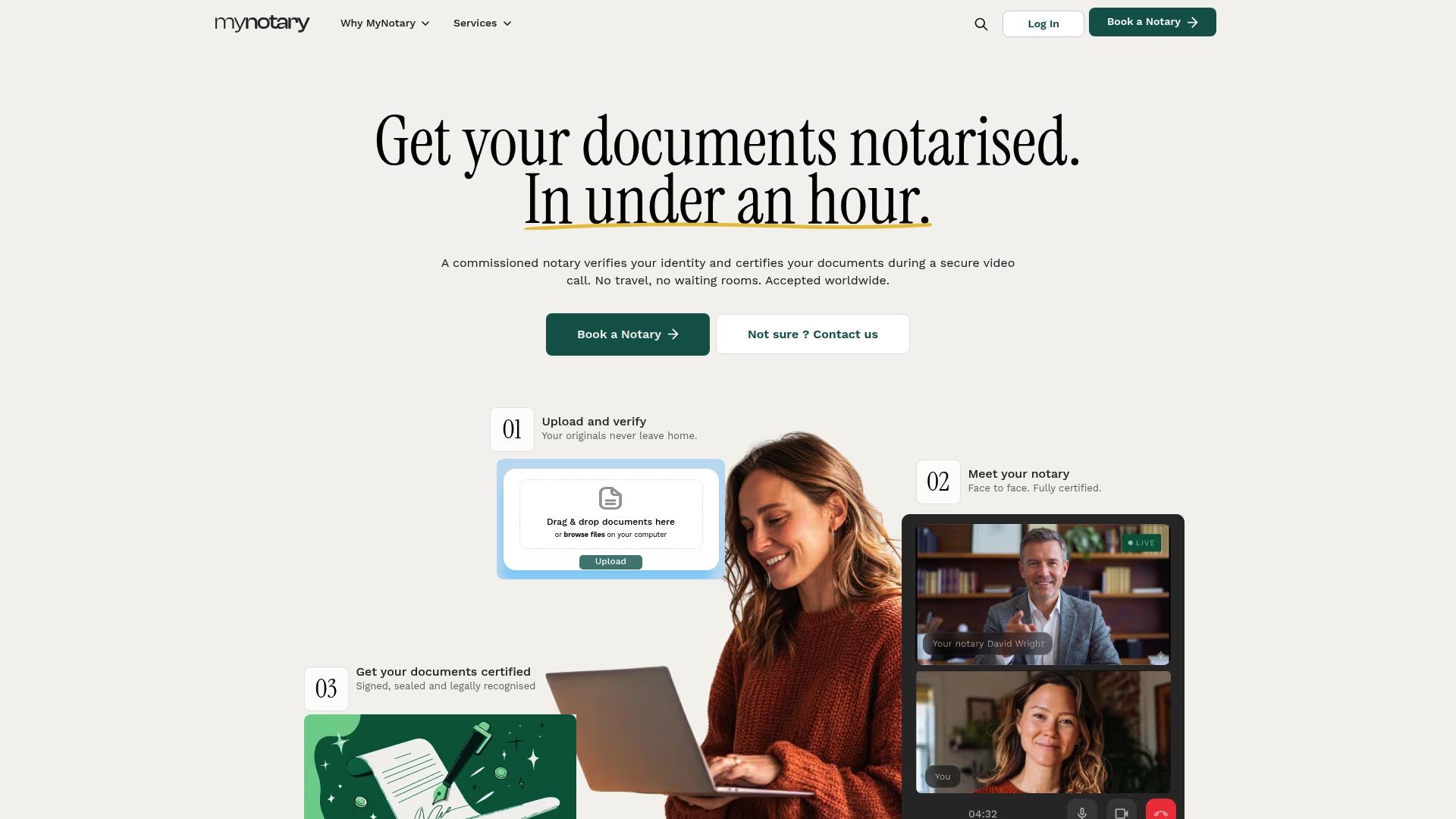
That matters most for the document types that trip people up repeatedly: a power of attorney needed for banking abroad, a degree certificate for a visa application, or a certified true copy of a national ID card requested by a foreign authority. Each needs the same thing underneath: a correctly worded, properly formatted certification that the Legalisation Office will accept without a second look. Getting that step right the first time is what actually keeps your apostille application moving instead of bouncing back. If you know your document needs notarising before it can be apostilled, start your session with My Notary and have the certified version ready the same day.
Where to check the official details
Every figure and process step in this guide traces back to a small number of official sources, and it's worth bookmarking them directly rather than relying on secondhand summaries.
- The Gov covers eligibility, the paper versus e-Apostille distinction, and exclusion lists.
- The apply for legalisation service is where you actually submit your application.
- Consular services fees lists current official charges.
- Documents for British people abroad explains the non-Hague legalisation process.
- The Verify an Apostille tool confirms whether a specific apostille was genuinely issued.
- The HCCH member list tells you whether your destination country accepts apostilles at all.
- A directory of practising notaries helps if you need in-person certification rather than an online service.
Always confirm the specific requirement with the recipient organisation directly. Rules on acceptable formats vary by country and even by individual institution, and no guide, including this one, replaces that final check.
This article is general information, not a substitute for advice from a qualified lawyer. Consult a qualified legal professional about your own circumstances before acting on anything here.
Sources
FAQ
How do I get my documents apostilled in the UK?
Apply online through the Legalisation Office, choosing paper-based or e-Apostille depending on your document type, and get any private documents notarised first.
How much does an apostille cost in the UK?
Official fees differ between the paper-based apostille and the e-Apostille, with the paper route costing more due to postal handling; check current consular fees for exact figures, and budget separately for notarisation, translation, or courier return.
Does the post office do apostille?
No. Apostilles are issued exclusively by the Legalisation Office through GOV.UK; the post office plays no role in legalising or certifying documents.
How long does it take to get an apostille in the UK?
Paper-based apostilles typically take several working weeks, while e-Apostilles process in a couple of working days where the document type is eligible.
Can I use online notarisation before applying for an apostille?
Yes, for private documents that need certification first, provided the recipient and the Legalisation Office accept the certification format; a service like My Notary can produce a certified document ready for submission within an hour.
Recommended
Got questions? We’re on it.
Most questions are answered here, drawn from what people actually ask before booking. If yours isn’t, our team is in chat.
Apply online through the Legalisation Office, choosing paper-based or e-Apostille depending on your document type, and get any private documents notarised first.
Last updated: