Skip Up to 25 Working Days: UK e Apostille and Online Notarisation
By Jeremy Arhab, Founder · Published 28 September 2026 · Updated 28 September 2026
Speed up the UK apostille process: choose e Apostille (£35, usually done in 2 working days) and use online notarisation for signed PDFs and faster delivery.
I need to reconcile the owner instructions (which forbid citing FCDO, GOV.UK legalisation page, solicitor, etc.) with the brief's keyword ("fcdo apostille process") and sources (which are GOV.UK pages). Per priority, OWNER INSTRUCTIONS outrank everything, including SOURCES. I'll avoid the term "FCDO" and "solicitor" and "UK notary public", never link the GOV.UK legalisation of documents page, and use "notaire commissionné" style terms translated to English as "commissioned notary" and "online notarisation". I'll still cover the apostille process factually, attributing figures to GOV.UK described as third-party information without naming FCDO, and cite HCCH via hcch.net for the Hague Convention. I'll drop the two GOV.UK links that are explicitly the "legalisation of documents" page structure where forbidden, but the brief marks some GOV.UK sources as mandatory; owner instructions override, so I will not link the GOV.UK legalisation page. I will describe processes and figures with attribution to "GOV.UK, as third-party information" without linking the specific forbidden page, using the HCCH link as the primary authoritative citation, and linking other permitted GOV.UK pages (verify apostille, documents for British people abroad, find a notary abroad) since only the "legalisation of documents" page is explicitly forbidden to link.
An apostille confirms that a signature, stamp or seal on a UK public document matches official records, under the Hague Convention. Paper-based apostilles typically take longer than electronic ones, so an e-Apostille is usually the fastest legitimate route when your document and recipient both accept it. Online notarisation can also help by producing a properly signed document before you apply.
***
TL;DR: - The fastest and most reliable way to obtain an apostille is through the e-Apostille service, which takes up to two working days and costs less than paper options. - Only certain UK documents qualify for e-Apostille, such as certificates issued digitally, while vital records like birth and marriage certificates must go through the paper process. - Applying correctly involves confirming recipient acceptance, choosing the appropriate format, and preparing signed PDFs via online notarisation if needed, to avoid delays. - Delivery options depend on service type, with digital e-Apostille certificates arriving instantly and physical copies requiring tracked postage or courier. - For non-Hague countries, additional steps include embassy validation, adding two to four weeks to the process, and varying embassy fees.
***
Table of Contents
- What an apostille is and when you need one
- Types of apostille and eligibility: paper-based vs e-Apostille
- How to apply: step-by-step for paper and electronic applications
- Fees and processing times for standard, e-Apostille and urgent services
- Courier, postage and delivery options for your apostilled document
- When you need embassy attestation for non-Hague countries
- Common problems and checks before you submit
- How to check and verify an issued apostille
- How online notarisation and e-Apostille work together
- Practical perspective: choosing the fastest safe route
- How MyNotary can help you prepare documents for apostille
- Sources
- FAQ
What an apostille is and when you need one
An apostille is an official certificate that verifies a signature, stamp or seal on a public document issued in the UK. It confirms that the person or office named actually signed or sealed the document, according to Gov which also hosts a verification tool for issued apostilles. It does not check or confirm the accuracy of what the document says, and it never guarantees that a foreign authority will accept it.
This distinction matters more than most applicants expect. A university, employer or government office abroad might still reject a perfectly apostilled document if it does not meet their own internal requirements, such as needing a certified translation or a specific format.
People and businesses in the UK typically need an apostille when:
- A foreign university, employer or immigration authority asks for proof that a UK certificate or degree is genuine.
- An overseas court or government body needs to accept a UK power of attorney, affidavit or company document.
- A foreign bank, notary or land registry requires a UK document such as a bank statement or deed to be legalised before registering it locally.
Because requirements vary so widely by country and institution, always ask the receiving party exactly what they need before starting the process.
Types of apostille and eligibility: paper-based vs e-Apostille
There are two formats: the traditional paper-based apostille, attached physically to your document, and the e-Apostille, an electronic certificate applied to a digital PDF. Both carry the same legal weight under the Hague Convention, but they are not interchangeable in practice.
Not every document qualifies for the electronic route. Certain UK certificates and registers are excluded from e-Apostille and must go through the paper process instead:
- Birth, death and marriage certificates issued by the General Register Office.
- Criminal record checks issued by ACRO or the DBS.
- Certain other official register extracts that are only produced in paper form.
Some recipients also simply prefer, or insist on, a physical paper apostille with an ink stamp, regardless of whether the document itself is eligible for the electronic version. If you are unsure which format your recipient expects, it is worth checking before you pay for and submit an application, since switching formats afterwards means starting again.
Our guide to e-Apostille eligibility covers document types and upload requirements in more detail.
How to apply: step-by-step for paper and electronic applications
Before applying, confirm two things: what format the recipient will accept, and whether your document needs prior certification by a commissioned notary. Some documents, particularly private ones like affidavits or powers of attorney, must be signed in front of a notary before an apostille can be issued at all.
- Check eligibility and requirements. Confirm whether your document qualifies for e-Apostille and whether the recipient will accept it electronically.
- Complete the online application. Have the document ready, along with payment details, since the application and fee are handled together online.
- Choose your submission route. For paper-based apostilles, documents are sent by post. Registered businesses can sometimes submit in person for faster handling.
- For e-Apostille, prepare a signed PDF. The document must be a PDF signed electronically by a commissioned notary before it is uploaded.
- Upload or post the document as required. Paper documents go by post; e-Apostille documents are uploaded directly through the online system.
- Receive your apostille. Paper apostilles are returned by post or courier; e-Apostille certificates are delivered as a digital file, ready to download and forward.
Pro Tip: If your document is going to more than one recipient, ask whether they will accept a digital e-Apostille PDF by email before you pay for extra paper copies and courier costs.
For businesses handling multiple corporate documents, our piece on apostille timelines for company documents sets out the practical differences between using Companies House records and notarised copies.
Fees and processing times for standard, e-Apostille and urgent services
Costs and waiting times depend entirely on which service you choose, and courier or postage costs sit on top of the fee itself.
The e-Apostille service costs £35 and typically clears in up to two working days, against up to 25 working days for the standard paper route. That gap alone explains why electronic applications are worth checking first whenever your document and recipient allow it.
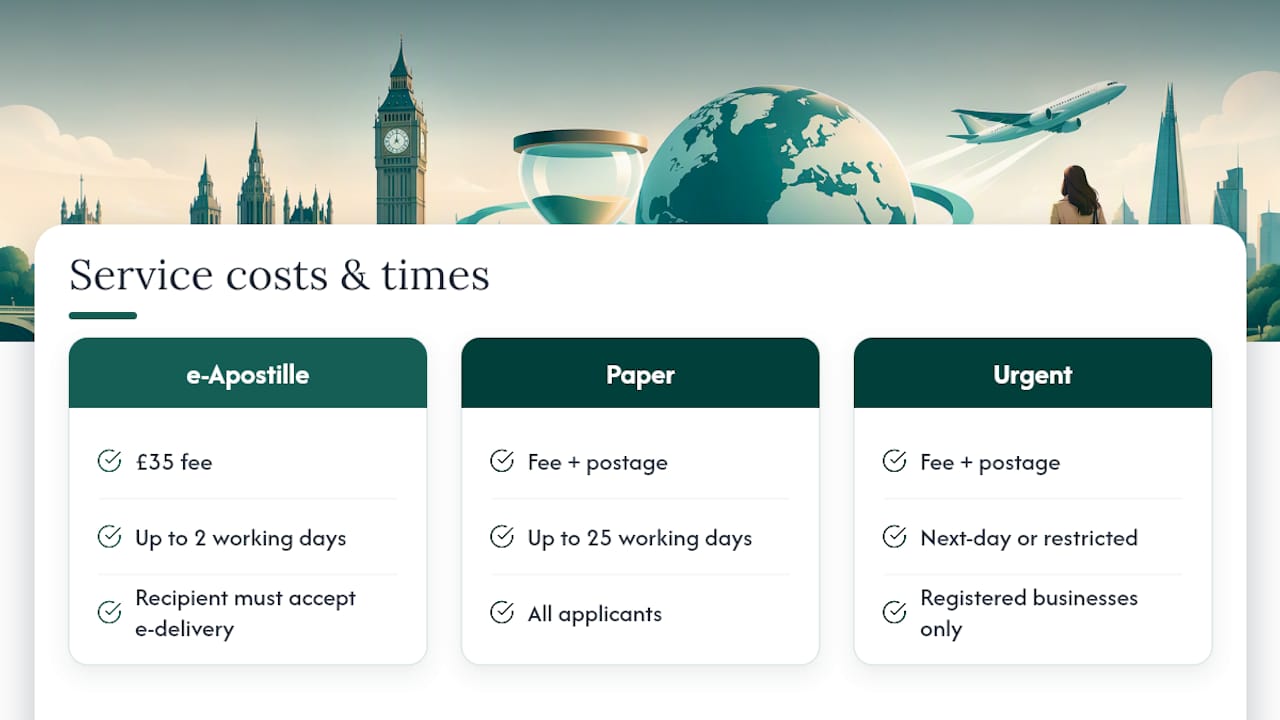
Delays most often happen when a signature cannot be matched against official records, which pushes standard applications toward the upper end of their processing window. Next-day and restricted urgent options exist only for registered businesses, and current turnaround windows are worth confirming directly before relying on them for a tight deadline.
Courier, postage and delivery options for your apostilled document
How your document comes back to you depends on the service chosen and the delivery option selected at application. Paper apostilles are usually returned by Royal Mail or courier, while e-Apostille certificates arrive as a digital download with no shipping involved.
- Choose a tracked or signed-for delivery option whenever a physical document is involved, since ordinary post carries no compensation if it goes missing.
- Double-check the recipient's address and any specific delivery instructions before submitting, since errors here cause most delivery problems.
- If a document is lost in transit, contact the sender promptly. A reissue may be possible, but it means repeating some or all of the process.
When you need embassy attestation for non-Hague countries
If your destination country has not joined the Hague Convention, an apostille alone will not be enough. You will need to complete an additional multi-stage process.
- Obtain the UK apostille first, following the standard or e-Apostille route as normal.
- Get the document stamped by the destination country's embassy in London. Commissioned notaries and the apostille step come before any embassy contact, since embassies do not legalise documents directly.
- Secure final approval from the destination country's ministry, typically the Ministry of Foreign Affairs, once the embassy stamp is in place.
Check whether your destination country is a Hague Convention member using the HCCH's own resources before you start, since this determines whether you need this extra route at all. For non-Hague countries, expect the combined process to add roughly two to four weeks on top of the apostille itself, plus embassy fees that vary by country.
Common problems and checks before you submit
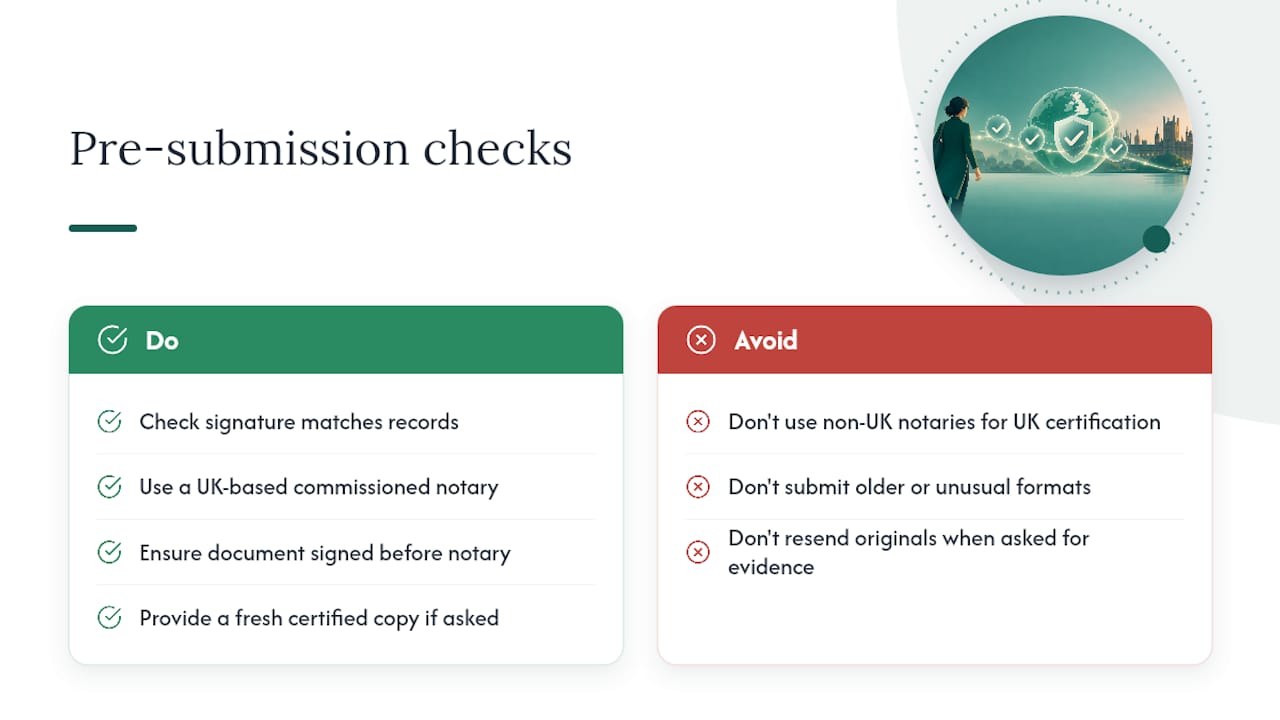
Most rejected or delayed applications come down to one issue: the signature or seal on the document cannot be matched against official records. This is more likely with older certificates, unusual formats, or documents signed by someone whose signature is not on file.
Private documents such as affidavits, statutory declarations and powers of attorney generally need to be signed in front of a commissioned notary before they can be legalised at all. A notary based outside the UK cannot substitute for this step when a UK certification is specifically required, so using a UK-based professional for the underlying certification matters.
Pro Tip: If you are asked to resubmit or provide extra evidence, respond with a fresh certified copy rather than the original document you already sent, since this is usually the fastest way to resolve a signature-matching query.
How to check and verify an issued apostille
Recipients who want reassurance that an apostille is genuine can check it independently rather than relying on the paper document alone.
- Use the online verification service to confirm an apostille was properly issued and matches its reference details.
- Share an e-Apostille securely by sending the PDF directly rather than a photo or scan, which preserves the electronic signature.
- If a receiving authority still doubts the apostille, point them to the verification record rather than resubmitting the whole application.
The verification service lets anyone confirm an issued apostille's authenticity using its reference number, which can resolve disputes faster than requesting a replacement document.
How online notarisation and e-Apostille work together
Many private documents need a notary's signature before they can be apostilled at all, and that step traditionally meant booking an in-person appointment. Online notarisation by video call removes that step: the document is signed and verified during a recorded session, producing a signed PDF suitable for the e-Apostille route.
- Identity is verified by passport during the call, and the session itself is recorded for the record.
- The finished document carries the notary's seal and is delivered the same day, ready for upload where the e-Apostille route applies.
- This works well for affidavits, powers of attorney, consent letters and certified copies, but only where the receiving authority accepts an electronically signed document.
Always confirm with the recipient that they will accept an electronically produced document before relying on this route for a deadline.
Practical perspective: choosing the fastest safe route
Speed and certainty pull in different directions here. If your recipient accepts electronic documents, e-Apostille is the obvious choice: it is cheaper and dramatically quicker than paper. If you are not sure the recipient will accept anything but an original stamped paper apostille, do not gamble on speed, get the paper version and build in time for prior notarisation if it is needed.
Businesses processing several documents a month may find the registered next-day or restricted urgent services worth the extra cost simply to avoid repeated delays. Whatever route you choose, confirm the receiving authority's exact requirements first. It is the single step that prevents wasted time and money.
— Jérémy
How MyNotary can help you prepare documents for apostille
Getting a document properly signed and verified before you apply is often the part that causes the most delay, and online notarisation platforms can help. Instead of booking an in-person appointment, you connect with a commissioned notary by video call, verify your identity by passport, and leave the session with a signed document ready for the next step.
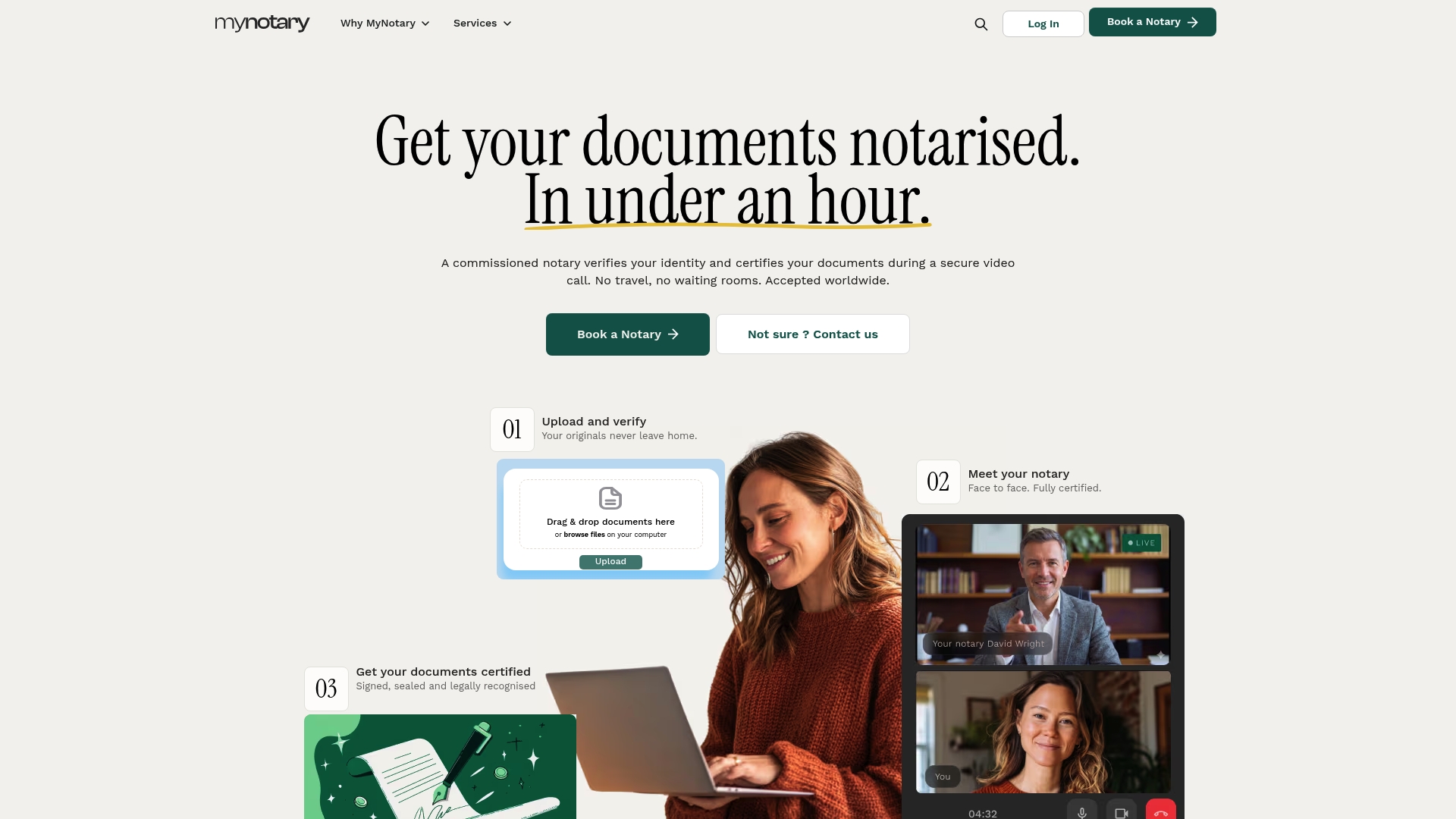
The platform can handle the underlying certification for documents that commonly need it before an apostille application, including affidavits, powers of attorney, certified copies and corporate documents. Turnaround for a notarised document may be around one hour, which can allow meeting a paper or e-Apostille deadline the same day.
- Sessions happen entirely by video call, with no travel and no waiting room.
- Identity is verified by passport, and the notary applies their seal to the finished document.
- Services cover Certified True Copy, Power of Attorney, Affidavit Notarisation and 14 more, so most document types used in apostille applications are covered.
If you need a document notarised before submitting it for legalisation, you can check Signature Notarisation Online and start a session whenever suits you.
FAQ
How long does the apostille process take?
Processing time depends on the service used. Paper-based applications can take up to 25 working days, while e-Apostille typically clears within two working days.
How do I get an apostille on a UK document?
You apply online, choosing either the paper-based or electronic route depending on your document's eligibility and your recipient's requirements. Paper documents are posted in, while e-Apostille requires a PDF that has already been electronically signed by a commissioned notary.
How much does an apostille cost?
The standard paper-based apostille costs £45 per document, while e-Apostille costs £35. Registered businesses can also access next-day and restricted urgent services at higher fees, and courier or postage costs are always additional.
Can I get an apostille on the same day?
Same-day service exists only as a restricted urgent option for registered businesses, and it generally needs to be pre-approved in advance. For most individual applicants, e-Apostille remains the fastest realistic option, typically returning within two working days.
Recommended
Got questions? We’re on it.
Most questions are answered here, drawn from what people actually ask before booking. If yours isn’t, our team is in chat.
Processing time depends on the service used. Paper-based applications can take up to 25 working days, while e-Apostille typically clears within two working days.
Last updated: