UK Apostille Process: Get a Certified Signature in One Hour
By Jeremy Arhab, Founder · Published 2 September 2026 · Updated 2 September 2026
Start at GOV.UK. Choose paper (£45) or e‑Apostille (£35, up to 2 working days). Use online notarisation to get a qualified signature in about an hour.

Start your application at GOV.UK's legalisation service and choose between two routes: the paper apostille, which suits any original document and costs £45, or the e-Apostille, which needs a qualified electronic signature and costs £35 with turnaround as fast as two working days. Most straightforward cases finish faster and cheaper through the e-Apostille route, provided your document and recipient both accept it.
***
TL;DR: - The e-Apostille route is faster and cheaper, often completing within two working days, but requires a qualified electronic signature from a notary or solicitor. - Most documents can go directly for certification if their signature or seal is already on the official register; otherwise, notarisation is needed beforehand. - Confirm recipient requirements in advance, as some countries or authorities accept only one format, and switching after submission can mean paying twice. - The main delays often occur before submission, during the notarisation or certification process, which can now be handled online and completed in about an hour. - Additional steps are needed for non-Hague countries, including embassy attestations, and extra time must be factored in for postal transit and foreign ministry approvals.
***
Table of Contents
- How to apply for legalisation in the UK
- Which documents can go straight to the Legalisation Office?
- What does an apostille cost and how long does it take?
- Paper apostille or e-Apostille: which one should you choose?
- Sending documents to countries outside the Hague Convention
- Avoiding the most common apostille rejections
- Why the certification step is the real bottleneck
- Get your document notary-ready before you apply for an apostille
- Where to check the official rules and fees
- Sources
- FAQ
How to apply for legalisation in the UK
Applying for an apostille is a single online process, but a few decisions before you submit determine whether it runs smoothly or gets bounced back.
First, confirm what the recipient actually needs. Some overseas authorities want a physical apostille certificate attached to the original document; others accept a digital file. Some countries outside the Hague Convention need an entirely different chain, covered further down. Get this in writing from the recipient if you can, because guessing wrong means paying twice.
Once you know the format, follow these steps:
- For the paper route, gather your original documents (never send the only copy you have of something irreplaceable), package them securely, and post them by tracked courier to the Legalisation Office address confirmed in your application.
- For the e-Apostille route, upload a qualified electronically signed PDF. This has to come from a commissioned notary or solicitor whose signature is registered with the Legalisation Office; a scanned wet-ink signature will not qualify.
- Wait for processing. The Legalisation Office checks the signature or seal against its official register and either applies the apostille or flags an issue.
- Receive your apostilled document back by post (paper route) or as a downloadable file (e-Apostille), and verify it using the public verification service if the recipient wants confirmation.
Pro Tip: Photograph every document before you post it. If the Legalisation Office queries something or the package goes astray, you'll have proof of exactly what you sent.
Which documents can go straight to the Legalisation Office?
Not every document is ready for an apostille the moment you have it in hand. The Legalisation Office only certifies a signature, seal, or stamp that's already on its official register, not the content of the document itself, so the real question is whether your document already carries a recognised signature.
Documents that usually go direct:
- GRO birth, marriage and death certificates
- ACRO police certificates
- Court-sealed orders and other government-issued originals
Documents that usually need certification first:
- Degree certificates and academic transcripts
- Company letters and board resolutions
- Powers of attorney
- Certified copies and translations of private documents
The practical rule is simple: if the signature or seal on your document isn't already listed on the Legalisation Office register, it won't be accepted as-is. A commissioned notary or solicitor needs to certify it first, which creates a new, registered signature the office can verify. This is exactly why so many applicants sort out notarisation before they even open the GOV.UK application. Our step-by-step apostille guide walks through the preparation stage in more detail, and our birth certificate apostille guide is worth a look if your document falls into the direct category.
Pro Tip: If you're not sure which category your document falls into, ask the Legalisation Office or your notary before you pay for anything. It's a five-minute question that can save you a fortnight.
What does an apostille cost and how long does it take?
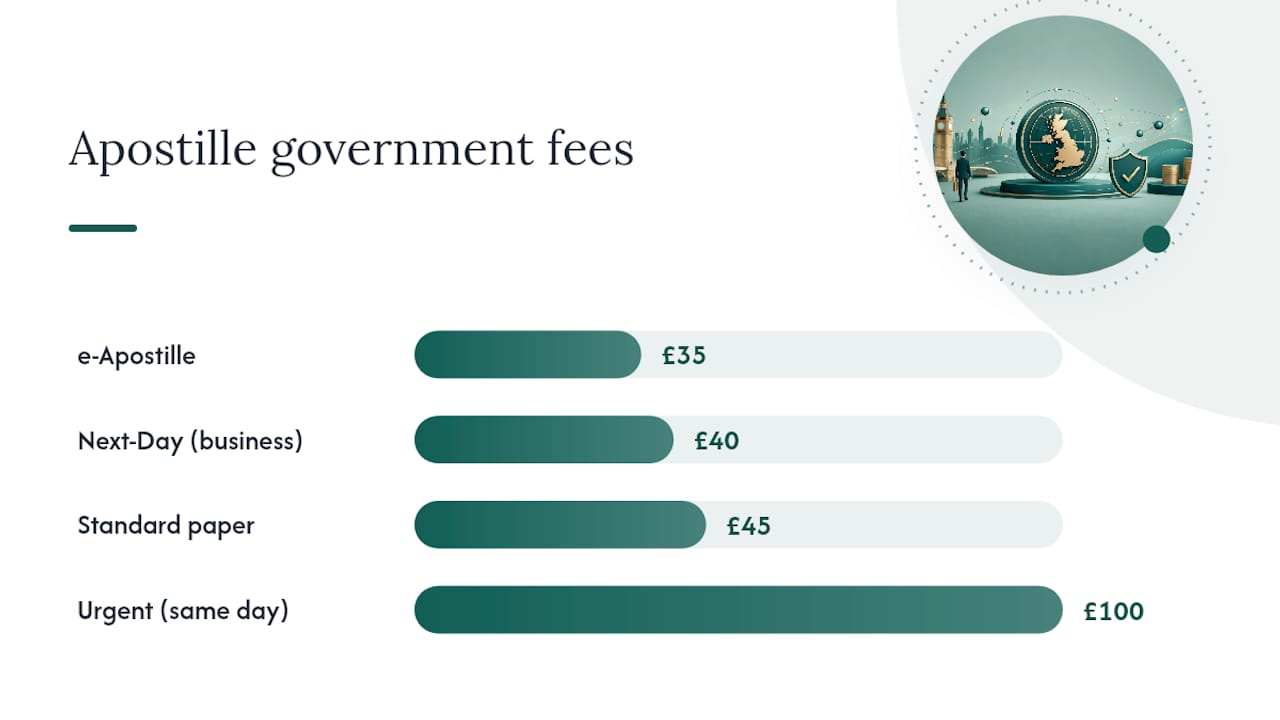
The official government fee for a standard paper apostille is £45 per document, while the e-Apostille costs £35. A Next-Day option exists for registered businesses at £40, and an urgent same-day route is available at £100, all according to the consular services fee schedule. None of these figures include courier or postage, which vary depending on destination and weight, and can add a meaningful amount if you're sending internationally by tracked delivery.
| Route | Government fee | Published processing time | Extra costs |
|---|---|---|---|
| Standard paper apostille | £45 | Several working days | Courier/postage both ways |
| e-Apostille | £35 | Up to 2 working days | None (digital delivery) |
| Next-Day (registered business) | £40 | Next working day | Business account access |
| Urgent | £100 | Same day | Business account access |
The e-Apostille is both the cheapest and the fastest route on paper. The catch is eligibility: your document has to already exist as a qualified electronically signed PDF, which rules out most physical originals unless a notary re-signs them electronically first.
Published processing times describe the Legalisation Office's own handling, not door-to-door reality. Add postal transit both ways for the paper route, and factor in a buffer if you're working to a visa or property deadline. Our breakdown of apostille costs covers courier pricing by destination if you want a fuller picture before you budget.
Paper apostille or e-Apostille: which one should you choose?
The decision usually comes down to what your document is and what the recipient will accept, not personal preference.
- e-Apostille works only when you have a qualified electronic signature from a commissioned notary or solicitor already applied to the file. It's quick, cheap, and delivered digitally, but plenty of overseas registries, banks and courts still insist on a physical certificate.
- Paper apostille is the safer default. It's accepted by every Hague Convention country and is frequently the only format non-Hague authorities will recognise once the embassy stage begins.
Always confirm acceptance with the recipient before you choose, because switching routes after submission means starting again and paying twice. A property lawyer overseas, a foreign university, or an immigration authority may have a strict preference buried in their own guidance that GOV.UK has no way of knowing. If your documents relate to a property purchase abroad, this partner checklist on notarisation for overseas property buyers is a useful companion, since property transactions are one of the most common places where paper apostilles are non-negotiable.
Pro Tip: Ask the recipient specifically whether they accept a digital apostille file, not just whether they accept "an apostille." The two answers are not the same thing. Our e-Apostille deep dive explains eligibility in more depth if you want to check before applying.
Sending documents to countries outside the Hague Convention
An apostille alone doesn't finish the job if your destination country hasn't signed the Hague Convention. In that case, the UK apostille is only the first stage of a longer chain, and British embassies and consulates don't legalise UK documents themselves, so you can't shortcut this by going straight to a foreign mission.
- Get the UK apostille first, using either the paper or e-Apostille route as normal.
- Take the apostilled document to the destination country's embassy or consulate in London for their own attestation stamp.
- Check whether the destination country's foreign ministry requires a further endorsement once the document arrives there; this varies by country and by document type.
Embassy stages run on their own schedules, separate from the Legalisation Office, so build in extra time and check fees directly with the embassy in question. If translation is also needed, arrange it before the embassy stage rather than after, so you're not sending the document back and forth unnecessarily.
Avoiding the most common apostille rejections
Most delays trace back to a handful of avoidable mistakes rather than anything unusual about the document itself.
Before you post anything, confirm: the recipient's exact format requirements, whether they need an original or a certified copy, translation needs, your correct return address, and that you're using tracked postage both ways.
The most frequent causes of rejection are straightforward once you know them:
- The signature or seal isn't on the Legalisation Office register
- Scanned documents for the e-Apostille route are poor quality or incomplete
- A document that needed notary or solicitor certification was submitted without it
If the Legalisation Office returns or rejects your document, it will usually explain why. Fix the underlying issue (get the missing certification, rescan the file, or confirm the correct signatory) and resubmit rather than assuming the whole process needs restarting from scratch.
Pro Tip: Keep a single checklist per document rather than one for the whole batch. Apostille rejections are almost always document-specific, and a shared checklist makes it easy to miss the one file that needs different handling.
Why the certification step is the real bottleneck
Most of the friction in this process has nothing to do with the Legalisation Office itself. It sits earlier, in getting a document into a state where it can even be submitted: finding a notary, booking an appointment, and physically attending in person to get a signature witnessed. That's the stage that actually eats days, not the government's own processing.
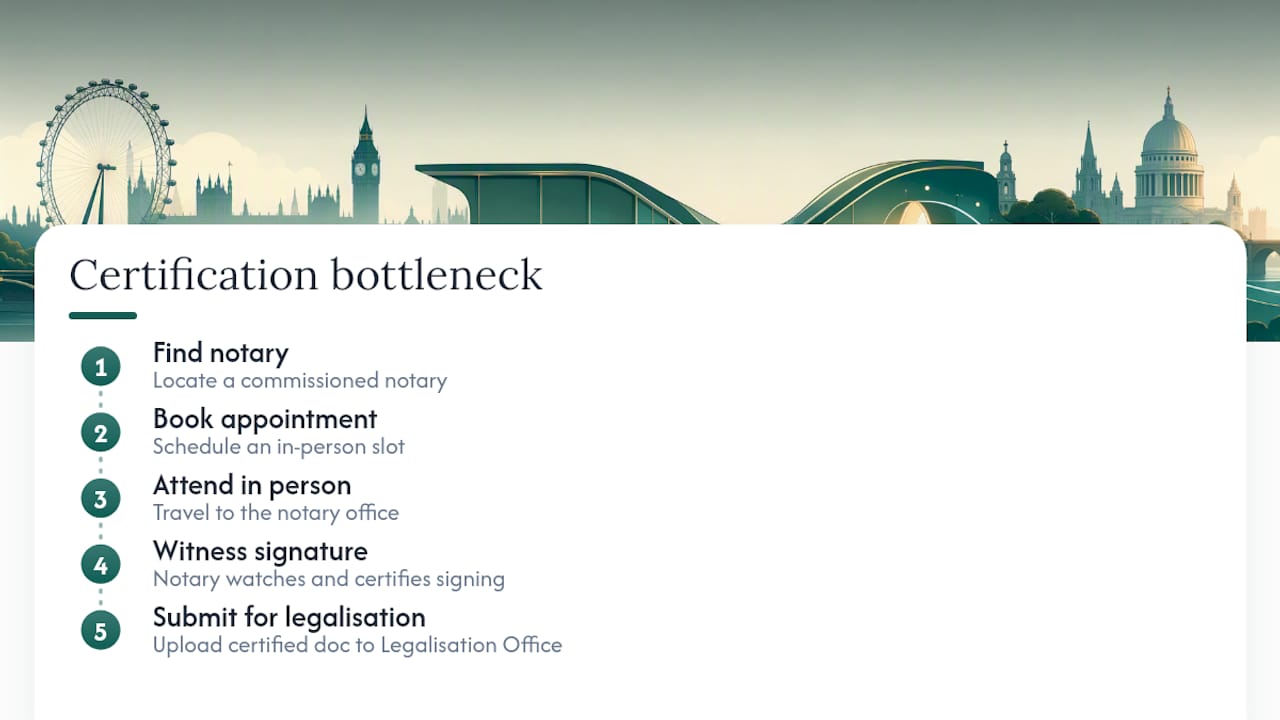
Remote identity verification changes that equation. When a commissioned notary can verify your identity and witness a signature over video call, the "last mile" between having a document and having a submittable one shrinks from a week of phone calls and travel to a single online session, often completed within an hour. That matters most for the e-Apostille route, which depends entirely on having a qualified electronic signature ready to upload; without it, you're locked into the slower paper route by default rather than by choice.
The requirement that matters here is narrow but strict: the signature has to meet the Legalisation Office's own standard for a qualified electronic signature, not just any digital signing tool. Confirm with your notary that their process satisfies this before you rely on it for an e-Apostille submission.
— Jérémy
Get your document notary-ready before you apply for an apostille
If the certification stage is what's slowing you down, My Notary handles it entirely online, without booking a solicitor's appointment or taking time off work to sit in a waiting room. You upload your document, verify your identity with biometric checks, and connect with a commissioned notary by video call who applies an electronically signed certificate recognised in over 180 countries.
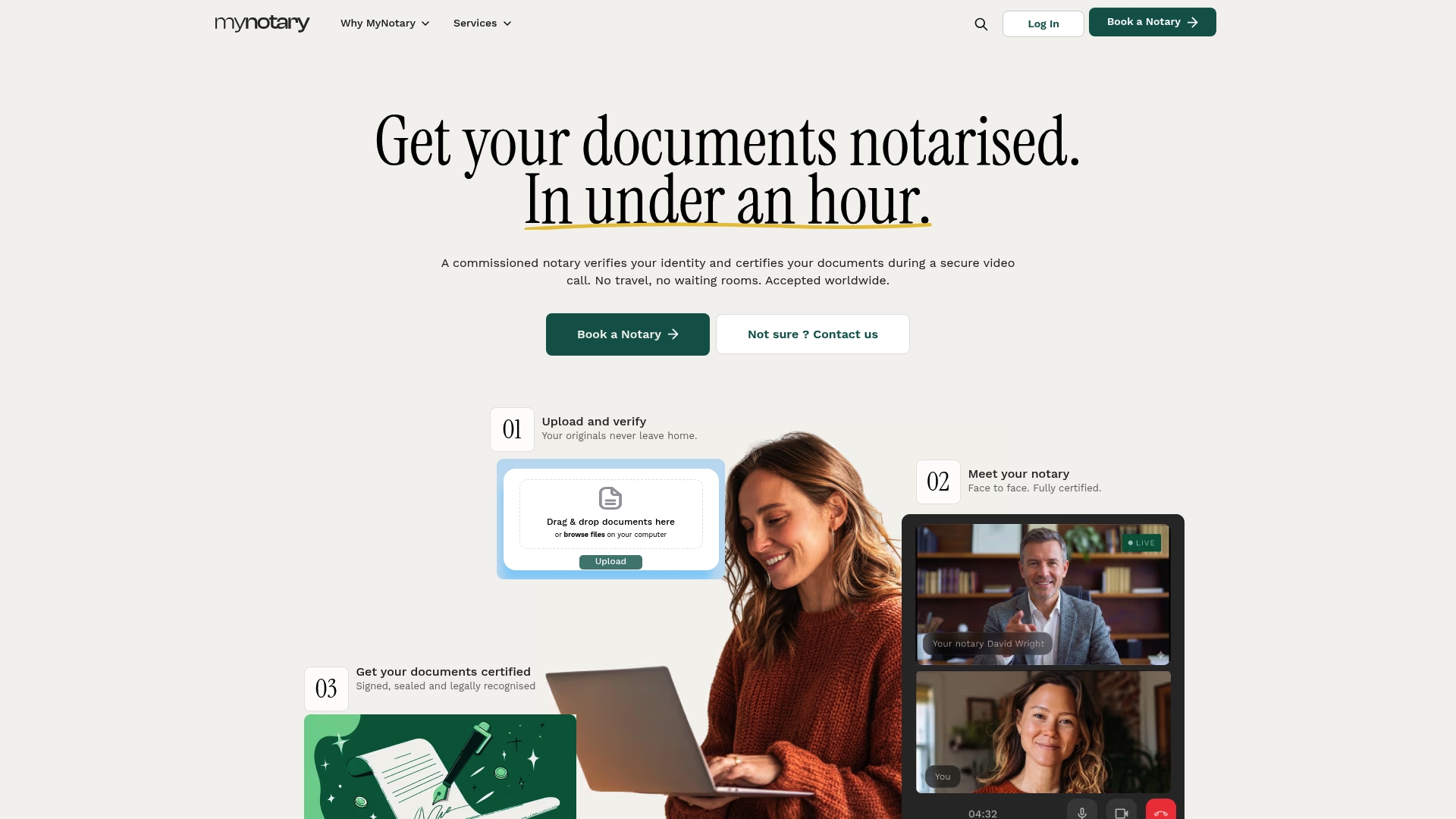
Turnaround averages around one hour, which means you can go from "document not yet certified" to "ready to submit for an apostille" in the same afternoon rather than the same fortnight. This works whether you're heading for the e-Apostille route and need a qualified electronic signature from the outset, or you're preparing an original for the paper route and just need the certification step done fast. If you're dealing with a power of attorney for an overseas bank, a degree certificate for a visa application, or any document that needs a solicitor or notary's signature before the Legalisation Office will touch it, start with online signature notarisation and have your certified document ready to upload the same day.
Where to check the official rules and fees
For anything time-sensitive, go straight to the source rather than relying on secondhand summaries. GOV.UK's legalisation overview and application page cover current fees and eligibility, while documents for British people abroad explains the embassy attestation chain for non-Hague destinations. Once you have your apostille back, the verification service lets any recipient confirm it's genuine in seconds.
FAQ
How long does it take to get an apostille in the UK?
The e-Apostille route is published as up to 2 working days, while the standard paper route takes several working days plus postal transit time. Next-Day and urgent options exist for registered business channels only.
How do I get an apostille on a document in the UK?
Apply through GOV.UK's legalisation service, choosing the paper or e-Apostille route, then either post your original documents by tracked courier or upload a qualified electronically signed PDF.
How do I apply for an apostille in the UK?
Start the application online, select paper or e-Apostille, pay the government fee by card, and follow the instructions for submitting your document, either by post or digital upload depending on the route chosen.
How much does an apostille cost in the UK?
The standard paper apostille costs £45 per document, the e-Apostille costs £35, Next-Day for registered businesses is £40, and the urgent same-day service is £100, all excluding courier or postage charges.
Can My Notary help before I apply for an apostille?
Yes. My Notary provides commissioned notarisation by video call with biometric identity verification, which can produce the qualified electronically signed document needed for the e-Apostille route or speed up certification before posting for the paper route.
Recommended
Got questions? We’re on it.
Most questions are answered here, drawn from what people actually ask before booking. If yours isn’t, our team is in chat.
The e-Apostille route is published as up to 2 working days, while the standard paper route takes several working days plus postal transit time. Next-Day and urgent options exist for registered business channels only.
Last updated: