Same Day Notarisation Online in the UK: How It Works
By Jeremy Arhab, Founder · Published 30 October 2026 · Updated 30 October 2026
Need a document notarised today? See how same day online notarisation works by video call, what to prepare, what can cause delay and when an apostille is needed.
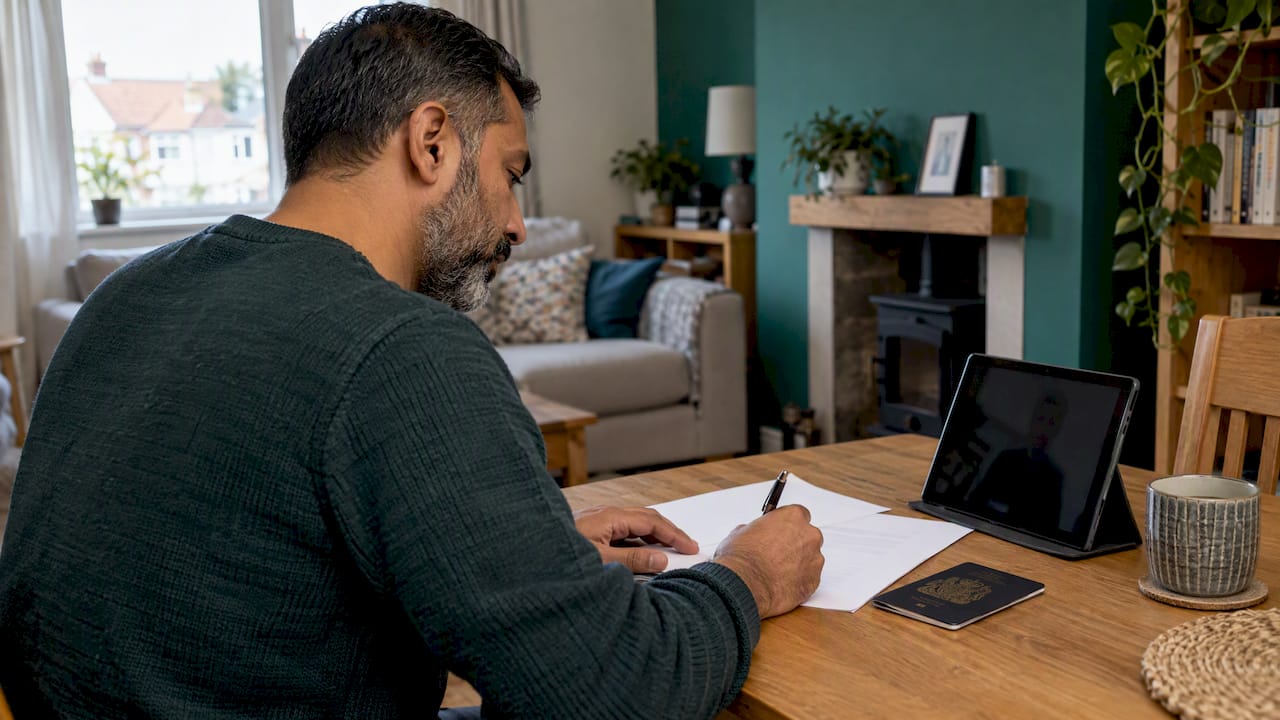
Yes, you can have many documents notarised online on the same day. You upload the document, verify your identity with a passport, meet a commissioned notary on a recorded video call, and receive the notarised PDF the same day. Our own sessions often finish within one hour. Whether the document is then accepted abroad depends on the organisation that receives it, so that check comes first.
This guide explains each stage, what you need ready, what slows things down, and how apostille and translation fit in if the document is going overseas.
TL;DR
- Online notarisation takes place on a video call with a commissioned notary. You show your passport, the notary witnesses the signing and applies a seal.
- Electronic delivery of the notarised document is the same day. Physical copies and apostilles take longer and usually follow on the next working day.
- Upload a clear, unsigned document and keep a valid passport to hand. Most delays come from poor scans, signed documents and unclear instructions from the receiving organisation.
- Always ask the organisation that will receive the document whether it accepts online notarisation. We cannot promise acceptance of any document.
- If the document is for use abroad, decide early whether you also need an apostille or a certified translation.
Table of Contents
- What same day online notarisation means
- The process from upload to delivery
- What to prepare before the appointment
- How long each stage takes
- Which documents people notarise online
- Will the receiving party accept it?
- When you also need an apostille
- Child travel consent, parents and grandparents
- What can slow a same day notarisation
- Our perspective
- Notarise your document with MyNotary
- FAQ
- Sources
What same day online notarisation means
Notarisation is a formal check carried out by a notary. The notary confirms who you are, witnesses your signature or certifies a copy, and adds a seal so that an official or business abroad can rely on the document. Traditionally this meant booking an office, travelling there and waiting for an appointment.
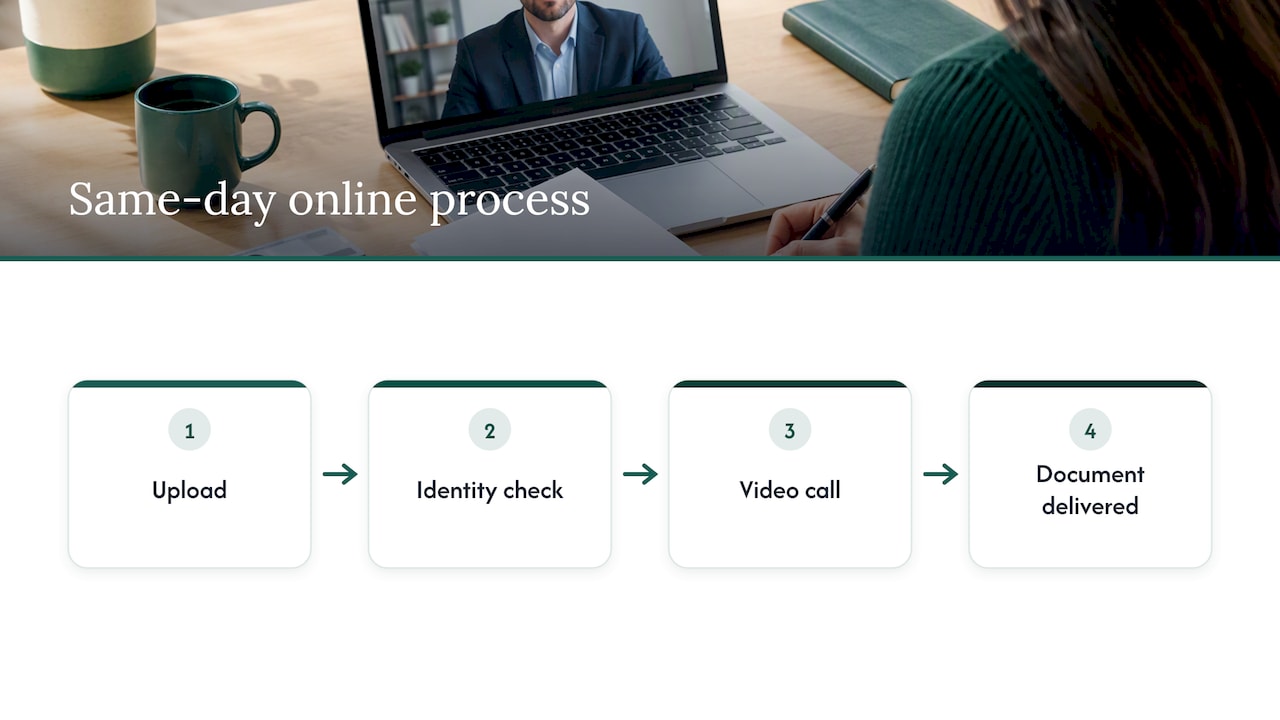
Online notarisation moves the same steps onto a video call. You do not travel and you do not wait for a diary slot. "Same day" describes the whole journey: upload, identity check, call and delivery of the notarised document, all within the same working day.
MyNotary is an online notarisation platform. We are not a law firm and we do not give legal advice. We connect you with a commissioned notary, run the identity verification, record the session and deliver the finished document.
The process from upload to delivery
The flow is the same for most documents. Our guide to how the online notary process works in the UK covers it in more depth, and the steps below are the short version.
- Choose the service. Pick the document type, for example a certified true copy, a signature notarisation or a power of attorney.
- Upload the document. Upload it unsigned. The notary needs to see you sign it, so a document that is already signed usually has to be prepared again.
- Verify your identity. You photograph your passport and complete a biometric match, a comparison of your face with the passport photo.
- Join the video call. The notary checks your passport against your face live, confirms you understand the document and are signing willingly, and watches you sign.
- Notary seal and signature. The notary signs and applies the seal. The session is recorded and kept as an audit trail.
- Delivery. You receive the notarised document as an electronically signed PDF the same day. If you need paper copies or an apostille, these are arranged afterwards.
Why the video call matters
The call is the core of the notarial act. It is where the notary sees you, sees the passport and sees you sign. A scan sent by email cannot do this, which is why a recording and a live check give the receiving party something to rely on.
What to prepare before the appointment
Most of the speed comes from preparation. A short list:
- A valid passport. Identity verification is by passport. Check it is not expired and that the photo page is clean and readable.
- The document, unsigned. A clear PDF or a good quality photograph, with every page visible and no cropped edges.
- A device with a camera and microphone. A phone or laptop with a stable connection is enough. Choose a quiet, well lit room.
- Your instructions from the receiving party. If a university, embassy, bank or employer has told you what wording or format it needs, have that to hand.
- Everyone who must sign. If the document has more than one signatory, each person needs their own passport and their own place on the call.
Our guide to the three conditions for UK online notarisation sets out identity, live signing and the digital identity check in detail. For the background on the identity side, see how KYC works for notarisation.
How long each stage takes
The table shows typical timings. They are guides, not guarantees, and they depend on the document and how quickly you complete each step.
| Stage | Typical timing | What affects it |
|---|---|---|
| Upload and service selection | A few minutes | Scan quality, number of pages |
| Identity verification | A few minutes | Passport condition, lighting |
| Video call with the notary | Often within the hour | Number of signatories, complexity of the document |
| Electronic delivery | Same day | Completing every step before the end of the working day |
| Physical copies | Usually next working day | Courier and destination |
| Apostille | Usually next working day with us, or longer by other routes | Document type and the route used |
The average turnaround for notarised documents on our platform is one hour. Plan for a working day to be safe, particularly if you are in a different time zone or more than one person must sign.
Which documents people notarise online
Our services cover personal, family, business and corporate documents. Common requests include:
- Certified true copies of passports, bank statements and certificates
- Degree and diploma certification, for study and work abroad
- Signature notarisation for contracts and forms
- Powers of attorney
- Proof of residency, proof of life and marital status affidavits
- Certificates of no impediment for marrying abroad
- Child travel consent and parental authority delegation
- Deed poll
- Corporate documents and beneficial owner declarations
- KYC identity verification for banks and regulated firms
- Notarised translation
You can see the full list on our services page. If you are unsure which category fits, choose the closest one and describe what the receiving organisation has asked for. The receiving organisation's wording matters more than the document's title.
Documents that need more than a video call
Some documents come with formalities that go beyond an online appointment, such as wills and certain property transactions. Rules differ by country and by document. A guide to the valid will formalities in Singapore shows how specific local requirements can be, and the same principle applies in any country. Before you book, ask the receiving party or a lawyer in the relevant country whether a video notarisation is enough for that document.
Will the receiving party accept it?
This is the question that decides whether a same day service helps you. A notarised document is only useful if the organisation that receives it is willing to rely on it. We describe what happens in the session: a recorded video call, a passport identity check, an unsigned document, the notary's seal and same day delivery. We do not promise that any particular university, embassy, court, bank or authority will accept the result.
Before booking, ask the receiving party these questions:
- Do you accept a document notarised by video call?
- Do you accept an electronically signed PDF, or do you need a paper original?
- Do you require an apostille or any further legalisation?
- Do you need a certified translation, and into which language?
- Is there specific wording the document must contain?
A written answer is best. Keep it, because it also tells you which add ons to order.
The same logic applies to property and investment. A guide on closing a Houston home from abroad illustrates how the destination country's own rules shape what the buyer must provide. Check the destination's requirements first and notarise second.
When you also need an apostille
An apostille is a certificate that confirms the origin of a public document so that it can be used in another country that is a party to the Hague Apostille Convention. The convention and its member countries are described on the Hague Conference on Private International Law apostille pages. If the destination country is not a party, a different legalisation route usually applies, so check this before ordering.
In practice:
- A notarised document for use in a Hague Convention country often needs an apostille.
- The apostille is a separate step after the notarisation.
- It can add time, so the same day part of the journey usually ends with the notarised document, not the apostille.
We explain the options in our guides to same day apostille in the UK, the e-Apostille and the UK apostille process. If you want to see how online notarisation avoids the longest paper waits, read how to skip up to 25 working days.
When you need a certified translation
If the receiving country works in another language, it will often ask for a certified translation of the notarised document. Order it after the notarisation, so the translation matches the final version. We offer notarised translation as an add on. Confirm the target language and any format requirements with the receiving party first.
Child travel consent, parents and grandparents
Child travel consent is one of the most common reasons people look for a fast notarisation, because the trip is often close.
GOV.UK explains that a grandparent or another adult who is not a parent should carry a letter from the person with parental responsibility, along with contact details, trip details and evidence of their relationship with the child, such as a birth certificate. A letter may be requested at a UK or foreign border. The same page says a separated parent needs permission from others with parental responsibility unless a child arrangements order says the child must live with them, in which case a short trip of up to 28 days is usually possible, unless a court order says otherwise.
This matters for planning. Here is a sensible order of work:
- Agree the trip details with everyone who holds parental responsibility.
- Check the airline, the destination country and the border requirements for any extra wording.
- Prepare the consent as an unsigned document with names, dates, destination and contact numbers.
- Book the notarisation, with each person who must sign joining the call from wherever they are.
- Print the notarised document, or keep the PDF on your phone, and carry the child's birth certificate too.
Multiple signatories do not have to be in the same place. Each person completes their own passport check and joins the same session from their own location. For a separated family, this removes the need for anyone to travel to meet the other parent.
What can slow a same day notarisation
Most delays are avoidable.
- Poor scans. Blurred, cropped or dark pages must be uploaded again.
- Signed documents. The notary must witness the signing, so a pre signed document may need to be redone.
- Passport problems. Expired passports, glare on the photo page or a worn chip area slow verification.
- Late changes from the receiving party. New wording after the call means a new document.
- Missed or late appointments. Join a few minutes early and test your camera.
- Extra steps. Apostille and translation add time after the notarisation.
- Unclear instructions. Without the receiving party's requirements, the document may need a second round.
If timing is tight, start the process as early in the working day as you can, and allow time to correct anything that comes up.
Our perspective
We built MyNotary because the slowest part of notarisation was never the legal check. It was the travelling, the waiting room and the back and forth by email. Taking the same steps onto a recorded video call, with a passport identity check and a notary who watches you sign, keeps the substance and removes the delay.
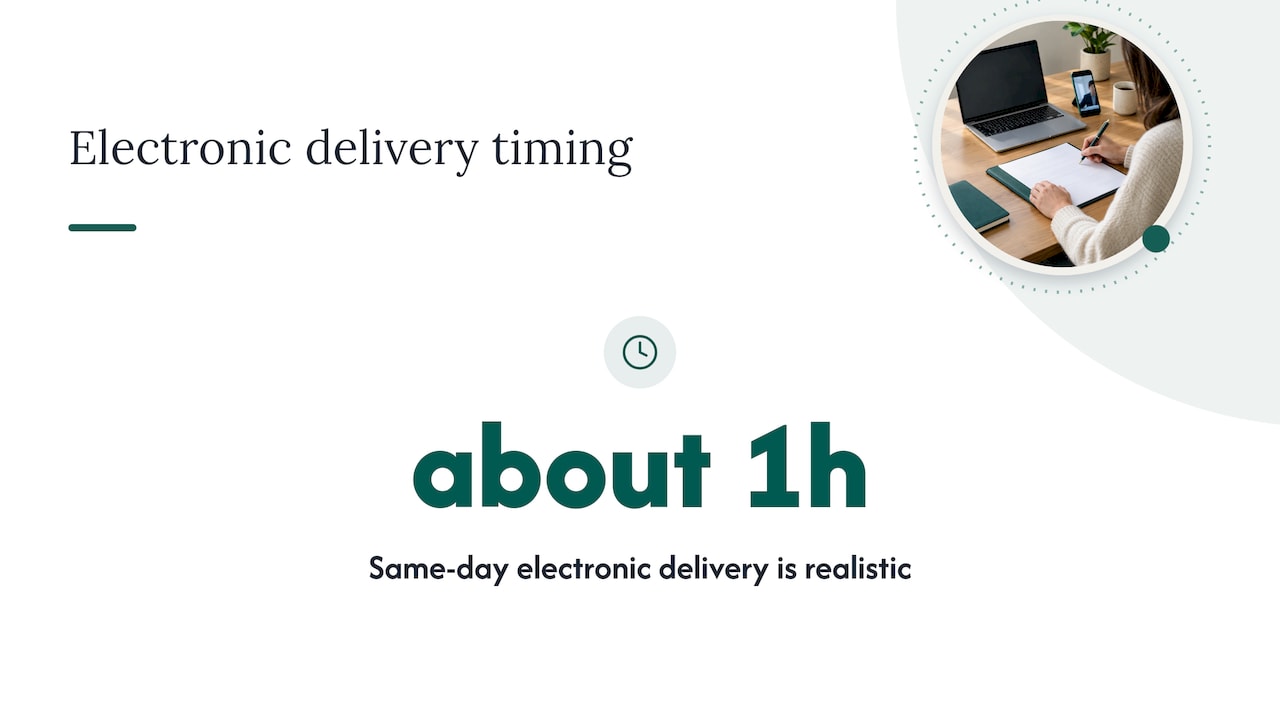
We also think the honest answer to "same day" is a qualified one. Electronic delivery on the same day is realistic and often takes about an hour. The parts that sit outside the call, such as paper copies, an apostille or a translation, depend on other processes. We would rather tell you that at the start than promise a time we cannot control.
The most useful habit we see in customers who finish quickly is simple: they ask the receiving organisation what it needs before they book. That one email saves more time than any feature of our platform.
— Jérémy
Notarise your document with MyNotary
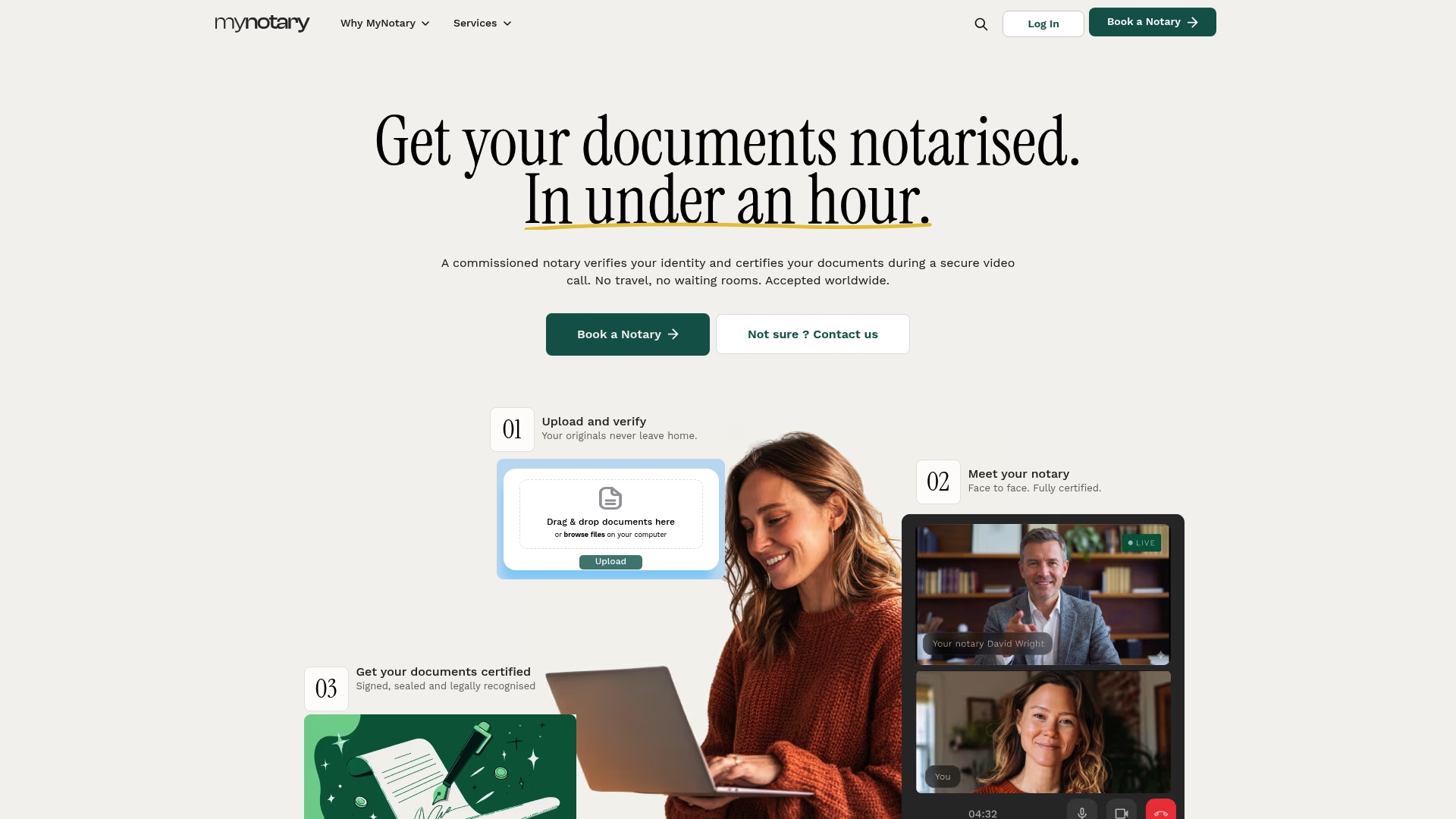
If your document is ready and the receiving party has confirmed what it needs, you can start now. Choose your document type on our services page, upload it, verify your identity with your passport and meet a commissioned notary on video. For signatures on contracts and forms, see online signature notarisation.
We also handle certified copies, degree certification, powers of attorney, corporate documents and notarised translation, with optional apostille. For a wider view of the choices, our overview of online notary services for UK documents explains what online notarisation means for UK users, and our guide to same day notarisation in the UK goes further on timings.
FAQ
Can I really get a document notarised online on the same day?
Yes, in many cases. You upload an unsigned document, verify your identity with your passport and join a video call with a commissioned notary. The notarised PDF is delivered the same day, and our average turnaround is about one hour. Physical copies and apostilles take longer.
Do I need to be in the UK to use the service?
No. You join the call from wherever you are with a camera, a microphone and a valid passport. Check that the organisation receiving the document, in whichever country, accepts online notarisation before you book.
Will my document be accepted abroad?
We cannot promise acceptance, because that decision belongs to the receiving organisation. Ask it whether it accepts a document notarised by video call, whether it needs an apostille and whether it needs a translation. Get the answer in writing if you can.
Can several people sign the same document from different places?
Yes. Each signatory completes their own passport check and joins the same session from their own location. This suits family documents, business contracts and travel consent where parents live apart.
Do I need an apostille as well?
Only if the receiving country or organisation asks for one. Countries that are party to the Hague Apostille Convention commonly use it. Confirm the requirement first, then order the apostille after the notarisation.
Sources
- Hague Conference on Private International Law: Apostille Convention pages
- GOV.UK: Get permission to take a child abroad
- Valid will formalities in Singapore
- Closing a Houston home from abroad
Recommended
Got questions? We’re on it.
Most questions are answered here, drawn from what people actually ask before booking. If yours isn’t, our team is in chat.
Yes, in many cases. You upload an unsigned document, verify your identity with your passport and join a video call with a commissioned notary. The notarised PDF is delivered the same day, and our average turnaround is about one hour. Physical copies and apostilles take longer.
Last updated: