Which Notarised Documents Are Accepted Abroad?
By Jeremy Arhab, Founder · Published 28 October 2026 · Updated 28 October 2026
Learn what makes a notarised document usable in another country, when an apostille or legalisation is needed, and how to check the rules before you book.

A notarised document is accepted abroad when the organisation receiving it agrees that it is in the right form. Acceptance depends on three things: the type of document, the country that will read it, and the extra certification that country asks for. Notarisation alone is enough in some cases. In others you also need an apostille, or a longer chain of legalisation. We cannot promise that any receiving body will accept a document, but we can show you how to find out what it expects before you spend time or money.
TL;DR
- Acceptance is decided by the receiving party abroad, not by the notary. Ask them in writing what they require before you start.
- Countries in the Hague Apostille Convention usually ask for a notarised document plus an apostille. Countries outside it may ask for a longer legalisation chain.
- Documents not in English often need a certified translation as well.
- Online notarisation by video suits many personal and business documents, including affidavits, powers of attorney, certified copies and child travel consent.
- Check the order of steps: notarise first, then apostille, then translate if required, unless the receiving party says otherwise.
Table of Contents
- What "accepted abroad" actually means
- The three levels of certification
- When an apostille is needed
- When legalisation is needed instead
- Which documents commonly need notarisation for use abroad
- Translation requirements
- Country specific examples
- How to check the rules for your destination
- How online notarisation works with us
- Our perspective
- Start your notarisation online
- FAQ
- Sources
What "accepted abroad" actually means
A notary does not decide whether a foreign authority will take your document. A commissioned notary confirms facts: who signed, that the signer's identity was checked, or that a copy matches the original. The foreign university, embassy, bank, court or employer then decides whether that confirmation is enough for its own purpose.
That is why two people with the same document can get different answers. One country may accept a notarised copy of a degree certificate. Another may want the notary's signature itself to be certified by an apostille. A third may want a translation attached. The rule sits with the receiver.
GOV.UK guidance for British people abroad says you should check with the person asking for your document whether it needs legalising and whether it needs certification first, and that using the correct service is your responsibility. That is sound practical advice. Get the requirement in an email or on the organisation's own instructions page, then work backwards from it.
The three levels of certification
Most cross-border document requests fall into one of three levels. Knowing which level you are at saves repeated work.
| Level | What it involves | Typical situation |
|---|---|---|
| 1. Notarisation only | A commissioned notary verifies your identity and witnesses your signature, or certifies a copy | Many employers, landlords, banks and some schools abroad |
| 2. Notarisation plus apostille | The notary's signature is then certified with an apostille under the Hague Convention | Visa files, court filings, company registrations and marriage paperwork in Convention countries |
| 3. Notarisation plus legalisation | A chain of stamps, including the destination country's own consular step | Countries outside the Apostille Convention |
Level 1 is the quickest. Levels 2 and 3 add steps, so it is worth confirming which one you need before the notarisation session, because the notarisation is the base layer everything else sits on.
When an apostille is needed
An apostille is a standard certificate under the Hague Apostille Convention. It confirms that the signature, seal or stamp on a public document is genuine, so the destination country does not need to check it again. It does not confirm that the content of the document is true, and it does not guarantee that the receiving body will accept the document for its purpose.
The Convention covers a large and growing group of states. At the time of the 14th International Forum on the electronic Apostille, the Hague Conference reported 129 Contracting Parties. Because that number changes as countries join, check the current status table on hcch.net for the country you care about. Our own apostille countries list is a good starting point for UK documents.
If you need to understand the mechanics, these guides explain each step:
- How to get an apostille in the UK, step by step
- The UK apostille process
- E-Apostille for UK documents
Paper or electronic apostille
Many Convention countries now accept electronic apostilles, but not all do, and some receiving bodies still ask for paper. Ask the receiver which format it accepts. If you have a choice, an electronic version usually travels faster, and our guide to skipping the long paper wait sets out how the two routes differ in practice.
When legalisation is needed instead
If the destination country is not part of the Convention, an apostille is not the recognised form. GOV.UK describes the usual alternative for those cases: the document is legalised through an embassy route, which involves a stamp from the destination country's embassy in London and approval by its Ministry of Foreign Affairs. The details differ by country, so each embassy's own instructions are the document to follow.
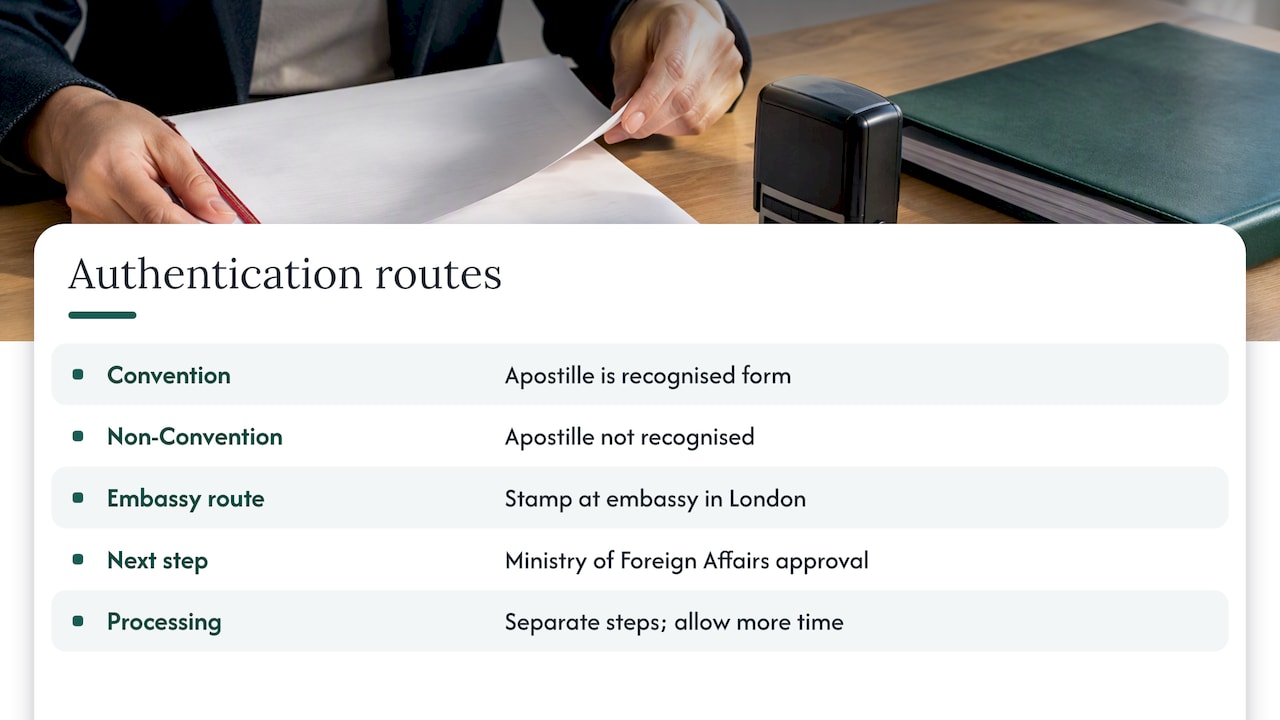
Allow more time for this route. Each stamp is a separate step with its own processing time, and the receiving country may reject a document if the order of steps is wrong.
Which documents commonly need notarisation for use abroad
The documents below are the ones we see most often. Whether a particular one needs notarisation depends on the country and the receiving body.
Personal and family documents
- Child travel consent. Used when a child travels with one parent, a grandparent or another adult. Airlines, border staff or the destination country may ask for written consent. See our Child Travel Consent service.
- Parental authority delegation. Used when parents are separated or abroad and want another adult to act for a child.
- Marital status affidavit and certificate of no impediment. Often requested by a foreign authority before a marriage abroad. Milton Keynes City Council notes that requirements differ by country and advises contacting the destination country's government to find out what is needed.
- Proof of life. Asked for by overseas pension providers to confirm the pensioner is alive.
- Deed poll. Used to evidence a change of name with banks and overseas institutions.
- Proof of residency and statutory declarations. Used for visa, banking and tax matters.
Education and professional documents
- Degree and diploma certified copies. Requested by foreign universities, regulators and employers. See our degree certification for visa applications and certified diploma for international use.
- Professional certificates. Often needed for licensing abroad. See certified copies of professional certificates.
- DBS certificates. Some overseas employers ask for a certified copy, which you can arrange through our certified copy of a DBS certificate service.
Business and financial documents
- Powers of attorney. Used to let someone act for you abroad. Our guide to the apostille for a power of attorney covers the sequence.
- Corporate documents. Board resolutions, incorporation papers and signatory lists, handled through corporate document notarisation.
- Beneficial owner declarations and KYC verification. Required by banks and regulated firms. See KYC identity verification.
- Bank statements. A notarised copy of a bank statement is a common request for visas and overseas accounts.
Court documents such as a divorce decree follow their own route. Our guide on the divorce decree apostille explains it.
Translation requirements
If the receiving country reads another language, it may want a translation attached. Some authorities also set rules for the translator. Milton Keynes City Council, for one marriage related service, asks that a document not in English comes with a full English translation certified as true, with the translator's name, address, telephone number and signature. That is a UK example, but it shows the type of detail receivers look for.
When the destination language is not English, ask early which language is required, whether the translation must be notarised, and whether the apostille should cover the original, the translation or both. We offer a notarised translation service so the translation can be certified at the same time.
Country specific examples
Rules are never identical across borders. Two guides on our site show how much the details can vary:
- UK documents for Canada covers differences between provinces and the choice between paper and electronic apostille.
- UK documents for China covers preparing documents for Chinese authorities.
If your country is not covered, the approach is the same: find the receiving body's written requirement first, and then match each step to it.
How to check the rules for your destination
Follow this order. It works for most countries.
- Ask the receiver. Contact the university, employer, bank, court or authority. Ask for the document type, whether it must be an original or a certified copy, and whether notarisation, an apostille or legalisation is required.
- Check the country's status. See whether the country is in the Hague Apostille Convention using the status table on hcch.net.
- Read the embassy's page. For countries outside the Convention, the embassy or consulate in London usually publishes its own legalisation instructions.
- Confirm format and language. Ask about paper versus electronic, original versus copy, and translation.
- Confirm the order. Notarise first, then apostille or legalise, then translate if the receiver wants it, unless they say otherwise.
- Keep the documents consistent. Names, dates and spellings should match your passport and the underlying records.
British embassies and consulates abroad are not an easy alternative. GOV.UK says they offer limited notarial services and generally cannot legalise documents, and advises seeking local notaries or lawyers where you live. If you are outside the UK and need a UK document prepared, our guide to preparing documents for a UK apostille from abroad explains how a video session can replace travel.
How online notarisation works with us
MyNotary is an online notarisation platform. We are not a law firm. We connect you with a commissioned notary by video call, and the process is straightforward.
- Upload your unsigned document. Do not sign it beforehand.
- Verify your identity using your passport, with biometric checks.
- Join a recorded video session with a commissioned notary.
- Sign during the session, where the notary can see you do it.
- The notary adds their seal and your document is returned to you, with same day delivery for most documents.
The session is recorded and the platform keeps an audit trail. If the document needs an apostille or translation afterwards, we can help you plan those steps. The service runs from home or from abroad, which suits expats, freelancers with international contracts and families arranging travel consent.
Documents with several signatories
If several people sign from different places, each person needs their own identity check and session. For electronic signatures, a signing platform can set an order and circulate the document in turn, and a certificate is produced for the sender, as a law firm's guide to signing options explains. The same guide notes that where a deed needs a witness, the witness must be physically present, because witnessing cannot be done by video call. Check the form your document takes before you plan the sessions.
Another point for cross border signing is identity assurance. Firms handling international clients apply the same logic, as in this piece on overseas buyer AML checks, where verifying a person who is not in the room is central. A passport check with biometrics serves the same purpose in a notarisation.
Our perspective
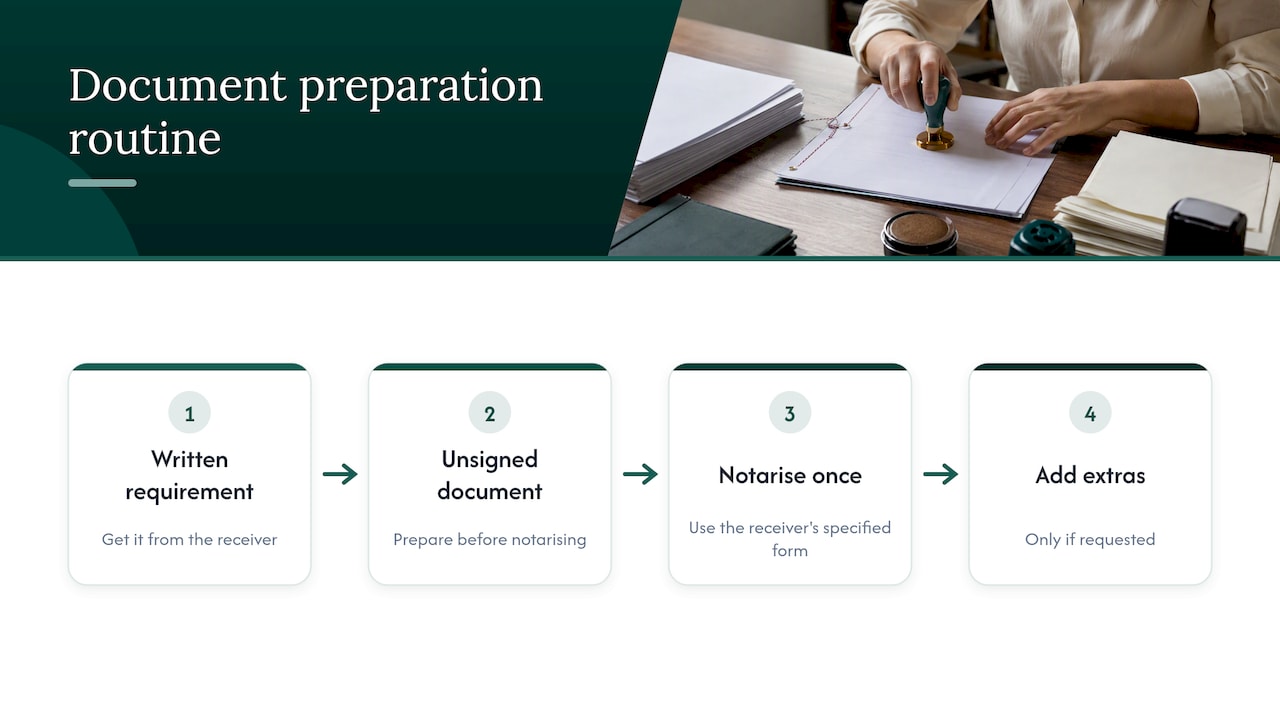
The most common problem we see is not a bad document. It is a document prepared before anyone asked the receiver what it needed. People notarise a copy when the receiver wanted the original signed, or get an apostille when the receiving country does not use one.
So we suggest a short routine. Get the requirement in writing. Prepare the document unsigned. Notarise it once, in the form the receiver described. Then add the apostille or translation only if it was asked for. Online notarisation helps because it removes the travel and waiting, which leaves more time for those checks. We describe the facts of the session plainly: video, a recorded session, passport verification, an unsigned document, the notary's seal, same day delivery. We do not promise acceptance, because that is the receiver's decision.
— Jérémy
Start your notarisation online
If you know what the receiver asked for, you can book a session for a certified copy, affidavit, power of attorney, child travel consent, statutory declaration or corporate document. Our full list of services is on the MyNotary services page, and you can also use online signature notarisation when only your signature needs to be certified. If you are unsure which service matches your request, send us the receiver's instructions and we will tell you which document fits.
FAQ
Is a notarised document automatically accepted in other countries?
No. The foreign organisation decides whether the document meets its own requirements. Some accept notarisation alone, while others also ask for an apostille, legalisation or a translation. Ask the receiver for its requirements in writing before you start.
Do I need an apostille as well as notarisation?
Only if the receiving country or organisation asks for one. Countries in the Hague Apostille Convention commonly use it, and the Convention had 129 Contracting Parties at the time of a recent HCCH forum. For other countries, legalisation through the embassy may apply instead.
Can I notarise a document by video call for use abroad?
Many documents can be notarised by video, including affidavits, certified copies and powers of attorney. Our session uses passport verification, a recorded call and an unsigned document. A deed that needs a witness may need that witness to be physically present, so check the form of your document first.
Does a translation need to be notarised?
Some receivers require it and some do not. Where an authority sets rules, it may ask for a translation certified as true, with the translator's details and signature. Ask the receiver whether the translation, the original or both need certification.
Can a British embassy abroad notarise or legalise my document?
Usually not. GOV.UK says embassies and consulates offer limited notarial services and generally cannot legalise documents. The advice is to use local notaries or lawyers where you live, or to prepare the document before you travel.
Sources
- Documents for British people abroad, GOV.UK
- 14th International Forum on the electronic Apostille, HCCH
- Getting married abroad: certificate of no impediment, Milton Keynes City Council
- What are my options for signing documents?, Russell-Cooke
Recommended
Got questions? We’re on it.
Most questions are answered here, drawn from what people actually ask before booking. If yours isn’t, our team is in chat.
No. The foreign organisation decides whether the document meets its own requirements. Some accept notarisation alone, while others also ask for an apostille, legalisation or a translation. Ask the receiver for its requirements in writing before you start.
Last updated: