Notarial Act Types in the UK: What Each One Is For
By Jeremy Arhab, Founder · Published 23 October 2026 · Updated 23 October 2026
A plain guide to the main types of notarial act in the UK: affidavits, certified copies, powers of attorney, declarations, and when an apostille follows.

A notarial act is a formal step in which a commissioned notary confirms who signed a document, that the signing really took place, or that a copy matches its original. In the UK, the acts people ask for most often are the certified true copy, the affidavit, the statutory declaration, the power of attorney, the signature notarisation, and the identity or status declaration. Most of them exist so that a document made here can be used abroad.
This guide explains each type in plain language, shows how they differ, and sets out what usually happens after the notarial act, including the apostille. It also covers which acts can be done online by video call.
TL;DR
- A notarial act is a notary's formal confirmation of a signature, an identity, a statement or a copy. It is usually needed when a document will be used outside the UK.
- The main types are certified true copies, affidavits, statutory declarations, powers of attorney, signature notarisation, status declarations and corporate documents.
- An apostille is a separate step. Under the Hague Convention it confirms the origin of a public document, not what the document says.
- Always ask the organisation requesting your document exactly which act, wording and extra steps it requires before you start.
- Many of these acts can be done by video call with a commissioned notary through MyNotary, with passport based identity checks and delivery on the same day.
Table of Contents
- What a notarial act is, and what it is not
- The main types of notarial act
- Quick comparison of the main acts
- Notarial act, certification and apostille: three different steps
- How to choose the right act
- Doing a notarial act online
- Our view on choosing a notarial act
- Start your notarisation online
- Practical tips before you book
- FAQ
- Sources
What a notarial act is, and what it is not
A notary is a type of lawyer who confirms that legal documents are authentic. GOV.UK explains that this is known as notarising a document. The notary does not draft your legal rights or judge whether your document is wise. The notary confirms facts about the formalities: who you are, that you signed in their presence, that you made your statement knowingly, or that a copy is a true copy.
Three features separate a notarial act from an ordinary signature or a casual certification:
- Identity is checked. The notary confirms the person in front of them is the person named in the document.
- A record is made. The act is dated and signed, and it carries the notary's seal.
- The document is built for use elsewhere. Foreign courts, banks, registries and consulates often ask for a notarial act because they cannot check a UK signature themselves.
Certifying a document is a related but lighter idea. GOV.UK describes certification as getting a copy signed and dated by a professional to confirm it is a true copy of the original. Many routine requests, such as a bank account application, only need that. A full notarial act is a different product, with the notary's own seal, and it is what many overseas bodies ask for.
The main types of notarial act
The list below covers the acts people request most often. The names vary slightly between providers, but the underlying purpose stays the same.
Certified true copy
The notary sees your original document, compares it with the copy, and certifies that the copy is a true reproduction. Typical documents are passports, bank statements, birth and marriage certificates, and company records.
This act is common for visa files, banking, school applications abroad and overseas employment. If your destination asks for a copy certified by a notary rather than by any professional, this is the act you need. For bank statements, a dedicated page covers a notarised copy of a bank statement.
Degree, diploma and qualification certification
This is a certified true copy of an educational or professional certificate. It is widely used for visa applications, professional registration and job offers abroad. Because universities issue the originals, the notary certifies the copy, not the qualification itself.
If you need this for work or migration, see the pages on a certified diploma for international use and degree certification for a visa application.
Affidavit
An affidavit is a written statement of facts that you swear or affirm to be true. The notary checks your identity, makes sure you understand what you are declaring, and witnesses you swearing or affirming it.
People use affidavits for many reasons, including confirming a name change, a family relationship, a lost document or a financial position. The act confirms that you made the statement formally. It does not prove that the facts in it are correct.
Statutory declaration
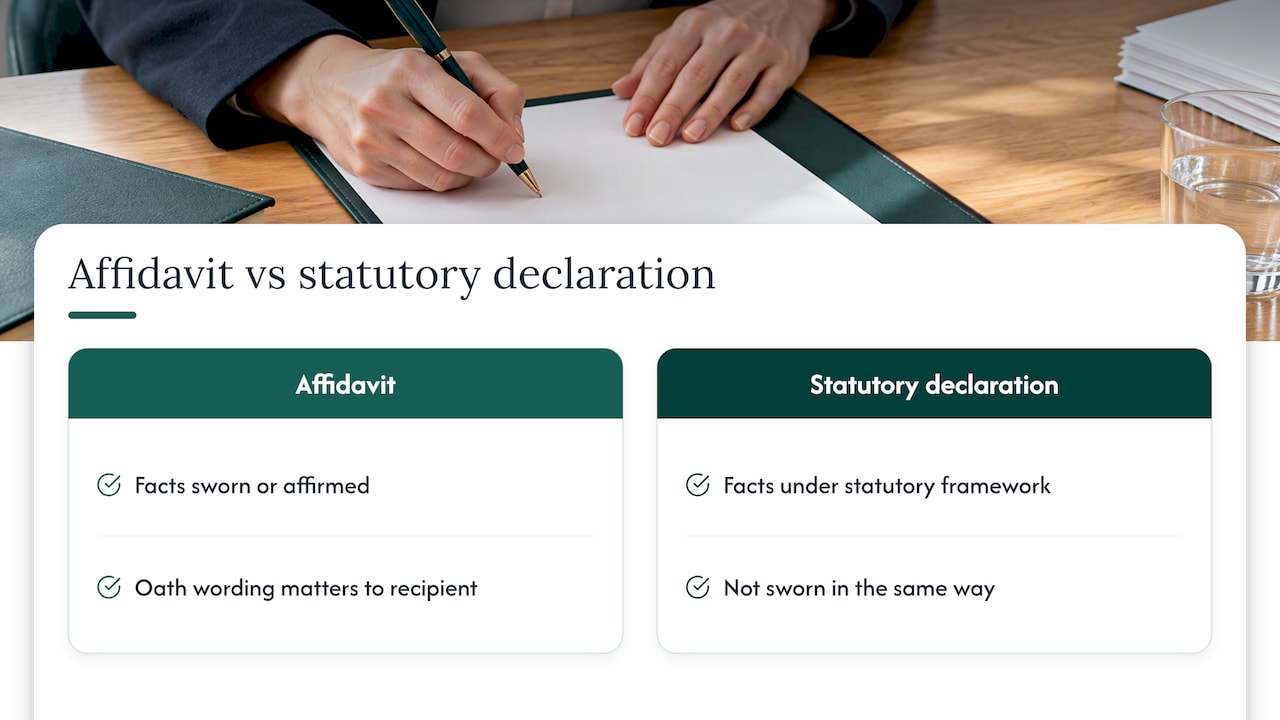
A statutory declaration is close to an affidavit. It is a formal written statement of facts, made under a statutory framework rather than sworn in the same way. In practice, requesting bodies often name one or the other, so check which term appears in the instructions you were given.
The practical difference for you is small. The wording and the form of the oath matter to the receiving organisation, so ask which it wants before the session.
Power of attorney
A power of attorney lets another person act for you, for example to sell property, manage a bank account or handle a legal matter in another country. For use abroad, the document is usually signed in front of a notary, who confirms your identity and that you signed it freely.
This is one of the documents where the next step often matters most. Foreign authorities frequently ask for an apostille on top of the notarial act. There is a separate walkthrough on the apostille for a power of attorney.
Signature notarisation
This is the simplest form of notarial act. You sign a document, and the notary confirms that the signature is yours and that you are who you say you are. It suits contracts, letters, consent forms and agreements that already exist in final form.
Freelancers with international clients often use this act to give a contract more weight with an overseas counterparty. Details are on the page for signature notarisation online.
Status and personal declarations
Several acts confirm a personal situation, usually for a foreign registry or immigration authority:
- Marital status affidavit
- Certificate of no impediment, used when marrying abroad
- Proof of life, often requested by overseas pension providers
- Proof of residency
- Deed poll, which records a change of name
Each one is a formal statement, made in front of the notary after an identity check. The receiving body decides the exact wording, so bring the template or instructions it provided.
Family and child travel documents
Parents and grandparents often need notarised paperwork when a child travels or lives abroad:
- Child travel consent: written permission from a parent for a child to travel, often with another adult.
- Parental authority delegation: a parent gives another adult defined authority over a child for a period.
These matter most for separated or divorced parents and for grandparents travelling with grandchildren, where an airline, border official or school may ask for proof of consent. Requirements differ between countries and carriers, so check the rules of your destination and your airline before booking a session.
Corporate and business documents
Businesses use notarial acts for board resolutions, company extracts, beneficial owner declarations, and documents signed by several directors or shareholders. A beneficial owner declaration states who ultimately owns or controls a company. The notary confirms the signatories' identities and the signing.
Multi signatory documents are common here, with people in different cities or countries. The page on corporate document notarisation explains how that works.
KYC identity verification
Banks and regulated firms abroad sometimes ask for a notarised identity form as part of anti money laundering checks. The notary verifies your identity against your passport and records the check on the form. See KYC identity verification with a notary.
Notarised translation
When a document is going to a country that works in another language, a certified translation is often attached to the notarised document. The two steps can be handled together, which avoids sending papers between several suppliers. There is more in the article on translation, notarisation and apostille online.
Quick comparison of the main acts
| Act | What the notary confirms | Typical use |
|---|---|---|
| Certified true copy | The copy matches the original seen | Visas, banking, study abroad |
| Signature notarisation | The signature is yours and your identity is verified | Contracts, consent forms |
| Affidavit | You swore or affirmed a statement of facts | Name, family or financial facts |
| Statutory declaration | You made a formal statutory statement | Status, residence, identity facts |
| Power of attorney | You signed the document freely and identity is verified | Property, banking, legal matters abroad |
| Corporate documents | Signatories and signing are verified | Company filings, resolutions |
| Child travel consent | A parent signed formal consent | Travel, residence, school |
Notarial act, certification and apostille: three different steps
People often merge these into one. They are separate.
- Certification. A professional of good standing signs a statement that a copy is a true copy. Lighter, and enough for many domestic requests.
- Notarial act. A commissioned notary verifies identity and applies a seal. This is the version many overseas bodies ask for.
- Apostille. A further certificate, issued under the Hague Convention, that confirms the authenticity of the signature, seal or stamp on a public document.
The Hague Conference explains that the Apostille Convention replaces the older, longer legalisation chain with a single certificate called an apostille. It applies between countries that are parties to the Convention. For a country outside it, further legalisation steps, such as embassy stamps, may be needed.
One point causes most misunderstandings. An apostille confirms where a public document comes from. It does not confirm that the contents are true. The same applies to a notarial act: the notary confirms formalities, not the facts you state.
For the steps in detail, read our guides on how to get an apostille in the UK and the UK apostille process. If you need to check a certificate you received, see how to verify an apostille.
How to choose the right act
Work through these questions in order.
- Ask the requesting body. Which act does it want, which wording, and in what language? GOV.UK guidance stresses confirming what the authority asking for the document requires.
- Check the destination country. Is it a party to the Hague Convention? If so, an apostille may be the final step. If not, ask about further legalisation.
- Decide on the document type. A copy needs a certified true copy. A statement needs an affidavit or declaration. Signing authority for someone else needs a power of attorney.
- Check for electronic acceptance. Some bodies accept an electronically signed PDF. Others want paper. Ask before you book.
- Plan for translation. If the receiving country needs another language, arrange it alongside the notarial act.
A document sent with the wrong act is the usual cause of delays, and fixing it means starting again. A short email to the requesting body at the start saves time later.
Doing a notarial act online
UK law gives electronic signatures legal effect. The retained text of Article 25 of the eIDAS Regulation states that an electronic signature cannot be denied legal effect or admissibility as evidence in proceedings only because it is electronic. The Electronic Signatures Regulations 2002 also form part of the framework.
That is the legal background. Whether your destination accepts an electronically signed, online notarised document is a separate question, and it depends on the receiving body and country. We cover this in more depth in what the 2000 Act does not guarantee. Always confirm acceptance with the recipient first.
What happens in a MyNotary session
The process is the same for most document types:
- You upload your document or choose a template on the platform.
- You verify your identity with your passport, using biometric checks.
- You join a video call with a commissioned notary. The session is recorded.
- You sign during the call, or the notary confirms your signature on the unsigned document.
- The notary applies their seal, and the certified document is delivered, usually on the same day.
The average turnaround for notarised documents on the platform is one hour. If an apostille or translation is needed afterwards, you can order it as an add on. For documents issued abroad, see our guide to US documents for UK use.
Our view on choosing a notarial act
We see the same pattern in nearly every enquiry. People arrive knowing they need a document notarised, but not which act. The requesting body has often given them a vague instruction, such as a notarised copy, or a name for the act that differs from how it is described here.
Our advice is to read the instruction twice, then ask one precise question: which act, which wording, and which further step. Most of the delays we see come from that single gap, not from the session itself.
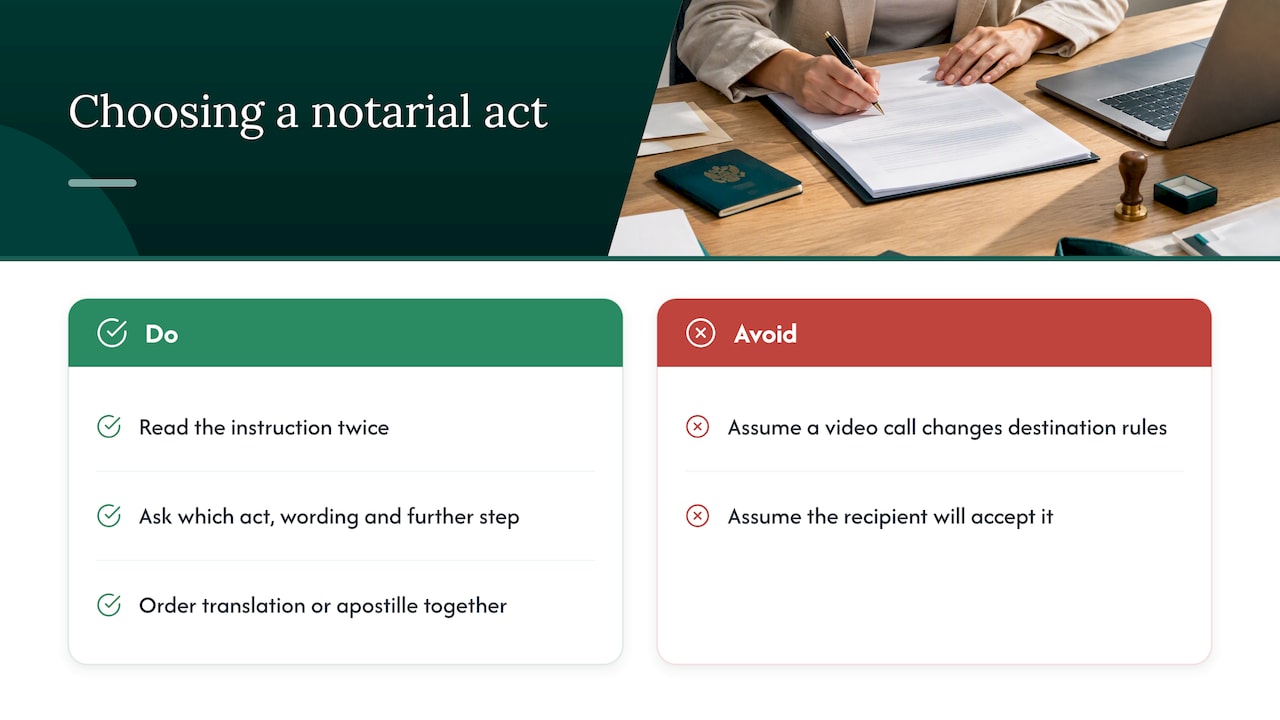
A video call removes the travel and the waiting room. It does not change the rules of the destination. We describe what happens in the session as it is: a recorded video call, a passport based identity check, an unsigned document, the notary's seal and same day delivery. We do not promise that any document will be accepted, because acceptance is decided by the body that receives it.
We also suggest bundling steps. If you know you will need a translation or an apostille, order them together, so the notarised document and its follow on steps stay consistent.
— Jérémy
Start your notarisation online
If you already know which act you need, you can see all our notarisation services, from certified true copies and affidavits to powers of attorney and corporate documents. You upload the document, verify your passport, and meet a commissioned notary by video. If you are unsure which act applies, contact our team through the main site with the instruction you received, and we will help you match it to the right service.
Practical tips before you book
- Use the original. For copies, you need the original document in front of you during the session.
- Keep the passport valid. The identity check relies on your passport.
- Do not sign early. If the act requires signing in front of the notary, leave the document unsigned until the call.
- Keep names consistent. The name on your passport, the document and the requesting form should match.
- Check dates. Some bodies reject documents older than a set number of months, so ask.
- Ask about delivery. Confirm whether the recipient needs a digital copy, a paper copy or both.
For divorce documents, there is a worked example in the divorce decree apostille guide. If you are in another country and need a UK document prepared, read about preparing documents by video from abroad.
FAQ
Is a certified copy the same as a notarised copy?
No. A certified copy is signed and dated by a professional to confirm it is a true copy, as GOV.UK explains. A notarised copy carries the commissioned notary's seal and an identity check, which many overseas bodies ask for. Check which one the requesting organisation wants.
Do I need an apostille after every notarial act?
No. An apostille is only needed when the receiving country or body asks for one. It applies to countries that are parties to the Hague Convention, as the Hague Conference explains. Confirm the requirement before you order it.
Can I notarise a document by video call?
Yes, in the way we provide it: a recorded video session with a commissioned notary, after a passport based identity check. Whether the receiving country accepts an online notarised document is decided by that country or body, so ask them first.
What is the difference between an affidavit and a statutory declaration?
Both are formal written statements of fact. An affidavit is sworn or affirmed, while a statutory declaration is made under a statutory framework. Use whichever term the requesting body names.
How long does it take?
The average turnaround on our platform is one hour for notarised documents. Apostille and translation add time, depending on the service you choose.
Sources
- Find a notary abroad, GOV.UK
- Certifying a document, GOV.UK
- Apostille Convention FAQ, Hague Conference on Private International Law
- Regulation (EU) No 910/2014, Article 25, legislation.gov.uk
- The Electronic Signatures Regulations 2002, legislation.gov.uk
Recommended
Got questions? We’re on it.
Most questions are answered here, drawn from what people actually ask before booking. If yours isn’t, our team is in chat.
No. A certified copy is signed and dated by a professional to confirm it is a true copy, as GOV.UK explains. A notarised copy carries the commissioned notary's seal and an identity check, which many overseas bodies ask for. Check which one the requesting organisation wants.
Last updated: