Online Notary for Real Estate: What Can Be Done Remotely
By Jeremy Arhab, Founder · Published 27 October 2026 · Updated 27 October 2026
Which property documents can be notarised by video call, what still needs a witness in person, and how to prepare for apostille, translation and overseas buyers.
An online notary can notarise many property related documents by video call. These include powers of attorney for a sale or purchase, signature notarisations, certified copies of ID and proof of address, declarations and company documents. An online notary cannot replace a witness who must be physically present, as the signing of a deed in England and Wales requires. This guide explains where the line sits, how a session works, and how to prepare so that your documents reach the other side of the transaction in good order.
MyNotary is an online notarisation platform. We are not a law firm and we do not give legal advice. A commissioned notary conducts each session by video, and we describe below what happens in it.
TL;DR
- Online notarisation suits property paperwork that is notarised for use abroad or for identity and authority purposes: powers of attorney, declarations, certified copies, signature notarisation and company documents.
- A deed that needs a witness in the room still needs that witness in person. A video link does not change this.
- Ask the recipient (buyer, lender, overseas registry or lawyer abroad) what they require before you book. Acceptance is decided by the receiving party and its law.
- Many destination countries also require an apostille under the Hague Convention. Check the status of the country first.
- Prepare a passport, the unsigned document and your signatories' details. Do not sign before the session.
Table of Contents
- What an online notary does for property documents
- What a video notarisation does not change
- Where online notarisation fits best
- How an online notarisation works, step by step
- Identity checks and what you should have ready
- Apostille and legalisation for property abroad
- Translation: before or after the notary?
- What can delay or stop a property notarisation
- How to check that the recipient will accept it
- Our perspective
- Book an online notarisation for your property documents
- FAQ
- Sources
What an online notary does for property documents
A notary does not decide whether a property transaction is sound. A notary confirms facts about a document and the people behind it: who signed, that they signed knowingly, and that the signature is theirs. In property matters that is useful because a buyer, a bank or a registry in another country often wants a sealed record that a real, identified person executed the paperwork.
With online notarisation the same steps happen over a video call. The notary sees you and your passport, you confirm the document in front of them, and the notary completes the notarial certificate and seal. The session is recorded, which gives a record of what took place.
In practice, the property documents most often brought to an online notary are these:
- Power of attorney so that a relative or agent can sell, buy or manage a property on your behalf.
- Signature notarisation for a document that the other party wants to see signed in front of a notary.
- Certified true copies of a passport, a bank statement or a utility bill used as proof of identity or address.
- Statutory declarations and affidavits that support a transaction, such as a declaration about marital status or the source of funds.
- Corporate documents when a company buys, sells or lets property, including beneficial owner declarations.
What a video notarisation does not change
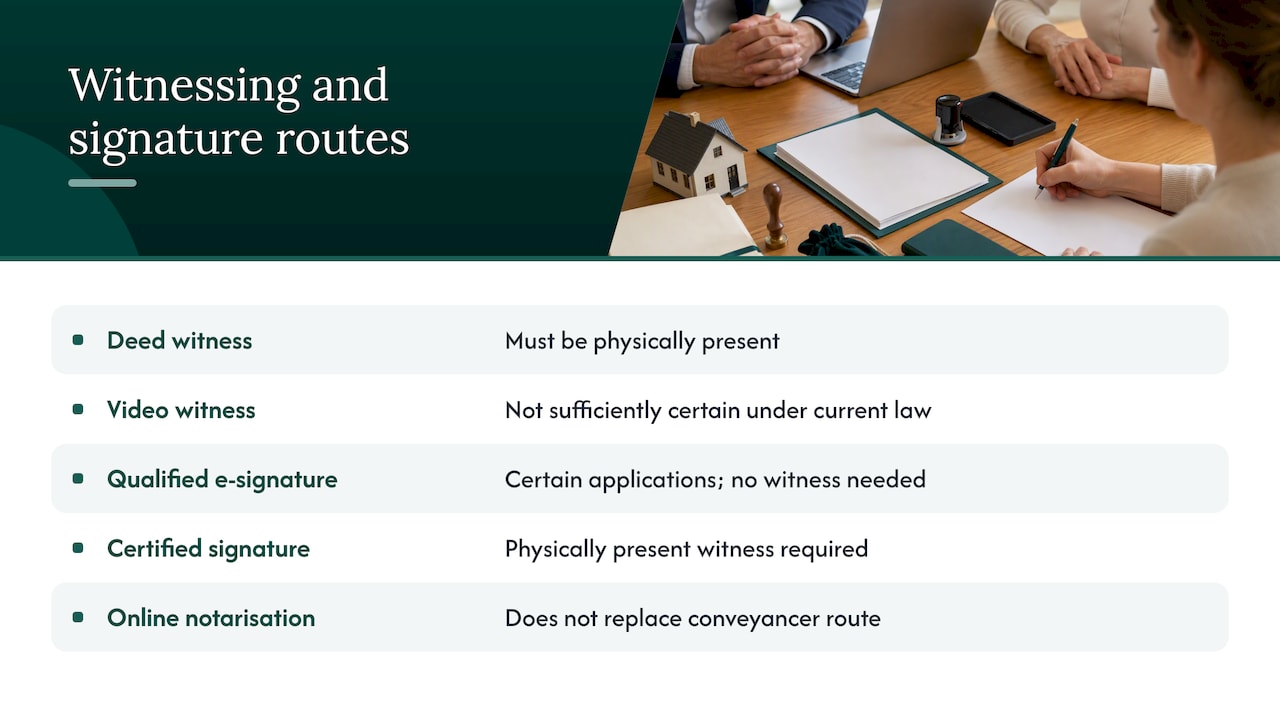
The law of England and Wales sets formalities for some documents, and electronic signatures do not remove them. The Law Society states that a witness to a deed must be physically present with the signatory, and that witnessing by video link is not sufficiently certain under current law. So you should not assume that a remote witness makes a deed valid.
This matters if you are buying or selling a home in England or Wales. The transfer deed, a mortgage deed or a lease usually runs through the conveyancer handling the transaction. Your conveyancer decides how it is executed and witnessed. An online notarisation is not a substitute for that route, and we would not suggest that it is.
HM Land Registry has widened what it accepts in recent years. Its 2025 blog explains that Qualified Electronic Signatures can be used for certain applications, including transfers, charges and assents, and that no witness is needed for such a signature because the signatory's identity is verified beforehand. Its practice guide on electronic signatures accepted by HM Land Registry also covers conveyancer certified signatures that need a physically present witness. These routes are run by the conveyancers on the transaction, not by a notarisation platform. If you are unsure which applies, ask your conveyancer.
Where online notarisation fits best
There are three common situations in which the video route saves real time.
You live abroad and own or are buying property in the UK
An expat often needs to prove identity or authority from another country. A power of attorney or a signature notarisation done on a video call spares you a trip to a notary near you, which in some countries means days of travel or a long wait. HM Land Registry's guidance on completing forms ID1 and ID2 says that if a person lives overseas and cannot be verified by a UK conveyancer, certain sections must be completed by a lawyer or notary qualified in that person's country of residence. Read that guidance with your conveyancer before deciding whether a video session can play any part.
You live in the UK and the property is abroad
This is the case where online notarisation is most useful. A foreign registry, bank or lawyer may ask for a power of attorney, a certified copy of your passport or a declaration signed before a notary. Whether they accept a notarisation done by video depends on their law. Ask them first, in writing, and keep their answer.
On a remote closing, the same logic applies in other countries. For example, this explanation of remote closing in Texas shows how a US state sets its own rules for remote property closings, which is a reminder that the receiving jurisdiction's rules come first.
Several people sign from different places
Couples, co-owners, family members and company directors are often in different cities or countries. Each signatory can join their own session from their own location. This avoids sending one paper original around the world. For company documents, one signatory can sign and the next can add a signature to the same document in sequence. The Law Society explains that company signatories can sign in counterpart or add signatures to the same version in some cases, so check the right method for your document.
How an online notarisation works, step by step
- Choose the service. Pick the document type, for example signature notarisation, power of attorney or certified copy. The services page lists all of them.
- Upload the document. Upload it unsigned. The notary needs to see you sign during the session.
- Verify your identity. You show your passport, and the platform runs a biometric check against it.
- Join the video call. A commissioned notary speaks to you, confirms who you are and asks you to confirm the document and its purpose.
- Sign in the session. You sign while the notary watches. The session is recorded.
- Receive your document. The notary applies the seal and issues the notarised document. Delivery is on the same day.
The notary can decline to proceed. If they cannot identify you to a high standard, or if they are not satisfied that you understand what you are signing and that you act freely, they will stop. That is a protection for you as much as for the recipient.
How long it takes
| Stage | What happens | Typical time |
|---|---|---|
| Preparation | Upload the document and choose the service | A few minutes |
| Identity check | Passport and biometric verification | A few minutes |
| Video session | Notary confirms identity, you sign | A short call |
| Delivery | Sealed digital document, optional paper copy | Same day for the digital version |
Times depend on the document and on the number of signatories. A multi signatory document takes longer than a single signature.
Identity checks and what you should have ready
A property transaction involves money, so identity checks are strict everywhere. Have these ready before you join:
- A valid passport for each signatory.
- The document in its final, unsigned form.
- The full names exactly as they appear on the property title or contract.
- The name and address of the recipient, if the document names one.
- A quiet place with a good connection and a working camera.
If you also need to prove identity to HM Land Registry, a notarisation is a different thing from its own forms. Its Form ID1 is required for specified transactions where the person is not represented by a conveyancer or the conveyancer cannot confirm identity, and each individual completes a separate form. The form also sets rules on photographs and on how recently it was signed. Read the current version before you start, as forms are updated.
For money laundering checks on a corporate buyer or seller, our KYC identity verification service produces a notarised identity record that a company, bank or agent can ask for.
Apostille and legalisation for property abroad
If your document is going to another country, that country may require an apostille. An apostille is a certificate that confirms the origin of a public document so that other member countries of the Hague Convention of 1961 can accept it without further legalisation. The Hague Conference publishes the status table of the Apostille Convention, which shows which states are parties and notes objections between particular states. Check the destination country there.
Some countries are not in the Convention. For those, the document usually needs a longer chain of legalisation, including steps at the embassy of the destination country. The chain varies by country, so ask the receiving party.
Our guides explain the process in detail: how e-apostilles work in the UK, how to get an apostille step by step and apostille for a power of attorney. The last is the one most property owners need.
Translation: before or after the notary?
If the receiving country's registry or bank needs the document in its own language, ask which order they want. In many cases the document is notarised first, and then translated, with the translation itself notarised. Some recipients want the reverse. The rule is simple: follow what the recipient asks for, and ask for it in writing.
We offer notarised translation as an add on, so the notarisation, translation and apostille can be arranged in one place. Our article on translation, notary and apostille online explains how that works.
What can delay or stop a property notarisation
Most delays come from a handful of causes:
- A document that was signed before the session. The notary needs to witness the signature on the call.
- A name that does not match the passport. Middle names and spellings must agree.
- A recipient with different rules. The overseas party may need an original, a witness in the room or a local notary.
- A deed that needs a physical witness. A video link cannot supply this, as explained above.
- A poor connection or unclear camera. The notary must see and hear you throughout.
- Unclear understanding of the document. If the notary doubts that you understand it, they will pause.
If an in person signature is required, speak to your conveyancer or to a notary near you for that document, and keep online notarisation for the supporting documents such as copies, declarations and powers of attorney.
How to check that the recipient will accept it
No notary can promise that a foreign registry, buyer or lender will accept a document. The receiving party decides. The Law Society makes the same point: acceptability depends on the law of the receiving country, and it advises confirming overseas requirements with lawyers there.
Use this short list before you book:
- Ask the recipient whether a notarisation done by video call is accepted.
- Ask whether they need an apostille, and whether an electronic one is enough.
- Ask whether a translation is needed, and in which order.
- Ask whether they need a paper original or a digital copy.
- Keep their answers in writing.
We have also written a guide with four checks for acceptance of an online notarisation, and another on what the 2000 Act does not guarantee.
Our perspective
We see the same pattern in property requests. People arrive with a deadline and a document, and what they lack is the recipient's requirements. The notarisation itself is the quick part. The questions that decide success come before it: what does the other side accept, which documents need a physical witness, and does the destination country need an apostille?
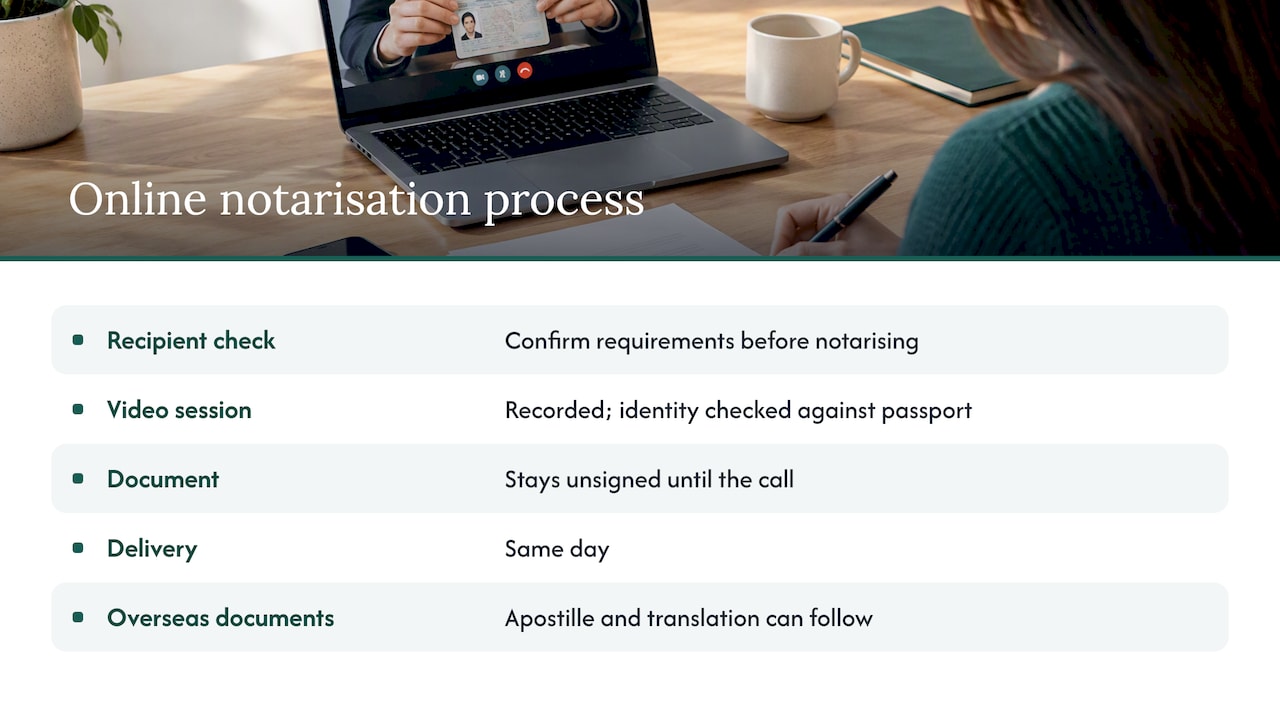
So we ask customers to check with the recipient first, and we describe what we do in factual terms. The session is by video, it is recorded, identity is checked against a passport, the document stays unsigned until the call, the notary applies a seal, and the document is delivered the same day. We do not promise that any document will be accepted, because that is not ours to decide.
What we can offer is speed, a clear record and a process that works across time zones. For multi signatory documents, each person joins from where they are. For documents going abroad, the apostille and translation can follow without starting again.
— Jérémy
Book an online notarisation for your property documents
If your document is a power of attorney, a declaration, a certified copy or a company document, you can start with signature notarisation online or look at the full list on our services page. For company property documents, see corporate document notarisation. Upload your document, verify your passport and meet a commissioned notary by video. Contact the team if you are not sure which service fits.
FAQ
Can I use an online notary to sign a property sale or purchase deed?
Not as a replacement for a witness. A deed's witness must be physically present with the signatory, and witnessing by video link should not be assumed valid. Your conveyancer decides how the transfer is executed. An online notary is better suited to supporting documents such as a power of attorney or a certified copy.
Will a foreign buyer, bank or registry accept an online notarisation?
That depends on the law and the practice of the receiving country. We cannot promise acceptance. Ask the recipient in writing before you book, and ask whether they also need an apostille or a translation.
Do I need an apostille for a property document used abroad?
Often yes, if the destination country is a party to the Hague Apostille Convention. The Hague Conference publishes a status table that shows which countries are parties. If the country is not a party, a longer legalisation chain usually applies, so ask the receiving party.
Can several owners sign from different countries?
Yes. Each signatory joins their own video session, verifies identity with a passport and signs in front of the notary. For company documents, signatures can often be added in sequence to the same version, but check the method that suits your document.
What do I need to have ready for the video call?
A valid passport, the unsigned document, names that match the passport, a quiet room and a stable connection. If a translation or apostille is needed afterwards, mention it when you book.
Sources
- Qualified Electronic Signatures: Answering your questions, HM Land Registry blog
- Practice guide 82: electronic signatures accepted by HM Land Registry
- Completing forms ID1 and ID2, GOV.UK
- Form ID1, HM Land Registry
- Q&A on electronic signatures and virtual executions, The Law Society
- Apostille Convention status table, HCCH
- Remote closing in Texas, Mogavero Group
Recommended
Got questions? We’re on it.
Most questions are answered here, drawn from what people actually ask before booking. If yours isn’t, our team is in chat.
Not as a replacement for a witness. A deed's witness must be physically present with the signatory, and witnessing by video link should not be assumed valid. Your conveyancer decides how the transfer is executed. An online notary is better suited to supporting documents such as a power of attorney or a certified copy.
Last updated: