Board Resolution Notarisation: How It Works Online
By Jeremy Arhab, Founder · Published 25 October 2026 · Updated 25 October 2026
When a board resolution needs notarising, what directors must prepare, and how online notarisation by video call works for company documents used abroad.

A board resolution does not have to be notarised under UK company law. It is notarised when someone else asks for it: an overseas bank, a foreign registry or a counterparty who wants proof that a director signed and that the company authorised the act. If you have been given that request, you can complete the notarisation online. A commissioned notary meets the signing director by video call, checks identity against a passport, and applies the notary's seal to the document the same day.
This guide explains when a notarised board resolution is needed, what to prepare, how the video session works, and where apostille and translation fit in.
TL;DR
- A board resolution is not automatically notarised. The organisation asking for it sets the requirement, so get its exact wording first.
- Notarisation authenticates the signature and the signatory's identity. It does not make the content of the resolution valid or the transaction lawful.
- With MyNotary, the director joins a recorded video call, verifies identity with a passport, signs, and receives the sealed document the same day.
- If the document is used abroad, an apostille under the Hague Convention may be a separate, later step.
- We cannot promise that a recipient will accept any document. Confirm acceptance with them before you book.
Table of Contents
- What a board resolution is and why anyone asks for it notarised
- Notarisation, certification and apostille are different things
- Does a UK board resolution need to be notarised?
- What to ask the recipient before you book
- What the director should prepare
- How online notarisation of a board resolution works
- Timing: what takes minutes and what takes days
- Our view: what we see go wrong with board resolutions
- Keeping the record afterwards
- Notarise your board resolution with MyNotary
- Common reasons a notarised resolution is rejected
- FAQ
- Sources
What a board resolution is and why anyone asks for it notarised
A board resolution is the formal record of a decision taken by a company's directors. It might approve a loan, authorise a director to open a bank account abroad, or give someone power to sign a contract on the company's behalf. A decision can be agreed at a board meeting or, in many companies, by written resolution.
Under the Companies Act 2006, a written resolution is agreed through an authenticated document that identifies the resolution and shows agreement. It can be sent in hard copy or electronic form. Nothing in that section says the document must be notarised.
So why does the request arise? Because the person on the other side cannot easily check your company from a distance. A bank in another country has no way of knowing whether the person who signed is a director. A notarised board resolution gives them an independent professional who has seen the signatory, checked their identity and witnessed the signature.
Typical situations include:
- opening or changing a corporate bank account overseas;
- setting up a branch, subsidiary or joint venture abroad;
- authorising a person to sign a property, share or loan document in another country;
- granting a power of attorney on behalf of the company;
- supporting a visa, licence or tender application that asks for proof of corporate authority.
In each case the requirement comes from the recipient, not from UK company law. That is why the first step is always to ask them what they want.
Notarisation, certification and apostille are different things
Three terms are often used as if they were one. They are not.
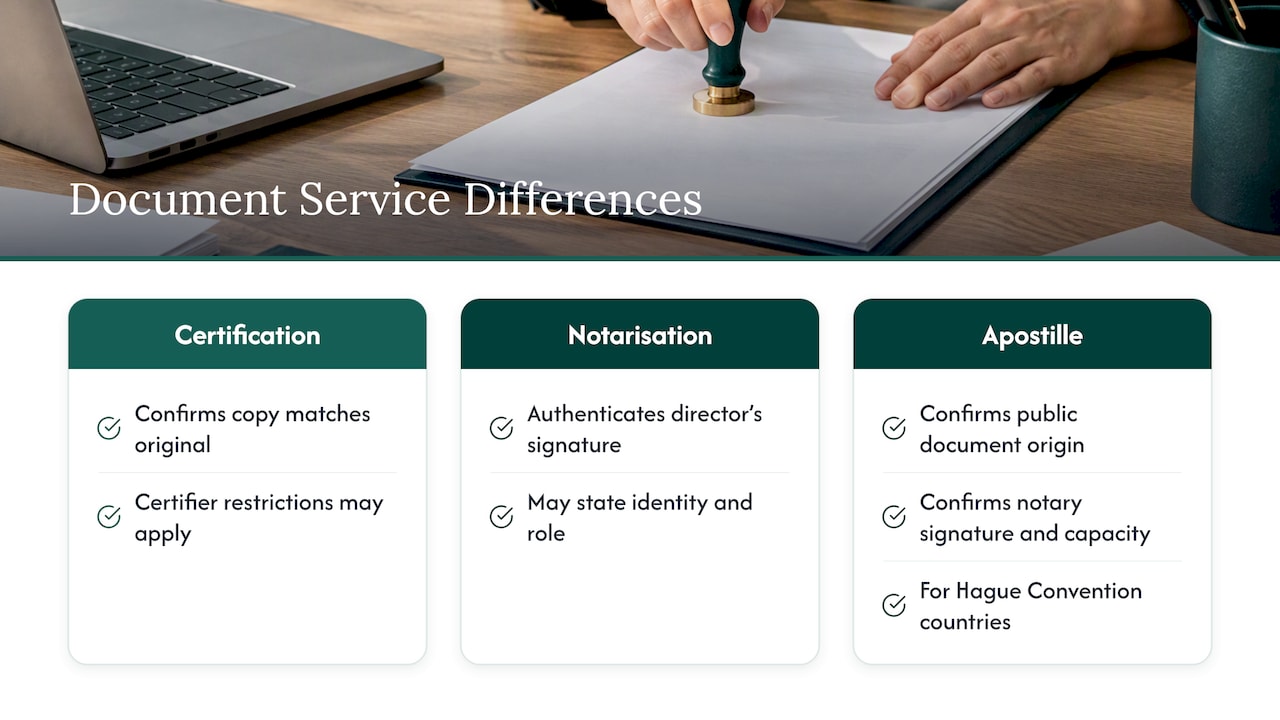
Certification of a copy confirms that a copy matches an original. UK government guidance on certifying a document explains that ordinary certification and notarisation are different services, and that an organisation asking for a certified copy can set its own restrictions on who may certify.
Notarisation is a notarial act. A notary is, in the words of UK government guidance, a type of lawyer qualified to confirm that legal documents are authentic. For a board resolution, the notarial act is usually the authentication of a director's signature, often with a statement about the signatory's identity and role.
Apostille is a certificate that confirms the origin of a public document, including the signature and capacity of the notary, so that it can be used in another country that is party to the Hague Convention. The Hague Conference on Private International Law publishes the details of competent authorities. It also shows that processing times and charges depend on the route used and change over time. Check current information before you plan around a fixed price or a fixed turnaround.
If you are unsure whether the recipient needs a certified copy or a notarised document, our guide to choosing between certified and notarised copies sets out four checks you can run.
Does a UK board resolution need to be notarised?
In most cases, no. Notarisation is a request, not a statutory step. Two points are worth separating.
Approval and execution are not the same act. A resolution may authorise a director to sign. The contract, deed or power of attorney that the director then signs can have its own signing and witnessing rules. For companies under the law of England and Wales or Northern Ireland, section 44 of the Companies Act 2006 allows a document to be executed by two authorised signatories, or by a director signing in the presence of a witness who attests the signature. Scotland has a separate framework and should be checked on its own.
Records are evidence. Section 356 treats the record of a resolution, signed by the appropriate officer, as evidence of the proceedings. That is why a notary or an overseas recipient may ask to see more than one page: the final resolution, the minutes or written-resolution circulation, the company's articles and proof that the signatory holds office.
The practical rule: do not assume. Ask the recipient whether they need the resolution notarised, whether a certified copy is enough, and whether they will accept an electronic signature.
What to ask the recipient before you book
A short email saves days. Ask for the following in writing.
- The exact wording they require, or a template if they have one.
- Who must sign. One director, two directors, or the company secretary?
- Whether notarisation is needed, or whether a certified copy of a signed original will do.
- Whether an apostille is needed, and for which country the document is destined.
- Whether a translation is needed, and whether it must itself be certified or notarised.
- The format. Some recipients accept an electronically signed PDF. Others require paper with a wet-ink signature and the notary's physical seal.
- Supporting documents, such as articles of association, a certificate of incorporation or evidence of the director's appointment.
Electronic signing is not one legal category. UK company law permits authenticated electronic documents for written resolutions, but a receiving authority can still demand a wet-ink signature, a particular standard of electronic signature, or a paper original. Settle that point first, then choose the workflow.
What the director should prepare
Once you know the requirement, assemble the file. A well prepared resolution is notarised in one session. A poorly prepared one is sent back.
The resolution itself
The text should name the company, its registered number and registered office. It should state the decision clearly, the date, and the name of the person authorised to act. If the resolution authorises a specific document, identify it by title and date. Leave the signature line blank: the director signs during the session, in front of the notary.
Evidence of authority
Have to hand any document that shows the signatory is a director or an authorised officer. Depending on the recipient, this may be a certificate of incorporation, the articles of association, or a current officer list.
Identity
The signatory needs a valid passport. The platform checks the passport and compares it with the person on camera. Use a well lit room and a device with a working camera and microphone.
The right document format
Upload a clean PDF. Do not sign it beforehand. If the resolution runs to several pages, make sure the pages are numbered and that the company name appears on each.
How online notarisation of a board resolution works
The process on MyNotary follows a fixed sequence.
- Upload the unsigned resolution. Add the supporting documents if the recipient has asked for them.
- Verify identity. The signatory's passport is checked and matched to the person on the video call.
- Join the video call. A commissioned notary meets the director. The session is recorded.
- Sign in front of the notary. The director signs the resolution during the call, so the notary sees the act.
- Receive the sealed document. The notary applies the seal and the notarised document is delivered the same day. Our average turnaround is about one hour, though timing depends on the notary's availability and the complexity of the file.
- Add an apostille or translation if needed. These are optional extra stages and are arranged separately.
The result is a document that carries the notary's seal, produced without anyone travelling to an office or waiting in a queue.
Several directors in different places
Some resolutions need more than one signatory, and the directors are rarely in the same city. MyNotary supports documents with multiple signatories across locations. Each person verifies identity and signs in their own session, so a board spread over two or three countries does not need to meet in one room.
Timing: what takes minutes and what takes days
The notarisation itself is the quickest stage. The stages around it take longer.
| Stage | What decides how long it takes |
|---|---|
| Checking the recipient's requirement | How quickly the recipient replies |
| Preparing the resolution | How many directors must review and agree the wording |
| Online notarisation | Usually the same day, with an average of about one hour |
| Apostille | The route used and the authority's current processing times |
| Certified translation | Length of the document and language pair |
| Courier or delivery abroad | Destination and carrier |
Do not build a deadline on an apostille turnaround you saw in an old article. The HCCH reference material for the UK has shown different figures at different times, so confirm the current position before you promise a date to anyone.
If the apostille is the part that worries you, our guide to apostilles for UK company documents compares the routes available.
Our view: what we see go wrong with board resolutions
We are an online notarisation platform. We are not a law firm, and we do not advise on whether a transaction is sound. What we do see, repeatedly, is a small set of avoidable problems.
The first is signing before the session. A director who signs at their desk and then joins the call asks the notary to witness a signature already made. The notary cannot witness an act that has already happened, so the document has to be redone.
The second is a vague resolution. A resolution that says a director may "deal with banking matters" will often be queried by a foreign bank. A resolution that names the bank, the account and the powers is much easier to rely on.
The third is confusing the resolution with the document it authorises. The resolution gives authority. The contract or power of attorney is a separate document with its own signing rules. Sometimes both need notarising, and it is cheaper in time to do them in the same session.
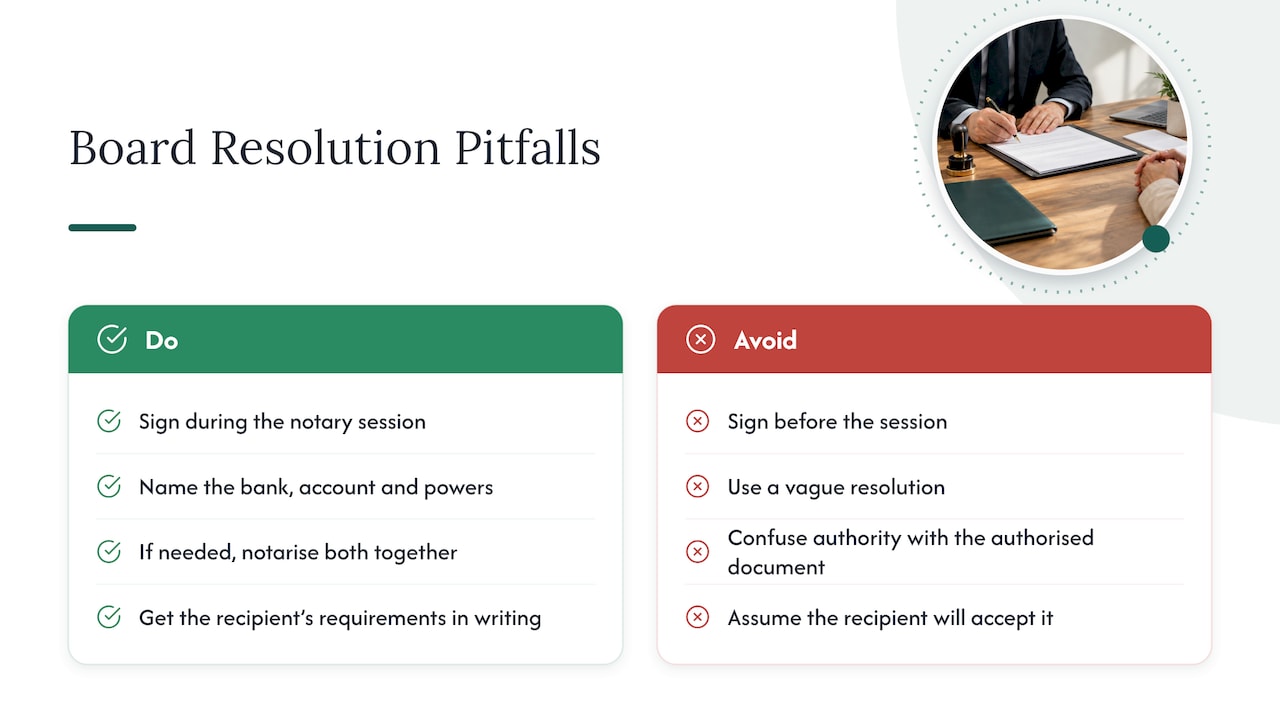
The fourth is not asking the recipient first. We cannot promise that a bank or registry will accept a document, and no honest provider can. The only safe route is to get the recipient's requirement in writing and prepare to that.
What we can offer is a clear, recorded process: identity checked against a passport, a commissioned notary on video, a signature witnessed live and a sealed document delivered the same day. For directors who are abroad, travelling or simply short of time, that removes the logistics, which are usually the real obstacle.
— Jérémy
Keeping the record afterwards
A notarised copy is the end of one task and the start of a record. Keep together:
- the signed resolution and the notarised copy;
- the meeting notice or written-resolution circulation;
- attendance records and evidence of approvals;
- the documents that showed the signatory's authority;
- any apostille or translation.
Under the Companies Act 2006, records of resolutions and meetings must generally be kept for at least 10 years. A single folder, digital or paper, makes it easy to answer a later query from a bank or auditor.
If your resolution relates to minutes, see our guide on how to notarise company minutes online for international use.
Notarise your board resolution with MyNotary
If your recipient has confirmed that they need a notarised resolution, you can start with our corporate document notarisation service. Upload the unsigned file, verify the director's identity with a passport, and meet a commissioned notary by video. If the recipient only needs a director's signature authenticated, signature notarisation online may fit better. You can see every service on our services page.
If you are unsure which service matches the recipient's wording, send us the request before you book and we will help you read it.
Common reasons a notarised resolution is rejected
Recipients tend to reject for reasons that were visible in advance.
- Wrong signatory. The recipient wanted two directors and only one signed.
- Wrong format. They required paper and received an electronically signed PDF.
- Missing apostille. The destination country requires one and the document arrived without it.
- Missing translation. The receiving authority works in another language and wants a certified translation attached.
- Outdated documents. Supporting papers were older than the recipient allows.
- Mismatch of names. The company name on the resolution differs from the name on the incorporation certificate.
Each of these is cheaper to fix before the session than after it. If a translation is needed, it can be arranged as a notarised translation once the resolution is final, so the translator works from the finished text.
FAQ
Who can certify or notarise a board resolution?
It depends on what the recipient asks for. A certified copy may be accepted from a professional person of good standing, but the organisation can set its own limits. A notarial act, such as authenticating a director's signature, is performed by a notary. MyNotary connects you with a commissioned notary by video call.
What is required for a board resolution?
UK company law does not set one form for every resolution. In practice it should name the company, state the decision, record the date and identify who is authorised to act. For a written resolution, the Companies Act 2006 requires an authenticated document showing agreement. A foreign recipient may add its own requirements, so ask for them first.
Can a board resolution be signed electronically?
UK company legislation permits written resolutions to be agreed in electronic form, provided the document is authenticated. The recipient may still require a wet-ink signature, a particular standard of electronic signature or a paper original. Confirm this with them before you choose a digital workflow.
Does a notarised board resolution need an apostille?
Only if the country where you will use it requires one. An apostille is a separate stage under the Hague Convention, applied after notarisation. Check the receiving country's requirement and current processing times, as these can change.
Does notarisation prove the resolution is valid?
No. Notarisation authenticates the signature and the signatory's identity. It does not confirm that the board was properly convened, that the decision was lawful or that the transaction is sound. Those points rest on the company's own records and, where needed, its professional advisers.
Sources
- Companies Act 2006, section 296: signifying agreement to a written resolution
- Companies Act 2006, section 44: execution of documents
- Companies Act 2006, section 356: records as evidence of resolutions
- GOV.UK: Certifying a document
- GOV.UK: Find a notary abroad
- HCCH: apostille competent authority details for the United Kingdom
Recommended
Got questions? We’re on it.
Most questions are answered here, drawn from what people actually ask before booking. If yours isn’t, our team is in chat.
It depends on what the recipient asks for. A certified copy may be accepted from a professional person of good standing, but the organisation can set its own limits. A notarial act, such as authenticating a director's signature, is performed by a notary. MyNotary connects you with a commissioned notary by video call.
Last updated: