Avoid Voided Gifts: UK Witness Rules for Wills, LPAs & Deeds + Notary
By Jeremy Arhab, Founder · Published 15 September 2026 · Updated 15 September 2026
Practical UK witness rules by document type: wills, LPAs and deeds. See who can sign, common mistakes, a checklist and online notary tips.
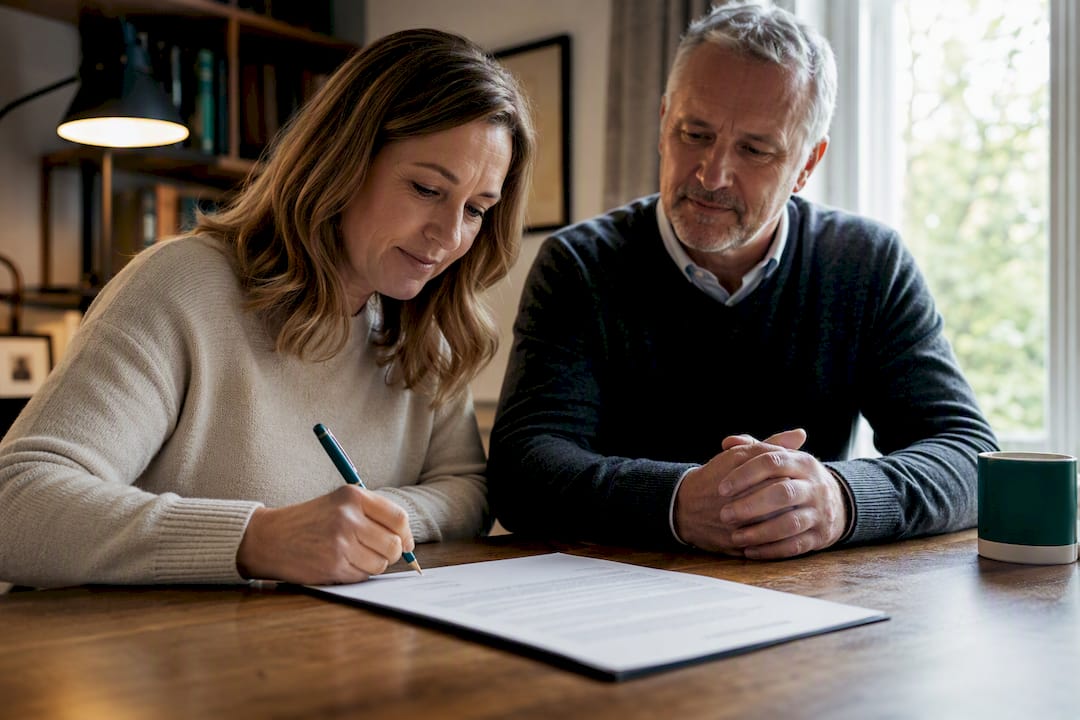
Most UK witnesses must be adults with the capacity to understand what they're witnessing, and they must be physically present when you sign. Wills need independent witnesses. Lasting powers of attorney (LPAs) need an impartial witness who isn't named as an attorney. Deeds need a witness who attests the signature and gives their full name and address. Get the document type wrong and a beneficiary's gift can be voided, or an LPA can be rejected outright.
***
TL;DR: - Witnesses must be adults over 18 with full mental capacity, capable of recalling the signing event if challenged in court. - Wills require witnesses to be present at the same time as the signer and not benefit from the document, or their gift becomes void. - LPAs need witnesses who are impartial, not named as attorneys, and must avoid overlapping roles like the certificate provider. - Deeds must be signed in front of a witness who records their full name, address, and signature, with no one witnessing their own signature. - Remote or video witnessing generally does not meet UK legal standards for deeds, wills, or LPAs, which require physical presence unless a notarisation records identity verification.
***
Table of Contents
- Basic legal requirements for witnesses in the UK
- Witness rules for wills
- Witness rules for lasting powers of attorney (LPAs)
- Witness rules for deeds and other formal documents
- Who cannot act as a witness and conflicts of interest
- Remote, electronic and video witnessing: what is and isn't accepted
- Common mistakes and a short witness checklist
- Witness requirements for affidavits and statutory declarations
- Witness requirements in different types of legal documents beyond wills, LPAs, and deeds
- What is a witness, and what is their role?
- Legal consequences of improper witnessing or forgery
- How to verify the identity of a witness
- A practical perspective on witnessing and online notarisation
- Getting a document notarised alongside your witnessing checklist
- Sources
- FAQ
Basic legal requirements for witnesses in the UK
Age and capacity come first. A witness generally needs to be 18 or older and mentally capable of understanding what they're watching and, if ever asked, giving evidence about it later. This isn't a formality for its own sake. If a signature is ever challenged in court, the witness may need to describe what happened, so someone who can't follow or recall the event is no use to anyone.
Presence is the second pillar. The witness must actually see you sign, not sign a document you've already put your name to, and not watch over video unless the specific document type allows it (most don't, as covered below). They then add their own signature to the same document.
Contactability matters more than people expect. A legible full name and address let a solicitor, registry, or court trace the witness years later if a dispute arises. Scrawled initials or an illegible address undermine that safeguard and can slow down probate or registration.
Witness rules for wills
A will needs witnesses present at the same time as you and each other when you sign. They must be able to see you sign, and they then sign the will themselves on the same document. Watching through a doorway or a window has been tested in court and generally satisfies the "clear view" requirement, but witnessing over video call does not meet the legal standard for a valid will.
The consequence of choosing badly is specific rather than catastrophic. If a witness, or their spouse or civil partner, is named as a beneficiary, that particular gift becomes void. The rest of the will remains valid. It's a narrow penalty, but it can mean a loved one loses an inheritance simply because they held the pen for someone else's signature. If you discover an error after the fact, the usual remedy is to re-execute the will correctly with two disinterested witnesses, and it's worth asking a solicitor to check the wording before you do.
Witness rules for lasting powers of attorney (LPAs)
LPAs carry extra safeguards because they hand someone else control over your finances or welfare. The donor and each attorney must sign in person, and every signature needs an impartial witness aged 18 or over. That witness cannot be named as an attorney or replacement attorney on the same form.
The certificate provider, the person who confirms the donor has capacity and understands what they're signing, is a separate role entirely and should not also act as a witness on the same document. Mixing the two is one of the most common practical errors people make when completing an LPA.
Regulation 9 of the Mental Capacity Act 2005 (Lasting Powers of Attorney) (England) Regulations 2007 sets out these formalities in detail, including the requirement that witnesses give their full name and address. Get the signing sequence wrong, or let roles overlap, and the Office of the Public Guardian can reject the registration and send the whole form back.
Witness rules for deeds and other formal documents
A deed, such as a property transfer or a formal declaration, must be signed in the presence of a witness who then attests that signature. HM Land Registry's guidance is explicit: the witness should record their full name and address on the deed, and their signature must be legible enough to identify them later, under Practice guide 8.
One rule trips people up more than any other: a party to the deed should never witness another party's signature. If two people are both signing the same deed, neither can act as the other's witness. Use someone entirely outside the transaction wherever possible, an independent adult with no stake in the outcome. Where someone signs a deed on another person's behalf because they lack capacity, two witnesses are needed, and the attestation clause must clearly show who was present and who signed for whom.
Who cannot act as a witness and conflicts of interest
Certain people are barred, or at least badly placed, to witness specific documents. A beneficiary of a will, or their spouse, risks losing their gift if they witness it. A named attorney or replacement attorney cannot witness the LPA that appoints them. A certificate provider should never double as a witness on the same form, and a party to a deed cannot witness another party's signature on it.
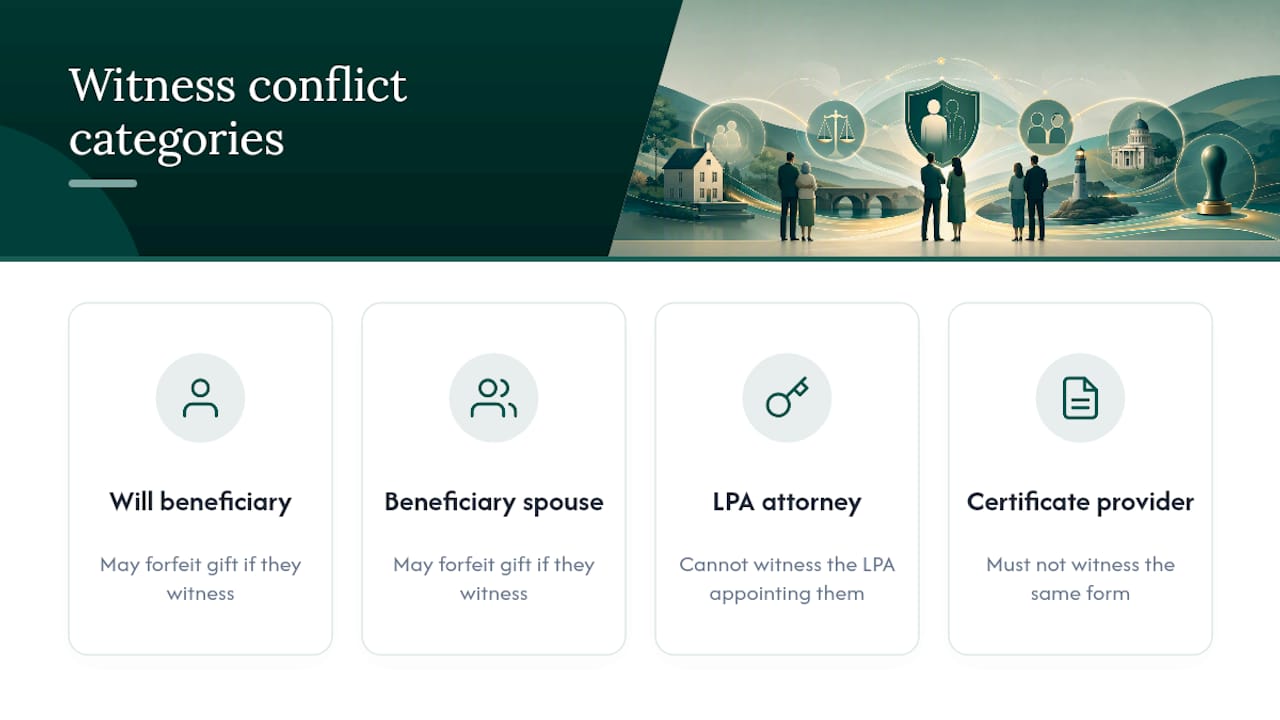
The practical rule of thumb is independence. Choose a witness with no financial or personal stake in the document, someone who can be reached again in a year or a decade if a court or registrar asks a question about the day it was signed.
Remote, electronic and video witnessing: what is and isn't accepted
Physical presence remains the default for most formal documents, deeds and LPAs among them, despite the wider acceptance of electronic signatures elsewhere. The Law Commission and HM Land Registry have both maintained that a witness must be in the same physical space as the signer for a deed to be validly executed, even though technology now makes remote alternatives technically possible.
Recorded online notarisation and identity verification sessions add a useful layer of evidence, showing who signed and under what circumstances, but they don't automatically replace a statutory witness requirement. Before assuming a video-based process will satisfy a registry or a bank, check three things: what the specific document type demands, whether the accepting body has published its own rules on remote execution, and whether a witness still needs to be physically present regardless of any digital verification layer. When in doubt, ask the institution that will ultimately rely on the document.
Common mistakes and a short witness checklist
Most rejected documents fail for the same handful of reasons: a witness who wasn't actually present, one who benefits from the document, or missing contact details that make the witness impossible to trace later.
Before you sign anything with legal weight, run through this:
- Confirm the witness is 18 or over and has no personal or financial interest in the document.
- Make sure the witness is physically present and watches you sign, not just present in spirit.
- Check the signing order required for the specific document, LPAs in particular are strict about sequence.
- Ask the witness to print their full name and address clearly, and date the signature.
- Never let a certificate provider, executor, or named attorney witness a document where the rules forbid it.
Pro Tip: Where it's permitted and not restricted by the document's own rules, take a dated photograph of the signing with the witness visible, and keep it with your file. It costs nothing and can settle a dispute in seconds years later.
Witness requirements for affidavits and statutory declarations
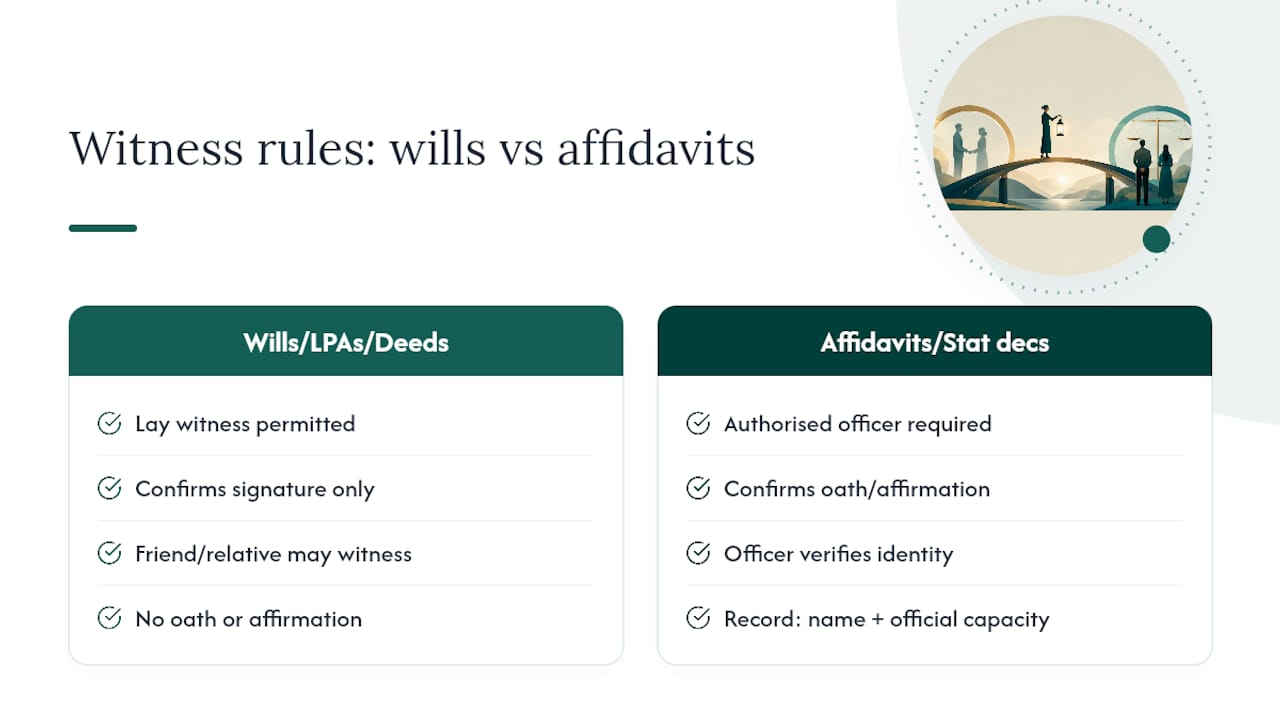
Affidavits and statutory declarations sit in a different category from wills, LPAs and deeds. Rather than a lay witness, these documents typically need to be sworn or affirmed before an authorised official, someone empowered to administer oaths and confirm the identity of the person signing.
The logic is different too. A will witness confirms that you signed the document; an affidavit's authorised officer confirms that you swore to the truth of its contents, under penalty of perjury if it later proves false. That distinction changes who can act in the role. A friend or relative present in the room isn't enough for an affidavit in the way they might be for a straightforward contract, because the document depends on an official verifying both identity and the act of swearing or affirming.
Format requirements tend to mirror the deed rules in one respect: the person overseeing the swearing should record their name, and often their official capacity, clearly enough that a court can later verify who was involved. Where an affidavit is destined for use abroad, particularly in a country that recognises the Hague Apostille Convention, the receiving country may also expect the document to carry a specific form of legalisation attached to the swearing itself, not just a witness signature. If you're unsure whether your document needs a sworn affidavit or a simpler witnessed statement, that distinction is worth checking before you approach anyone to administer it, since the wrong format can mean starting again from scratch.
Witness requirements in different types of legal documents beyond wills, LPAs, and deeds
Not every legal document that needs a signature needs a witness at all. Most everyday contracts, employment agreements, tenancy agreements, commercial supply contracts, are valid once both parties sign, with no witness requirement in law. Businesses often add a witness anyway, purely as a practical safeguard against later disputes about who actually signed, but it isn't a legal precondition for the contract to take effect.
Contracts that are also deeds are the exception, and this is where confusion often creeps in. A commercial lease over a certain length, a mortgage, or a transfer of land is usually executed as a deed rather than a simple contract, which pulls it straight back into the attestation rules covered earlier: a witness who attests the signature, records their name and address, and has no stake in the transaction.
Company documents add another layer. Where a director signs on behalf of a company, the Companies Act framework allows execution either by two authorised signatories or by one director in the presence of a witness, depending on how the company chooses to execute. International contracts raise a further practical question: a document destined for use in another jurisdiction may need to satisfy that country's own witnessing or notarisation rules, not just UK domestic practice, so it's worth checking the receiving country's requirements before assuming a UK-style witness signature will be accepted.
What is a witness, and what is their role?
A witness, in the legal sense, is someone who observes an act, most often a signature, and then confirms that observation by adding their own signature or a formal attestation. Their role isn't decorative. They exist to provide independent, contemporaneous evidence that a specific person signed a specific document, of their own free will, on a specific occasion.
That evidentiary function is why the rules focus so heavily on presence and independence rather than on paperwork or qualifications. A witness doesn't need legal training or any special status to witness a will or a deed; what matters is that they were genuinely there, had a clear view, and have no personal stake in the outcome that might bias their account. Courts treat an independent witness's testimony as far more persuasive than one from someone who stood to gain from the document being valid.
This also explains why some documents need more than a lay witness. An affidavit needs someone with authority to administer an oath, because the document's validity rests on a sworn statement, not merely an observed signature. A deed needs a witness who attests in writing precisely because deeds carry legal weight without requiring separate payment or consideration, unlike an ordinary contract, so the formalities compensate by demanding stronger evidence of execution.
Legal consequences of improper witnessing or forgery
Getting witnessing wrong carries consequences that scale with the document and the intent behind the error. An honest mistake, a witness who turns out to be a beneficiary, usually has a contained effect: under will law, that specific gift is void, but the will itself survives and the rest of its terms stand as written.
Other errors are more disruptive. An LPA with the wrong signing sequence, a missing witness address, or an overlap between the certificate provider and witness roles typically gets rejected by the Office of the Public Guardian rather than accepted with a partial defect. That means starting the signing process again, which costs time and, if the donor's capacity is declining, can create real urgency.
Forgery and deliberate false attestation sit in an entirely different category. Signing as a witness to something you didn't actually see, or falsely claiming a document was executed correctly, isn't a paperwork slip, it's potential fraud, and it can expose the person responsible to criminal liability and civil claims for any loss the fraud causes. Courts have overturned wills and set aside deeds where evidence showed the attestation was fabricated after the fact.
The safest position is straightforward: never sign as a witness to something you didn't personally observe, no matter how minor the favour seems at the time. A witness signature is a legal statement that you were there, and treating it casually is exactly how genuine documents end up challenged in court years later.
How to verify the identity of a witness
Verifying a witness's identity matters most when a document is likely to be scrutinised later, high-value estates, disputed LPAs, or property transactions where the stakes of a successful challenge are significant.
The starting point is simple: ask for a form of photo identification, a passport or driving licence, and cross-check the name against what they write on the document itself. It sounds basic, but mismatched names between a witness's signature and their printed details are a recurring reason documents get queried during probate or land registration.
Address verification adds a second layer. A witness who can be traced years later through a stable, legible address is far more useful than one who signs with an illegible scrawl and no contact details. Where a witness has recently moved, it's worth noting both the address at the time of signing and a current contact route if one's available.
For documents handled through a recorded process, such as an online notarisation session, identity verification typically happens through a passport check against the person signing, with the session itself recorded as evidence of who was present and what took place. That recorded evidence can be valuable for showing due diligence was followed, though it's worth remembering it serves the identity verification and evidential trail, not necessarily the statutory witness requirement itself, which may still call for physical presence depending on the document.
A practical perspective on witnessing and online notarisation
A recorded video session with a commissioned notary and a passport identity check builds a strong evidential trail, supported by digital verification trends and tools like those described in AI Legal Tools | Beyond Horizons Legal Singapore. It confirms who signed, when, and under what circumstances. What it doesn't do is override a statutory witness requirement that specifically demands physical presence, such as most deeds and LPAs. Recorded sessions earn their value in international use, identity verification, and producing certified copies quickly, often with same-day delivery once the session ends.
— Jérémy
Getting a document notarised alongside your witnessing checklist
Witnessing rules cover who watches you sign. Notarisation covers something different: proving your identity and certifying that a document is genuine, often for use abroad or with an institution that demands independent verification. If you've confirmed your witnesses are in order and now need a signature independently verified, My Notary offers online notarisation by a commissioned notary over a recorded video call, with identity checked against your passport and delivery of certified documents typically the same day, without a physical office visit or wasted afternoon in a waiting room.

My Notary doesn't replace the statutory witness rules covered in this guide, and it can't promise that any specific bank, registry, or embassy will accept a given document; always confirm formal requirements with the recipient first. Where you need a signature certified for use with a UK bank, university, or overseas authority, the online signature certification service is the fastest starting point to book a session and get moving today.
FAQ
Who can be a witness in the UK?
Generally, any adult aged 18 or over with the mental capacity to understand what they're witnessing can act as a witness, provided they have no personal or financial interest in the document, such as being a beneficiary of a will.
Can I use a family member as a witness?
You can for most documents, but it's risky for a will if that family member is also a beneficiary, since their gift becomes void, and it's not allowed at all for an LPA if they're named as an attorney.
What are the legal requirements for signatures in the UK?
Requirements vary by document. Wills need two witnesses present together who see the signing; LPAs need an impartial witness who isn't a named attorney; deeds need a witness who attests the signature and records their full name and address.
Does remote or video witnessing satisfy UK witness requirements?
Physical presence is still generally required for deeds, wills and LPAs, so a standard video call does not satisfy statutory witnessing, though a recorded notarisation session can support identity verification and evidence for other purposes.
What happens if a witness benefits from a will they've witnessed?
The gift to that witness, or their spouse or civil partner, becomes void, but the rest of the will remains valid and enforceable as written.
Recommended
Got questions? We’re on it.
Most questions are answered here, drawn from what people actually ask before booking. If yours isn’t, our team is in chat.
Generally, any adult aged 18 or over with the mental capacity to understand what they're witnessing can act as a witness, provided they have no personal or financial interest in the document, such as being a beneficiary of a will.
Last updated: