3 Conditions for UK Online Notarisation: ID, Live Signing, ID5
By Jeremy Arhab, Founder · Published 26 September 2026 · Updated 26 September 2026
Three must haves for UK video notarisation: ID check, live witnessed signing and an audit trail. Check HM Land Registry rules before you book.

Yes, many UK documents can be notarised online by video call, provided you meet three conditions: verified identity, a live witnessed and recorded signing session, and a proper audit trail with the notary's certificate or seal attached. The main caveats sit with certain deeds, some wills, and documents heading to authorities that insist on a wet-ink signature. If your document falls outside those exceptions, a video session with a commissioned notary usually does the job.
***
TL;DR: - Most UK documents, except deeds, certain wills, and some official submissions, can be notarised online if identity is verified, signing is witnessed live, and recording is maintained. - A notarisation session requires proof of government-issued ID, a stable internet connection, and a clear view of the signer, with the entire process recorded for audit purposes. - For property-related documents, a conveyancer's involvement and specific HM Land Registry protocols are necessary, especially for remote identity verification and digital signing standards. - Electronic signatures are legally valid in the UK for most documents, but deeds and certain formalities still demand in-person or carefully controlled witnessing practices. - Always confirm destination acceptance and whether an apostille or certified translation is needed before booking online notarisation to avoid rejection.
***
Table of Contents
- What are the online notary requirements in the UK?
- Online versus in-person notarisation: what actually changes
- Which documents can be notarised by video call?
- Are electronic signatures legally valid in the UK?
- HM Land Registry: ID forms and digital verification standards
- The step-by-step online notarisation process
- When online notarisation might get rejected
- Your pre-session checklist for a UK video notarisation
- How My Notary supports these requirements in practice
- When online notarisation makes sense, and when it does not
- Ready to notarise a document online?
- Sources
- FAQ
What are the online notary requirements in the UK?
The requirements split into three areas: who you are, what you sign, and how the session is recorded. A commissioned notary must confirm your identity, watch you sign or acknowledge the document live on camera, and produce a certificate that ties the recording, the document, and your identity check together.
None of this happens informally. The notary needs government-issued photo identification, a stable video connection, and a clear view of you signing or confirming the paper in front of the camera. The session itself is recorded, which creates the audit trail that receiving authorities look for when they question whether a document is genuine.
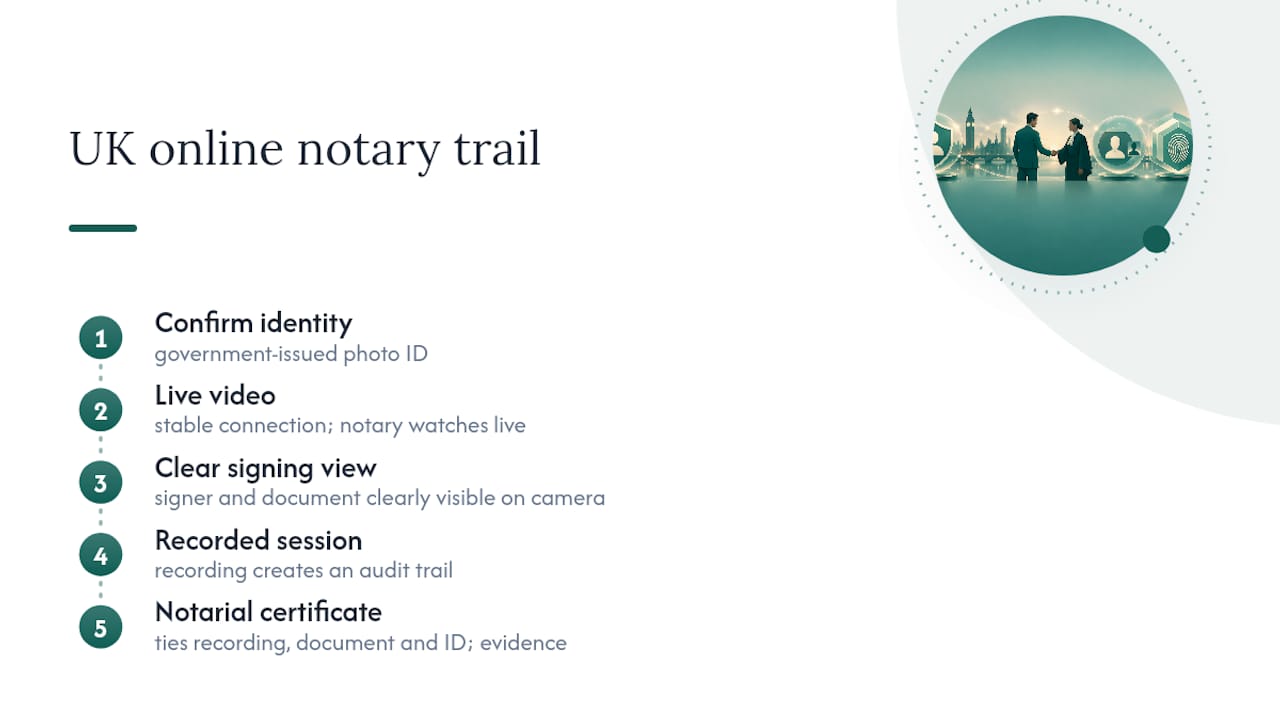
The gap most people miss is destination acceptance. A notarial certificate can be flawless and still get rejected if the receiving country or institution has its own rules about remote signing. That is a separate check from the notarial process itself, and it is worth doing before you book rather than after you pay.
Online versus in-person notarisation: what actually changes
The legal weight of a notarial act does not shift just because the session happens on screen rather than in an office. What changes is the evidence trail behind it. A video session generates a recording, a timestamped biometric identity check, and often a screenshot captured at the point of verification. Walking into a notary's office generates a signed register entry and a face-to-face memory, but rarely a video record.
- Convenience: online sessions remove travel and same-day availability limits.
- Evidence: video sessions can actually produce stronger documentation, since the whole exchange is recorded rather than briefly logged.
- Acceptance risk: in-person notarisation still carries less risk with authorities that have not updated their guidance for remote methods.
Pro Tip: If your document is going to a foreign land registry, court, or government office you have never dealt with before, ask them directly whether a video-notarised document is acceptable before you book. A five-minute email can save you a second appointment.
Which documents can be notarised by video call?
Most straightforward personal and business documents suit remote notarisation well. Statutory declarations, affidavits, powers of attorney, certificates of no impediment, proof of life declarations, and certified true copies of degrees, diplomas, or identity documents are all routinely handled by video call.
- Affidavits and statutory declarations
- Powers of attorney (excluding property transfers that require conveyancer-controlled signing)
- Certificates of no impediment and marital status affidavits
- Certified true copies of degrees, diplomas, and personal documents
- Child travel consent letters and parental authority delegations
- Corporate documents such as board resolutions or beneficial owner declarations
Deeds, certain wills, and property transfer documents sit in a different category. These often carry specific witnessing or execution formalities that predate remote technology, and some HM Land Registry transactions require a conveyancer to control the signing process rather than a notary alone. If the document is heading abroad, check whether the destination country is party to the Hague Apostille Convention. Where it is, an apostille (including an electronic apostille under the HCCH's e-APP) confirms the notary's signature and seal are genuine, and a Contracting Party cannot refuse an e-Apostille purely because it is electronic.
Are electronic signatures legally valid in the UK?
Electronic signatures already sit on solid statutory ground in England and Wales. Section 7 of the Electronic Communications Act 2000 confirms that electronic signatures and the certificates that support them are admissible in evidence, provided the signatory intended to authenticate the document. That is the legal backbone for most video-notarised documents.
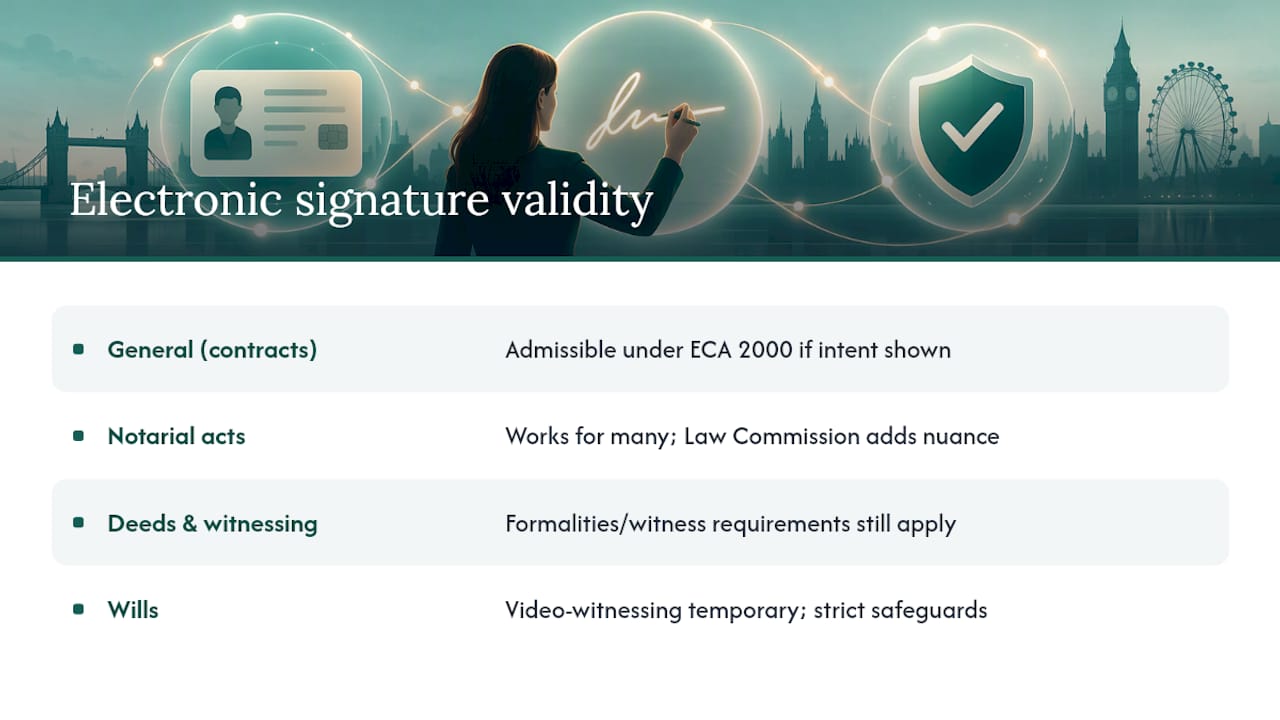
The Law Commission's guidance on electronic execution adds necessary nuance. Electronic execution works for most contracts and many notarial acts, but deeds and certain other documents still carry formalities, such as witnessing requirements, that were written with pen and paper in mind. The Commission's ongoing work reflects the fact that the law has not fully caught up with remote practice in every corner of the system.
Wills sit in their own bracket. GOV.UK guidance permitted video-witnessing of wills as a temporary measure, but it comes with specific safeguards around real-time sight of the signature and is not a general licence for remote will-making.
Electronic signatures are widely admissible under the Electronic Communications Act 2000, but formalities for deeds and witnessing still demand careful handling. A credible platform needs an audit trail and controls that match what happens in person, not a shortcut around them.
HM Land Registry: ID forms and digital verification standards
Property and conveyancing work brings its own paperwork on top of general notarial rules. HM Land Registry sets out evidence-of-identity requirements in practice guide 67, which explains when forms ID1 and ID2 are required and confirms that a screenshot must be taken when identity is verified by video call rather than in person.
Where a conveyancer verifies identity remotely, form ID5 must accompany the application. The verifier keeps a colour screenshot taken during the call, and HM Land Registry can request it later. Practice guide 82 goes further for electronic signing itself, requiring the conveyancer to control the signing flow, include one-time passcodes, and lodge a certificate signed by a regulated conveyancer.
| Form or guide | What it covers | When it applies |
|---|---|---|
| ID1 / ID2 | Standard identity evidence for conveyancing applications | Most property transactions requiring identity verification |
| ID5 | Records identity verified by video call, with screenshot | When a conveyancer verifies identity remotely rather than face to face |
| Practice guide 67 | Evidence-of-identity rules for conveyancers | Setting time limits and screenshot standards |
| Practice guide 82 | Electronic signature acceptance for deeds | Conveyancer-controlled electronic signing of land registry documents |
This is a separate track from personal document notarisation. If your matter touches property, a conveyancer usually needs to be involved alongside, or instead of, a notary.
The step-by-step online notarisation process
Preparing properly before the call is what separates a smooth session from a rejected document later.
- Check destination acceptance first. Confirm with the receiving authority whether they accept remote notarisation and whether an apostille will be needed.
- Gather your identification and leave the document unsigned. Do not sign in advance. The notary needs to witness the signature live.
- Book the session and upload the document. Most platforms ask you to upload the file before the appointment so the notary can review it.
- Run a technical check. Confirm your camera, microphone, and internet connection work on a supported browser.
- Attend the session. The notary verifies your identity against your passport or photo ID, watches you sign or acknowledge the document, and records the whole exchange.
- Receive your certified document. You get an electronically signed file with the notary's certificate or seal, usually within hours.
- Arrange an apostille if needed. This is a separate step from the notarial act itself, requested once the certified document is issued.
Pro Tip: Have your passport ready and undamaged, in good lighting, with the photo page fully visible on camera. A blurred or angled scan is one of the most common reasons a video verification session has to be repeated.
When online notarisation might get rejected
Rejections almost always trace back to one of three causes: the document type, the destination, or a mismatch in formalities.
- Some property deeds and certain wills fall outside what remote witnessing currently covers.
- Foreign courts, land registries, or government departments in some jurisdictions still insist on a wet-ink signature or a local notary physically present.
- Older bilateral treaties or specific institutional policies sometimes predate remote practice and have not been updated.
The fix is rarely complicated once you spot the risk early. An apostille under the Hague Apostille Convention resolves most cross-border authentication questions where the destination country is a Contracting Party. A certified translation alongside the notarised document helps where the receiving authority does not work in English. For property matters, involving a conveyancer who controls the signing flow under HM Land Registry's framework avoids the mismatch altogether.
Your pre-session checklist for a UK video notarisation
Run through this before you click "join" on the call.
- Identification: a valid passport or photo ID, held flat and well lit, with no glare across the photo page.
- Document: unsigned, in its final form, uploaded ahead of the appointment where the platform requests it.
- Witnesses: arranged in advance if your document needs one beyond the notary, and briefed on how the call will run.
- Technical setup: a supported browser, a camera positioned to show your face and hands clearly, and a wired or strong Wi-Fi connection.
- Destination check: confirmation from the receiving party that a remotely notarised document, with apostille if relevant, will be accepted.
Pro Tip: Test your camera angle before the call starts. The notary needs to see both your face and the document surface at the same time, so prop your device rather than holding it.
How My Notary supports these requirements in practice
My Notary's video sessions are built around the same three pillars this article has covered: identity verification, live witnessed signing, and a recorded audit trail. Identity checks use biometric passport verification rather than a simple visual glance, the session itself is recorded, and the resulting document carries the notary's seal along with an electronically signed PDF.
The platform's positioning is that its electronic signatures are recognised in many countries, with typical turnaround of about one hour from booking to certified document, supported by encrypted, audit-trailed sessions designed to meet relevant standards.
What the platform cannot do is guarantee that a specific foreign authority will accept the finished document. That check sits with you, and it is worth doing before booking, particularly for property matters or destinations with unusual local rules. My Notary's own guide on confirming acceptance in England and Wales walks through the four checks worth running first.
When online notarisation makes sense, and when it does not
Video notarisation earns its place for anything where the core requirement is identity verification plus a witnessed signature: affidavits, powers of attorney, certified copies, corporate declarations, and most personal statutory documents. It is faster, better documented, and removes the need to find a notary's diary slot that matches yours.
Property transactions and anything touching a deed are a different conversation. There, a conveyancer working within HM Land Registry's practice guide 82 framework is the right route, not a general notarial video call. The same caution applies to wills, where witnessing rules remain tightly drawn.
Before you book anything, confirm acceptance with the receiving party first. It is the one step that prevents almost every rejection this article has described.
— Jérémy
Ready to notarise a document online?
If your document fits the categories this article has covered, a full in-person appointment is not the only route left. My Notary runs the entire process by video call: passport-based identity verification, a recorded signing session, and a notary's seal on the finished file, with most sessions turned around the same day.
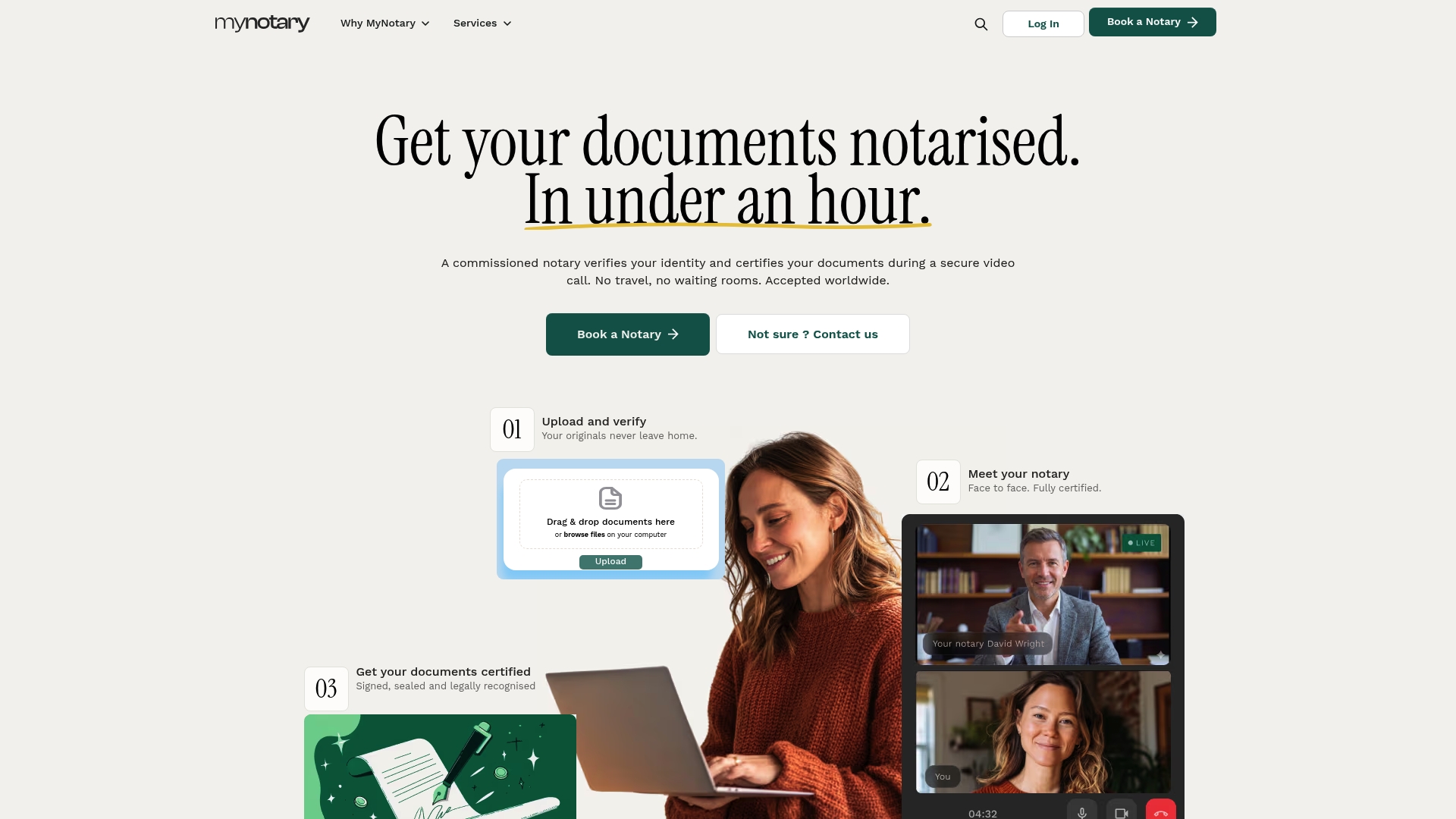
You can see the full range of documents covered, from affidavits and powers of attorney to corporate declarations and certified copies, on the services page. Certified translation and apostille support are available as add-ons where your destination requires them. Booking takes a few minutes, and you upload your unsigned document before the session starts, exactly as this article's checklist describes.
This article is general information, not a substitute for advice from a qualified lawyer. Consult a qualified legal professional about your own circumstances before acting on anything here.
Sources
- Law Commission — electronic execution of documents
- Electronic Communications Act 2000, section 7
- Form ID5 (HM Land Registry) — evidence where identity verified by video call
- HCCH — Apostille Convention and e-APP information
FAQ
Can I notarise documents online in the UK?
Yes, for most affidavits, statutory declarations, powers of attorney, and certified copies, provided your identity is verified and the session is recorded. Deeds, some wills, and documents heading to authorities with strict local rules may need a different route, as outlined in the Law Commission's guidance on electronic execution.
Who verifies identity during an online notarisation session?
A commissioned notary verifies your identity against government-issued photo ID, typically a passport, during the live video call. For conveyancing matters specifically, HM Land Registry requires a colour screenshot and form ID5 when identity is checked by video rather than in person.
How much does online notary service cost in the UK?
Costs vary by document type and any add-ons such as certified translation or apostille. On My Notary, most notarisation services, including affidavits, powers of attorney, and certified true copies, start from £70 one-off.
What is the best online notary platform for UK documents?
The right choice depends on the document and destination, but a strong platform combines biometric identity checks, a recorded session, and a properly issued electronic signature. The platform builds its process around all three, with electronic signatures recognised in many countries and typical turnaround around one hour.
Will a receiving authority always accept a video-notarised document?
Not always. Acceptance depends on the receiving country's or institution's own rules, which is why checking beforehand matters more than the notarisation itself in cross-border cases. Where the destination is a Hague Apostille Convention member, an apostille usually resolves the authentication question.
Recommended
Got questions? We’re on it.
Most questions are answered here, drawn from what people actually ask before booking. If yours isn’t, our team is in chat.
Yes, for most affidavits, statutory declarations, powers of attorney, and certified copies, provided your identity is verified and the session is recorded. Deeds, some wills, and documents heading to authorities with strict local rules may need a different route, as outlined in the Law Commission's guidance on electronic execution.
Last updated: