Get Documents Notarised for Use Abroad in About an Hour
By Jeremy Arhab, Founder · Published 1 September 2026 · Updated 5 September 2026
Find which documents require notarisation for use abroad, how to prepare them, and when to apostille or legalise. Online notarisation can finish in about...

Powers of attorney, affidavits, corporate documents, and certified copies of ID or academic certificates make up the bulk of documents that need notarization for use abroad. Original government-issued certificates such as birth or marriage certificates usually don't need notarising, but photocopies of them almost always do. Read on for the full list, plus what happens after notarisation.
***
TL;DR: - Most notarisation requests involve powers of attorney, affidavits, corporate documents, or certified copies of ID and certificates, especially for international use. - A qualified notary must verify identity, confirm understanding, witness signatures, and apply a seal, which authenticates the document for foreign authorities. - Notarised documents often require apostilles if the destination country is in the Hague Convention, or full legalisation if not. - Remote online notarisation is common for many documents and can typically deliver certified paperwork within about an hour, but some types still demand in-person signing. - Preparation steps like bringing valid ID, original documents, and certified translations can prevent delays and rejections at the appointment.
***
Table of Contents
- Common documents that are frequently notarised
- Who can notarise a document and what the role involves
- Why documents need notarisation in the first place
- The notarisation process step by step
- Apostille and legalisation after notarisation
- Fees, timings and practical constraints
- How to prepare a document for notarisation
- How online notarisation actually works in practice
- Practical takeaways for individuals and businesses
- How My Notary handles the documents on this list
- Sources
- FAQ
Common documents that are frequently notarised
Most notarisation requests fall into a handful of categories, and knowing which one applies to you saves a wasted appointment.
- Powers of attorney covering property, banking, or agency matters abroad are among the most requested notarial acts, particularly when a family member overseas needs to sell a house or manage a bank account on your behalf.
- Affidavits and statutory declarations, sworn written statements courts or authorities abroad ask for when they need a formal, witnessed account of facts.
- Corporate documents, including certificates of incorporation, board minutes, and documents granting a director authority to act, especially when a UK company opens a subsidiary or account overseas.
- Certified copies of ID and academic or professional certificates, since foreign universities, employers, and licensing bodies routinely refuse an uncertified photocopy of a passport or degree.
- Property and transaction paperwork, such as deeds, sale contracts, and mortgage documents tied to an overseas purchase.
- Personal documents like parental consent letters for a child travelling alone, proof-of-life declarations for pension providers, and marriage documentation needed to marry abroad.
Private documents such as these generally need notarising before a foreign institution will accept them, precisely because the institution has no way to independently verify a signature made in another country.
Who can notarise a document and what the role involves
A notary is a specialist legal professional whose job is to verify identity, confirm a signer understands what they're signing, witness the signature, then apply a personal seal and certificate. That combination, known as the notarial act, is what gives a document credibility with an authority that has never met the signer.
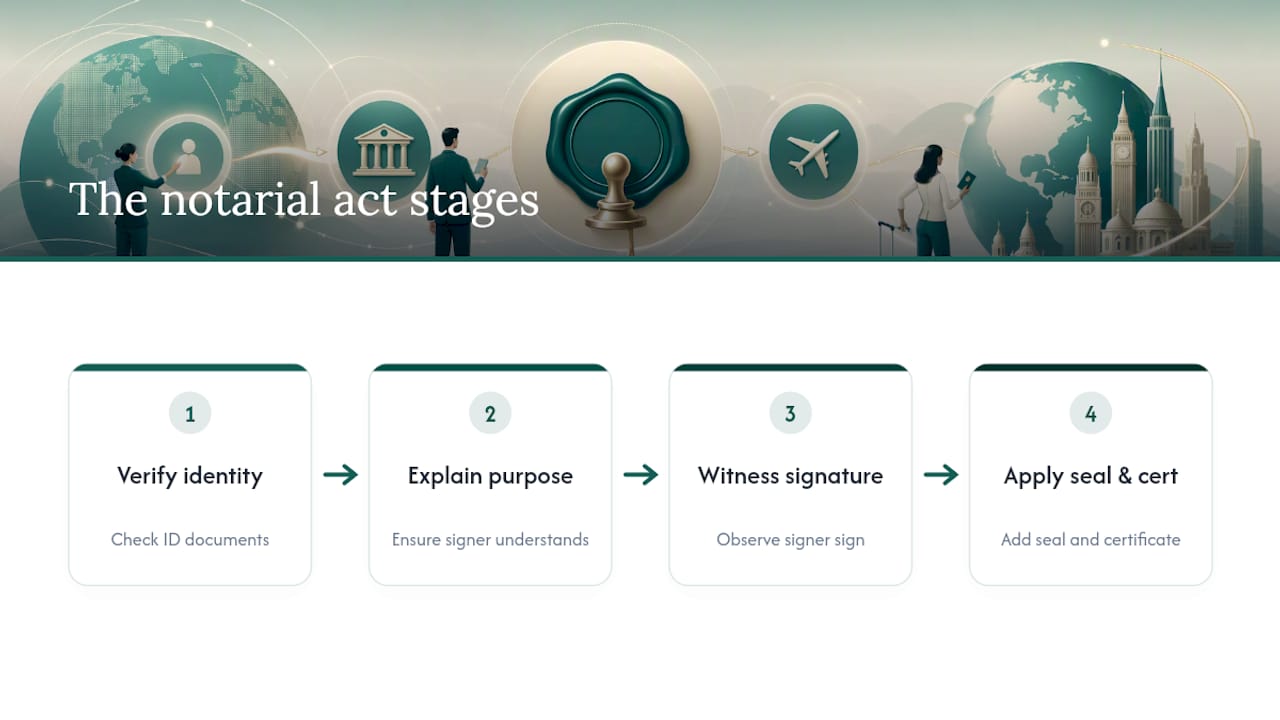
A notary attests authenticity so the finished document is accepted by foreign courts and authorities without further checks on their end. That's the whole point of the exercise: the recipient trusts the notary's seal instead of chasing verification themselves.
A solicitor who is not separately qualified as a notary cannot perform this act, no matter how experienced they are in other areas of law. The distinction is a real one: foreign authorities frequently specify "notary" by name in their requirements, and a document signed by the wrong type of professional gets rejected.
To find a qualified notary, check the Regulated Professions Register, or use an authorised online notarisation service if you'd rather avoid travelling to an office.
Pro Tip: Ask the recipient organisation exactly what wording they expect on the notarial certificate before your appointment. Some banks and universities specify particular phrasing, and a notary can usually accommodate it if you flag it in advance.
Why documents need notarisation in the first place
Notarisation exists to prove three things at once: the signer's identity, that they signed voluntarily, and that a qualified professional witnessed and attested to all of it. A notarised document effectively pre-answers the questions a foreign authority would otherwise have to ask itself.
That's why many overseas recipients accept a notarised document at face value, with no further verification required on their part. Common scenarios that trigger a notarisation request include:
- Buying or selling property abroad, where the notary confirms your identity and intent for the local land registry.
- Immigration applications requiring certified copies of ID, degree certificates, or marital status affidavits.
- Taking up employment overseas, where an employer wants notarised proof of qualifications.
- Setting up or running a company abroad, where notarised corporate documents satisfy a foreign registrar.
The notarisation process step by step
Booking the right appointment starts with knowing exactly where the document is going and what the recipient has asked for. Skipping that step is the single biggest cause of delay.
- Book and specify the destination. Tell the notary the destination country and, if you know it, the recipient's exact wording requirement.
- Gather your documents. Bring the original document (unsigned, if it needs to be signed in front of the notary), a valid passport, and proof of address.
- Attend the appointment. The notary checks your identity, confirms you understand what you're signing, watches you sign, then attaches a notarial certificate and seal.
- Keep your copies. Notaries retain records of the act performed, so you can request confirmation later if a recipient queries the document.
Remote video appointments now cover a large share of routine notarial acts, but some documents still require wet-ink, in-person signing — deeds, wills, and certain oaths among them. A notary can refuse a remote act entirely if they can't adequately confirm identity or capacity over video.
Pro Tip: If your document needs to travel to more than one country, ask whether it can be notarised once and apostilled separately for each destination. It's usually cheaper than starting from scratch each time.
Apostille and legalisation after notarisation
Notarisation is rarely the final step for a document heading abroad. What happens next depends entirely on where it's going.
- If the destination is a member of the Hague Convention, an apostille authenticates the notary's signature, and that's usually the end of the process.
- If the destination is not a Hague signatory, the document typically needs full consular legalisation, involving both the destination country's embassy and, often, an additional government step first.
- Check the recipient's exact instruction before booking anything. Practical experience suggests most delays come from guessing wrong on this point rather than any fault in the notarisation itself.
- Apostilles are obtained after notarisation, and our step-by-step guide covers where to apply and what to expect.
Destination-specific rules vary considerably. Anyone applying for residency in Paraguay, for instance, faces a distinct apostille pathway worth checking well before travel.
Fees, timings and practical constraints
Typical cost: personal documents commonly start around a moderate fee plus VAT per document, with business documents priced higher.
That figure comes from published pricing data for notarising UK documents, and VAT applies to resident clients. Bundling several documents into one appointment usually brings the per-document cost down, since the identity check only needs doing once. In-person appointments can take days to schedule; online notarisation, including with My Notary, commonly turns documents around within about an hour of the appointment itself. Apostille and consular legalisation, translation, and any travel to an office are additional costs on top.
How to prepare a document for notarisation
A few minutes of preparation avoids most rejected appointments.
- Leave the document unsigned if witnessing is required, or bring the original if you need a certified copy made.
- Bring a valid passport and recent proof of address, and check your name is spelled identically across every document involved.
- If the document isn't in English, arrange a certified translation before your appointment, not after.
- Confirm with the recipient whether an apostille or consular legalisation will follow, and build that extra time into your plan.
How online notarisation actually works in practice
Online services typically handle the process through document upload, a live video identity check, and video witnessing of your signature, followed by a stamped and sealed certificate delivered digitally. My Notary supports common documents including powers of attorney, certified copies, and corporate paperwork, with turnaround averaging around one hour. Some acts still require physical presence, so always confirm the destination's exact requirement first.
Practical takeaways for individuals and businesses
Three things matter more than anything else here: check the recipient's exact requirement before booking, gather your ID and originals in advance, and budget time and money for apostille or legalisation as a separate step. Where speed matters and the document qualifies for remote signing, a reputable online notary is worth considering over a traditional office visit.
— Jérémy
How My Notary handles the documents on this list
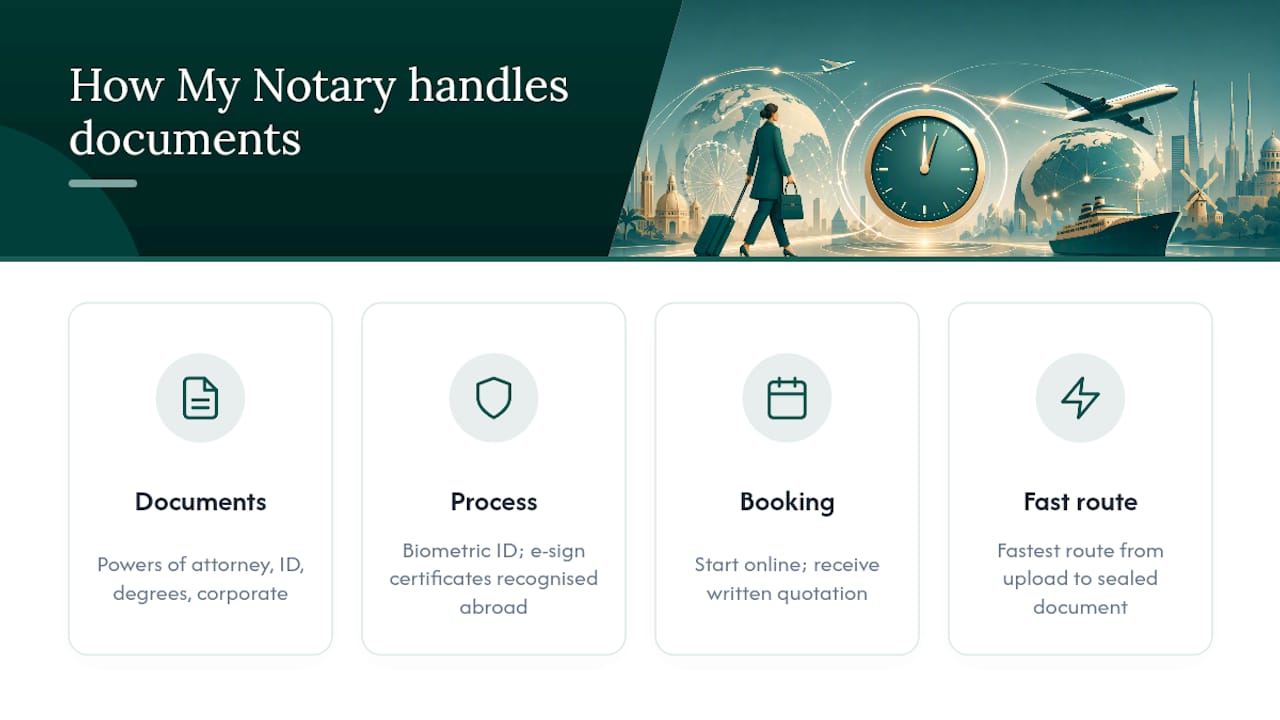
My Notary is built around exactly the documents covered here: powers of attorney, certified copies of ID, degree certification, and corporate paperwork, all notarised over a secure video call instead of a waiting-room appointment.
The process runs on biometric identity verification and electronically signed certificates recognised in many countries, with a typical quick turnaround from booking to a finished, sealed document. That speed matters most when a foreign recipient has already set a deadline and a physical appointment simply isn't practical.
If you need a power of attorney notarised for banking abroad, a degree certificate certified for a visa application, or corporate documents notarised for an overseas subsidiary, you can start the booking online and get a written quotation before committing to anything. For straightforward signature work, the online signature certification service is the fastest route from upload to sealed document.
Sources
For destination-specific rules, check GOV.UK's guide to getting a document legalised and the Regulated Professions Register for verifying a notary's credentials.
- What is a Notary? - The Faculty Office
- Gov
- United Kingdom Notary Public: Fees, Process, and Regulation - LegalClarity
- What is a notary public and when might your business need one?
FAQ
What documents need notarisation?
Powers of attorney, affidavits, statutory declarations, corporate documents, and certified copies of ID or academic certificates are the documents most commonly requiring notarisation for use abroad.
Who can notarise a document?
Only a commissioned notary can perform a notarial act; other legal professionals, including solicitors, cannot notarise documents unless separately qualified as notaries.
Why would a document need to be notarised?
Notarisation proves identity, confirms the signature was made voluntarily, and gives foreign authorities a verified document they can accept without further checks.
What does it mean when a document is notarised?
It means a notary has verified the signer's identity and capacity, witnessed the signature, and applied a personal seal and certificate confirming the act took place.
Do original government-issued documents need notarising?
Usually not. Originals like birth or marriage certificates are typically accepted as issued, but photocopies of them generally need certifying as true copies first.
Recommended
Got questions? We’re on it.
Most questions are answered here, drawn from what people actually ask before booking. If yours isn’t, our team is in chat.
Powers of attorney, affidavits, statutory declarations, corporate documents, and certified copies of ID or academic certificates are the documents most commonly requiring notarisation for use abroad.
Last updated: