Get UK Visa Documents Notarised in Around an Hour
By Jeremy Arhab, Founder · Published 30 August 2026 · Updated 30 August 2026
Check the embassy checklist wording, follow notarisation then apostille or consular legalisation in order, and use online notaries to speed UK visa documents.
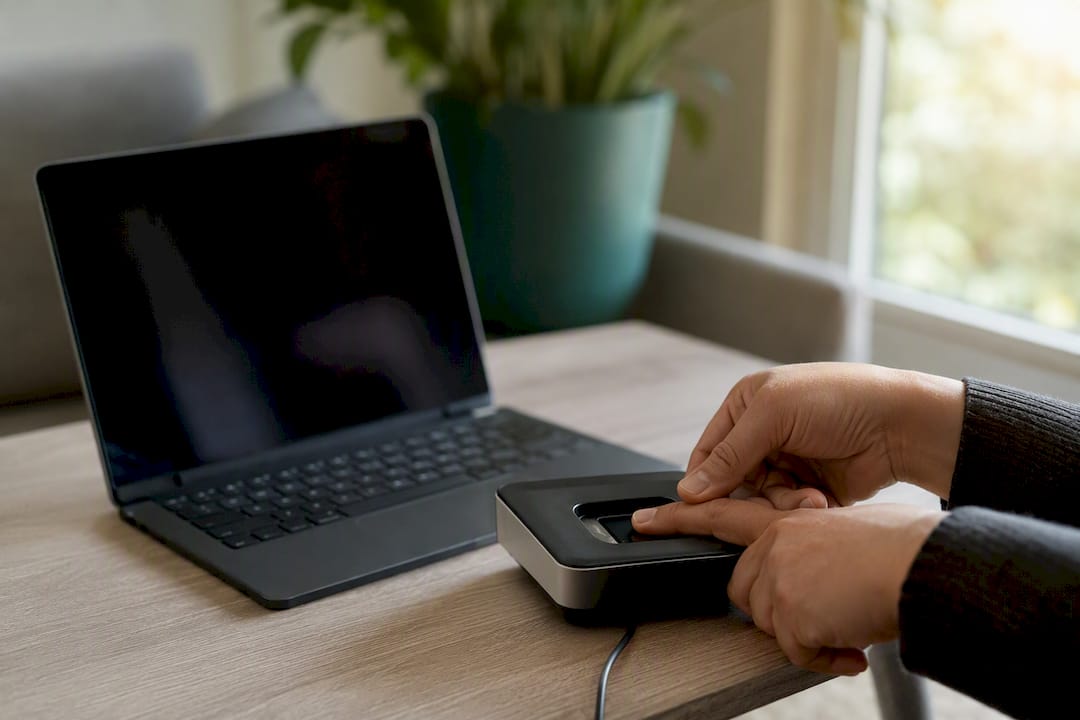
Notarisation is not automatic for visa applications: it depends entirely on the wording of the receiving authority's checklist, not on a general rule. Some documents need a notarised copy, others need only a certified copy, and some need nothing more than the original. My Notary offers a fast online route for many of these cases. Your first move is simple: pull up the exact visa checklist and confirm which authentication terms it uses.
***
TL;DR: - Notarisation requirements for visa documents vary depending on the visa type, destination country, and specific document, making verification essential. - Commonly notarised documents include affidavits, sponsor declarations, powers of attorney, and birth or marriage certificates, often due to their legal weight. - The sequence matters: you must notarise first, then apply for an apostille or consular legalisation, with each step having distinct procedures and acceptance criteria. - Online notarisation via platforms like My Notary offers same-hour processing with biometric verification, but you must confirm destination acceptance before relying on digital signatures. - Always follow the visa checklist wording precisely, screenshot it before booking, and clarify whether the authority requires notarisation, certification, or legalisation to prevent document rejection.
***
Table of Contents
- When is a notary required for visa documents?
- Common visa documents that often need notarisation
- Notarisation, apostille, and legalisation: what's the correct order?
- How to get visa documents notarised, step by step
- Timelines and costs for notarisation, apostille, and translation
- Checklist for your notary appointment
- How MyNotary works for visa documents
- What qualifications do notarising officers need?
- How do different countries' notarisation standards affect visa acceptance?
- How do you notarise documents originally issued in a foreign language?
- Follow the wording, not your assumptions
- Complete your visa document notarisation with My Notary
- Sources
- FAQ
When is a notary required for visa documents?
Requirements swing depending on the visa category, the destination country, and even which specific document you're submitting. A tourist visa might ask for nothing more than a bank statement in its original form. A settlement or work visa, on the other hand, often demands notarised affidavits, sworn declarations, or powers of attorney because the receiving authority wants independent verification that a signature is genuine.
Notarisation typically becomes necessary in situations where someone is attesting to something under oath, or where a copy of an original document needs to be certified as true. Sponsor declarations, affidavits of relationship, and powers of attorney are the classic examples, largely because these documents carry legal weight that a plain signed letter doesn't.
The tricky part is language. "Notarised copy" and "certified copy" sound interchangeable but often aren't. A notarised copy usually means a notary has witnessed the signing or verified the copy against the original and applied their seal. A certified copy can sometimes be done by a solicitor, accountant, or other authorised person without full notarial procedure, depending on the destination's rules.
Given how much this varies, verification matters more than memorising a rule of thumb. Three reliable ways to confirm requirements:
- Check the specific visa application checklist published by the embassy or consulate handling your case.
- Call or email the visa application centre processing your documents if the wording is ambiguous.
- Request written consular guidance where the checklist doesn't specify the exact authentication format.
Consular notarial services are often limited, which is one reason so many applicants turn to an independent notary or an online notarisation service instead of assuming an embassy can handle it directly.
Common visa documents that often need notarisation
Certain document types show up again and again on visa checklists, and knowing which ones typically trigger a notarial requirement saves time before you even book an appointment.
- Certified true copies of passports — frequently required alongside the original for identity verification.
- Birth and marriage certificates — often need notarisation, particularly for family or spousal visa categories.
- Affidavits of relationship — used where family ties must be sworn to under oath.
- Sponsor declarations — common in student and dependant visa routes.
- Powers of attorney — needed when someone else is managing your application or finances on your behalf.
- Academic certificates and transcripts — required for study or skilled worker visas.
- Bank statements and employment letters — sometimes need certification, though notarisation is less common here.
Public and court records, such as birth or marriage certificates issued by a government registry, are the documents most likely to need an apostille after notarisation. Private declarations like affidavits usually stop at the notarisation stage unless the destination specifically demands further authentication.
If any of these documents were originally issued in a language other than the destination country's official language, a translation requirement kicks in on top of the notarisation. A certified translation for visa purposes must include the translator's name, a statement of accuracy, and contact details, and this is a separate step from notarisation, not a substitute for it.
Notarisation, apostille, and legalisation: what's the correct order?
These four terms get used almost interchangeably by applicants, and that confusion causes more rejected submissions than any other single mistake. Each one does a distinct job:
- Notarisation confirms identity and witnesses a signature, or certifies that a copy matches its original.
- Certified copy is a verified true copy of an original document, sometimes done by a notary, sometimes by another authorised professional depending on jurisdiction.
- Apostille is a standardised certificate recognised between countries that are party to the Hague Apostille Convention, confirming the notary's seal and signature are genuine.
- Consular legalisation is the equivalent process for non‑Hague countries, where the destination's embassy verifies the document directly instead of relying on an apostille.
Callout: An apostille only works between Hague Convention member states. For any other destination, consular legalisation is the required substitute, and it typically adds significant extra time to your timeline.
The fail-safe sequence to follow:
- Get the document notarised first.
- Check whether the destination is a Hague Convention member.
- If yes, apply for an apostille through the relevant government office.
- If no, submit the notarised document for consular legalisation at the destination's embassy.
- Arrange any certified translation, sequenced according to what the receiving authority specifies (some want the translation notarised too, others don't).
Notarisation is often only step one of a longer chain, and skipping ahead or reordering these steps is one of the most common reasons documents get bounced back.
How to get visa documents notarised, step by step
Before booking anything, gather your originals, a valid form of photo ID, and the exact wording your visa checklist uses. This last point matters more than people expect. If the checklist says "notarised copy of passport" but you turn up with a "certified copy," you may need to start again.
The process itself follows a consistent structure whether you go in person or online:
- Book an appointment with a notary, either in person or via a video-based platform.
- Verify your identity using photo ID and, for online services, biometric checks.
- Sign or present the document in front of the notary, who witnesses the signature or compares your copy against the original.
- Receive the notarised document, either a sealed paper copy or an electronically signed PDF with an audit trail.
Remote Online Notarisation (RON) has become a genuine alternative to booking an in-person slot. It works through a secure video session where the notary verifies your identity, witnesses the signing, and produces an electronic notarial certificate with a built-in audit trail. The technical requirements are straightforward: a working camera, a stable connection, and valid photo ID.
The catch is acceptance. Not every receiving authority recognises RON output, and this varies by country and even by specific visa category. Confirm two things before you rely on it: whether the destination accepts electronically notarised documents at all, and whether the apostille office in your jurisdiction can process an electronically notarised document if one is needed next.
Pro Tip: Screenshot or save the exact checklist wording from the embassy's website before you book your notary appointment. If a dispute arises later about whether "certified" or "notarised" was required, you'll have the original source to point to.
If your document needs to move on to apostille or legalisation afterwards, ask the notary in advance whether their sealed output, whether paper or a signed PDF, is accepted by the apostille office you'll be using. This one question prevents a surprisingly common bottleneck.
Timelines and costs for notarisation, apostille, and translation
Same-day notarisation is realistic if you can get an appointment, and online platforms often move faster than walk-in solicitor offices simply because there's no travel time involved. Once notarisation is done, the clock resets for the next stage.
- Notarisation: often same-day, subject to appointment availability.
- Apostille: same-day if processed in person, or several working days when submitted by post.
- Consular legalisation: can add multiple weeks depending on the destination embassy's own procedures.
- Certified translation: turnaround varies by document length and language pair, typically a few working days.
Callout: Rush processing exists at every stage of this chain, but it comes at a premium, and stacking rush fees across notarisation, apostille, and translation can meaningfully inflate your total cost.
Costs increase with the number of documents, whether translation is needed on top of notarisation, and whether the destination country requires the more expensive consular legalisation route rather than a straightforward apostille. Build in contingency time rather than assuming the fastest-case scenario for every stage.
Checklist for your notary appointment
A rushed appointment is where most avoidable mistakes happen. Bring the following:
- Original documents, not photocopies.
- Valid photo ID (passport or driving licence, depending on what the notary accepts).
- Proof of address if requested.
- Clean, legible scans if you're using an online service, saved with clear file names.
Common mistakes worth flagging before you book:
- Assuming a certified translation removes the need for notarisation, or vice versa. They're separate requirements.
- Missing the apostille step entirely because the checklist wording was ambiguous.
- Re-scanning a tamper-evident PDF, which can invalidate its digital seal.
- Not confirming in advance whether a witness is required alongside the notary.
Ask your notary directly about witness requirements, the exact certificate wording they'll apply, and whether they can advise on the apostille process that follows. A five-minute conversation here saves a week of correction later.
How MyNotary works for visa documents
My Notary handles the notarisation stage of this chain entirely online, through secure video calls with biometric identity verification. Electronic signatures produced this way are recognised in over 180 countries, and the average turnaround sits around one hour, a significant contrast to booking a solicitor's appointment and waiting days for a slot.
Services relevant to visa applications include:
- Certified copies of passports for identity verification.
- Degree certification for visa applications for study or skilled worker routes.
- Marital status affidavits for spousal or family visa categories.
Online notarisation suits documents where the receiving authority explicitly accepts RON. For destinations that still insist on physical presence or wet-ink signatures, in-person notarisation remains the safer choice.
What qualifications do notarising officers need?
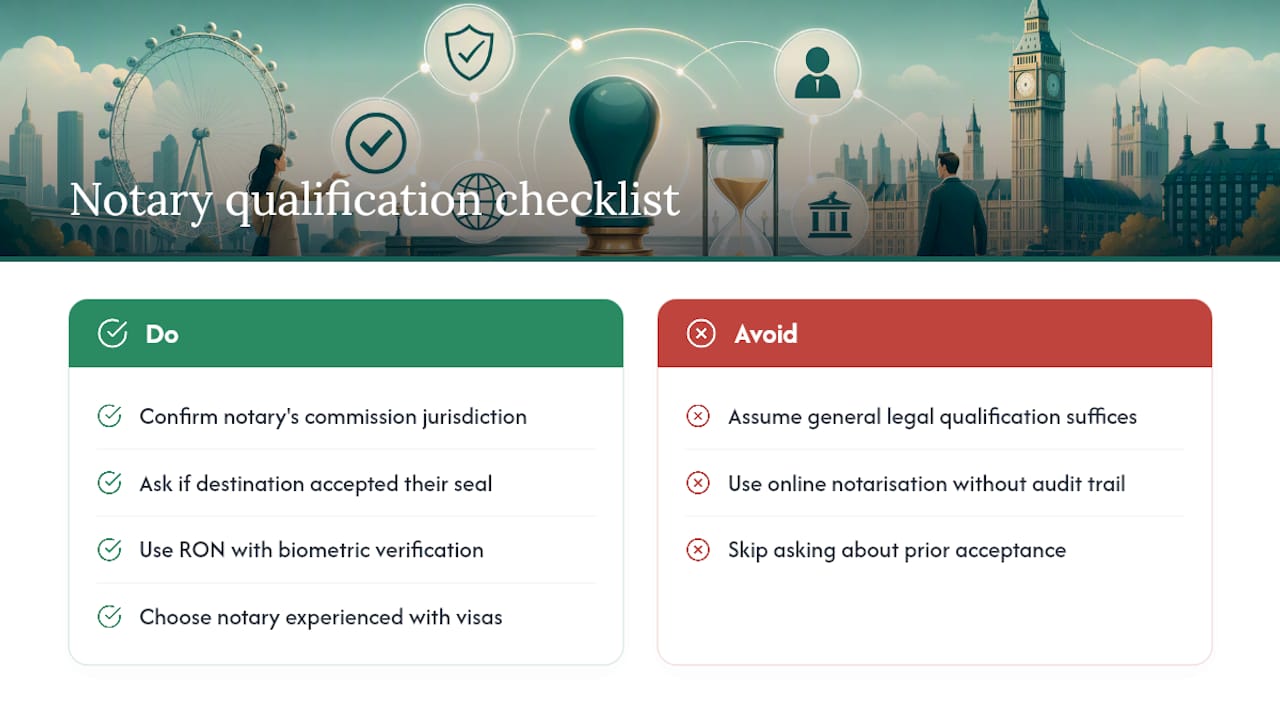
Notarising officers must hold formal authorisation from the relevant appointing body in their jurisdiction before they can witness signatures or certify documents for legal use. This authorisation, rather than any general legal qualification, is what gives their seal weight with foreign receiving authorities.
For online notarisation, the same underlying authorisation applies. The notary conducting a video session must still be a properly commissioned officer, and biometric identity verification during the call replaces the physical presence check that an in-person appointment provides. This is precisely why RON platforms build audit trails into every session, so a receiving authority can trace exactly how identity was confirmed if questions arise later.
If you're arranging notarisation for a visa document, it's worth asking the notary directly which jurisdiction their commission covers, and whether their seal is one the destination country has previously accepted for similar documents. Notaries who regularly handle visa and immigration paperwork will usually know the common pitfalls for specific destinations, because they've seen where other applicants have gone wrong.
How do different countries' notarisation standards affect visa acceptance?
Notarial systems are not standardised worldwide, and that inconsistency is exactly why the apostille and legalisation chain exists in the first place. A notary's seal that's fully valid in one country carries no automatic weight in another unless an apostille or consular legalisation bridges that gap.

Hague Convention member states accept an apostille as sufficient proof that a notarial seal is genuine, without needing further embassy involvement. Non-Hague destinations, some Gulf states among them, often require an extended chain: notary, then apostille, then consular legalisation, then sometimes an additional in-country ministerial attestation once the document arrives. Missing any link in that sequence, or completing it out of order, is a common reason documents get rejected outright rather than simply delayed.
This is also where checking the receiving authority's own wording becomes non-negotiable rather than a nice-to-have. Two countries with visa categories that sound almost identical can have completely different authentication chains behind the scenes. A country-specific apostille guide is a useful starting point for confirming which route applies before you commit to a notary appointment.
How do you notarise documents originally issued in a foreign language?
Notarising a foreign-language document works the same way procedurally: the notary still verifies identity, witnesses the signing, or certifies the copy against the original. What changes is what happens around that step. Most notaries won't (and often can't) certify that a translation is accurate, because that's a distinct professional skill from notarisation itself.
The safer sequence is to get the original document notarised first, then arrange a certified translation separately. A properly certified translation includes the translator's name, a signed statement of accuracy, and contact details, and some receiving authorities want that translation notarised too, as a document in its own right, once it exists.
Where things go wrong is when applicants assume notarising a document somehow validates its translation, or skip the translator's certification because "the notary already signed off on it." Read the checklist wording carefully here: if it asks for a "certified translation," that's a translator's certification, not a notarial one, even though both processes might ultimately touch the same piece of paper.
Follow the wording, not your assumptions
Most rejected visa documents don't fail because someone used the wrong notary. They fail because someone read "certified" and assumed it meant "notarised," or vice versa, and built their entire authentication chain on that guess. The receiving authority's exact wording is the only source of truth here, and it's worth treating every other guide, including this one, as background rather than gospel for your specific case.
The practical habit worth building: before booking anything, screenshot the checklist, note the exact terms used, and work backwards from there. Build the apostille or legalisation step into your schedule from day one rather than treating it as an afterthought once notarisation is done.
— Jérémy
Complete your visa document notarisation with My Notary
Booking a solicitor's appointment, then waiting days for a slot, then travelling to sign in person, is the traditional route, and it's often the slowest part of an already tight visa timeline. My Notary removes that wait: sessions happen over secure video call, with biometric identity verification replacing the need to turn up anywhere in person, and most documents come back within around an hour.
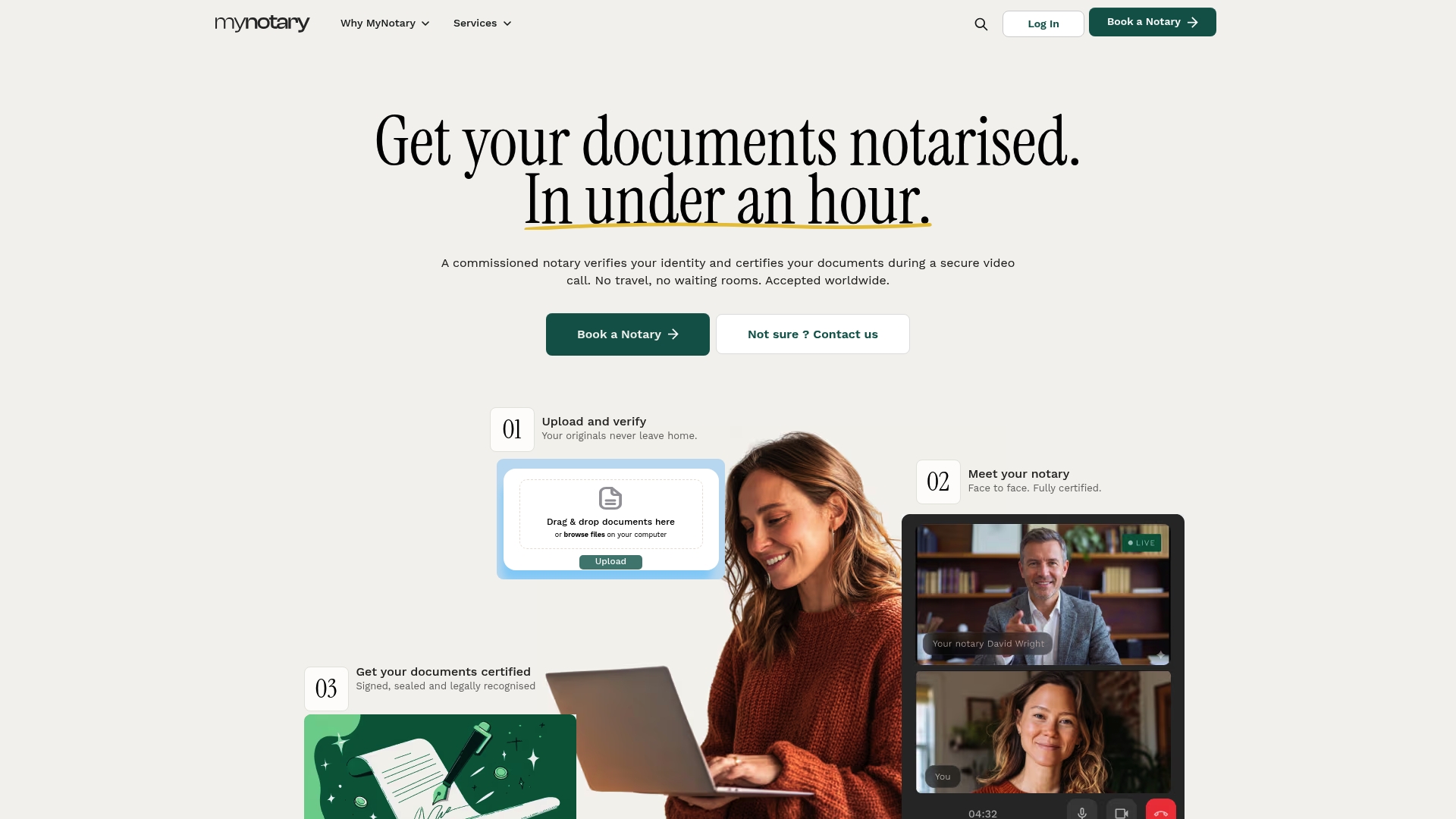
For visa applications specifically, this matters because so many documents in the chain, sponsor declarations, affidavits, powers of attorney, sit on a deadline you can't move. My Notary's marital status affidavit service and degree certification for visa applications are built around exactly this kind of time pressure, with electronic signatures recognised across more than 180 countries once the notarisation stage is complete. If you're ready to move forward, check which of your visa documents qualifies for online notarisation and book a session today.
Sources
- Gov
- Do I Need a Notary for Visa Documents? — Notary NI
- Visa application documents — what needs notarisation — Phelan Solicitors
- Apostille vs certified translation — Taika Translations
- How to notarize documents online — Orange County Apostille
Always confirm the exact checklist wording in writing before you book any appointment.
FAQ
What documents need notarisation for a visa application?
It depends on the visa category, but affidavits, sworn declarations, sponsor declarations, and powers of attorney are among the documents most commonly notarised. Always check the specific embassy checklist rather than assuming.
Who can notarise documents for a visa application?
A commissioned notary who holds formal authorisation from the relevant appointing body can notarise visa documents, whether in person or via a secure online video session like those offered through My Notary.
Can a notarised document from one country be used in another?
Often, yes, but usually only after an apostille (for Hague Convention destinations) or consular legalisation (for non-Hague destinations) has been added, since a notary's seal alone rarely carries automatic weight abroad.
Does online notarisation work for visa documents?
Online notarisation works for many visa documents where the receiving authority accepts Remote Online Notarisation, but you should confirm acceptance before relying on it, since not every destination recognises electronically notarised paperwork.
Is a certified translation the same as a notarised translation?
No. A certified translation requires a translator's signed statement of accuracy, while notarisation verifies identity or witnesses a signature, and neither process substitutes for the other.
Recommended
Got questions? We’re on it.
Most questions are answered here, drawn from what people actually ask before booking. If yours isn’t, our team is in chat.
It depends on the visa category, but affidavits, sworn declarations, sponsor declarations, and powers of attorney are among the documents most commonly notarised. Always check the specific embassy checklist rather than assuming.
Last updated: