Secure document delivery: the UK guide for 2026
By Jeremy Arhab, Founder · Published 5 August 2026 · Updated 5 August 2026
Discover how to ensure secure document delivery in the UK for 2026. Learn about the essential elements for online notarization and verification.

Yes, notarised documents can be delivered securely online. The condition is that delivery uses a Qualified Electronic Signature (QES), a tamper-evident digital seal, end-to-end encryption, and a verifiable audit trail. When those four elements are present, a recipient anywhere in the world can confirm the file is genuine, unaltered, and issued by a commissioned notary.
Before you rely on any delivered file, check it carries all of the following:
- A QES certificate issued by a qualified trust service provider
- A tamper-evident digital seal and electronic time-stamp
- A verifiable audit trail showing who accessed the file and when
- Access controls (password, expiry link, or secure portal login)
- A commissioned notary record identifying the notary who performed the act
My Notary combines every one of these elements in a single online workflow, making it a practical choice for UK individuals and businesses who need certified documents without travelling to a notary's office.
***
Table of Contents
- How does the full online notarisation and secure delivery process work?
- What technologies make encrypted document sharing trustworthy?
- What legal recognition should UK users expect from a digitally delivered notarised document?
- Who uses secure online delivery of notarised documents?
- How do you choose a provider for secure online document transmission?
- What should you prepare, and how long does it take?
- How do recipients verify a delivered notarised document?
- Key takeaways
- Why integrated workflows reduce rejection risk
- My Notary: book your online notarisation and secure delivery today
- Further reading and sources
- FAQ
How does the full online notarisation and secure delivery process work?
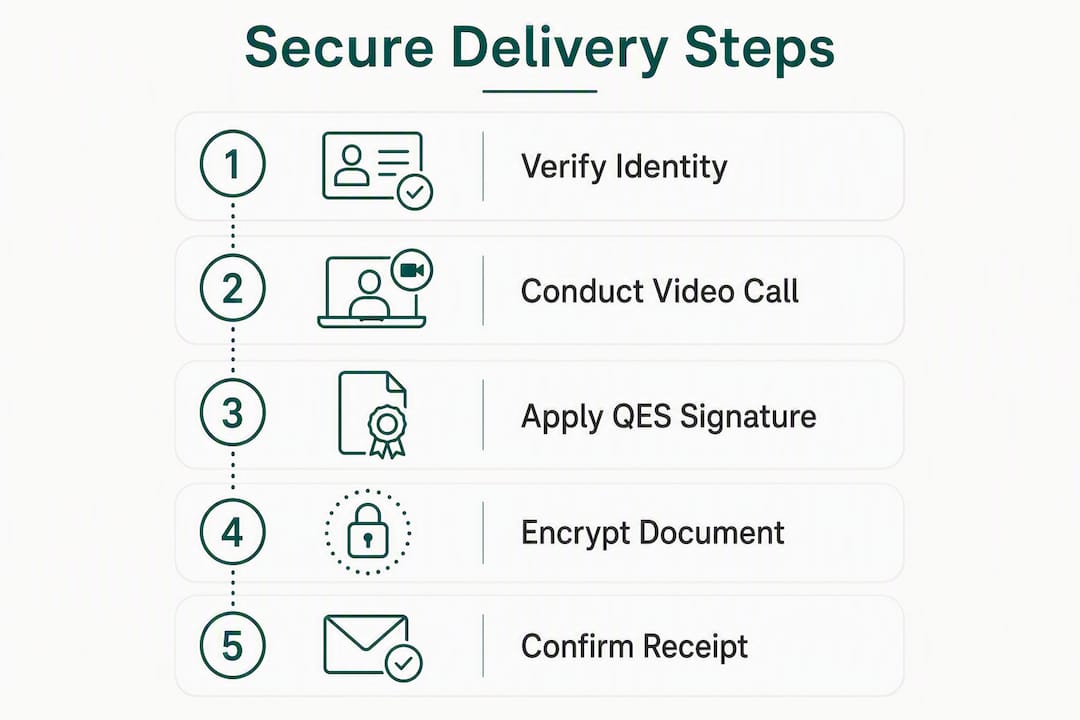
The process moves through six clearly defined stages, each with its own security control.
- Upload your document. You submit your document through a secure portal. Files are encrypted in transit from the moment you upload them.
- Identity verification. You complete biometric ID checks, typically a photo ID scan and a liveness test, before the session begins. The notary verifies your identity and views the document on the platform.
- Live video call with a commissioned notary. The notary conducts a video conference to confirm your understanding, free will, and capacity. Where you are signing electronically, best practice guidance recommends the notary control the signing process through their own platform account.
- QES and tamper seal applied. The notary issues the electronic notarial act, applying a QES and an electronic facsimile of their seal of office to the document.
- Encrypted delivery. The sealed file is delivered through a registered delivery service or secure portal link, with access controls and an expiry date where appropriate.
- Recipient verification. The recipient validates the QES certificate, checks the tamper seal, and reviews the audit trail directly within the file or portal.
The session recording is retained as evidence of the remote meeting, with your prior consent, in line with practice rules. That recording forms part of the audit package that overseas authorities may request.
Pro Tip: Before booking, confirm with the receiving authority whether they accept a purely digital notarised file or require a physical certified copy. Checking this in advance prevents the most common cause of delay.
***
What technologies make encrypted document sharing trustworthy?
Moving notarisation online shifts it from a paper administrative task to a technical, high-security process. Three layers of technology carry the weight.
- Qualified Electronic Signature (QES). QES is the highest level of electronic signature assurance, created by a qualified signature creation device and based on a qualified certificate issued by a qualified trust service provider. Recipients can validate it directly in a PDF reader or trust-service portal.
- Tamper-evident digital seal and electronic time-stamp. The seal locks the document's content at the moment of notarisation. Any subsequent alteration breaks the seal visibly. The time-stamp proves when the notarial act occurred.
- End-to-end encryption and registered delivery. Electronic registered delivery services protect data against loss, theft, or unauthorised alteration and provide proof of delivery and receipt. Plain email does not meet this standard.
- Verifiable audit trail. The access log records every interaction with the file: who opened it, when, and from which device. Courts and overseas authorities frequently request this evidence.
Trust services such as time-stamps and registered delivery are not optional extras. They supply the provenance and handling evidence that courts and overseas authorities require alongside the signature itself.
***

What legal recognition should UK users expect from a digitally delivered notarised document?
A properly issued electronic notarial act carries a commissioned notary record, a QES, and an auditable notarial certificate. For many cross-border transactions, that combination is sufficient. Guidance is clear that notaries should apply the highest available level of electronic signature and an electronic facsimile of their seal to electronic notarial acts.
What you should verify before relying on a digital file:
- Whether the receiving jurisdiction accepts electronic notarial acts without further formality
- Whether an apostille or legalisation is required for the destination country
- Whether the recipient institution (a bank, university, or government body) has its own acceptance policy
- Whether a certified physical copy is needed alongside or instead of the digital file
Where a physical copy becomes necessary after a remote session, guidance permits a repeat notarisation when the original document is provided within 30 days of the remote act.
Pro Tip: Always confirm acceptance rules with the receiving authority before the notarisation session, not after. A notary must be satisfied that the procedure will produce an acceptable document, or inform you that acceptance is not guaranteed.
***
Who uses secure online delivery of notarised documents?
The range of people and organisations that rely on this document delivery service is broader than most expect.
- Expats and overseas residents needing certified copies of passports, national IDs, or bank statements for foreign authorities
- Students and graduates requiring degree certification for visa applications or certified qualifications for overseas employers
- Remote employees providing witness statements, notarisation of employment contracts, or professional registration documents
- SMEs and corporate teams handling powers of attorney for banking, corporate document certification, or cross-border filings
- Individuals in family or immigration matters requiring affidavits or certified copies for visa applications
One limitation applies across all these scenarios: where a transaction involves a high-risk situation or a vulnerable party, a notary may determine that an in-person procedure is more appropriate. Remote notarisation is not suitable for every case.
***
How do you choose a provider for secure online document transmission?
The checklist below covers the minimum a credible provider must offer.
Must-have features:
- QES support from a qualified trust service provider
- Tamper-evident digital seal on every notarised file
- Recorded audit trail and access log
- Biometric identity verification before the session
- End-to-end encryption for file transfer and storage
- Commissioned notary on record for every act
- Verifiable electronic certificate recipients can check independently
Questions to ask any vendor:
- What evidence will the recipient see in the delivered file?
- In which certificate format is the QES issued, and which trust-service portal can validate it?
- How long are session recordings and audit records retained?
- Do you offer apostille or legalisation add-ons for cross-border use?
- Can you confirm acceptance in the receiving jurisdiction before I book?
Red flags to avoid:
- No QES, or only a simple or advanced electronic signature offered as equivalent
- No audit trail or access log on delivered files
- Delivery by plain email with no registered delivery service or access controls
- Inability to show the commissioned notary's record or seal on the document
***
What should you prepare, and how long does it take?
Your step-by-step workflow:
- Prepare your original document and a clear digital copy, plus valid photo ID.
- Upload your document securely through the platform portal.
- Complete biometric ID checks (photo ID scan and liveness verification).
- Join the live video call with the commissioned notary.
- Receive your QES-sealed file and secure delivery link, typically within one hour.
Timeline factors: Most integrated platforms complete the full process, from upload to delivery, within an hour for straightforward documents. Identity check queues, notary availability, and optional apostille or certified translation add-ons extend that window. Physical certified copies, where needed, add postal transit time.
Cost components to budget for:
- Per-transaction notarisation fee
- QES and trust-service fees (sometimes bundled)
- Certified translation, where the destination requires it
- Apostille or legalisation, for countries that require it
- Optional secure courier for physical certified copies
***
How do recipients verify a delivered notarised document?
Recipients do not need specialist software. A standard PDF reader or the provider's secure portal is sufficient for most checks.
Recipient verification checklist:
- Validate the QES certificate: open the file's signature panel; the certificate should show as valid and issued by a recognised trust service provider.
- Check the tamper seal and time-stamp: any alteration after notarisation will show as an invalid seal; the time-stamp confirms the date and time of the notarial act.
- Review the audit trail: the access log confirms who has handled the file since delivery.
- Confirm the commissioned notary's details: the notary's name, seal facsimile, and notarial certificate should be visible within the document.
The most common causes of rejection are a missing QES (replaced by a weaker signature type), an absent audit trail, or delivery by a method that strips metadata and certificates from the file. Insisting on a registered delivery service or secure portal, rather than plain email, prevents all three.
***
Key takeaways
Secure electronic delivery of notarised documents is reliable when the file carries a QES, a tamper-evident seal, an auditable access log, and is transmitted through a registered delivery service or encrypted portal.
| Point | Details |
|---|---|
| QES is non-negotiable | Only a Qualified Electronic Signature provides the highest level of assurance recipients and overseas authorities can independently verify. |
| Confirm acceptance before booking | Check with the receiving authority whether they accept a digital notarised file or require an apostille or physical certified copy. |
| Audit trail proves handling | A verifiable access log is the evidence courts and foreign bodies request alongside the signature itself. |
| Physical follow-up is possible | If a physical copy is needed after a remote session, a repeat notarisation is permitted when the original is provided within 30 days. |
| My Notary as integrated option | My Notary combines biometric ID checks, video notary calls, QES issuance, tamper seals, and secure delivery in a single workflow. |
***
Why integrated workflows reduce rejection risk
The conventional advice is to find a notary and then worry about delivery separately. That approach creates a gap where documents lose their integrity: certificates get stripped, audit trails disappear, and recipients receive a file they cannot verify. The problem is not the notarisation itself; it is the handoff between notarisation and delivery.
An integrated platform closes that gap by design. When identity verification, the video call, QES issuance, and encrypted delivery all happen within the same system, the audit trail is continuous and the file arrives with every verification artefact intact. The commissioned notary record, the QES, and the delivery log travel with the document rather than existing as separate attachments that can be lost or separated.
For cross-border transactions in particular, that continuity matters. A receiving authority in another country is not going to chase down a missing certificate or accept a verbal assurance that the original was properly notarised. The file either carries the evidence or it does not.
***
My Notary: book your online notarisation and secure delivery today
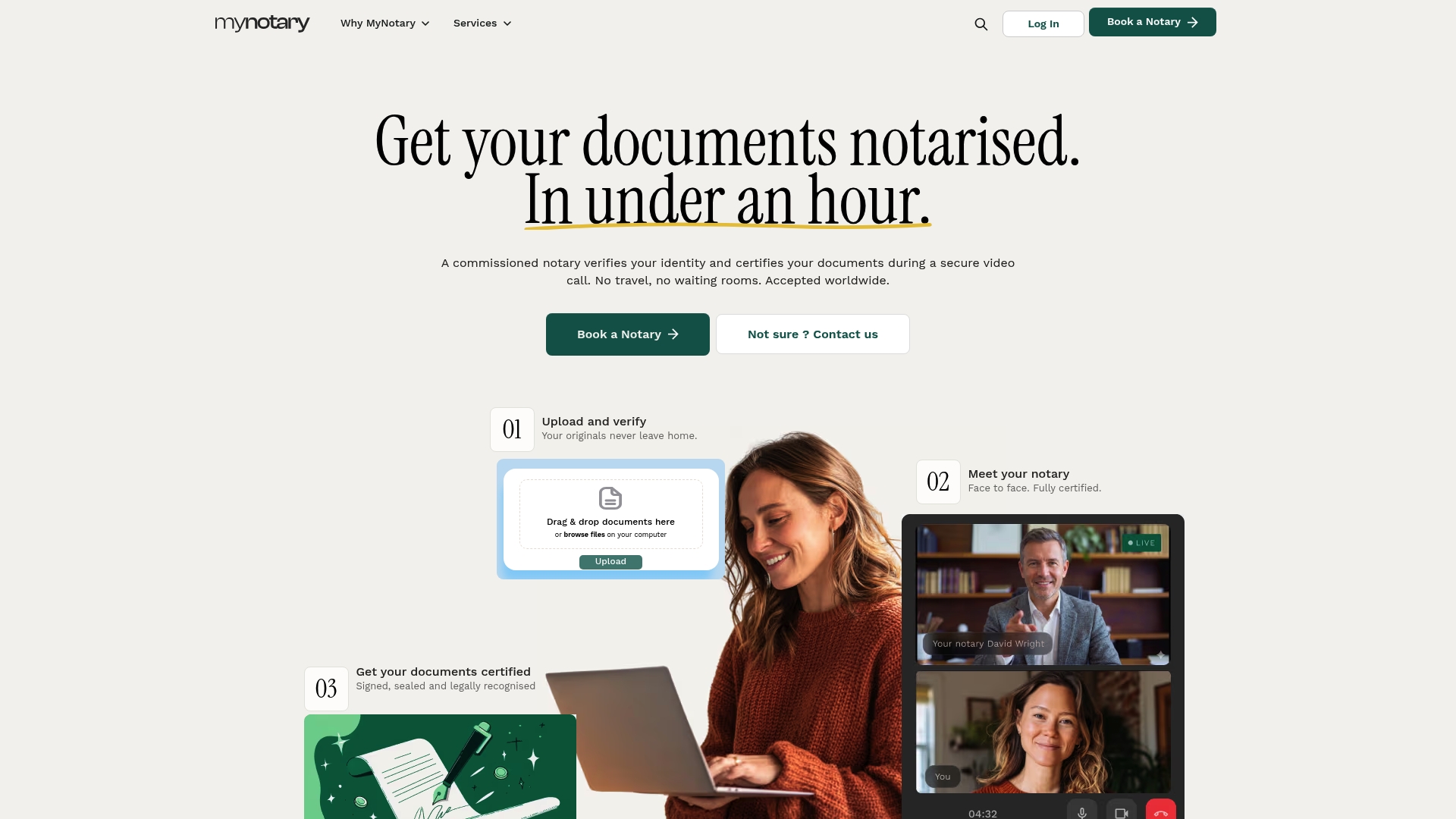
My Notary gives UK individuals and businesses a faster, more reliable alternative to the traditional notary appointment. The platform handles biometric identity verification, a live video call with a commissioned notary, QES issuance, tamper sealing, and encrypted delivery in a single session, with an average turnaround of one hour. Optional apostille and certified translation add-ons mean you can handle cross-border requirements without switching providers. Electronic signatures are recognised in over 180 countries.
Whether you need a single document certified or a corporate package for ongoing cross-border filings, My Notary covers both. View the full range of notarisation services and book your session online today.
***
Further reading and sources
- Electronic signatures and trust services — BEIS guidance
- Electronic Documents and Electronic Notarial Acts — guidance on QES and notarial seals
- Guidance on remote notarisation — video call protocols and evidence retention
- Online notarisation UK: the complete guide — My Notary blog
***
FAQ
What is secure document delivery in the context of notarisation?
Secure document delivery means transmitting a notarised or certified digital file using end-to-end encryption, a Qualified Electronic Signature, and a registered delivery service or secure portal, so the recipient can verify its authenticity and integrity independently.
Is a digitally delivered notarised document legally valid in the UK?
Yes, provided it carries a QES and an electronic facsimile of the notary's seal. Acceptance by overseas authorities depends on the receiving jurisdiction's rules, and an apostille may be required for some countries.
How long does online notarisation and secure delivery take with My Notary?
My Notary's average turnaround is one hour for straightforward documents, covering identity verification, the video call, QES issuance, and encrypted delivery. Optional apostille or certified translation add-ons extend the timeline.
What should I do if a recipient rejects my digitally delivered document?
Check whether the file carries a valid QES, a tamper seal, and an audit trail. Rejection most often occurs when delivery was made by plain email, stripping the file's certificates and metadata. Re-deliver through a registered delivery service or secure portal.
Can I get a physical certified copy after an online notarisation session?
Yes. If you provide the original document within 30 days of the remote session, a repeat notarisation can be performed to produce a physical certified copy where the receiving authority requires one.
Recommended
Got questions? We’re on it.
Most questions are answered here, drawn from what people actually ask before booking. If yours isn’t, our team is in chat.
Secure document delivery means transmitting a notarised or certified digital file using end-to-end encryption, a Qualified Electronic Signature, and a registered delivery service or secure portal, so the recipient can verify its authenticity and integrity independently.
Last updated: