Sworn translation in the UK: your complete guide
By Jeremy Arhab, Founder · Published 31 July 2026 · Updated 31 July 2026
Discover everything about sworn translation in the UK. Learn about certified translations, notary services, and how to streamline your process.

***
TL;DR: - The UK does not issue sworn translations but only certified translations accompanied by a signed accuracy declaration. Such translations, possibly notarised or apostilled if required, are generally accepted internationally when the receiving authority's requirements are confirmed. Always verify specific document needs directly with the relevant authority before ordering translation or notarisation services.
***
The UK does not issue "sworn translations" in the formal sense used by civil-law countries. What you can obtain is a certified translation, produced by a qualified professional and accompanied by a signed declaration of accuracy. For most international purposes, that certified translation, optionally witnessed by a commissioned notary and followed by an apostille if required, is fully accepted. The entire process can be completed remotely via video call.
The simplest accepted pathway, in order:
- Qualified translator produces the translation with a signed declaration of accuracy
- Commissioned notary witnesses the declaration via video call (only if the receiving authority asks)
- Apostille or legalisation is applied if the destination country requires it
TL;DR: Contact the receiving authority first, get their exact wording in writing, then order only the steps they specify.
***
Table of Contents
- What does "sworn translation" actually mean in the UK?
- How do you confirm what the receiving authority actually requires?
- Step-by-step: how to get a translation accepted internationally
- How do you choose and verify a translator?
- How does online notarisation via video call work?
- How My Notary handles certified translations and notarisation online
- What to prepare before your online session
- Key takeaways
- Get your documents certified with My Notary
- FAQ
What does "sworn translation" actually mean in the UK?
The term "sworn translation" comes from civil-law countries such as France, Spain, and Germany, where translators are court-appointed and authorised to add a legal stamp or oath to their work. That status is jurisdiction-specific: a sworn translator in Spain is sworn in Spain, not globally.
The UK has no equivalent status. No British translator can legally call themselves "sworn" in that civil-law sense. Instead, the UK uses a certified translation: a professional translation accompanied by a signed statement confirming it is accurate and complete.
Common labels you will encounter, and what they typically mean:
- Sworn translation — produced by a court-authorised translator in a civil-law country; includes an official stamp and oath declaration
- Certified translation — a professional translation with a signed certificate of accuracy; the standard for UK authorities including the Home Office, Passport Office, and universities
- Notarised translation — a certified translation whose declaration has been witnessed by a commissioned notary (verifies identity and signature, not linguistic accuracy)
- Apostilled translation — a notarised or certified document to which a government legalisation office has added an apostille, authenticating the signature for international use
Pro Tip: *If a foreign authority uses the word "sworn," do not assume a UK certified translation automatically satisfies that requirement. Terminology varies by jurisdiction and only the receiving authority can confirm what format they will accept.*
***
How do you confirm what the receiving authority actually requires?
The receiving authority's instructions are the only definitive source. If the destination country specifically demands a "sworn" format, a UK certified translation alone may not suffice without further notarisation or legalisation.
Before ordering anything, work through this checklist:
- Contact the authority directly (embassy, university admissions office, foreign registry, court) and ask for their document requirements in writing
- Look for trigger words in their guidance: sworn, traductor jurado, traduction assermentée, beeidigt, tłumacz przysięgły, apostille required
- Ask specifically whether a UK certified translation with a signed translator declaration is acceptable, or whether a notarised version is needed
- Request a sample acceptance email or a link to their official requirements page so you have written evidence
- Note the language pair and document type, as requirements sometimes differ between, say, a birth certificate and a degree transcript
Pro Tip: Save the authority's written reply. If a document is queried later, that email is your evidence that you followed their stated requirements precisely.
***
Step-by-step: how to get a translation accepted internationally
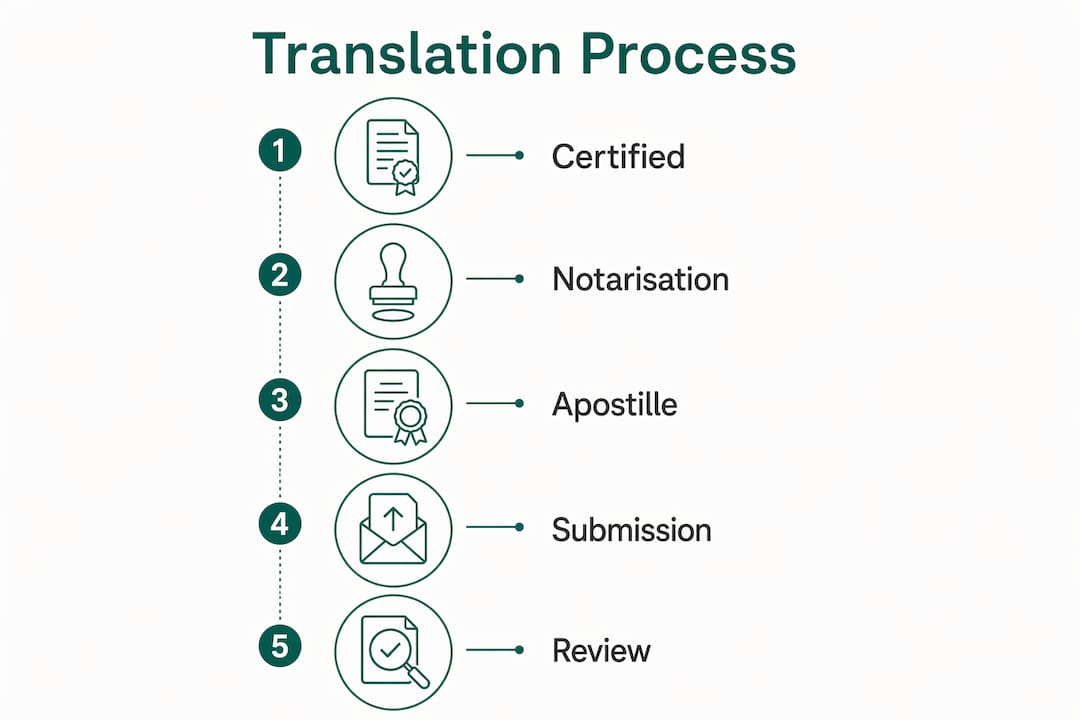
- Confirm requirements with the receiving authority and note the exact format they specify.
- Select a qualified translator who is a member of ITI, CIOL, or ATC, or who can demonstrate equivalent professional standards. Check their membership on the relevant public register.
- Commission the certified translation. The translator produces the translated document and attaches a signed declaration of accuracy, including their name, contact details, credentials, and date.
- Arrange notarisation (only if the authority requests it). A commissioned notary witnesses the translator's signature via a secure video call, confirming identity. They do not verify linguistic accuracy.
- Apply for an apostille if the destination country is a signatory to the Hague Convention and requires one. The UK legalisation office issues apostilles that authenticate the notary's signature and seal for international recognition.
- Arrange further legalisation if the destination country is not a Hague Convention signatory; this typically involves the destination country's embassy.
- Deliver the completed document set digitally or by tracked post, as the authority specifies.
Typical timelines and cost components
| Stage | Typical turnaround | What affects speed |
|---|---|---|
| Certified translation | 1–3 working days | Document length, language pair, complexity |
| Online notarisation | Same day | Appointment availability, ID verification |
| Apostille application | 3–10 working days | Standard vs. premium service, postal time |
| Further legalisation | 1–4 weeks | Embassy processing times, country |
Cost components to budget for: translation fee (varies by word count and language pair), notarisation fee, apostille or legalisation fee, and optional courier charges for physical copies.
Before paying for extra notarisation or apostille steps, always confirm with the receiving organisation whether a signed translator declaration alone will suffice. Many UK processes accept that without any additional layer.
***
How do you choose and verify a translator?
UK certified translations for most official purposes are accepted when accompanied by a formal signed statement of accuracy. The translator's professional membership is the primary quality signal.
Credentials and registers to check:
- ITI (Institute of Translation and Interpreting) — public member directory at iti.org.uk
- CIOL (Chartered Institute of Linguists) — member register and guidance available online
- ATC (Association of Translation Companies) — agency-level membership with documented standards
Because the UK translation sector is largely unregulated, ask for a named translator contact, written confirmation of their professional membership, and examples of previous work in the same document type before commissioning.
A properly formatted UK certified translation declaration should include:
- A statement that the translation is accurate and complete
- The translator's full name, contact details, and professional membership reference
- The date of certification
- The translator's signature
- Agency letterhead if produced by a translation company
A compliant declaration reads along these lines:
***
How does online notarisation via video call work?
Remote notarisation replaces the physical office visit with a secure video session. The process follows a clear sequence: you upload your documents to the platform, complete a biometric identity check, then join a live video call with a commissioned notary.
During the session:
- The notary verifies your identity using photo ID and biometric checks
- You or the translator swears or affirms the declaration of accuracy on camera
- The notary applies a signed attestation to the document
One distinction worth keeping clear: the notary witnesses identity and signature, not the linguistic accuracy of the translation. The translator remains responsible for the content.
Documents and requirements for a typical video session:
- Original document (or certified copy) to be translated
- Completed certified translation with declaration
- Valid photographic ID (passport or national identity card)
- Proof of address if requested by the authority
Technical requirements: a device with a working camera and microphone, a stable internet connection, and a well-lit environment so the notary can read your ID clearly.
Physical postal steps may still be necessary when the receiving authority requires an original wet-ink document or when an apostille must be affixed to a paper certificate rather than a digital file.

Pro Tip: Test your camera and microphone before the session. Log in five minutes early and have all documents open and ready to show on screen.
***
How My Notary handles certified translations and notarisation online
My Notary brings the full document certification workflow into a single online platform, from translation through to notarisation and optional apostille. The service flow is straightforward:
- Upload your source document and select the services you need (certified translation, notarisation, apostille add-on)
- Complete biometric identity verification before the video session
- Join a live video call with a commissioned notary who witnesses your declaration
- Receive your certified digital document, with optional physical copies dispatched by post
Trust signals built into the platform include biometric identity verification, electronic signatures recognised in over 180 countries, and an average turnaround of one hour for notarised documents. My Notary's notarised translation service covers personal, family, and corporate documents, including degree certificates, academic transcripts, and marital status documents for use abroad.
For academic documents, the degree certification for visa applications service is particularly relevant when an embassy or university requires both a certified translation and a notarised copy.
***
What to prepare before your online session
Documents to have to hand:
- Original document or certified copy to be translated
- Completed certified translation with signed declaration
- Valid photographic ID (passport preferred; national identity card accepted)
- Proof of address if the receiving authority requests it
- Written confirmation from the receiving authority of their exact requirements
Technical checklist:
- Device with a working camera and microphone
- Stable internet connection (wired or strong Wi-Fi)
- Well-lit area where your face and ID are clearly visible
Pro Tip: For bilingual documents, label each page clearly (e.g. "Page 1 of 4 — Source" and "Page 1 of 4 — Translation") and present them in matching order. This helps the notary cross-reference pages quickly and reduces the chance of queries.
***
Key takeaways
A UK certified translation with a signed declaration of accuracy is the standard accepted format for most international purposes; sworn translator status does not exist in the UK, and notarisation or apostille should be added only when the receiving authority explicitly requests it.
| Point | Details |
|---|---|
| No sworn status in the UK | The UK has no court-appointed sworn translator; a certified translation with a signed declaration is the equivalent. |
| Authority confirmation is definitive | Always obtain the receiving authority's exact requirements in writing before ordering any service. |
| Credentials to verify | Prefer translators who are members of ITI, CIOL, or ATC; check their membership on the relevant public register and learn more about proper tenant screening as part of tenant referencing. |
| Apostille only when required | The UK legalisation office issues apostilles; order one only if the destination country explicitly asks for it. |
| My Notary for remote workflows | My Notary combines biometric identity verification, commissioned notary witness via video call, and optional apostille in one online booking. |
***
Why online notarisation is changing how documents cross borders
The shift to video-call notarisation is not simply a convenience upgrade. For expats, international businesses, and anyone managing documents across multiple jurisdictions, it removes a genuinely significant barrier: the requirement to be physically present in a specific city on a specific day.
What I find underappreciated is how much of the old friction was procedural rather than legal. The evidential value of a notarised document does not depend on the notary being in the same room; it depends on verified identity and a witnessed declaration. Remote sessions deliver both. The remaining risks are worth naming plainly: always verify the destination country's acceptance of remotely notarised documents before you book, keep originals safely stored, and allow realistic time for any apostille or legalisation step that still requires physical processing. Those caveats aside, the remote workflow is now a credible, well-evidenced route for the vast majority of certified translation and notarisation needs.
***
Get your documents certified with My Notary
Obtaining a certified translation with notarisation no longer means booking appointments weeks in advance or travelling to a solicitor's office. My Notary gives you a faster route: select your service, upload your documents, complete biometric identity verification, and join a video call with a commissioned notary, all from your home or office.
The platform covers the full range of personal and corporate documents: from signature certification and corporate document notarisation to certified translations and apostille add-ons. Average turnaround for notarised documents is one hour. To get started, confirm your receiving authority's exact requirements, then visit My Notary to select the service that matches your needs and book your video session.
***
Authoritative sources to consult
- ITI (Institute of Translation and Interpreting) — explains the UK position on sworn translators and how to find a qualified professional
- CIOL (Chartered Institute of Linguists) — guidance on certified translations and a public member register for verifying translator credentials
- ATC/CIOL/ITI joint guidance — industry standard on terminology differences between certified, sworn, and official translations
- GOV.UK — Get a document legalised — official guidance on apostilles and the UK legalisation process
- GOV.UK — Certifying a document — official guidance on what a certification statement should contain
For destination-specific rules, contact the relevant embassy or consulate directly. For translator credibility, check the ITI or CIOL public register first.
***
FAQ
Does the UK have sworn translators?
No. The UK has no state-appointed sworn translator status. The accepted equivalent is a certified translation accompanied by a signed declaration of accuracy from a qualified professional.
When do you need a notarised translation rather than a certified one?
You need notarisation only when the receiving authority explicitly requests it. Many UK and international authorities accept a certified translation with a signed declaration without any additional notarisation step.
What is an apostille and when is it required?
An apostille is an authentication certificate issued by the UK legalisation office that confirms a signature or seal is genuine, allowing the document to be recognised internationally under the Hague Convention. It is required only when the destination country specifically asks for it.
Can you get a certified translation notarised online via video call?
Yes. Platforms such as My Notary allow you to upload your certified translation, verify your identity biometrically, and have a commissioned notary witness your declaration via a secure video call, with an average turnaround of one hour for notarised documents.
Which translator credentials should you look for in the UK?
Prefer translators who are members of ITI, CIOL, or ATC. These bodies maintain public registers you can check, and their membership is widely accepted by UK authorities and many overseas offices as evidence of professional competence.
This article provides general information about translation and document certification processes and does not constitute legal advice. Always confirm the current requirements with the relevant authority or a qualified professional for your specific situation.
Recommended
Got questions? We’re on it.
Most questions are answered here, drawn from what people actually ask before booking. If yours isn’t, our team is in chat.
No. The UK has no state-appointed sworn translator status. The accepted equivalent is a certified translation accompanied by a signed declaration of accuracy from a qualified professional.
Last updated: