Apostille for Birth Certificate: Fast UK Guide
By Jeremy Arhab, Founder · Published 27 July 2026 · Updated 28 July 2026
Learn how to quickly obtain an apostille for your birth certificate in the UK. Simplify the process with our fast guide and secure notarisation.

Yes, a UK birth certificate can be apostilled. The UK Legalisation Office issues the apostille, the General Register Office (GRO) or a local register office issues acceptable certificates, and Mynotary can speed the certified-copy and submission steps via secure video notarisation.
Here is what you need to know before you start:
- Acceptable documents: An original GRO or local register office certificate, or an official replacement. Photocopies and scans are rejected.
- Notarisation: Usually not required before apostille for a government-issued birth certificate. The Legalisation Office verifies the registrar's signature or seal directly.
- Certified true copy: If you cannot send your only original, an online commissioned notary can create a certified true copy acceptable for legalisation submission.
- Paper apostille only: Birth certificates are not eligible for an e-Apostille. The apostille is physically attached to the document.
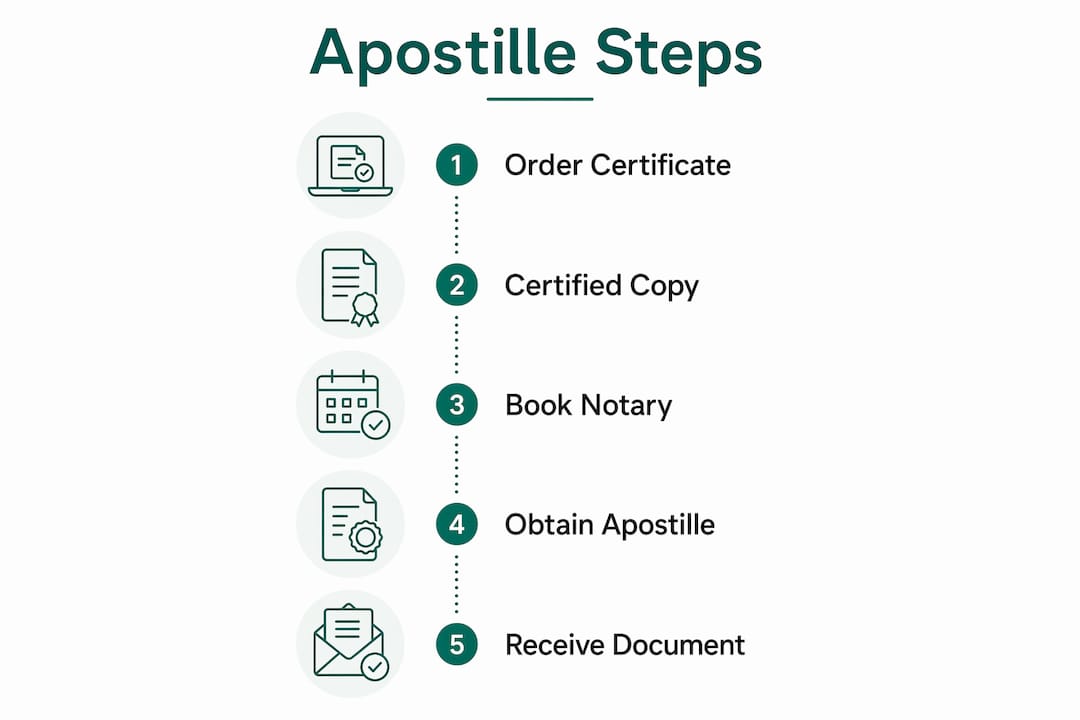
- Fast route: Obtain the correct certificate → create a certified true copy if needed → submit to the Legalisation Office → receive the paper apostille.
Pro Tip: If you are an expat or cannot travel to a UK office, Mynotary's video notarisation lets you create a certified true copy remotely, then handles courier submission to the Legalisation Office on your behalf.
Table of Contents
- What is an apostille and when do you need one?
- Do you need a notary before the apostille?
- How to get an apostille on a UK birth certificate, step by step
- How online video notarisation fits the apostille workflow
- Typical turnaround times and costs
- Common problems that delay or block an apostille
- What to prepare before booking a notary or submitting to the Legalisation Office
- Key Takeaways
- Why the online-certified-copy workflow reduces risk
- Mynotary makes the apostille process faster and more secure
- Official sources to verify rules and next steps
What is an apostille and when do you need one?
An apostille is a certificate that authenticates the signature, seal, or stamp of the issuing authority on a public document, so that document is recognized abroad under the 1961 Hague Apostille Convention. It does not verify the personal details on the certificate itself. For UK documents, the UK Legalisation Office is the sole competent authority that attaches apostilles to eligible public documents, including birth certificates.
Common situations that require a birth certificate apostille include:
- Overseas marriage or civil partnership registration
- Visa and immigration applications in Hague Convention member states
- Citizenship or nationality applications abroad
- School or university enrollment in another country
- Adoption proceedings with a foreign authority
- Corporate filings requiring proof of identity or parentage
Always verify the receiving authority's exact requirement before submitting. Some countries accept the apostille alone; others require additional embassy or consular legalisation, certified translations, or both.
The UK Legalisation Office checks whether signatures, stamps, or seals on a document match their records before attaching an apostille. This is why a government-issued birth certificate from the GRO or a local register office is usually accepted directly, without extra certification.
Do you need a notary before the apostille?
For most UK birth certificates, the answer is no. Because the Legalisation Office verifies the registrar's signature or seal already present on the document, adding a notary certification on top is usually redundant and can actually cause confusion during processing.
There is one clear exception: if you need a certified true copy because you are unwilling or unable to send your only original. In that case, an online commissioned notary can create a certified true copy acceptable for legalisation, provided the receiving authority also accepts certified copies rather than originals. Confirm this with the foreign authority before proceeding.
- Direct submission: Send the original GRO certificate to the Legalisation Office without prior notarisation.
- Certified true copy route: Use an online commissioned notary (such as Mynotary) to certify a copy via video call, then submit that copy for legalisation.
- Avoid unnecessary steps: Extra notarisation adds time and cost without benefit unless the recipient specifically requests it.
Pro Tip: Check the receiving authority's written instructions before booking any notary. Some foreign embassies specify whether they require the original or will accept a certified true copy with apostille.
How to get an apostille on a UK birth certificate, step by step
Follow these five steps to move from document selection to receiving the paper apostille with minimal delays.
- Confirm the destination's requirements. Contact the foreign authority, embassy, or consulate to establish whether they need the apostille alone, a full or short certificate, certified translations, or additional embassy legalisation after the apostille.
- Obtain the correct certificate. Use your original GRO or local register office certificate. If it is laminated, damaged, or unavailable, order a replacement from the GRO before proceeding. Replacement certificates avoid rejection and simplify legalisation checks.
- Decide whether you need a certified true copy. If you are keeping the original, book an online commissioned notary with biometric ID verification to create a certified true copy. This step is optional if you are sending the original directly.
- Submit to the UK Legalisation Office. Apply for legalisation via the official postal route. Birth certificates require a paper apostille; e-Apostille is not available for GRO-issued vital records.
- Arrange return and any post-apostille steps. Choose a tracked or courier return option. If the destination requires embassy attestation or a certified translation, arrange those after the apostille is attached.
| Stage | Typical time |
|---|---|
| Order GRO replacement certificate (standard) | several working days |
| Order GRO replacement certificate (priority) | a few working days |
| Online notarisation session (certified true copy) | typically short duration |
| Legalisation Office processing | Check the official website for current times |
| Managed service (document received to apostille returned) | usually a couple of working days |
| International courier return | several working days |
How online video notarisation fits the apostille workflow
Online notarisation handles the certified-copy creation stage, not the apostille itself. Here is what the process covers:
- Remote identity verification: Biometric ID checks confirm your identity before the session begins.
- Commissioned notary via video call: A commissioned notary witnesses the document, confirms it matches the original, and certifies a true copy.
- Certified true copy output: You receive a notarised, certified true copy ready for legalisation submission.
- No travel required: The entire certified-copy stage happens remotely, which is particularly useful for expats or anyone who cannot visit a a notary in person.
The Legalisation Office still issues a physical, paper apostille attached to the document. Video notarisation cannot produce an e-Apostille for GRO-issued birth certificates, and many foreign authorities require the physical paper apostille attached to the original certificate rather than an electronic record.
Practical flow with Mynotary: Upload your certificate → complete biometric ID verification → join a video session with a commissioned notary (average one hour) → receive your certified true copy → submit the physical document to the Legalisation Office for the paper apostille.
Pro Tip: *A certified true copy of a birth certificate created by a commissioned notary preserves your original while giving you a submission-ready document. This is the preferred route for anyone managing multiple apostille requests or working across time zones.*
Typical turnaround times and costs
Time and cost depend on which route you take and how urgently you need the apostille.
- GRO replacement certificate: Standard service takes longer; priority service typically delivers within 1–2 working days. Check the GRO website for current fees.
- Online notarisation session: Mynotary averages one hour for a commissioned notary session, compared to waiting days for an in-person appointment.
- Legalisation apostille fee: Check the official legalisation website for the current fee before submitting, as fees are subject to change.
- Managed service turnaround: Specialist providers can often complete the apostille within 1–2 working days once they hold the physical document.
- Courier costs: Domestic tracked return and international courier are additional. Budget extra time for international delivery.
Factors that increase time or cost include damaged or laminated certificates (requiring a GRO replacement), destinations that require embassy legalisation after the apostille, and last-minute same-day courier requests.
Pro Tip: Build in at least one extra working day as a buffer for postal transit between stages, particularly if you are coordinating GRO replacement, notarisation, and legalisation submission separately.

Common problems that delay or block an apostille
Most rejections are avoidable. The issues below account for the majority of delays.
Sending a photocopy or scan is the single most common reason an apostille application is returned unprocessed. Only an original or an official certified copy from the GRO or a local register office is acceptable.
- Laminated, damaged, or altered certificates: These will be rejected. Order a replacement from the GRO before submitting.
- Assuming an e-Apostille is acceptable: Birth certificates issued by the GRO require a paper apostille. Confirm this with the receiving authority.
- Unnecessary solicitor notarisation: Adding an unnecessary certification stamp to a GRO-issued certificate can create confusion during processing. Use a notary only when the recipient explicitly requests it.
- Missing translations: Some destinations require a certified translation alongside the apostille. Arrange this after the apostille is attached, not before.
- Wrong certificate type: Some foreign authorities require a full certificate rather than a short one. Confirm the specification before ordering.
What to prepare before booking a notary or submitting to the Legalisation Office
Gather the following before your online notary session or postal submission:
- Original or official replacement certificate from the GRO or local register office (full or short, as specified by the receiving authority).
- Government-issued photo ID (passport or biometric residence permit) for identity verification during the video session.
- Written instructions from the receiving authority, specifying certificate type, translation requirements, and whether embassy legalisation is needed after the apostille.
- Return address and courier preference for the apostilled document.
- A personal photocopy for your records (do not submit this photocopy for apostille).
Key Takeaways
Getting an apostille for a UK birth certificate requires an original or official certified copy, a paper apostille from the Legalisation Office, and confirmation of the receiving country's specific requirements before you begin.
| Point | Details |
|---|---|
| The Legalisation Office issues the apostille | The UK Legalisation Office attaches apostilles to UK public documents, including birth certificates. |
| Paper apostille only | GRO-issued birth certificates are not eligible for an e-Apostille; the apostille must be physically attached to the document. |
| Original or certified copy required | Photocopies and scans are rejected; order a GRO replacement if your original is damaged, laminated, or unavailable. |
| Online notarisation speeds the process | A commissioned notary can create a certified true copy via video call, averaging one hour, removing the need for an in-person visit. |
| Mynotary for fast remote workflow | Mynotary handles biometric ID, commissioned notary sessions, and can coordinate courier submission to the Legalisation Office for the paper apostille. |
Why the online-certified-copy workflow reduces risk
The conventional advice to "just send the original" works when you have a spare copy and a straightforward destination. In practice, many people hold only one original birth certificate, and posting it untracked to the Legalisation Office, then onward to a foreign embassy, creates real exposure to loss or damage.
Mynotary's recommended approach is to use an online commissioned notary to create a certified true copy first. This preserves the original while producing a document accepted for legalisation. For corporate HR teams processing multiple apostilles, the same logic applies at scale: a single commissioned notary session can produce multiple certified copies, each submitted independently to the Legalisation Office.
Two practical scenarios illustrate the choice. An expat living abroad who holds one original and cannot travel to the UK should use the certified-copy route via Mynotary, then arrange courier submission. A UK-based individual with a clean, undamaged original and a destination that accepts paper apostille directly can submit to the Legalisation Office without a prior notarisation step, saving both time and cost.
Mynotary makes the apostille process faster and more secure
Getting a birth certificate apostilled involves several moving parts: sourcing the right certificate, creating a certified copy if needed, submitting to the Legalisation Office, and managing courier logistics. Mynotary brings these steps together in one place, removing the need to coordinate separately with a courier and the Legalisation Office.
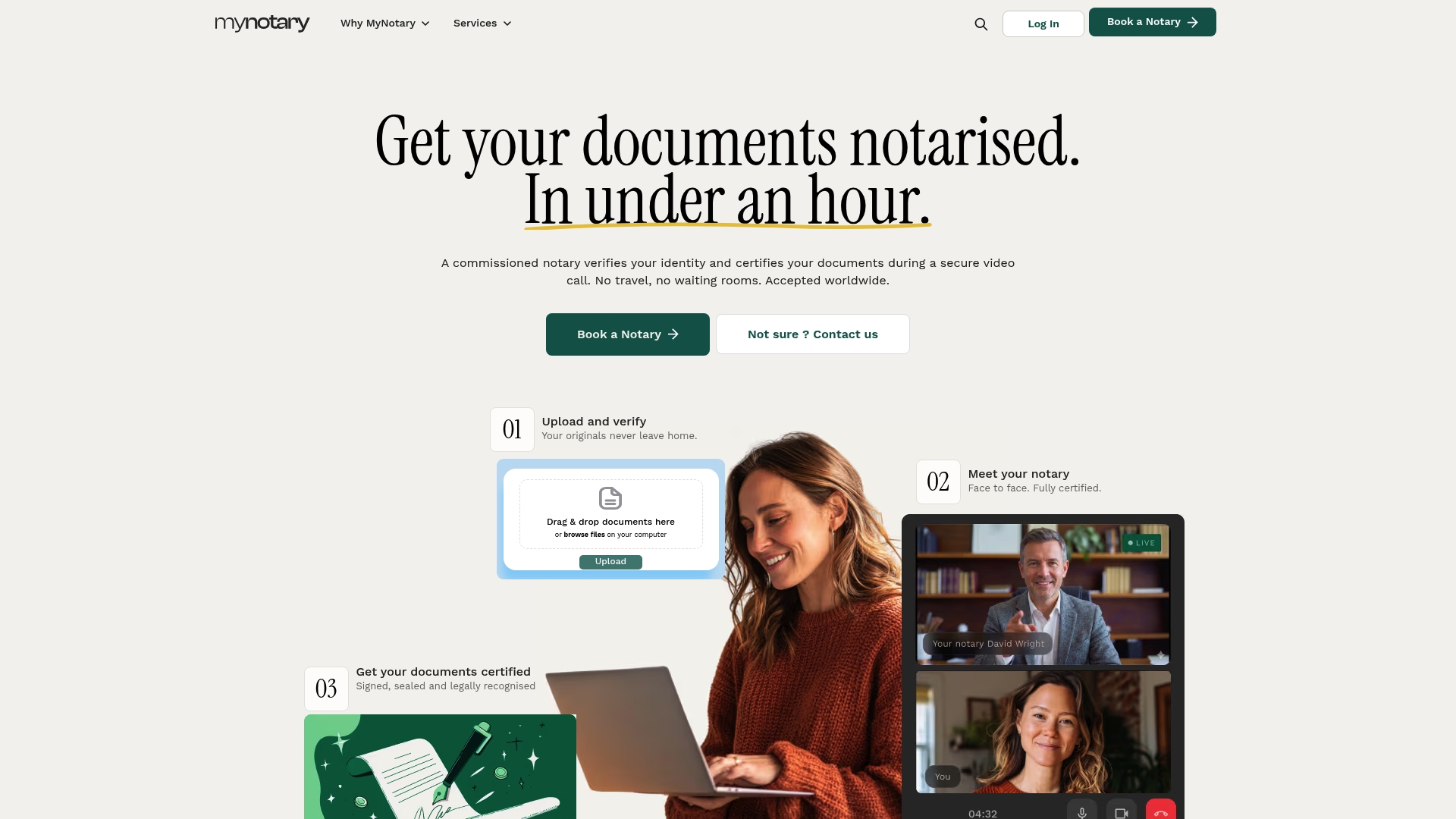
The workflow is straightforward. Upload your birth certificate, complete biometric ID verification, and join a video session with a commissioned notary. The average notarisation turnaround is one hour. Mynotary then produces a certified true copy ready for legalisation submission and can handle secure courier dispatch on your behalf. The service is particularly well-suited for expats managing documents across borders, HR departments processing multiple apostilles, legal teams with urgent deadlines, and individuals who want a single point of contact for the entire process.
For online signature certification and commissioned notary sessions, book directly through Mynotary's platform. For corporate document needs, the corporate document notarisation service covers business filings that require apostilled supporting documents.
Official sources to verify rules and next steps
Before submitting, confirm current fees and procedures directly from official sources. Requirements and processing times do change.
- Official legalisation guidance: The authoritative source for understanding what the apostille covers, which documents are eligible, and the difference between paper apostilles and e-Apostilles.
- Apply for legalisation (official): Step-by-step application instructions, current fees, and postal return options. Check this page immediately before submitting, as fees are updated periodically.
- General Register Office (GRO): Order replacement or priority birth certificates directly through the GRO. Priority service is the fastest route when your original is unavailable.
- Receiving authority's written instructions: Always request written confirmation from the foreign embassy, consulate, or institution specifying whether they require a full or short certificate, a certified translation, or embassy legalisation after the apostille.
- Apostille verification tool: After your apostille is issued, use the official online verification tool to confirm its authenticity before forwarding the document abroad.
| Resource | Purpose |
|---|---|
| Official legalisation guidance | Confirm document eligibility and paper vs e-Apostille rules |
| Apply for legalisation (official) | Current fees, submission instructions, and return options |
| General Register Office (GRO) | Order original or replacement birth certificates |
| Legalisation verification tool | Confirm apostille authenticity after issue |
This article provides general information about the UK apostille process and is not legal advice. Confirm current fees, processing times, and your destination's specific requirements with official sources or a qualified legal professional before submitting your documents.
Recommended
Last updated: