What Is an Apostille? How U.S. Documents Are Accepted Abroad
By Jeremy Arhab, Founder · Published 28 July 2026 · Updated 28 July 2026
Discover what an apostille is and how it helps U.S. documents get recognized abroad. Ensure your paperwork is valid for international use.

An apostille is an official certificate that verifies a public official's signature, seal, and capacity so a U.S. document will be recognized in a foreign country. It does not translate the document, and it does not replace notarization. What it does is confirm, for the receiving country's authorities, that the signature on your document is genuine and that the person who signed it had the authority to do so.
Quick check: do you need an apostille?
- Is your destination country a member of the Hague Apostille Convention? If yes, an apostille is the correct authentication path.
- Is the destination country outside the Hague Convention? If yes, you will need consular legalization instead (covered below).
- Was your document issued by a U.S. state agency (vital records, courts)? Your state's Secretary of State office handles the apostille.
- Was your document issued by a federal agency? The U.S. Department of State is the competent authority.
The Hague Conference on Private International Law administers the 1961 Hague Apostille Convention, which includes numerous member countries. Checking the official member list before you do anything else will save you time and money.
***
Table of Contents
- How does an apostille work, and which countries accept one?
- Who issues apostilles in the United States?
- Which documents commonly need an apostille?
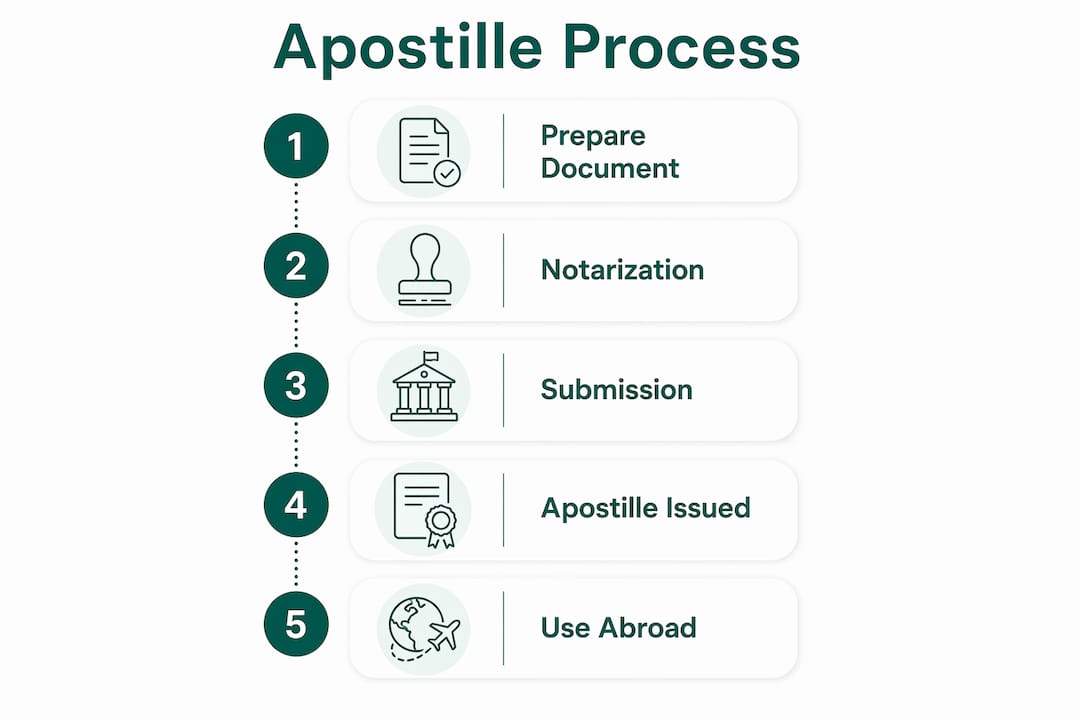
- How to get an apostille in the U.S.: a step-by-step checklist
- How notarization and the notary's role connect to apostilles
- Online notarization and apostilles: what works in the U.S.
- What to do if the destination country is not in the Hague Convention
- Costs, processing times, and expediting
- Common mistakes and how to avoid them
- Key Takeaways
- A practical note on getting documents ready for apostille
How does an apostille work, and which countries accept one?
An apostille certifies three specific things: the authenticity of the signature on the document, the capacity in which the signer acted (notary, registrar, court clerk), and the identity of any seal or stamp on the document. It does not validate the content of the document itself. A birth certificate with an apostille is still just a birth certificate; the apostille simply tells the foreign authority that the registrar's signature is real.

The 1961 Hague Apostille Convention created a single-step authentication system to replace the older, multi-step chain of consular legalization between member countries. Before the Convention, getting a U.S. document accepted in France, for example, required multiple rounds of authentication through different government offices. The apostille collapsed that into one certificate.
Common misconceptions worth clearing up:
- An apostille is not a translation. If the receiving country requires the document in its own language, you will need a certified translation in addition to the apostille.
- An apostille is not the same as notarization. A notary verifies your identity and witnesses your signature; an apostille authenticates the notary's or official's credentials.
- Apostilles are not accepted everywhere. They apply only between Hague Convention member countries. Sending an apostilled document to a non-member country will not satisfy that country's requirements.
- Not every document needs one. The requirement depends on the receiving institution's rules, not just the country.
***
Who issues apostilles in the United States?
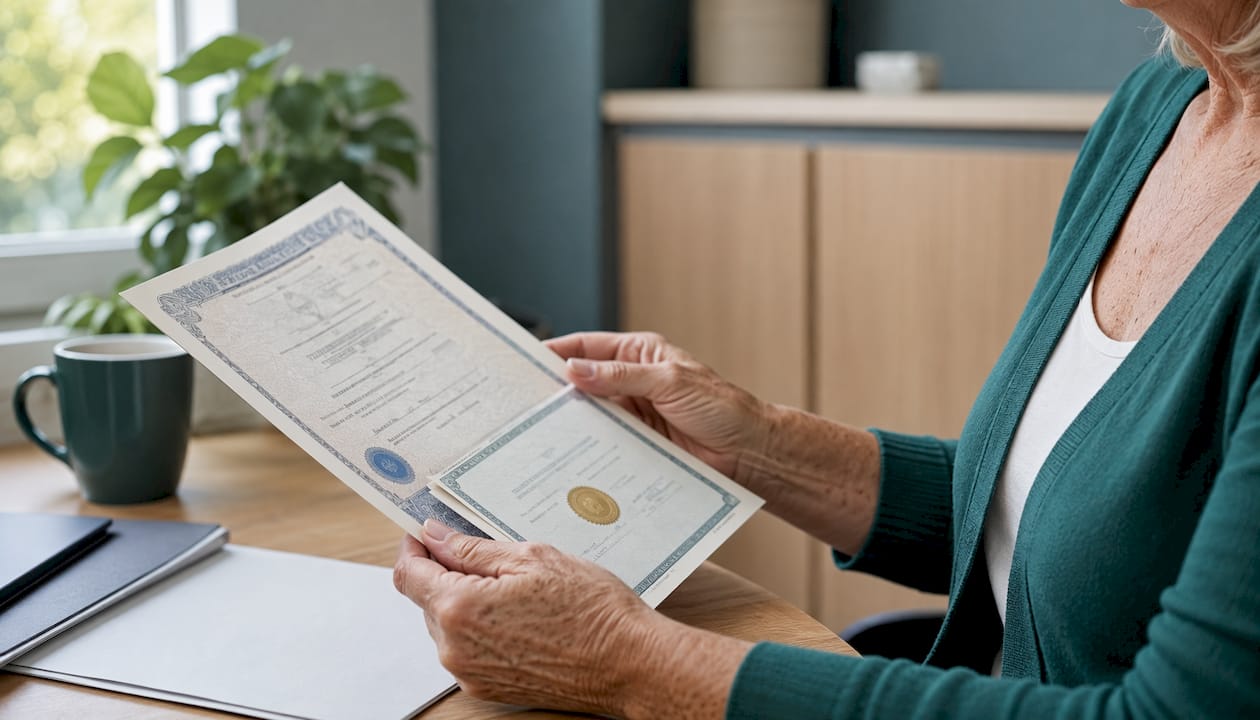
The issuing authority depends entirely on where the document originated. State-issued documents, including vital records, court orders, notarized affidavits, and state-licensed professional certifications, are apostilled by the state where the document was issued, typically through the Secretary of State's office or its equivalent. Federal documents, such as FBI background checks, federal court documents, or documents signed by federal officials, are apostilled by the U.S. Department of State.
Florida's process is a clear example of how this works in practice. The Florida Department of Health uses a two-step workflow: you first request a certified vital record from the vital records office, then that certified copy is forwarded to the Florida Department of State for the apostille. Many states follow a similar two-step model. The California Secretary of State accepts both mail-in and in-person apostille requests and publishes detailed instructions on required cover sheets and submission formats.
To find the correct office for your state, search for "[Your State] Secretary of State apostille" or "[Your State] apostille authentication." Most state offices list their apostille program under a heading like "Apostille/Authentication" within the business or notary section of their website.
| Document type | Issuing authority | Apostille authority |
|---|---|---|
| Birth, marriage, death certificate | State vital records office | State Secretary of State (or equivalent) |
| Court order or judgment | State or federal court | State SOS (state court) or U.S. Dept. of State (federal) |
| Notarized affidavit or POA | Notary public (state-commissioned) | State Secretary of State |
| FBI background check | Federal Bureau of Investigation | U.S. Department of State |
| Diploma or academic transcript | Educational institution | State Secretary of State |
| Federal agency document | Federal agency | U.S. Department of State |
When you contact the issuing office, include the document type, confirm whether you have a certified copy or original, ask about required forms, and clarify return postage requirements. Offices vary on whether they accept prepaid envelopes or require a specific courier account.
***
Which documents commonly need an apostille?
The most frequently apostilled documents fall into a few clear categories. Personal vital records top the list: birth certificates, marriage certificates, death certificates, and divorce decrees. Powers of attorney, particularly those used for banking or property transactions abroad, are also common. Notarized affidavits, academic diplomas, and transcripts are regularly apostilled for employment, immigration, or enrollment purposes overseas.
For certified academic transcripts and diplomas, the document must typically come directly from the issuing institution or be a certified copy before the apostille can be attached. A photocopy you made at home will not qualify.
Corporate documents, including articles of incorporation, certificates of good standing, and board resolutions, frequently require apostilles for international business transactions. Certified copies of passports or national ID cards may also need apostilles in certain contexts, though requirements vary by country and institution.
Certified copy vs. original: For vital records, the agency-issued certified copy (with the registrar's raised seal or security paper) is what gets apostilled. A notarized copy of a birth certificate is not the same thing and will generally be rejected. For documents like powers of attorney or notarized affidavits, the original notarized document is submitted directly.
Federal agency documents follow a separate path. An FBI background check, for instance, must be apostilled by the U.S. Department of State, not by any state office, because the issuing authority is federal.
***
How to get an apostille in the U.S.: a step-by-step checklist
The order of operations matters here. Skipping steps or reversing them is the most common reason apostille requests are rejected.
- Verify the destination country is a Hague Convention member. Check the official Hague Conference member list before doing anything else.
- Identify the correct issuing authority. State document → state Secretary of State. Federal document → U.S. Department of State.
- Obtain the correct version of your document. For vital records, request a certified copy from the issuing agency (not a photocopy). For notarized documents, have the notarization completed first.
- Do not notarize original public records. The U.S. Department of State explicitly warns that notarizing a document that should be submitted as an agency-certified copy can invalidate it for apostille purposes.
- Complete the required request form. Each state office has its own cover sheet or application form. Download it from the official state website.
- Prepare your submission package. Include the original or certified copy, the completed form, the correct fee (check or money order as specified), a prepaid trackable return envelope, and your contact information.
- Choose your submission method. Most states accept mail-in requests. Some, including California, offer in-person or walk-in service at designated offices. Check the California Secretary of State's request page for an example of what a well-documented submission looks like.
- Track your submission and confirm receipt. Keep copies of everything you send. Note the tracking number on your return envelope.
Sample submission checklist:
- Original or agency-issued certified copy of the document
- Completed state cover sheet or apostille request form
- Correct fee (confirm the current amount on the official state website)
- Prepaid, trackable return envelope (FedEx, UPS, or USPS Priority with tracking)
- Your name, address, phone number, and email on the cover sheet
- Note specifying the destination country (some offices ask for this)
Pro Tip: Never send your only original. If the document is irreplaceable, request a second certified copy from the issuing agency before submitting anything for apostille. Offices can and do lose mail.
Expedited service varies by state. Some offices offer walk-in same-day processing. Others use contracted vendors for faster routing. Florida, for example, lists VitalChek as a contracted vendor for expedited routing, though that service adds processing and service fees on top of the government fee.
***
How notarization and the notary's role connect to apostilles
A notary public and an apostille serve different functions, and confusing them is one of the most common mistakes in this process. A notary witnesses a signature, verifies the signer's identity, and attaches a certificate confirming those facts. An apostille then authenticates the notary's own credentials, confirming to a foreign authority that the notary is a legitimately commissioned official in that state.
For documents that originate as notarized instruments (a power of attorney, an affidavit, a consent letter), the workflow is: notarize the document first, then submit the notarized original to the Secretary of State for the apostille. For documents that originate as government-issued public records (a birth certificate, a court order), the notarization step does not apply at all.
Do not notarize your document if it is an original public record intended for apostille. The U.S. Department of State's official guidance states plainly: "Do not notarize your document. Your document will no longer be valid if it is notarized." The apostille must be placed on the original or certified copy issued by the government agency, not on a notarized copy of that original.
State-by-state variation adds another layer. Some states have specific rules about remote online notarization (RON) for documents that will later be apostilled. A few states require wet-ink notarization for certain document types before they will accept the document for apostille processing. Always confirm the specific requirement with the state office before scheduling any notarization.
***
Online notarization and apostilles: what works in the U.S.
Remote online notarization is legally recognized in the majority of U.S. states, and many state Secretary of State offices will apostille electronically notarized documents. However, acceptance is not universal, and the rules vary enough that you should verify your state's position before proceeding.
What to check before submitting an e-notarized document for apostille:
- Confirm your state has enacted RON legislation and that the Secretary of State's office accepts electronically notarized documents for apostille.
- Ask whether the office requires a printed certified copy of the electronic document or will accept the digital file with a tamper-evident seal.
- Verify whether the office needs supplementary documentation, such as a notary commission certificate or a transaction audit record.
Online notarization platforms typically provide identity verification through biometric checks, a recorded video session, and a tamper-evident electronically signed PDF. When submitting such a document for apostille, include the transaction audit record or any supplementary attestation the office requests. Some states treat electronic notarizations identically to wet-ink notarizations; others require an additional attestation from the notary or a printed certified copy.
Pro Tip: When submitting an e-notarized document for apostille, attach a brief cover note explaining the notarization method, the platform used, and the notary's commission details. This reduces back-and-forth with the state office and speeds processing.
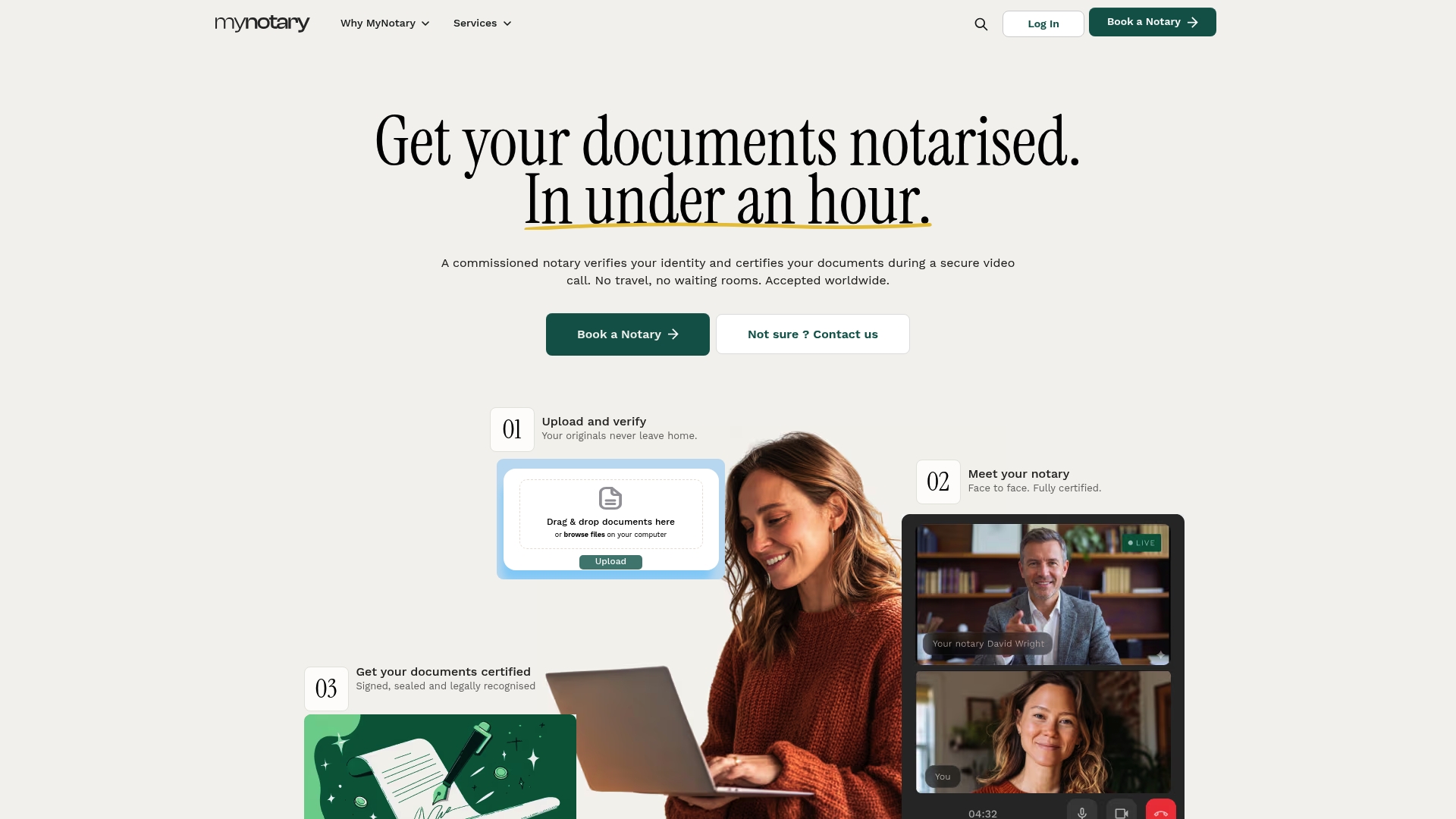
Mynotary's online notarization workflow includes biometric identity verification, a recorded video audit trail, and compliant electronic signatures. For documents that will proceed to apostille, Mynotary can provide the supporting documentation state offices typically request.
***
What to do if the destination country is not in the Hague Convention
When the receiving country has not joined the Hague Apostille Convention, an apostille will not be accepted. The alternative is consular legalization, a multi-step chain that takes longer and involves more offices.
The typical consular legalization chain for a U.S. document runs in this order: the document is first certified at the state level (Secretary of State authentication), then authenticated by the U.S. Department of State, and finally legalized by the embassy or consulate of the destination country in Washington, D.C. Each step must be completed in sequence; skipping one invalidates the chain.
Common additional requirements for non-Hague countries include:
- A certified translation of the document into the destination country's official language
- A consular appointment at the relevant embassy or consulate (some require advance booking weeks out)
- Additional embassy fees, which vary by country and document type
- Extra certified copies, since some embassies retain the original
- Longer timelines, often several weeks from start to finish
If you are dealing with multiple destination countries, tight deadlines, or documents that require translation and multiple rounds of authentication, working with a professional document authentication service is worth considering. The chain is straightforward in principle but unforgiving if a step is missed or completed out of order.
***
Costs, processing times, and expediting
Fees and timelines vary significantly by state and document type. State apostille fees can be quite low: Tennessee, for example, charges $2.00 per document for apostilles through its vital records office. Other states charge more. The U.S. Department of State charges a separate fee for federal document apostilles. Always verify the current fee on the official office website before submitting payment, as fees change and an incorrect payment will delay your request.
Processing times at state offices typically range from a few business days to several weeks, depending on the office's current volume. Walk-in or same-day service is available at some offices, including certain California Secretary of State locations, but availability is not guaranteed. Third-party expediting services, such as VitalChek for Florida vital records, can reduce wait times but add service fees on top of the government fee.
To speed up your request:
- Use a prepaid, trackable return envelope (FedEx or UPS Next Day Air is common for urgent requests).
- Submit a fully completed cover sheet with no missing fields.
- Call or email the office before submitting to confirm current processing times and any form updates.
- For walk-in service, check the office's published hours and appointment requirements in advance.
Pro Tip: Include a self-addressed, prepaid FedEx or UPS return envelope rather than a standard USPS envelope. Offices process trackable return envelopes more reliably, and you will know exactly when your document ships back.
***
Common mistakes and how to avoid them
Most apostille rejections trace back to a small number of predictable errors. Catching them before you submit saves days or weeks.
Frequent mistakes:
- Submitting to the wrong authority. A state-issued document sent to the U.S. Department of State, or a federal document sent to a state office, will be returned unprocessed.
- Notarizing a document that should be an agency-certified copy. As noted above, notarizing an original public record can invalidate it for apostille purposes.
- Missing or broken seals. The apostille is attached to the document's existing official seal or signature. If the seal is missing, smudged, or damaged, the office cannot authenticate it.
- Wrong document type for the destination. Some countries require specific document versions (long-form birth certificate vs. short-form, for example). Confirm the requirement with the receiving institution before ordering.
- Incorrect fee or payment method. Many offices do not accept cash or credit cards by mail. Check the accepted payment methods before submitting.
- No return envelope or incorrect postage. Without a prepaid return envelope, your document will sit waiting.
If your request is rejected:
Contact the issuing office immediately to understand the specific reason. Request a new certified copy from the issuing agency if the original was returned damaged or if the wrong version was submitted. Correct the form, resubmit with clear return instructions, and confirm the current fee before sending payment again.
Before paying for any additional services, verify the exact requirements on the official office webpage. Requirements, forms, and fees are updated periodically, and relying on outdated information is a common source of errors.
***
Key Takeaways
An apostille authenticates a public official's signature and seal for use in Hague Convention countries; the correct issuing authority, document version, and order of operations determine whether the request succeeds.
| Point | Details |
|---|---|
| What an apostille certifies | It verifies the signature, seal, and capacity of the issuing official, not the document's content. |
| Who issues it in the U.S. | State Secretary of State for state documents; U.S. Department of State for federal documents. |
| Order of operations | Obtain the certified copy or notarize first, then request the apostille; never reverse the steps. |
| Non-Hague countries | Use consular legalization (state authentication → U.S. Dept. of State → destination embassy). |
| Immediate next step | Check the Hague Convention member list, then contact the correct issuing office for current forms and fees. |
***
A practical note on getting documents ready for apostille
One thing that often gets overlooked in guides like this is how much the preparation stage determines the outcome. The apostille itself is straightforward once the document is in the right form. The delays and rejections almost always happen earlier: the wrong document version, a notarization applied where it should not have been, or a certified copy requested from the wrong office.
Online notarization has made the preparation stage considerably more accessible for documents that do require notarization before apostille, such as powers of attorney, affidavits, and consent letters. When timelines are tight, being able to complete a notarization via secure video call, with biometric identity verification and a tamper-evident record, removes one of the slower steps from the process. Mynotary offers online signature certification and marital status affidavits that can be prepared quickly and submitted with the supporting documentation state offices typically request for apostille processing.
The broader point is this: apostilles are a well-defined, rules-based process. The rules are public, the authorities are named, and the steps are fixed. What trips people up is not the complexity but the details. Verify the destination country's membership, identify the correct office, get the right version of the document, and follow the submission checklist. That sequence, done carefully, produces a result.
Recommended
Last updated: