Apostille countries list: the complete UK guide
By Jeremy Arhab, Founder · Published 29 July 2026 · Updated 29 July 2026
Discover the complete apostille countries list for the UK. Ensure your documents meet authentication requirements easily with our step-by-step guide.

***
TL;DR: - countries accept an apostille under the Hague Apostille Convention, but eligibility varies by country. - Verifying the destination country's status and entry date is essential before submitting documents for authentication.
***
129 contracting states currently accept an apostille under the Hague Apostille Convention, according to the Hague Conference on Private International Law (HCCH). If your destination country appears on the HCCH status table, a UK apostille is generally sufficient for document authentication. If it does not, you will need full consular legalisation instead. Check the HCCH status table first, confirm the entry-into-force date for your destination, then use a service such as My Notary to handle notarisation and apostille submission online.
Table of Contents
- What is an apostille and why does the Hague Convention matter?
- Which countries accept an apostille?
- How do you confirm whether your destination needs an apostille?
- How to get a UK document apostilled: steps, timescales, and costs
- How online notarisation and apostille services work in practice
- Common problems when getting documents apostilled
- Key takeaways
- Why online apostille services are worth considering
- My Notary: notarisation and apostille handling online
- Useful sources
- FAQ
What is an apostille and why does the Hague Convention matter?
An apostille authenticates the signature, seal, or stamp on a document. It does not certify that the document's contents are true. A birth certificate with an apostille, for example, confirms that the registrar's signature is genuine — not that the details inside are accurate.
The Hague Apostille Convention, formally the 1961 Hague Convention, created a single internationally recognised certificate that replaces the older, lengthier chain of consular legalisation. Whether a destination accepts that certificate depends entirely on whether it is a contracting state. For UK-issued documents, this distinction determines whether you submit to the UK Legalisation Office or begin a more involved embassy process.
Paper apostilles vs e-Apostilles: a paper apostille is a physical stamp or attached certificate. An e-Apostille is an electronic equivalent issued for electronically signed PDF documents. The following document types are ineligible for an e-Apostille and must be submitted as paper:
- Birth, death, and marriage certificates
- ACRO police certificates
- DBS certificates
- Documents bearing wet-ink signatures that have not been digitised through an approved process
Pro Tip: Before relying on an e-Apostille, contact the receiving authority — the bank, university, or government office — and confirm in writing that they accept electronically apostilled documents. Some institutions still require paper originals regardless of convention membership.
Which countries accept an apostille?
The HCCH status table is the only authoritative source. Published counts in industry guides vary slightly — some list 129 contracting states, others 130 — because accession deposits and entry-into-force dates do not always coincide. Always verify at hcch.net before filing.

Recent accessions worth noting include Canada, China, and Viet Nam, with entry-into-force dates that may extend into 2026 and beyond, so accession alone does not mean apostilles are immediately accepted there.
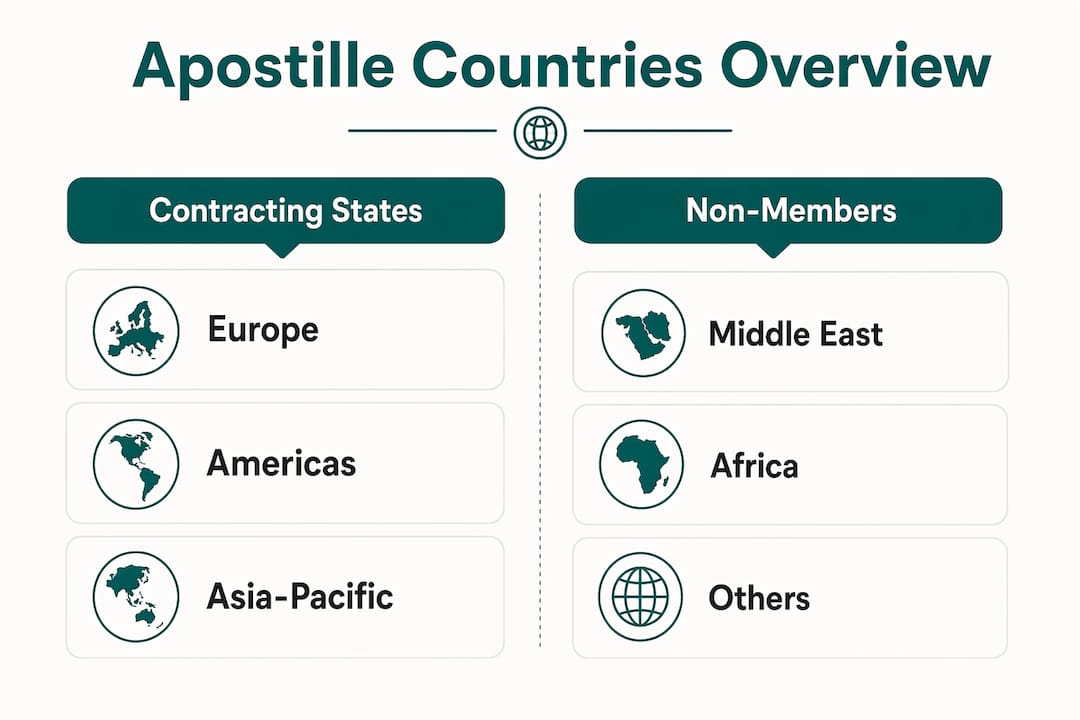
The table below lists a representative selection of contracting states. For the complete, date-stamped list, consult the HCCH status table directly.
| Country | Status |
|---|---|
| Albania | Contracting state |
| Argentina | Contracting state |
| Australia | Contracting state |
| Austria | Contracting state |
| Belgium | Contracting state |
| Brazil | Contracting state |
| Canada | Contracting state |
| China | Contracting state |
| Colombia | Contracting state |
| Croatia | Contracting state |
| Cyprus | Contracting state |
| Czech Republic | Contracting state |
| Denmark | Contracting state |
| France | Contracting state |
| Germany | Contracting state |
| Greece | Contracting state |
| Hungary | Contracting state |
| India | Contracting state |
| Ireland | Contracting state |
| Israel | Contracting state |
| Italy | Contracting state |
| Japan | Contracting state |
| Mexico | Contracting state |
| Netherlands | Contracting state |
| New Zealand | Contracting state |
| Norway | Contracting state |
| Poland | Contracting state |
| Portugal | Contracting state |
| Romania | Contracting state |
| Russia | Contracting state |
| South Africa | Contracting state |
| Spain | Contracting state |
| Switzerland | Contracting state |
| Turkey | Contracting state |
| Ukraine | Contracting state |
| United Arab Emirates | Contracting state |
| United States of America | Contracting state |
| Viet Nam | Contracting state (entry into force 2026) |
Notable non-members as of 2026 include Egypt, Malaysia, and several Middle Eastern and sub-Saharan states. Documents destined for those countries require full consular legalisation.
How do you confirm whether your destination needs an apostille?
- Search the HCCH status table at hcch.net/en/instruments/conventions/status-table and locate your destination country.
- Check the entry-into-force date, not just the accession date. A country may have signed but not yet implemented the convention.
- Review the receiving authority's own guidance — the embassy website, university admissions page, or bank's international documentation requirements.
- Contact the receiving organisation directly and ask: "Do you accept an e-Apostille on an electronically signed PDF, or do you require a paper apostille?" Get the answer in writing.
If your destination is not listed on the HCCH status table, consular legalisation is the required route. That process typically involves the UK Legalisation Office and the destination country's embassy in London, and it takes considerably longer.
Pro Tip: For non-member destinations such as Egypt or Malaysia, budget at least two to four additional weeks and contact the relevant embassy early. Requirements differ by document type and can change without notice.
How to get a UK document apostilled: steps, timescales, and costs
Most UK documents follow this sequence:
- Notarisation (if required): Powers of attorney, certified copies, and certain commercial documents need a commissioned notary's signature before the apostille can be applied.
- Document preparation: Gather the original document or a certified copy. Translations must be certified if the receiving country requires them.
- Apostille application: Submit to the UK Legalisation Office, either by post or online for eligible documents.
- Delivery: Paper apostilles are returned by post; e-Apostilles are issued electronically.
| Method | Typical turnaround | Notes |
|---|---|---|
| Postal legalisation (standard) | 3 working days | Paper apostille; check GOV.UK for current fees |
| Online e-Apostille | 1–2 working days | Eligible electronically signed documents only |
| Online commissioned-notary + apostille bundle | Same day to one hour | My Notary averages one hour for notarisation |
For urgent visa deadlines or corporate signings, a bundled online service that handles notarisation and apostille submission in a single workflow offers the fastest route.
How online notarisation and apostille services work in practice
My Notary's workflow removes the need to travel or post original documents for the notarisation stage:
- Upload your document to the My Notary platform and select the service required (certified copy, signature certification, power of attorney, etc.).
- Complete biometric identity verification via a secure video call with a commissioned notary.
- The notary certifies or signs the document electronically, producing a compliant electronically signed PDF.
- The certified document is submitted for apostille handling, with the option of courier return for paper apostilles.
My Notary's electronic signatures are recognised internationally, and the platform's average notarisation turnaround is one hour. Common use cases include:
- Degree certification for visa applications, where universities and employers abroad require apostilled academic records
- Powers of attorney for overseas banks, where wet-ink originals are impractical
- Certified copies of identity documents for international KYC checks
- Corporate document packages for cross-border transactions
Common problems when getting documents apostilled
The most frequent cause of rejection is submitting the wrong document version. Apostilles are applied to originals or certified copies, not uncertified photocopies. If a commissioned notary has not certified the copy, the Legalisation Office will return it.
Missing notarisation is the second common issue. Not every document requires a notary's signature before apostille, but powers of attorney, affidavits, and many commercial documents do. Submitting directly without notarisation wastes time and fees.
Translation errors cause delays that are easy to avoid. An apostille does not satisfy a translation requirement. If the receiving authority needs a certified translation, that translation may itself need notarisation and, in some cases, its own apostille. Confirm the full chain of requirements before you begin.
Certain certificates — birth, death, marriage, ACRO police checks, and DBS certificates — cannot be e-Apostilled and must go through the paper route. Attempting to submit these electronically will result in rejection.
Pro Tip: Ask the receiving authority for their exact requirements in writing before preparing any documents. Specifically, confirm whether they need an apostille on the translation as well as on the original, and whether certified copies are acceptable or originals are required.
Key takeaways
The Hague Apostille Convention covers many contracting states, but always verify your destination's entry-into-force date on the HCCH status table before submitting any documents.
| Point | Details |
|---|---|
| Check the HCCH status table | Confirm your destination is listed and that the convention has entered into force there. |
| Verify e-Apostille acceptance | Contact the receiving authority directly — many still require paper apostilles for civil-status documents. |
| Prepare originals and certified copies | Uncertified photocopies are rejected; notarisation may be required before apostille. |
| Allow for translation requirements | An apostille does not replace a certified translation; confirm the full document chain with the recipient. |
| My Notary for speed | My Notary bundles commissioned-notary certification and apostille handling with an average one-hour notarisation turnaround. |
Why online apostille services are worth considering
The conventional wisdom is that apostille applications are straightforward postal exercises. In practice, the process has several points of failure — wrong document version, missing notarisation, rejected e-Apostille — that only become apparent after you have already waited days for a return. What most people underestimate is how much of the delay sits before the Legalisation Office even receives the document: finding a notary, booking an appointment, travelling, and posting originals can add a week or more to a process that the Legalisation Office itself completes in one to two days.
Online commissioned-notary services shift that bottleneck. Biometric identity verification by video call replaces the in-person appointment; electronic signatures on PDFs replace the postal round-trip for eligible documents. The result is not just faster — it is more auditable, with a clear digital record of identity verification and certification. For businesses managing cross-border documentation regularly, that audit trail has real operational value beyond the time saving.
My Notary: notarisation and apostille handling online
Getting a UK document apostilled quickly means solving two problems at once: finding a commissioned notary and submitting to the Legalisation Office without losing days to postal delays. My Notary addresses both in a single online booking.
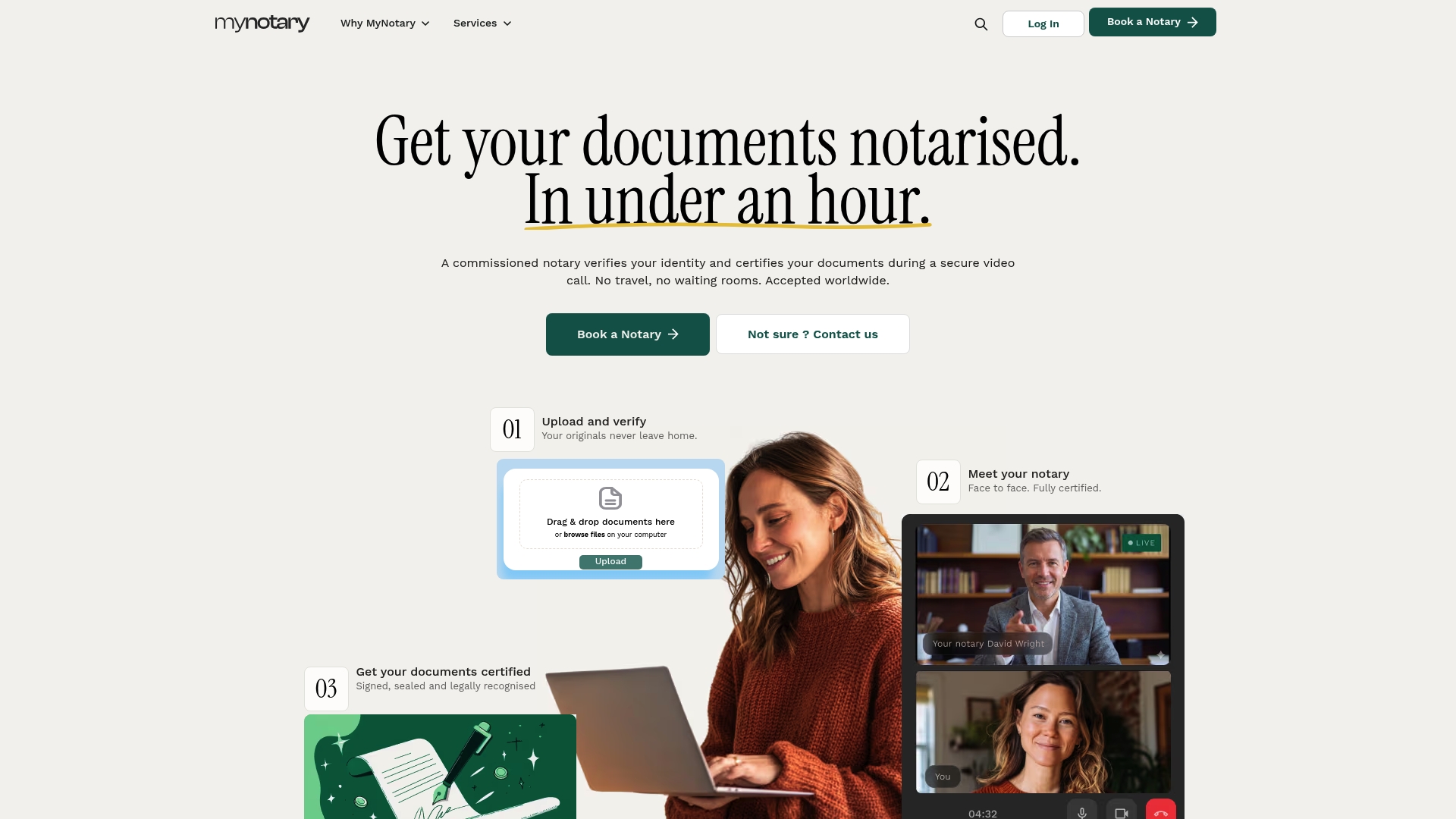
The platform connects you with a commissioned notary via secure video call, completes biometric identity verification, and produces electronically signed certified documents recognised internationally. For documents requiring a paper apostille, My Notary coordinates submission and courier return. The average notarisation turnaround is one hour. Whether you need a certified signature for a power of attorney, corporate document certification for an overseas transaction, or academic records apostilled for a visa application, My Notary handles the full workflow. Book your session at uk.mynotary.io to get started today.
This article provides general information about apostille processes and is not legal advice. Confirm current requirements with the HCCH, the UK Legalisation Office, or a qualified legal professional before submitting documents.
Useful sources
The sources below are the primary references for verifying apostille eligibility, country membership, and UK process details.
- HCCH status table: The single authoritative list of contracting states, with accession and entry-into-force dates for each country. Re-check this immediately before filing and save a dated screenshot as proof.
- GOV.UK legalisation guidance: Covers the UK application process for both paper apostilles and e-Apostilles, lists ineligible document types, and provides current fee and postal return information.
- HagueApostille.co.uk: Explains the scope and limitations of an apostille, including the distinction between authenticating a signature and certifying document contents.
Always re-check these sources immediately before applying. Membership counts and entry-into-force dates change, and a list that was accurate three months ago may not reflect the current position.
FAQ
How many countries accept an apostille in 2026?
The HCCH lists 129 contracting states as of current data, though published counts vary slightly due to the gap between accession and entry into force. Always verify at hcch.net before filing.
Which countries do not accept an apostille?
Notable non-members include Egypt, Malaysia, and several Middle Eastern and sub-Saharan African states. Documents destined for these countries require full consular legalisation through the relevant embassy.
Can I get an apostille on a birth certificate electronically?
No. Birth, death, and marriage certificates are ineligible for e-Apostilles under current GOV.UK guidance and must be submitted as paper documents to the UK Legalisation Office.
How long does a UK apostille take?
Postal legalisation typically takes a few working days; an online e-Apostille is usually faster for eligible documents. Using a bundled online commissioned-notary and apostille service such as My Notary can reduce the overall process significantly, with fast notarisation turnaround.
Do I need a notary before applying for an apostille?
Not always. Simple certificates such as educational qualifications may not require prior notarisation. However, powers of attorney, affidavits, and many commercial documents must be certified by a commissioned notary before the apostille can be applied.
Recommended
Got questions? We’re on it.
Most questions are answered here, drawn from what people actually ask before booking. If yours isn’t, our team is in chat.
The HCCH lists 129 contracting states as of current data, though published counts vary slightly due to the gap between accession and entry into force. Always verify at hcch.net before filing.
Last updated: