Notary fees UK: what you should expect to pay
By Jeremy Arhab, Founder · Published 4 August 2026 · Updated 4 August 2026
Discover notary fees UK for personal and corporate documents. Learn what to expect and ensure you get an accurate quote before booking.

***
TL;DR: - Notary fees in the UK vary based on document complexity, with straightforward cases costing about £80–£125 plus VAT. Additional disbursements such as apostille, translation, and courier services are charged separately and can significantly affect the total cost. Providing detailed information and requesting a fixed, itemised quote ensures transparency and accurate budgeting.
***
For most straightforward personal documents, notary fees in the UK generally start at a moderate level + VAT, while more complex matters such as powers of attorney or corporate documents commonly incur higher fees. Disbursements, including the apostille fee, certified translations, and courier charges, are almost always charged separately on top of the notarial fee itself.
TL;DR: Send a commissioned notary a clear scan of your document, the destination country, the number of signatories, and your deadline. You will receive a fixed-fee quote you can compare properly.
Three things to confirm before you book:
- VAT: Ask whether the quoted figure is inclusive or exclusive of VAT, as not all notaries are VAT-registered.
- Apostille requirement: Check whether the receiving country requires an apostille or full embassy legalisation, since this adds cost and time.
- Appointment type: Decide whether you need an in-person visit, a mobile appointment, or whether an online video notarisation will satisfy the receiving authority.
***
Table of Contents
- How commissioned notaries calculate their fees
- What are realistic UK notary fee ranges by document type?
- What extra costs get added on top of the notary fee?
- How VAT, payment methods, and turnaround times work
- Online notarisation versus in-person: which costs less and works better for you?
- What to send a notary to get an accurate fixed-fee quote
- Key takeaways
- Why transparent pricing is the standard you should insist on
- Get a fixed-fee notarisation quote with My Notary today
- Useful sources
- FAQ
How commissioned notaries calculate their fees
Notaries set their own fees based on time, complexity, and overhead. There is no fixed national tariff, which is why quotes can vary noticeably between practitioners and locations. Three billing models are common in practice.
Fixed fee per transaction is the most straightforward. The notary assesses the document type, the destination country, and the number of signatories, then quotes a single price for the work. This model suits routine tasks such as certifying a copy of a passport or witnessing a signature on a standard form.
Per-document or per-copy pricing applies when a client needs multiple certified copies of the same document. Each additional copy typically attracts a reduced incremental charge rather than a full repeat fee, though the first copy carries the full professional fee.
Time-based or hourly charging comes into play for complex matters: drafting bespoke powers of attorney, handling multi-signatory corporate resolutions, or advising on the legalisation chain for a document destined for a jurisdiction with unusual requirements. Some practitioners publish a minimum per-job fee, with hourly rates applied above that threshold for work that runs longer than anticipated.

On any invoice, you should expect to see the professional fee, a separate line for each disbursement (apostille, translation, courier), and a VAT line if the notary is VAT-registered. Clarity on each of those lines is what allows you to compare quotes accurately.
***
What are realistic UK notary fee ranges by document type?
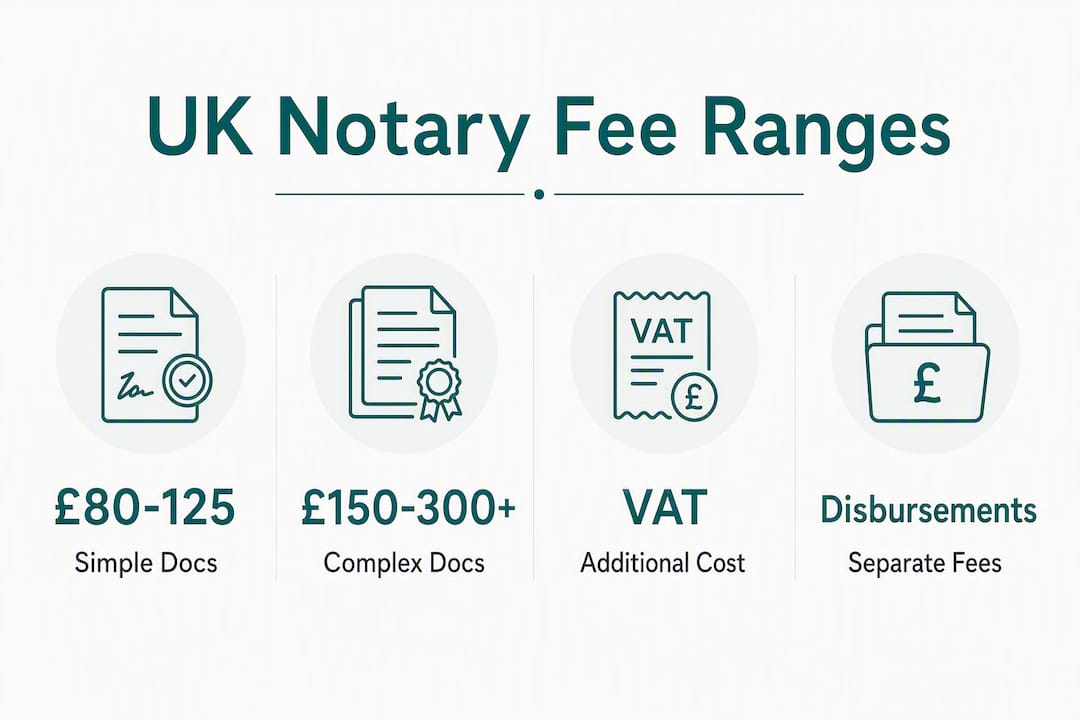
The table below gives guide price bands for the most common notarial tasks. These are indicative ranges drawn from published UK notary fee guidance and should be treated as benchmarks, not binding quotes.
| Service | Typical guide range (excl. VAT) |
|---|---|
| Certified copy of a document (e.g. passport, bank statement) | £80–£125 |
| Witnessing a signature | £80–£125 |
| Affidavit or statutory declaration | £80–£125 |
| Power of attorney for overseas use | £150–£300+ |
| Degree or diploma certification | £150–£300+ |
| Company or corporate documents | £150–£300+ |
| Urgent / same-day appointment | Surcharge typically £50–£100 |
| Mobile visit (travel to client) | Surcharge typically £50–£150 depending on distance |
Ranges are wide for good reason. A power of attorney destined for a country with a complex legalisation chain requires more notarial effort than one for a straightforward Hague Convention country. Similarly, a document with four signatories takes longer to process than one with a single signatory, and London-based practitioners tend to charge more than those in smaller cities due to higher overheads.
Degree and diploma certification, for example, can attract higher fees when the receiving institution requires detailed verification of the awarding body, as is common for UK ENIC recognition or overseas employer submissions.
These figures cover the notarial fee only. Budget separately for disbursements.
***
What extra costs get added on top of the notary fee?
Many clients underestimate the total cost because they focus on the notarial fee and forget to budget for the legalisation and translation steps that often follow. Listing disbursements clearly is the most reliable way to avoid a surprise invoice.
Common disbursements include:
- Apostille fee: Charged by the relevant authority for affixing an apostille to a notarised document. The UK government's legalisation service charges a set fee per document; next-day and postal options carry different rates.
- Embassy or consular legalisation: Required for countries that are not party to the Hague Apostille Convention. This step is arranged separately and can add both cost and several working days to the process.
- Certified translation: If the receiving authority requires the document in another language, a certified translator must produce a translation that accompanies the notarised original. Translation fees vary by language pair and document length.
- Courier and tracked return postage: Physical documents sent abroad typically require tracked international courier services. Costs depend on destination and urgency.
- Agency or handling fees: Some notaries use a legalisation agency to submit apostille applications on the client's behalf. This adds a handling charge but saves the client time.
Whether the notary manages disbursements on your behalf or passes them to you to arrange varies by practice. Clarify this at the outset, particularly for documents that need to travel through multiple legalisation steps. Visa and immigration documents, for instance, frequently require notarisation followed by an apostille and sometimes consular legalisation, as outlined in guidance on UK family visa document requirements.
***
How VAT, payment methods, and turnaround times work
VAT treatment varies between notaries. Some practitioners are VAT-registered and will add 20% to their professional fee and to any disbursements they handle; others are not registered and charge no VAT at all. Always confirm whether a quoted figure is VAT-inclusive before agreeing to proceed.
Typical payment methods accepted by notaries include:
- Bank transfer (BACS or faster payment), usually required before or at the appointment
- Credit or debit card payment via an online portal or card reader
- Online payment links for remote or video appointments
- A deposit for complex or multi-stage matters, with the balance due on completion
Turnaround times depend on the service level and the legalisation chain involved:
- Same-day or urgent: Available from some practitioners for an additional surcharge. Suitable for straightforward documents where no apostille is needed.
- Standard (48–72 hours): Covers most routine notarial work once the appointment is complete.
- With apostille (postal service): The UK government's standard legalisation service adds further working days; a next-day service is available through approved providers at a higher fee.
- With embassy legalisation: Can add one to two weeks or more, depending on the embassy's processing times.
Mobile appointments, where the notary travels to you, typically carry a surcharge that reflects travel time and distance. Out-of-hours appointments attract a similar premium. Both are worth factoring into your total budget if your schedule or location makes a standard office visit impractical.
***
Online notarisation versus in-person: which costs less and works better for you?
The cost difference between online and in-person notarisation is not always as large as people expect, but the convenience gap can be significant. Online notarisation platforms remove travel time, eliminate mobile visit surcharges, and allow documents to be uploaded and reviewed before the appointment, which reduces the risk of errors that would require a repeat session.
Key differences to weigh up:
- Identity verification: — Online notarisation uses biometric identity checks conducted via secure video call. In-person appointments rely on presenting original identity documents. Both are accepted for most document types.
A practical example: an individual in Edinburgh needing a certified copy of a passport for an overseas employer could book an online video appointment, upload the document in advance, complete biometric identity verification during the call, and receive a certified digital copy the same day, without travelling to a notary's office or paying a mobile visit surcharge.
***
What to send a notary to get an accurate fixed-fee quote
Vague enquiries produce vague estimates. A notary cannot give you a binding fixed price without knowing the specifics of your matter. Providing the complete picture up front is the most reliable way to get a comparable, fixed quote quickly.
Send the following with your initial enquiry:
- A clear scan of the full document (every page, including any existing stamps or endorsements).
- The destination country and the name of the receiving organisation or authority.
- The number of signatories who need to sign or whose signatures need to be witnessed.
- The number of certified copies required.
- Whether an apostille or translation is needed (or whether you are unsure and need guidance).
- Your deadline or preferred appointment date.
- Whether you need an in-person, mobile, or online video appointment.
Notaries may ask follow-up questions about the purpose of the document or the specific requirements of the receiving authority. That is normal and reflects due diligence rather than delay. Answering promptly keeps the process moving.
Pro Tip: Include the exact name of the receiving institution and any reference or case numbers on the document. This prevents rework: if the notary's certificate references the wrong authority name, the receiving organisation may reject the document, triggering additional verification and a further fee.
***
Key takeaways
Notary fees in the UK typically start around £80–£125 + VAT for simple personal documents. For complex matters such as powers of attorney or company documents, fees commonly range from £150–£300+, with disbursements such as apostilles, translations, and courier charges added separately. Requesting a fixed-fee quote with itemised disbursements is the single most important thing to do before committing.
| Point | Details |
|---|---|
| Typical fee bands | Simple documents: £80–£125 + VAT; complex matters: £150–£300+. |
| Budget for disbursements | Apostille, embassy legalisation, translation, and courier fees are charged on top of the notarial fee. |
| Confirm VAT status | Always ask whether a quote is VAT-inclusive; not all notaries are VAT-registered. |
| Get a fixed quote | Supply a full document scan, destination country, signatories, extras needed, and your deadline. |
| My Notary | Offers online video notarisation with biometric ID verification and an average one-hour turnaround, with fixed quotes and itemised disbursements. |
***
Why transparent pricing is the standard you should insist on
Pricing opacity is one of the most common sources of frustration in notarial services. Clients receive a headline fee, agree to proceed, and then discover that the apostille, the translation, and the courier have each been invoiced separately at the end, doubling the original figure they had budgeted for.
The solution is straightforward: before you confirm any appointment, ask for a written breakdown that lists the professional fee, every disbursement the notary will handle, VAT status, and the total. That is not an unreasonable request. Transparency requirements within the profession exist precisely to give clients the information they need to make informed choices.
My Notary's approach to this is built into the platform itself. Because documents are uploaded and reviewed before the video appointment begins, the notary can assess the full scope of the work and quote a fixed fee with disbursements listed before the session starts. Biometric identity verification is completed during the call, which removes the ambiguity around identity checks that sometimes adds cost to in-person processes. The result is a quote that holds, rather than one that expands as the matter progresses.
You are entitled to an itemised written quote before you commit. If a provider is unwilling to give you one, that tells you something useful.
***
Get a fixed-fee notarisation quote with My Notary today
For individuals and businesses who need documents notarised without the uncertainty of an open-ended invoice, My Notary offers a clear alternative to the traditional office appointment.
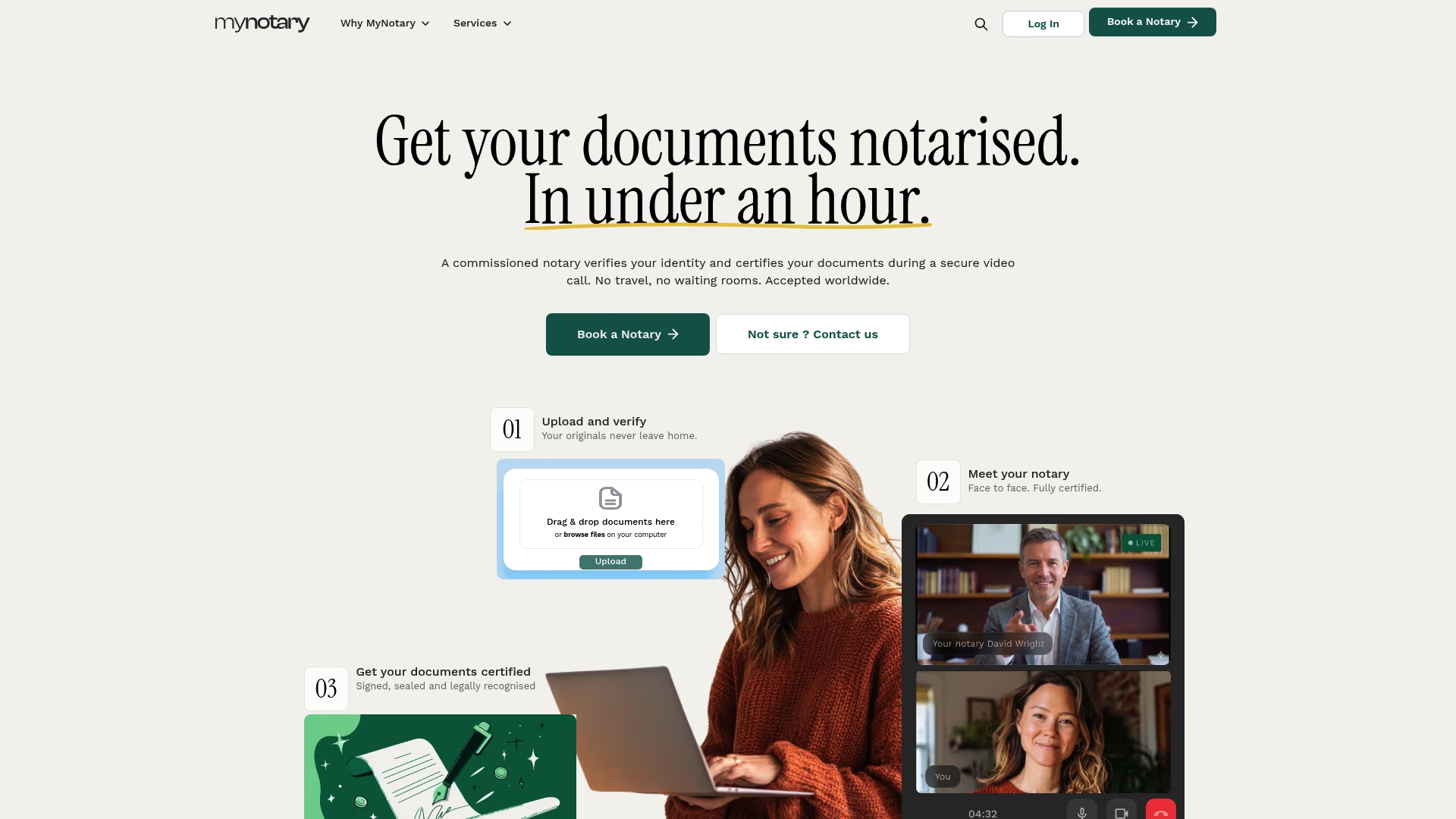
The platform connects you with a commissioned notary via a secure video call. You upload your documents in advance, complete biometric identity verification during the session, and receive a certified digital or physical copy, typically within one hour. Fixed quotes are provided upfront, with disbursements such as apostille handling and certified translation listed as separate, transparent line items. Optional add-ons for online signature certification, visa-related affidavits, and corporate document notarisation are available within the same platform, with no travel required and no mobile visit surcharge. Electronic signatures produced through the platform are legally recognised in over 180 countries.
To get your fixed-fee quote, visit uk.mynotary.io and select the document type that matches your needs.
***
Useful sources
- My Notary: online notarisation platform — the platform's main landing page, covering service categories, turnaround claims, and identity verification features.
- Online notarisation UK: the complete guide | My Notary — detailed walkthrough of the online notarisation process, including identity verification steps and platform capabilities.
- Certified true copy service | My Notary — service detail for certified true copies, useful for understanding per-copy pricing.
- Certified copy of passport | My Notary — entry-level service page with practical detail on certifying identity documents online.
- Degree certification for UK ENIC | My Notary — explains the higher-effort certification process for degree documents requiring ENIC recognition.
- Get a document legalised | GOV.UK — the UK government's official guidance on apostilles and the legalisation process.
- Next-day legalisation service providers | GOV.UK — official list of approved providers for expedited apostille services.
- UK family visa documents required | MNS Solicitors — practical partner guidance on which documents visa applications commonly require, including notarisation and legalisation steps.
- My Notary blog — further guides on notarisation processes, document types, and platform how-tos.
***
FAQ
How much do notaries charge in the UK?
For straightforward personal documents, notary fees in the UK typically start around £80–£125 + VAT. More complex matters such as powers of attorney, degree certification, or corporate documents commonly range from £150 to £300 or more, with disbursements charged separately.
Is a notary cheaper than a solicitor?
For notarial acts specifically, such as certifying copies or witnessing signatures for overseas use, a commissioned notary is often the appropriate and cost-effective choice. Solicitors can perform some witnessing functions, but notarial certification for international use generally requires a commissioned notary.
Who can notarise a document in the UK?
A commissioned notary is the appropriate professional for documents requiring notarisation for use abroad. For certain domestic purposes, a solicitor or other authorised person may suffice, but international documents typically require a commissioned notary's seal and signature.
Why are notary fees sometimes higher than expected?
The notarial fee is only part of the total cost. Apostille fees, embassy legalisation, certified translations, and courier charges are typically invoiced separately and can substantially increase the final amount. Requesting an itemised written quote before booking, as offered by platforms such as My Notary, is the most reliable way to budget accurately.
What is the apostille cost in the UK?
The UK government charges a set fee per document for its standard legalisation service; a next-day option is available through approved providers at a higher rate. The apostille fee is separate from the notary's professional fee and should appear as a distinct line item on any itemised quote.
Recommended
Got questions? We’re on it.
Most questions are answered here, drawn from what people actually ask before booking. If yours isn’t, our team is in chat.
For straightforward personal documents, notary fees in the UK typically start around £80–£125 + VAT. More complex matters such as powers of attorney, degree certification, or corporate documents commonly range from £150 to £300 or more, with disbursements charged separately.
Last updated: