Notarized letter format: templates and UK guide
By Jeremy Arhab, Founder · Published 30 July 2026 · Updated 30 July 2026
Discover the essential notarized letter format with templates and UK guidance. Ensure compliance and streamline your document authentication.

***
TL;DR: - A notarized letter follows a fixed structure including a title, parties, purpose, attestation, attachments, signature, and notary area. - It must be signed in front of a commissioned notary, with preparation verifying names, ID, and document completeness to prevent delays.
***
A compliant notarized letter follows a fixed, line-by-line structure: title, parties, purpose statement, attestation line, attachments list, signature block, and a reserved area for the notary certificate and seal. The letter must be signed in front of a commissioned notary, never before. Here is a minimal template you can copy immediately:
According to GOV.UK guidance, notarisation is primarily used to authenticate documents for use outside the UK, with a commissioned notary attesting signatures and identity so that foreign authorities accept them without further checks. My Notary offers this process entirely online, with biometric identity verification and an average turnaround of around one hour.
Pro Tip: Never sign the letter before your appointment. Bring your original photo ID and any original supporting documents the notary will need to inspect.
***
Table of Contents
- What does a notarized letter format include, line by line?
- Three ready-to-use notarized letter templates
- How to get a letter notarised in the UK
- Pre-notarisation checklist: what to verify before your appointment
- Why notarisation from a commissioned notary matters for overseas use
- Key takeaways
- My Notary: notarise your letter online, without the wait
- FAQ
What does a notarized letter format include, line by line?
Getting the structure right from the start prevents the most common reason letters are rejected: missing or misplaced elements. Each block below has a specific purpose, and the order matters.

| Element | What to include | Placement |
|---|---|---|
| Document title | Short, descriptive (e.g., "Residency Confirmation") | Top of page, centred |
| Date and contact details | Full date; author's name, address, and contact | Below title, left-aligned |
| Parties | Full legal names, addresses, and any ID reference numbers | Opening paragraph |
| Purpose paragraph | Plain-language statement of facts or authorisation, first person | Body of letter |
| Attestation line | "I, [Name], confirm/declare that the above is true…" | Before signature block |
| Attachments list | Names and dates of supporting documents | Below attestation |
| Signature block | Space for signature and printed name; date line | Bottom of letter body |
| Notary certificate area | Reserved blank space or separate page for notary wording, seal and signature | Immediately below signature block or on a separate certificate page |
A few formatting points are worth noting. Use a standard font (Times New Roman or Arial, 11–12pt), set margins of at least 2.5 cm on all sides, and leave no blank fields in the body text. If you are attaching scanned documents, annotate each one with a reference label that matches the attachments list. Where the letter runs to more than one page, number each page and include the document title in the header.
Pro Tip: If the receiving authority has specified exact notarial wording, paste it verbatim into the reserved certificate area as a placeholder so the notary can see what is expected and confirm whether it matches their standard form.
***
Three ready-to-use notarized letter templates
The three templates below cover the most common scenarios. Replace every item in square brackets with the correct details before your appointment.
Template 1: Travel consent for a minor
- Replace: parent/guardian name, child's name, date of birth, passport number, travel dates, destination, accompanying adult.
- Attach: copy of child's passport, your own photo ID, any custody order if applicable.
- Use a separate notarial certificate page if the receiving airline or embassy requires it.
Template 2: Residency or employment confirmation
- Attach: utility bill or bank statement confirming address, employment contract or payslip as applicable.
- Note the period covered clearly; visa authorities often require a minimum period of residency to be stated.
Template 3: Limited authorisation to act
- State the scope and expiry date explicitly; vague or open-ended authorisations are often rejected.
- Attach: copy of your photo ID and, where relevant, a letter from the organisation confirming what is to be collected.
***
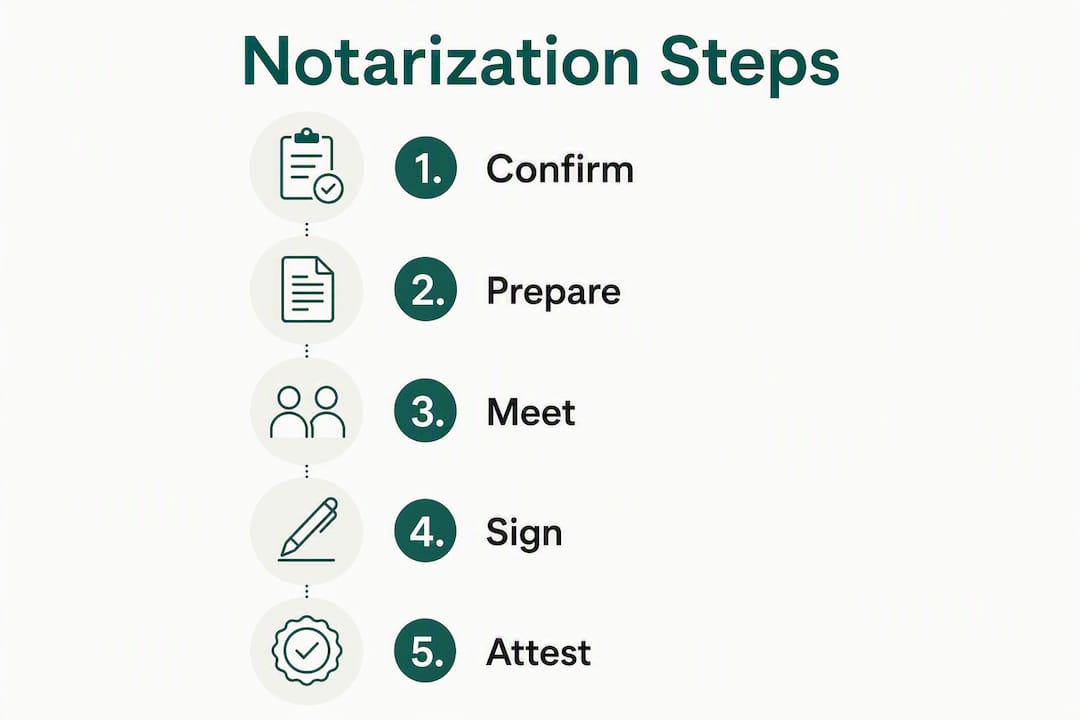
How to get a letter notarised in the UK
The process has five clear stages. Skipping any one of them is the most common cause of delays.

| Stage | What to do | Typical timeframe |
|---|---|---|
| 1. Confirm requirements | Contact the receiving authority to confirm exact notarial wording, apostille needs, and translation requirements | Before booking |
| 2. Book an appointment | Choose in-person or remote video notarisation (My Notary offers online notarisation with biometric identity checks) | 1 working day in advance |
| 3. Prepare documents | Gather originals, photocopies, primary photo ID (passport or driving licence), and proof of address | Day before appointment |
| 4. Attend and sign | Sign only in the notary's presence; the notary witnesses the signature and attaches the certificate and seal | At appointment |
| Aftercare | Check the certificate, retain originals and certified copies; arrange apostille or legalisation if the document is for overseas use | Same day or within two days |
For remote appointments via My Notary, the process mirrors the in-person steps: you upload your document, complete a biometric identity check, and sign during a live video call with a commissioned notary. Many documents are completed within approximately one hour. If the destination country requires an apostille, My Notary can arrange this as an add-on service.
***
Can you handwrite a letter to be notarised?
Yes, handwritten documents can be notarised, provided the letter meets the same standards as a typed one. Follow these steps if you choose a handwritten form:
- Write clearly and legibly throughout; any word that could be misread may cause the document to be rejected.
- Complete every field — leave no blank spaces in the body of the letter.
- Do not sign before the appointment. The notary must witness the signature in real time and will require a fresh copy if you arrive with a pre-signed document.
- If the receiving authority prefers typed documents, attach a typed transcript of the handwritten letter and ask the notary to certify both together.
***
What does a notarial certificate look like?
The notarial certificate is the section the notary completes, signs, and seals. It is separate from the letter body and typically appears immediately below the signatory's signature block or on a dedicated certificate page.
| Certificate component | Purpose | Example wording |
|---|---|---|
| Attestation clause | States what the notary is certifying | "I certify that [Name] signed this document in my presence on [Date] at [Place]." |
| Notary identity | Identifies the notary by name and qualification | "I, [Notary's Full Name], Notary Public, practising at [Address]…" |
| Date and place | Records when and where notarisation occurred | "[City], [DD Month YYYY]" |
| Seal / stamp | Official notary seal affixed to the certificate | Embossed or inked seal alongside signature |
| Signature | Notary's manuscript signature | Signed beneath the attestation clause |
Where the letter and certificate appear on the same page, the notary will typically draw a line beneath the signatory's signature block and begin the certificate wording below it. For multi-page documents, the certificate is usually a separate final page, with each page numbered and initialled. The notary's seal is affixed to the certificate page only, unless the receiving authority specifies otherwise.
***
Real-world examples: how the format changes by use case
The core notarized letter format stays consistent, but each use case adds one or two critical details.
- Travel consent for a minor: include the child's passport number, full travel dates, destination country, and the accompanying adult's full name. Many airlines and embassies require the letter to be notarised within three months of travel.
- Document collection authorisation: name the specific documents to be collected, the organisation holding them, and an explicit expiry date. A power of attorney for specific tasks follows the same principle of limited, defined scope.
- Residency or employment proof for a visa: state the exact period of residency or employment, the subject's full address or job title, and attach supporting evidence (utility bill, payslip). The embassy or visa authority will usually specify the minimum period to be confirmed.
- Certified declaration for a foreign authority: the receiving body may require the declaration to be in a specific language. In that case, a certified translation is needed alongside the notarised original. Confirm this with the authority before drafting.
When a document is destined for a country that is a signatory to the Hague Convention, an apostille issued by the relevant authority converts the notarised document into one that is accepted across all member states without further legalisation. For non-Hague countries, full legalisation through the destination country's embassy may be required. Always confirm apostille requirements with the receiving body before your appointment.
***
Pre-notarisation checklist: what to verify before your appointment
| Check | Detail | Red flag if missing |
|---|---|---|
| Names consistent | Full legal names match across letter, ID, and all attachments | Any discrepancy will likely cause rejection |
| Originals available | Original documents present for the notary to inspect | Photocopies alone are not sufficient for attestation |
| Primary photo ID | Passport or photographic driving licence; recent utility bill or bank statement for proof of address | Missing ID means the appointment cannot proceed |
| No pre-signing | Letter is unsigned until the notary witnesses it | Pre-signed documents require a fresh copy |
| Special wording confirmed | Any wording specified by the receiving authority is noted and shared with the notary in advance | Incorrect wording may invalidate the certificate |
| Apostille / translation arranged | Confirmed whether the destination requires an apostille or certified translation | Omitting this step causes delays after notarisation |
| No blank fields | Every field in the letter body is completed | Blank spaces can render the document ambiguous or invalid |
***
Why notarisation from a commissioned notary matters for overseas use
A notarised document carries a specific kind of authority that a witnessed signature or a solicitor's certification does not replicate. When a commissioned notary attests a signature and identity, they create a chain of evidence that foreign courts, embassies, and authorities can rely on without conducting their own checks.
- Professional standing: notaries are specialist lawyers who operate to professional practice rules, including insurance and conduct obligations, which makes their certificates reliable evidence internationally.
- Protected title: "notary" or "notary public" is a protected title; only qualified and registered practitioners may use it, which gives the certificate a verifiable legal status.
- Online notarisation: platforms such as My Notary combine biometric identity verification with live video witnessing to recreate the chain-of-evidence elements that receiving authorities require, with online notarisation accepted in over 180 countries.
- Apostille caveat: for some countries or authorities, notarisation alone is not sufficient. An apostille or additional legalisation may still be required; always confirm this with the receiving body before the appointment.
A note on acceptance: notarisation does not guarantee that every foreign authority will accept a document without further steps. The receiving body's own requirements always take precedence, and confirming those requirements in writing before drafting the letter is the single most effective way to avoid delays.
***
Key takeaways
A compliant notarized letter requires a clear title, named parties, a purpose statement, an explicit attestation line, and a reserved area for the notary certificate, seal, and signature, all signed in the notary's presence.
| Point | Details |
|---|---|
| Core format | Include title, parties, purpose, attestation line, attachments list, signature block, and notary certificate area. |
| Never pre-sign | The notary must witness the signature in real time; a pre-signed letter will require a fresh copy. |
| ID required | Bring a passport or photographic driving licence, plus proof of address such as a recent utility bill. |
| Apostille check | Confirm with the receiving authority whether an apostille or certified translation is needed before the appointment. |
| My Notary | Offers online notarisation via video call with biometric identity checks, with many documents completed in approximately one hour. |
***
The mistake that causes more delays than any other
The single most common failure at a notary appointment is a name mismatch: the letter says "Jonathan Smith," the passport says "John A. Smith," and the supporting documents say "J. Smith." Each variation looks minor in isolation, but together they break the chain of evidence the notary is there to certify.
The remedy is straightforward. Before drafting the letter, check every document you plan to bring and confirm the exact legal name as it appears on your primary photo ID. Use that form of the name throughout the letter, the attachments list, and any translations. If a discrepancy exists in your underlying documents (a deed poll, a marriage certificate, a name change), bring the supporting evidence and tell the notary in advance. Preparation and a brief written confirmation from the receiving authority about their exact requirements will resolve almost every issue before it becomes a problem.
***
My Notary: notarise your letter online, without the wait
Booking a notary appointment, travelling to an office, and waiting for a stamped copy to be posted back can take days. My Notary cuts that to approximately one hour for most documents, with no travel required.

Upload your letter, complete a biometric identity check, and sign during a live video call with a commissioned notary. The result is a legally recognised notarised document, accepted in over 180 countries. For letters that need to go further, My Notary also offers certified translation and apostille services as add-ons, so you can handle the entire process in one place. Whether you need a signature notarised online or a certified copy of a supporting document, the booking process takes minutes. Visit My Notary's services page to start your notarisation today.
***
Useful sources and further reading
| Source | What it covers |
|---|---|
| GOV.UK: Find a notary abroad | Official guidance on using notarised documents overseas and when apostille or legalisation is required |
| The Notaries Society: What is a notary? | Plain-language explanation of what a commissioned notary does and their professional obligations |
| Curtis Parkinson: Notes for clients | Practical preparation notes: what ID to bring, what to expect at the appointment, and the signing rules |
| Notary.co.uk: Travel consent | Guidance on travel consent documents, ID requirements, and template considerations |
| My Notary: Online notarisation services | Full list of documents My Notary can notarise online, including identity verification and apostille add-ons |
| My Notary: Certified copy of bank statement | Service page for certified copies of financial documents, useful for visa and residency applications |
| My Notary: Notarisation guides | Practical articles on notarisation requirements, document types, and preparation tips |
***
FAQ
What is a notarized letter in the UK?
A notarized letter is a document whose signature and identity have been verified and attested by a commissioned notary, making it acceptable to foreign courts, embassies, and authorities. It differs from a witnessed or solicitor-certified document because the notary's certificate creates a recognised chain of evidence for international use.
How do you write a letter to be notarized?
Structure the letter with a clear title, the full legal names of all parties, a plain-language purpose statement, an explicit attestation line ("I declare that the above is true…"), an attachments list, and a signature block, followed by a reserved area for the notary certificate and seal. Do not sign until you are in front of the notary.
Can you handwrite a letter to be notarized?
Yes. Handwritten letters can be notarised provided the text is legible, complete, and contains no blank fields. If the receiving authority prefers a typed document, attach a typed transcript and ask the notary to certify both.
How do you get a notarised consent letter?
Draft the letter using the travel consent template above, then book an appointment with a commissioned notary, in person or online via a platform such as My Notary. Bring your original photo ID, the child's passport, and any custody documentation; sign only in the notary's presence.
What ID do you need for a notary appointment?
Standard requirements are one primary photo ID (passport or photographic driving licence) and proof of address such as a recent utility bill or bank statement. Additional documents may be requested for name changes or complex transactions.
Recommended
Got questions? We’re on it.
Most questions are answered here, drawn from what people actually ask before booking. If yours isn’t, our team is in chat.
A notarized letter is a document whose signature and identity have been verified and attested by a commissioned notary, making it acceptable to foreign courts, embassies, and authorities. It differs from a witnessed or solicitor-certified document because the notary's certificate creates a recognised chain of evidence for international use.
Last updated: