Remote Witnesses Online: What the UK Allows and What It Doesn't
By Jeremy Arhab, Founder · Published 24 October 2026 · Updated 24 October 2026
Can someone witness your signature over video in the UK? See which documents allow remote witnessing, which need a person in the room, and the online options.
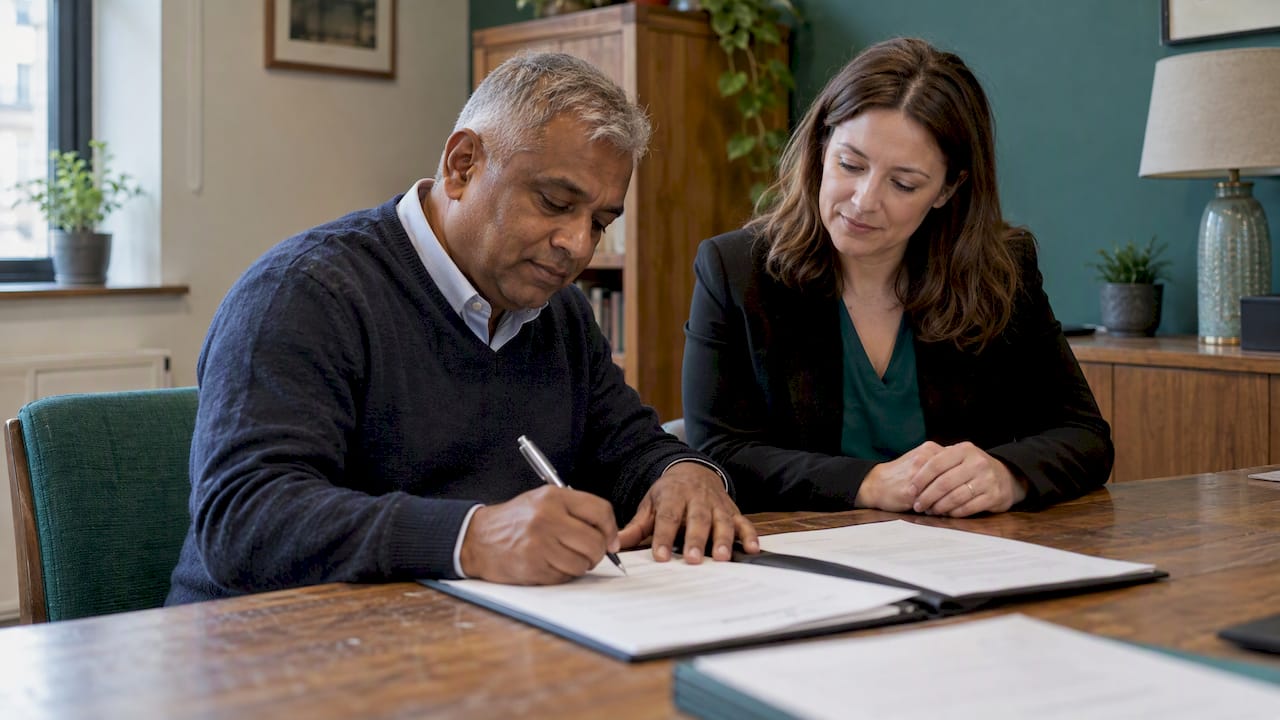
You can use a remote witness online for some documents in the UK, but not for all of them. A deed in England and Wales still needs a witness who is physically present when you sign. Many other documents, such as contracts and letters, do not need a witness at all, and a video session with a commissioned notary can be used to certify your signature and identity. This guide explains where the line sits, so you pick the right route before you sign.
TL;DR
- Deeds (for example a property transfer or some powers of attorney) need a witness present in the room. A video link does not replace that, according to GOV.UK execution of deeds guidance.
- Wills: the temporary rules allowing video witnessing ended on 31 January 2024, so a will should be witnessed in person.
- Most other documents (affidavits, declarations, consent letters, certified copies) can be signed electronically and notarised online by video.
- Online notarisation is not the same as witnessing a deed. A commissioned notary sees you sign live, checks your passport and adds a seal.
- Always check with the organisation receiving the document what it will accept before you book.
Table of Contents
- What people mean by a remote witness
- Deeds: why a video link is not enough
- Wills: the temporary rules have ended
- Documents where no witness is needed
- How online notarisation by video works
- Online notarisation versus witnessing a deed
- Perspective: what we see in practice
- Child travel consent: a common case
- When the document is going abroad: apostille
- Who should be careful with remote signing
- Book your online notarisation
- FAQ
- Sources
What people mean by a remote witness
The phrase covers three different situations, and mixing them up causes most of the problems.
- A witness to a deed. The law requires a person to watch you sign and then sign to confirm it. This is a formal legal requirement.
- A witness to a will. A separate set of rules applies, with its own history of temporary changes.
- A notarial act. A notary confirms who you are, watches you sign and certifies the document so that a person or authority abroad can rely on it.
The third is the one that works well over video. The first two are governed by formalities that the law has not fully moved online.
Deeds: why a video link is not enough
A deed is a document that has legal force because of the way it is executed, not because someone paid for it. Common examples include property transfers, some powers of attorney and certain guarantees.
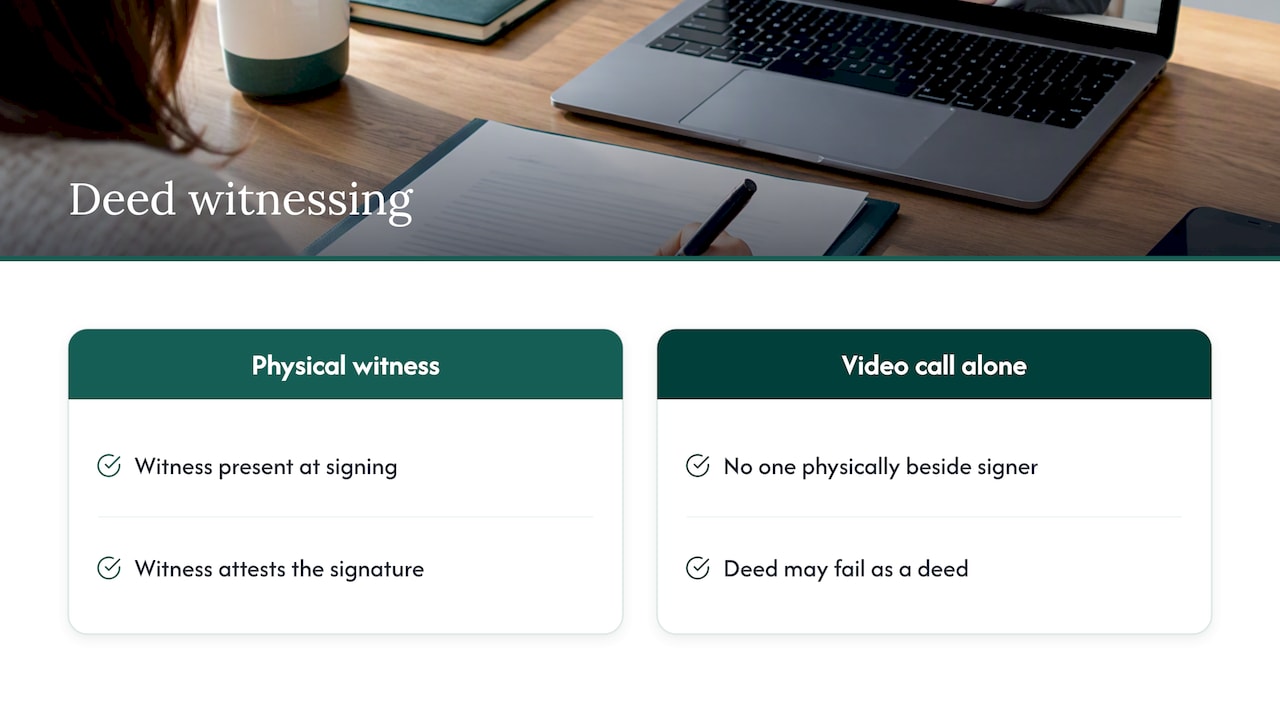
For an individual, the law asks that the person signs "in the presence of a witness who attests the signature". The requirement comes from section 1(3) of the Law of Property (Miscellaneous Provisions) Act 1989, as quoted in the GOV.UK practice guide on execution of deeds.
The question is what "presence" means. The Law Commission's work on electronic execution of documents notes that the law attaches particular signing and witnessing procedures to certain documents. Its view is that a witness to a deed should be physically present. A legal practice note on this exact question also reports no relaxation of that understanding, as set out in this Practical Law answer on video witnessing of deeds.
The practical risk is real. If you sign a deed over a video call with nobody physically beside you, the document may fail as a deed. That can matter a great deal for something like a property transfer.
The Land Registry exception
There is one notable change. In August 2025, HM Land Registry announced that it accepts Qualified Electronic Signatures. The announcement describes them as the most secure form of electronic signature, with no paper or witness needed. It is aimed at lawyers and their clients, and HM Land Registry asks interested parties to contact it for guidance. This applies to specific property transactions. It is not a general rule that deeds can now be witnessed by video.
Wills: the temporary rules have ended
During the pandemic, temporary legislation allowed wills to be witnessed by video. That legislation was extended until 31 January 2024, as the Law Society's guidance on video witnessing wills records. Since that date, a will should be witnessed in person.
The same guidance explains that, while the rules applied, "presence" meant a real-time visual link and not a recording played back later. Recording the session was treated as good practice because it gives evidence of the circumstances if the will is challenged later.
If you need a will, ask a will writer or a legal professional how to have it witnessed properly. An online notarisation service is not the right tool for this.
Documents where no witness is needed
A large share of the paperwork people try to "witness remotely" does not need a witness in the legal sense. It needs a trustworthy signature and a verified identity. For these documents, a signature can be made electronically, and the question is mainly whether the person receiving it will accept it.
Typical examples include:
- Affidavits and statutory declarations
- Certified true copies of passports, degrees or bank statements
- Proof of residency or marital status declarations
- Child travel consent letters
- Corporate documents and beneficial owner declarations
- Proof of life forms for pensions
Often the recipient, such as an embassy, a university, a bank or a foreign authority, wants a notary's certification as proof that the signature is genuine. That is where online notarisation helps.
How online notarisation by video works
Online notarisation replaces the trip to a notary's office with a live video session. At My Notary, the process works like this:
- Choose your document type and upload the document. Template tools are available if you need to draft one.
- Verify your identity. You show your passport and complete a biometric check.
- Join the video session. A commissioned notary sees you, confirms the document is unsigned, and watches you sign.
- The session is recorded. This gives an audit trail of what took place.
- Receive the certified document. The notary applies their seal, and delivery can be the same day. Our average turnaround is about one hour.
For the full walkthrough, read how the online notary process works in the UK. The three basics, identity, live signing and an ID check, are covered in our page on the conditions for UK online notarisation.
Timing at a glance
| Stage | What happens | Typical time |
|---|---|---|
| Upload and details | Add the document and your information | A few minutes |
| Identity check | Passport and biometric verification | A few minutes |
| Video session | Live signing in front of the notary | Short session |
| Delivery | Certified digital copy, physical copy if requested | Same day for the digital copy |
The overall average from start to certified document is about one hour. Timings vary with the document and with how complete your information is.
Online notarisation versus witnessing a deed
These are often confused, so here is the difference in plain terms.
| Witnessing a deed | Online notarisation | |
|---|---|---|
| Purpose | Meets a legal formality for the deed to be valid | Certifies identity and signature for use by a third party |
| Who is involved | An independent person present in the room | A commissioned notary on video |
| Over video | Not accepted for deeds in England and Wales | Yes, by live session |
| Typical use | Property transfers, some powers of attorney | Affidavits, declarations, certified copies, consent letters |
Other jurisdictions have written remote notarisation into statute. For example, Florida has a dedicated process, described in this Florida remote online notarisation guide. That is a different legal system, and it does not change the position for deeds in England and Wales.
Perspective: what we see in practice
Most people who contact us about a remote witness do not need a witness. They need a document that a foreign authority, a school, an employer or an airline will take seriously. That is a notarisation question, and it is one we can answer.
We are an online notarisation platform. We are not a law firm, and we do not advise on whether your document must be executed as a deed. When a reader asks us about a property transfer or a will, we say plainly that the formalities may require someone in the room, and that they should check with whoever drafted the document.
For everything else, the video format is a real improvement. A parent can complete a travel consent letter without taking time off work. An expat can certify a degree for a visa application without returning home. A business with signatories in three cities can complete documents in one day.
The point we repeat most often is simple: check what the receiving party wants before you sign, not afterwards.
— Jérémy
Child travel consent: a common case
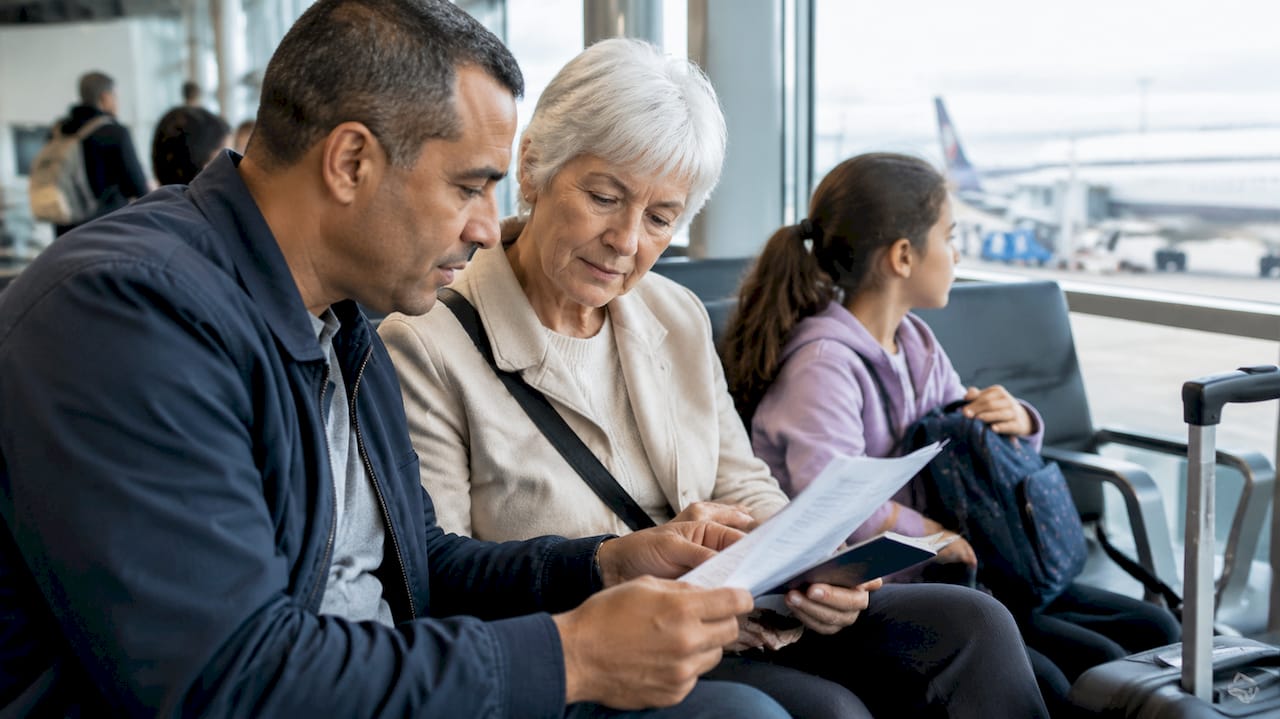
Many parents search for a remote witness because of a child's trip abroad. The GOV.UK guidance on taking a child abroad says you need the permission of everyone with parental responsibility, or of a court. A signed letter with the other person's contact details and the trip specifics is the usual approach. The letter does not always have to be notarised, but supporting proof such as a birth certificate can help at the border.
A notarised letter adds a certified signature and identity check, which some parents choose for peace of mind, particularly when parents live apart or a grandparent travels with the child. We cannot promise that any border officer or airline will accept a document. We can describe what the document contains: a verified signature, a notary's seal and a recorded session.
Two guides explain this in more detail: how to notarise a UK parental consent letter online and the child travel consent letter and online notary option.
When the document is going abroad: apostille
If the document is for use overseas, the receiving country may ask for an apostille after notarisation. An apostille is a certificate under the Hague Apostille Convention. The Hague Conference on Private International Law (HCCH) lists the competent authority for the United Kingdom.
The UK now issues electronic apostilles for documents that can be processed digitally, according to GOV.UK's announcement on electronic legalisation. Two cautions apply:
- Some documents or issuing departments may still need original paper or wet ink signatures.
- Some destination countries or organisations may not accept an e-apostille, so confirm first.
If you are abroad and need a UK apostille, our guide on preparing a UK apostille from abroad by video covers the preparation.
Who should be careful with remote signing
Remote processes suit people with a stable connection, a working camera and a valid passport. They suit others less well. The Law Society's commentary on remote hearings points out that lack of digital skills, disability or unreliable technology can make remote participation unsuitable, so it should be judged case by case.
If you have difficulty using video, ask someone you trust to help set up the call, or choose an in person route.
Book your online notarisation
If your document needs a certified signature rather than a deed witness, we can help. My Notary offers online notarisation by secure video call for personal, family, business and corporate documents, with optional certified translation and apostille services. Fees start from £70 per document, as listed on our services page.
For a single signature, go straight to online signature notarisation. For company paperwork, see corporate document notarisation.
FAQ
Can a friend witness my signature over a video call?
For a deed in England and Wales, no. The witness should be physically present. For a document that needs no witness, a friend adds nothing legally, and a notary's certification is usually more useful to the receiving party.
Can I still have my will witnessed by video?
Not under the temporary rules, which ended on 31 January 2024. A will should now be witnessed in person. Ask whoever is drafting it how to arrange this.
Is online notarisation the same as having a witness?
No. A commissioned notary confirms your identity, sees you sign live and applies a seal. It certifies the signature for a third party. It does not replace the witness a deed requires.
Will every organisation accept an online notarised document?
We cannot promise acceptance, because each organisation sets its own rules. Ask the receiving party in advance. If they need an apostille, check that the destination country accepts the format.
What do I need for the video session?
You need your unsigned document, your passport, a device with a camera and a stable connection. You sign during the session, in front of the notary.
Sources
- GOV.UK: Practice guide 8, execution of deeds
- Law Commission: Electronic execution of documents
- Practical Law: Can the execution of a deed be witnessed by video link?
- GOV.UK: HM Land Registry accepts Qualified Electronic Signatures
- The Law Society: Video-witnessing wills
- The Law Society: Remote hearings
- GOV.UK: Get permission to take a child abroad
- GOV.UK: UK legalises public documents electronically
- HCCH: Authority details for the United Kingdom
- Oldham Law PLLC: Florida remote online notarisation guide
Recommended
Got questions? We’re on it.
Most questions are answered here, drawn from what people actually ask before booking. If yours isn’t, our team is in chat.
For a deed in England and Wales, no. The witness should be physically present. For a document that needs no witness, a friend adds nothing legally, and a notary's certification is usually more useful to the receiving party.
Last updated: