Notarise a UK parental consent letter online and get same day certification
By Jeremy Arhab, Founder · Published 22 September 2026 · Updated 22 September 2026
Practical UK parental consent letter templates for travel, passport and visa use. Learn what to include, when to notarise, and how to get same day online...

If everyone with parental responsibility signs a letter naming the child, the dates and the travel details, that letter is usually enough for border checks. Passports and visas ask for more: specific signature rules and extra content. Pick the matching template below, then check the receiving authority's own checklist before you travel or submit anything.
***
TL;DR: - Parental consent letters are mainly required when a child travels with one parent, a non-parent adult, or unaccompanied minors crossing borders or applying for visas. - The letter must include detailed information such as child's full name, travel specifics, signatures of all responsible adults, and supporting documents like passport copies. - Signatures must be handwritten and the letter should be tailored for its specific purpose, whether for travel, passport application, or visa, to prevent rejection. - Notarisation is optional but recommended for international travel or when signatures may later be disputed, with online notarisation available for quick service. - Always verify official guidance and check for small errors like mismatched names or outdated passport numbers to avoid border clearance delays.
***
Table of Contents
- What is a parental consent letter and when do you need one in the UK?
- Who has to sign it? The UK legal baseline
- What to include in the letter: a field-by-field checklist
- Three ready-to-adapt templates for travel, passport and visa consent
- When to notarise a parental consent letter, and how it works online
- Quick checks before you travel or submit the letter
- Why getting the detail right matters more than the paperwork itself
- Get a notarised parental consent letter without leaving home
- Where to check the official rules yourself
- Sources
- FAQ
What is a parental consent letter and when do you need one in the UK?
A parental consent letter is written evidence that a child has permission to travel, apply for a passport, or apply for a visa without both parents present. Border officers, passport examiners and visa caseworkers all rely on it differently, so the same page of text rarely satisfies all three.
You are most likely to need one in these situations:
- Travelling with one parent while the other stays at home, especially if surnames differ from the child's.
- Travelling with a grandparent, teacher, or other adult who is not the child's parent.
- Unaccompanied minors flying or crossing borders on school trips or to visit relatives.
- Passport applications where a parent cannot attend in person or sign the main form.
- Child Student visa applications, where the Home Office wants confirmation of who is responsible for the child's care in the UK.
Border staff mainly check names, dates and travel details. HM Passport Office checks the signature against its own records. Visa caseworkers read the letter as part of a wider evidence bundle, alongside identity and relationship documents.
Who has to sign it? The UK legal baseline
Gov: permission is needed from everyone with parental responsibility, or from a court. A letter from the person or people holding that responsibility is usually enough to prove permission, and it may be requested at a UK or foreign border.
Parental responsibility does not always sit with both biological parents by default. A mother automatically holds it from birth, but a father only holds it automatically if married to the mother at the time of birth, or through later legal steps. Unmarried fathers and step-parents often need to check their own status before assuming their signature counts.
Key figures at a glance:
- Everyone with parental responsibility must consent, or a court must grant permission.
- Courts sometimes allow a short-term exception where a parent with a residence order can take a child abroad for a limited period without everyone else's consent, unless a court order says otherwise.
If another parent refuses consent, or cannot be reached, a specific issue order from a family court is the route forward. No letter template fixes a genuine dispute over parental responsibility.
What to include in the letter: a field-by-field checklist
A consent letter is only as strong as its detail. Vague wording is the most common reason letters get questioned at a border or bounced back by a passport examiner. Work through this order:
- Child's full name, date of birth, and passport number exactly as they appear on the passport.
- Names and relationship of every consenting adult, plus a plain statement that they hold parental responsibility.
- Purpose of the letter: state clearly whether it is for travel, a passport application, or a visa application, since the wording differs for each.
- Travel specifics: destination, outbound and return dates, flight or crossing details, and the name of the accompanying adult, which border officials and caseworkers check first.
- Contact details for the consenting parent, including a phone number reachable while the child is travelling.
- Signature and date, handwritten wherever the letter might go to HM Passport Office.
- Attachments: a copy of the consenting adult's passport photo page and, where relevant, evidence of the relationship such as a birth certificate.
Pro Tip: *Write the flight number, the exact crossing, or the coach route rather than "travelling to France in August." Specific, checkable details are what a border officer or caseworker actually looks for, so refer to a practical transport compliance checklist to ensure all relevant details are included.*
Three ready-to-adapt templates for travel, passport and visa consent
One template rarely covers every situation. A short travel letter reused for a visa application often misses the detailed points visa caseworkers expect to see, so match the wording to the purpose.
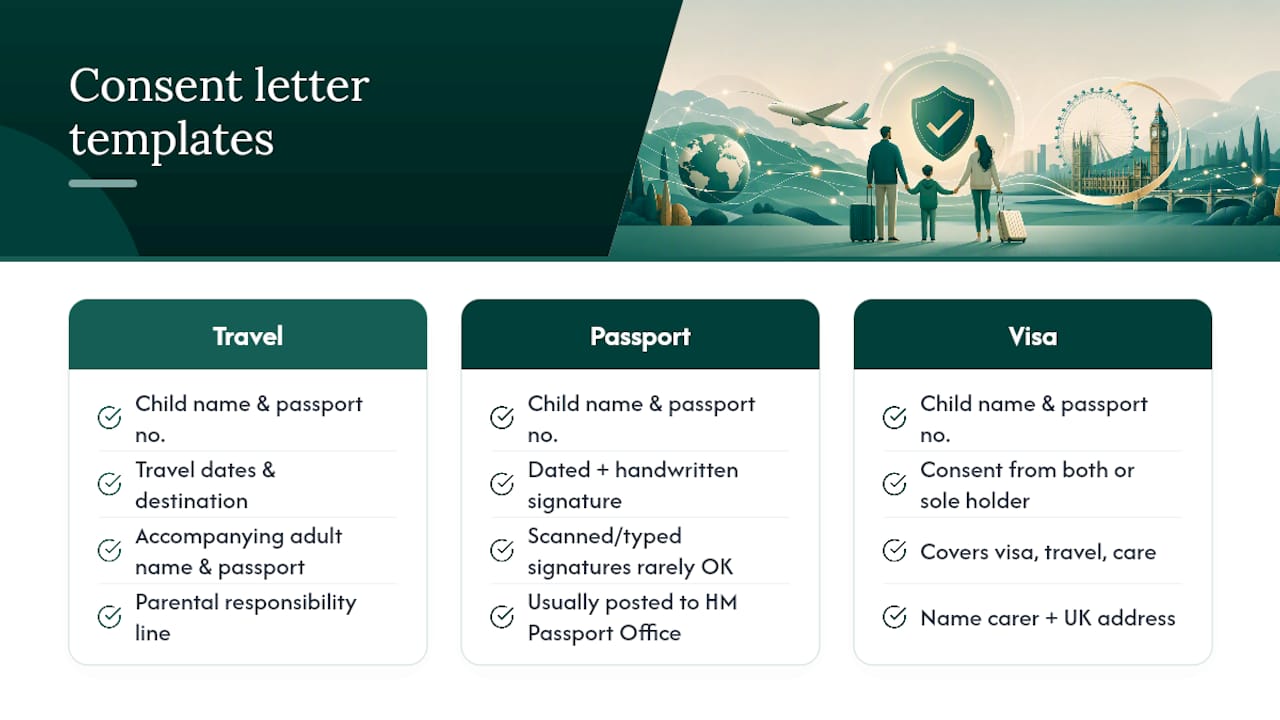
Travel consent letter. State the child's name and passport number, the dates of travel, the destination, the accompanying adult's full name and passport number, and a line such as "I confirm I hold parental responsibility for [child's name] and consent to this trip." Attach a copy of your own passport photo page.
Passport consent letter. HM Passport Office requires this to be dated and carry a handwritten signature, since examiners may ask for further evidence to verify it. Scanned or typed signatures are rarely accepted, and the letter is normally posted rather than emailed to allow that check.
Visa or immigration consent letter. For a Child Student visa, written consent from both parents, or from whoever holds sole responsibility, must cover the visa application itself, travel to the UK, and the child's living and care arrangements once here. Name the person who will care for the child and the address where they will live.
When to notarise a parental consent letter, and how it works online
Notarisation is not always required, but it helps when a receiving authority is unfamiliar with a UK letter or when someone questions whether the signature is genuine. It does not change who holds parental responsibility and it cannot replace a court order where one is actually needed.
A few situations where a notarised letter is worth arranging:
- Travelling to a country where officials expect a witnessed or certified signature, not just a plain letter.
- Submitting evidence to a foreign school, embassy, or authority that asks for identity-checked documentation.
- Any case where the other parent's signature might be disputed later.
Pro Tip: *If a document is heading to a country outside the UK, ask whether an apostille under the Hague Convention is also expected. That is separate from notarisation itself.*
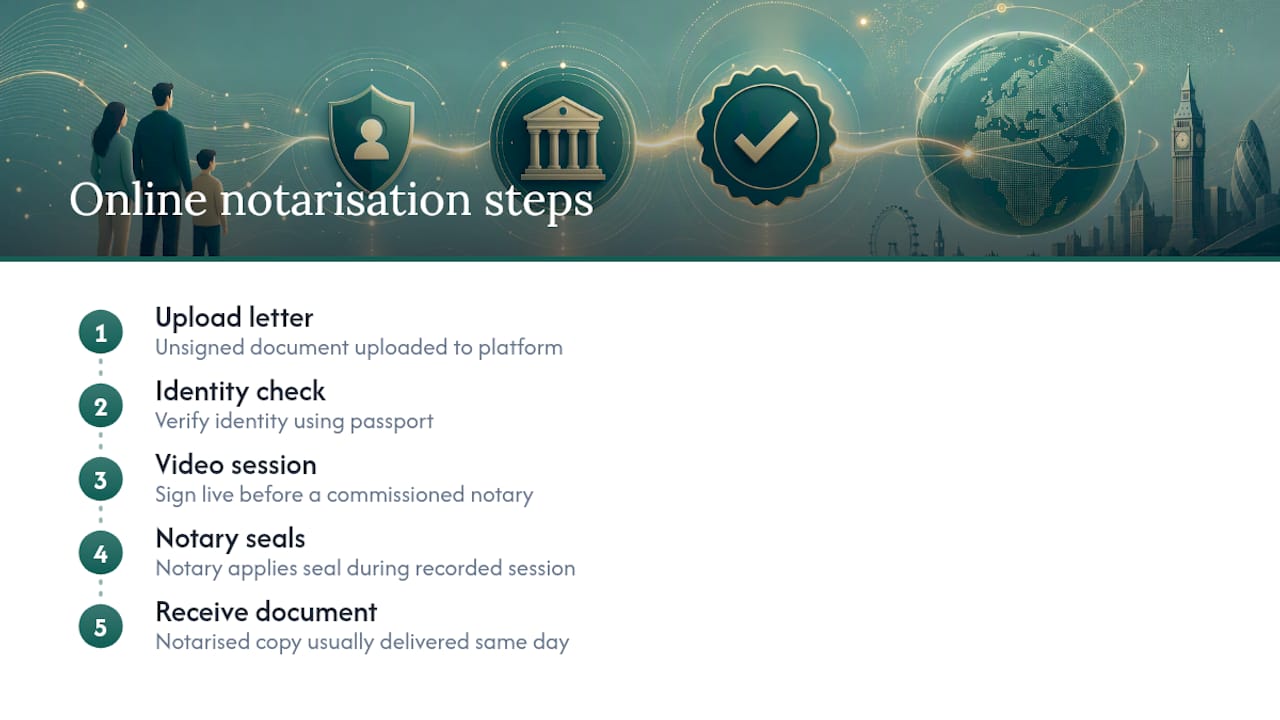
With My Notary, the process runs entirely by video call. You upload the unsigned document, verify your identity by passport, and sign during a recorded session with a commissioned notary, who applies their seal once identity and intent are confirmed. Delivery of the notarised document usually happens the same day.
Quick checks before you travel or submit the letter
Most rejections come down to small mismatches, not a missing signature. Run through these before you leave the house or click submit:
- Match every name spelling across the letter, the child's passport, and the accompanying adult's passport.
- Double check dates: travel dates, the letter's own date, and the child's date of birth.
- Confirm contact numbers work while travelling, including international dialling codes.
- Verify passport numbers are current and haven't been superseded by a renewal.
- If consent is refused or a parent is unreachable, contact a family court about a specific issue order rather than travelling on an incomplete letter.
Red flags that commonly trigger delay: an undated letter, a typed signature on a passport consent form, or a travel letter reused unchanged for a visa application.
Why getting the detail right matters more than the paperwork itself
Most consent letter problems aren't legal disputes. They're small errors: a mismatched date, a signature style the passport examiner won't accept, a letter written for one purpose and submitted for another. The rules themselves are published and stable; what trips parents up is assuming one letter does every job.
Check the exact guidance for whichever authority you're dealing with before you travel or submit anything, because a border officer, a passport examiner and a visa caseworker are not reading for the same things. Where a signature might be challenged, or the letter is heading somewhere unfamiliar with UK paperwork, a notarised version through a service like My Notary gives it more weight than a plain printout.
— Jérémy
Get a notarised parental consent letter without leaving home
The platform offers a faster route to a witnessed letter than booking an appointment and travelling to see someone in person, which can be useful when travel dates are close or family members live in different parts of the country.
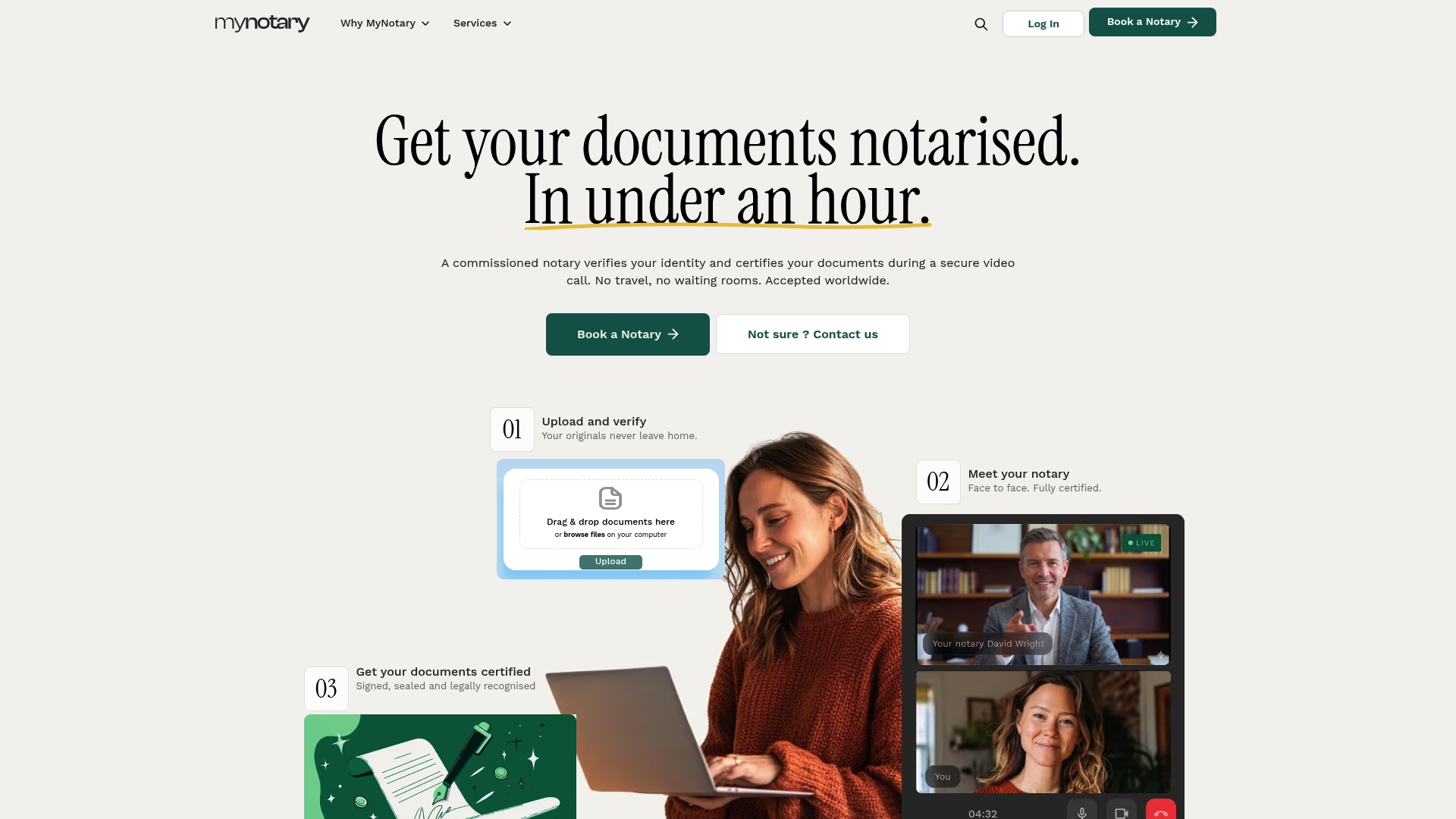
The session takes place over video call. Users upload the unsigned letter, verify their identity by passport, and sign in front of a commissioned notary during a recorded session. The notary applies their seal and delivery of the notarised document usually happens the same day, which is helpful when a school trip or flight is imminent. Parents dealing with a co-parent abroad, or who simply need a certified copy on hand for a visa application, tend to find this quicker than arranging an in-person meeting.
Always check the specific requirements of the border authority, passport office, or visa caseworker involved. The platform facilitates notarisation and certified copies but cannot guarantee that any particular authority will accept a given document. Explore My Notary's services, including Child Travel Consent notarisation from £70, to see how the process fits your situation.
Where to check the official rules yourself
Before you finalise anything, read the source guidance directly: permission to take a child abroad, HM Passport Office consent requirements, and Immigration Rules Appendix Children for visa consents.
This article is general information, not a substitute for advice from a qualified lawyer. Consult a qualified legal professional about your own circumstances before acting on anything here.
Sources
FAQ
Do I need a consent letter to take my child abroad from the UK?
Not by strict legal requirement, but it's strongly recommended. GOV.UK notes that a letter from everyone with parental responsibility is usually enough to show permission, and border staff may ask for it on either side of the trip.
How do I write a letter of parental consent?
Include the child's full name and passport number, the consenting adult's details and a statement that they hold parental responsibility, the purpose of the letter, and full travel or application details. Sign and date it, using a handwritten signature if it's going to HM Passport Office, and attach a copy of your passport photo page.
Can my ex get a passport for my child without my permission?
No. HM Passport Office requires additional written consent that is dated and carries a handwritten signature from everyone with parental responsibility, unless a court order says otherwise. If consent is refused, the applying parent would need to apply to a family court.
Can I leave home at 16 without my parents' consent in the UK?
This is a separate question from travel consent letters and depends on individual circumstances rather than a fixed rule. It's not something a parental consent letter template addresses, and a young person in this situation should seek independent advice suited to their specific case.
Does a parental consent letter need to be notarised?
Not always. A plain signed letter is often enough for routine travel, but notarisation helps when the receiving authority is unfamiliar with the letter or the signature is disputed. Services like My Notary offer this by video call, with identity verification and same-day delivery.
Recommended
Got questions? We’re on it.
Most questions are answered here, drawn from what people actually ask before booking. If yours isn’t, our team is in chat.
Not by strict legal requirement, but it's strongly recommended. GOV.UK notes that a letter from everyone with parental responsibility is usually enough to show permission, and border staff may ask for it on either side of the trip.
Last updated: