Notarised Document Delivery: What Arrives and When
By Jeremy Arhab, Founder · Published 22 October 2026 · Updated 22 October 2026
How notarised document delivery works with online notarisation: digital copies, physical originals, apostille timing and what to check before you send.

When you notarise a document online, delivery is the last step and the one that decides whether you meet your deadline. You receive an electronically signed PDF, and if you need paper, a physical copy can follow. Below we explain what you receive, how long each stage takes, how an apostille changes the timetable and which mistakes cause delays.
TL;DR
- Online notarisation through MyNotary ends with a certified digital document, with a physical copy available if the receiving party asks for paper.
- Delivery is the same day for most documents, and the average turnaround is about one hour from the video session.
- An apostille, a certified translation or a courier leg adds time, so decide what you need before you book.
- Some documents, such as certain deeds, have formalities that online signing alone may not meet. Check with the receiving party first.
- We never promise that an authority abroad will accept a document. We can only make sure it is prepared and delivered correctly.
Table of Contents
- What notarised document delivery means
- How the process runs from upload to delivery
- Timings at a glance
- Digital or physical: which should you choose?
- Do not mix wet ink and electronic signatures
- When delivery includes an apostille
- Child travel consent: delivery before the trip
- Documents with several signatories
- Our view on delivery
- Booking your notarisation with MyNotary
- Common causes of delivery delays
- Frequently asked questions
- Sources
What notarised document delivery means
Delivery covers everything that happens after the notary has witnessed your signature or certified your copy. There are three possible outputs:
- A certified digital document. This is an electronically signed PDF carrying the commissioned notary's seal. It reaches you by secure download.
- A physical copy. Some banks, embassies, universities and employers still ask for paper with a wet ink seal. A physical document is posted or couriered to the address you give.
- A document with an apostille or translation attached. These are optional add ons and they extend the timeline, as explained below.
Most people need only the first option. The second and third depend on who will read the document at the other end, so ask them before you book.
How the process runs from upload to delivery
MyNotary is an online notarisation platform. We are not a notary practice. The notarisation is carried out by a commissioned notary on a video call, and our platform handles the upload, the identity check and the delivery.
- Upload the document. You add your file, or you start from one of our templates. The document must be unsigned. You sign it during the session, in front of the notary.
- Verify your identity. You show your passport and complete a biometric check. Our platform encrypts the data and keeps an audit trail of the session.
- Join the video call. The commissioned notary confirms who you are, checks that you understand the document and watches you sign. The session is recorded.
- The notary applies the seal. The document is certified electronically with the notary's seal.
- Receive the document. The certified digital file is delivered the same day. If you ordered paper, apostille or translation, those follow on their own schedules.
The time from call to download is usually short. Our average turnaround for a notarised document is one hour.
Timings at a glance
| Stage | What happens | Typical timing |
|---|---|---|
| Upload and ID check | Document added, passport and biometric check completed | Minutes |
| Video session | Notary verifies identity, witnesses signature | Short call, booked at your convenience |
| Digital delivery | Electronically signed PDF released to you | Same day, about one hour on average |
| Physical copy | Printed, sealed and posted or couriered | Depends on the carrier and destination |
| E-apostille | Issued separately for eligible documents | Set by the issuing office, see below |
| Paper apostille | Issued separately by post | Several weeks, see below |
| Certified translation | Prepared after notarisation | Depends on length and language |
The first three rows are within our control. The later rows involve other organisations, so we give you the steps rather than a promise.
Digital or physical: which should you choose?
Ask the person who requested the document. Their answer settles the question.
- Choose digital if the recipient accepts a PDF by email or upload. Courts, employers, banks and overseas agencies increasingly do, and the file arrives within hours.
- Choose physical if the recipient writes that it needs an original, a wet ink seal or a document it can file. Allow for postage time on top of the notarisation.
- Choose both if you need to send a copy immediately and then post the original to follow.
An electronic signature is not a weaker form of signature by default. Under the Electronic Communications Act 2000, an electronic document is admissible in evidence when authenticity is in question. The Law Commission's work on electronic execution reaches a similar view: an electronic signature can validly execute a document where the signer intends to authenticate it and any specific statutory requirements are met.
That last condition matters. Some documents carry their own formalities. A deed, for example, can require a witness to be physically present when you sign, even if everyone uses electronic tools. If you are unsure, ask the receiving organisation or the person who drafted the document which form it requires.
Do not mix wet ink and electronic signatures
One delivery mistake is common and avoidable. If a document is created as a digital file for electronic signing, it should stay fully electronic. HM Land Registry explains in its guidance on qualified electronic signatures that once a document is signed electronically it is locked, and adding a wet ink signature later can make it insecure or invalid.
In practice:
- Do not print an electronically signed PDF and sign it again by hand.
- Do not scan a hand signed page and attach it to an electronic file.
- If you need paper, ask us for the physical copy of the notarised document rather than altering the digital one.
The same guidance notes that a qualified electronic signature pre checks the signatory's identity, so no witness is needed for that signature. This applies to the Land Registry context it describes. Do not assume it applies to every document type.
When delivery includes an apostille
An apostille is a certificate that confirms a public document is genuine so that another country can recognise it. It comes from the 1961 Hague Convention, which abolished the requirement of legalisation for foreign public documents between member states. HCCH lists the competent authorities for each country.
Three points shape your delivery plan.
1. The destination decides. An apostille is useful only if the destination country is a member of the Hague Convention. If it is not, a longer chain of authentication applies: legalisation here, a stamp from the destination country's embassy in London, and then approval by its ministry of foreign affairs. Government guidance for British people abroad notes that British embassies cannot perform these legalisations for you.
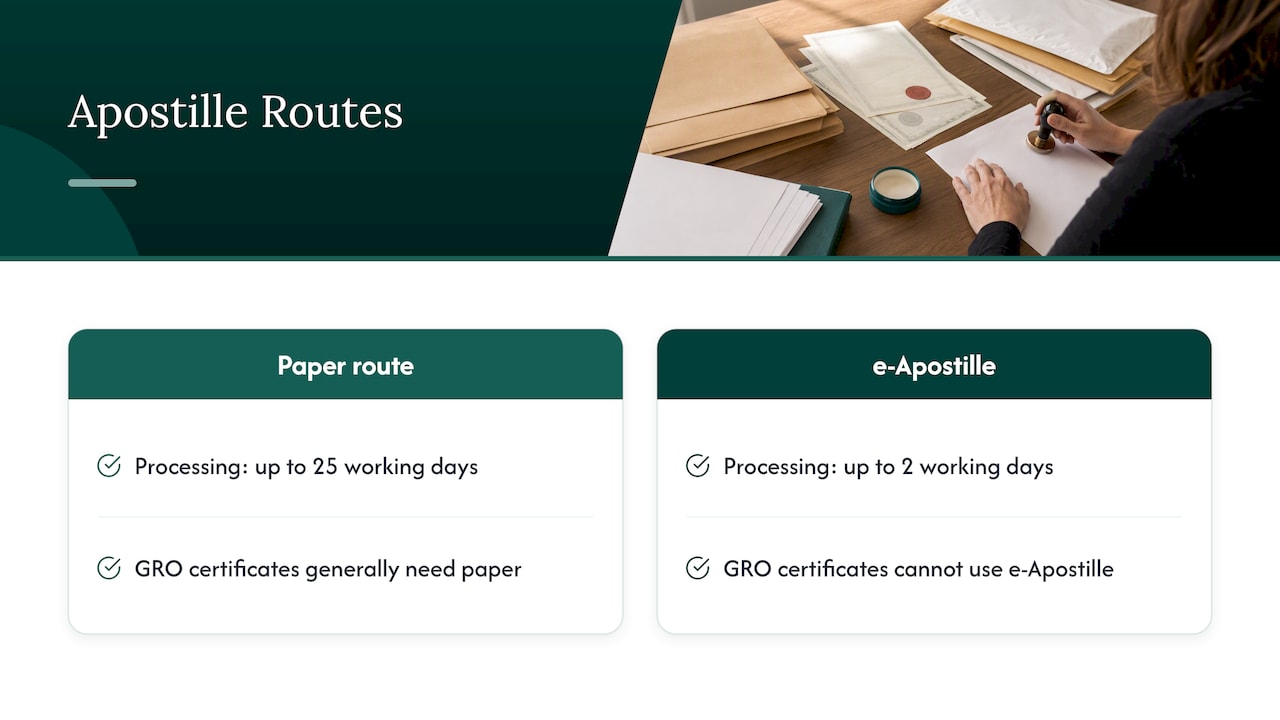
2. Not every document is eligible for the electronic route. Official guidance explains that certificates issued by the General Register Office, such as birth, marriage and death certificates, generally need a paper based apostille and cannot use the e-Apostille service, whatever their digital format. Check the type of document before you choose the delivery format.
3. The timeline is set by the issuing office. The same guidance describes the paper route as taking up to 25 working days and the e-Apostille route as up to 2 working days. Those are third party figures that can change, so check the current page before you plan around them.
If you want a closer look at the steps, our guides on how to get an apostille in the UK, the e-Apostille route and apostille for company documents cover each case in detail.
Child travel consent: delivery before the trip
Parents and grandparents often ask us about delivery because a flight date is fixed. A child travel consent letter has to be in your hands before you reach the airport, and in some cases the receiving airline or border officer may want to see a printed copy as well.
The starting point is the law on consent. Government guidance states that you need permission from everyone with parental responsibility, or from a court, before taking a child abroad, and that taking a child abroad without permission can be child abduction. A notarised letter is a practical way to show that permission was given. It is not a strict legal requirement in every case, but it can help resolve questions at a border.
A good letter includes:
- the full names and contact details of each parent with parental responsibility;
- the child's name and passport number;
- the travel dates, destination and the name of the adult travelling with the child;
- a clear statement that the parent consents to the trip.
For separated or divorced parents, the parent who is not travelling signs in front of the notary on video. That parent can be in a different city or country. The certified document is then delivered electronically, and the travelling adult can print it or carry it on a phone.
Parents in other countries face similar questions. For a view from the United States, see this explanation of overseas custody agreements for US parents. It describes US practice only, so use it for context and not as a statement of UK rules.
Our guides on the parental consent letter and the child travel consent letter at border control give wording suggestions and a checklist.
Documents with several signatories
Business resolutions, family agreements and joint declarations often need more than one person to sign, and those people are rarely in the same place. Online notarisation helps because each signatory joins a video session from their own location, shows a passport and signs in front of the notary.
For delivery, this means:
- each signature is witnessed and recorded;
- the complete document is released once every party has signed;
- everyone receives the same certified file, so no one waits for a paper original to be passed around.
If one signatory is delayed, the whole document is delayed. Agree a window with everyone before you book.
Our view on delivery
We see the same pattern each week. People focus on the notarisation and treat delivery as an afterthought, then find that the recipient wanted a different format.
Our advice is to settle three questions first. What format does the recipient accept? Does the document need an apostille or translation? What is the real deadline, including postage?
We built MyNotary so that the first stage, the video session and the certified digital copy, is fast and predictable. Identity is checked by passport and biometrics, the session is recorded, the document is unsigned until the notary watches you sign, and the delivery is the same day. We cannot control how a foreign authority, a courier or a registry behaves. We can give you a clear, well documented file and tell you what to ask next.
We also never tell a customer that a document will be accepted. Acceptance is the decision of the organisation that receives it, and the honest answer to "will they take this?" is always "ask them first".
— Jérémy
Booking your notarisation with MyNotary
If your document is ready, you can start from our services page and choose the document type. We cover items such as affidavits, statutory declarations, powers of attorney, certified copies, child travel consent and corporate documents. Optional certified translation and apostille services can be added when your recipient requires them.
For specific needs, these pages may be the quickest route:
- Parental authority delegation for travel and guardianship arrangements.
- Signature notarisation online for a signature that must be witnessed.
- Corporate document notarisation for company paperwork.
If you are not sure which one fits, contact our team before you book and tell us who will receive the document.
Common causes of delivery delays
Most delays come from preparation, not from the notarisation itself.
- Signing the document in advance. The notary must see you sign. Upload it unsigned.
- Expired or unclear passport scan. The identity check needs a valid passport and a clear image.
- Wrong recipient address for the physical copy. Check postcodes and add a phone number for the courier.
- Choosing e-Apostille for an ineligible document. Confirm eligibility before you pay for the route.
- Forgetting translation. If the receiving country needs the document in its own language, plan the translation after notarisation and allow time for it.
- Ignoring non Hague destinations. The extra embassy steps can add considerable time.
A quick call or email to the recipient, asking for their exact requirements in writing, prevents most of these.
Frequently asked questions
How quickly will I receive my notarised document?
The certified digital document is delivered the same day, and our average turnaround is about one hour after the video session. A physical copy, an apostille or a translation takes longer and depends on the carrier or the issuing office.
Is a digitally delivered notarised document valid?
An electronically signed document can be valid and is admissible in evidence under the Electronic Communications Act 2000. Some documents, such as certain deeds, have extra formalities, so check what the receiving party requires. We do not guarantee acceptance by any third party.
Can I get a paper copy of a document that was notarised online?
Yes. You can request a physical copy, which is sent to the address you provide. Do not sign the printed digital file again by hand, because mixing wet ink and electronic signatures can invalidate it.
Do I need an apostille as well?
Only if the destination country is a Hague Convention member and the recipient asks for one. If the country is not a member, a longer authentication chain applies. Ask the recipient which route they need before you order.
Can the other parent sign from abroad for a child travel consent?
Yes. Each signatory joins a video session from where they are, shows a passport and signs in front of the commissioned notary. The completed document is then delivered to the travelling adult.
Sources
- Electronic Communications Act 2000
- Electronic execution of documents, Law Commission
- Qualified Electronic Signatures: Answering your questions, HM Land Registry
- HCCH Apostille Convention authorities
- Documents for British people abroad, GOV.UK
- Get your document legalised, GOV.UK
- Get permission to take a child abroad, GOV.UK
- Overseas custody agreements explained for US parents
Recommended
Got questions? We’re on it.
Most questions are answered here, drawn from what people actually ask before booking. If yours isn’t, our team is in chat.
The certified digital document is delivered the same day, and our average turnaround is about one hour after the video session. A physical copy, an apostille or a translation takes longer and depends on the carrier or the issuing office.
Last updated: