Same Day Notarisation in the UK: Realistic Turnaround Times
By Jeremy Arhab, Founder · Published 11 September 2026 · Updated 11 September 2026
UK guide to notarisation turnaround: when online notarisation and electronic apostilles deliver same day or 24–48 hours, plus steps to avoid delays.

Most routine documents notarised online are certified within the same day, often within an hour, while in-person appointments typically add a day or two once travel and office queues are factored in. Add an e-apostille for eligible documents and expect another 24 to 48 hours. A paper apostille or embassy legalisation can stretch that to several working days. The fastest realistic route for most people is an online video appointment paired with an e-apostille, provided the destination accepts it.
***
TL;DR: - Online notarisation paired with an electronic apostille can often be completed within 1 to 2 days, making it the fastest option for most personal documents. - In-person notarisation typically adds at least one to two days due to travel, waiting times, and physical document handling. - The processing time for an e-apostille is usually 24 to 48 hours, while paper apostilles can take several days to two weeks depending on workload. - Not every document or destination country accepts e-apostilles, so confirm acceptance before choosing this route to avoid delays. - Expedited services depend on document type, destination, and proof of urgency, but genuine same-day legalisation remains rare and expensive.
***
Table of Contents
- Typical notarisation turnaround: in-person and online explained
- How apostille and legalisation add to the timeline
- Key factors that affect turnaround time
- Practical steps to speed up notarisation and legalisation
- What happens during the appointment itself
- Expedited and same-day options: what's realistic
- Why online notarisation actually changes the maths
- Book an online notary appointment without the wait
- Sources
- FAQ
Typical notarisation turnaround: in-person and online explained
A standard notarial appointment, whether conducted face to face or by video, usually takes between a quarter of an hour and an hour. That window covers identity verification, a review of the document, the signing itself, and the notary's certification. Once that's done, the certification is complete. Nothing about the notarial act itself takes days, unless something in the document or the identity checks raises a flag.
Where the two routes genuinely diverge is everything around the appointment. Online notarisation removes the travel and waiting-room time entirely. You upload the document beforehand, a commissioned notary reviews it, and the session itself is recorded for compliance purposes. Identity is confirmed against your passport before the call even starts, so the appointment focuses purely on signing and certification. Because delivery is digital, a routine document can be notarised, certified, and back in your inbox within the same working day.
In-person notarisation carries structural delays that have nothing to do with the notary's speed:
- Travel to and from the notary's office, which can easily exceed the appointment itself.
- Waiting for the next available slot, particularly outside major cities.
- Physical binding of the document with ribbon, eyelet, and seal, which adds a fixed amount of time before you can leave.
- Any need to return for signature witnessing if a co-signer wasn't present.
Some cases take longer no matter which route you choose. Corporate documents with multiple signatories, powers of attorney requiring extra verification, or documents where the notary needs to confirm the issuing authority's details will all add time. A notary who cannot verify a document's origin quickly is not going to rush that step to hit a deadline, and shouldn't.
How apostille and legalisation add to the timeline
Notarisation and apostille are two separate steps, and conflating them is the most common reason people underestimate how long the whole process takes. An apostille is a certificate that authenticates a public document for use in another country, and it exists because of the Hague Conference on Private International Law's Apostille Convention. It's only needed when the destination country is a signatory to that convention; if it isn't, the document needs consular legalisation instead, which is a different and generally slower process.
Where the timeline changes is the format of the apostille. E-apostilles for eligible documents are typically processed within 24 to 48 hours, which is why pairing online notarisation with an electronic apostille is the fastest combined route available for most personal documents. Paper apostilles, by contrast, depend on postal handling and office queues, and can commonly take anywhere from several working days to two weeks depending on the issuing authority's workload.
A few things to check before you assume the fast route applies to you:
- Not every document type is eligible for e-apostille in every jurisdiction.
- Not every receiving country or institution accepts an e-apostille, even where one is technically available.
- Embassy legalisation, where required instead of an apostille, runs on its own schedule entirely separate from the notary or the apostille office.
Confirm acceptance with the receiving authority directly before committing to the e-apostille route. Relying on general guidance from a forum or a third-party guide is how people end up redoing the whole process because the receiving institution insisted on a paper original.
Key factors that affect turnaround time
Several variables decide whether your document moves in an hour or a fortnight. Working through them in order helps you spot where your own case might slow down.
- Document type and copy requirements. A certified copy of a passport moves faster than an original power of attorney requiring witness signatures.
- Destination country rules. Some countries accept e-apostilles and digital signatures without question; others insist on wet-ink originals and paper apostilles, which immediately adds days.
- Depth of identity verification. Straightforward passport checks are quick. Third-party verification, such as confirming a company director's authority, takes longer because it depends on external records.
- Notary and office availability. A commissioned notary handling a queue of same-day bookings will move faster than an office scheduling appointments a week out.
- Delivery and courier choice. Digital delivery is close to instant. A tracked physical original depends on courier transit time, which varies by destination.
The Faculty Office code of practice requires notaries to act promptly, and to tell clients directly if an agreed timescale can't be met so an alternative can be agreed. That's a useful expectation to hold any provider to, regardless of the route you choose.
Practical steps to speed up notarisation and legalisation
Most delay in this process is avoidable, and it usually comes from poor preparation rather than anything the notary controls.
- Scan and send your documents in advance so the appointment itself is limited to signing and identity checks, not paperwork review.
- Bundle every document you need notarised into one appointment rather than booking separately for each one.
- Choose an online notarisation and e-apostille route wherever the destination accepts it, since it removes travel and postal time almost entirely.
- Confirm requirements with the receiving institution directly rather than relying on generic online guidance, which frequently gets destination-specific rules wrong.
- Only pay for tracked courier delivery when a physical original is genuinely required. Many institutions now accept a certified digital copy.
Pro Tip: Ask the receiving institution, in writing, whether they accept an electronically signed document with an e-apostille before you book anything. That single question avoids the most common cause of repeat notarisation.
A practical guide to same-day notarisation covers preparation steps in more depth if your document has unusual formatting or multiple signatories.
What happens during the appointment itself
Whether online or in person, the appointment follows a consistent sequence. First, identity verification against a passport or equivalent photo ID. Then a review of the document to confirm it matches what was submitted beforehand. The signing follows, witnessed directly by the notary, who then applies the notarial certificate and seal.
- Identity checks and document review: typically a few minutes if pre-checked in advance.
- Signing and certification: the core of the appointment, usually 15 to 30 minutes.
- Binding or sealing: adds 10 to 30 minutes for physical documents, negligible for digital ones.
- Retention: the notary may keep the original briefly if it's going onward for apostille or legalisation.
Delivery depends on the route. Online notarisation typically produces an electronically signed PDF the same day. In-person appointments may hand you the physical document immediately, or send it by tracked courier if it needs to travel onward first.
Expedited and same-day options: what's realistic
Same-day and premium services exist, but they come with real limits. Providers offering same-day apostilles generally require the document to reach the legalisation office by a strict daily deadline, and they need proof the request is genuinely urgent, not just a preference.
- Eligibility for expedited services usually depends on document type, not just willingness to pay more.
- Requests get declined when identity verification can't be completed quickly enough, or when the destination's legalisation office doesn't operate a same-day service at all.
- Speed beyond notarisation depends on external offices; the list of next-day legalisation service providers shows how much of this sits outside any single notary's control.
- Expedited work commonly costs more, since compressing verification and logistics into a shorter window takes extra resource on the provider's side.
Paying for premium turnaround makes sense when a visa deadline or contract signing genuinely can't move. It's a poor trade when the real fix is simply booking earlier.
Why online notarisation actually changes the maths
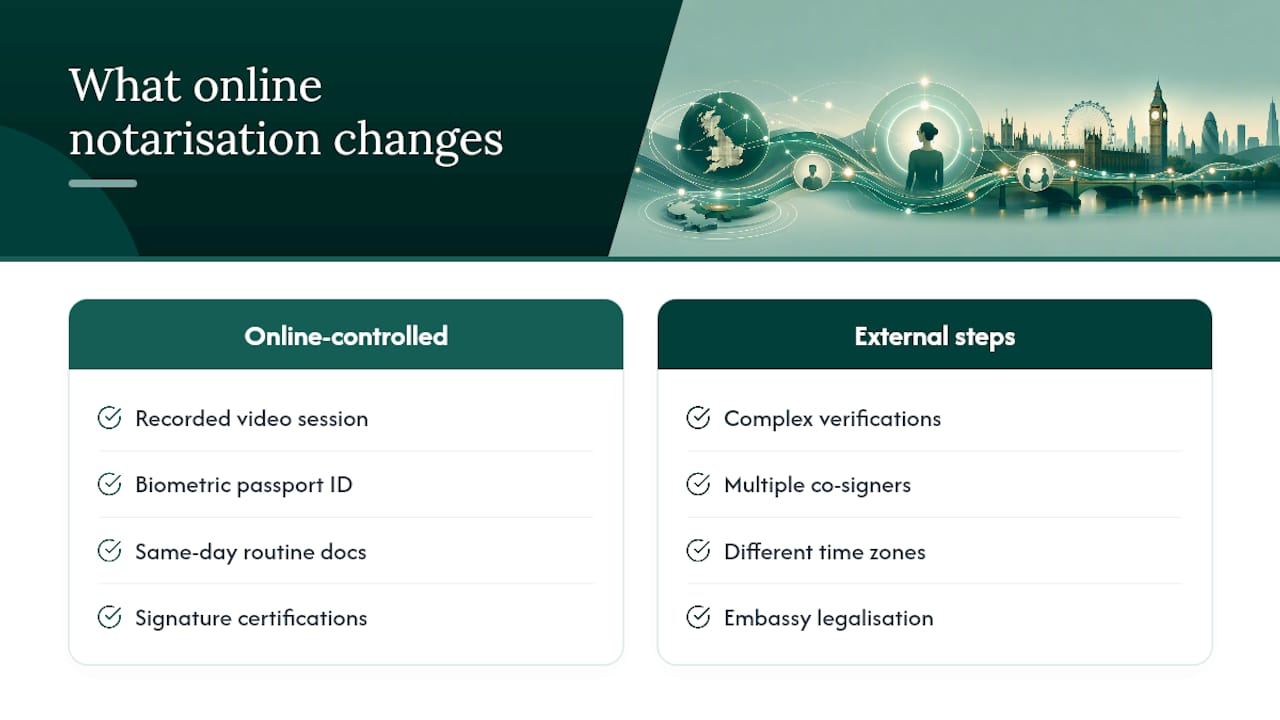
Video notarisation removes the two things that slow the process down most: travel and physical handling. A recorded session with biometric identity verification against a passport lets a commissioned notary confirm everything that an in-person meeting would, without either party leaving the house. Routine documents, such as signature certifications or standard affidavits, are commonly resolved the same day.
That speed has limits. Complex verifications, multiple co-signers in different time zones, or onward embassy legalisation still take the time those steps require. Online notarisation shortens the part of the process it controls. It doesn't shortcut the parts it doesn't.
— Jérémy
Book an online notary appointment without the wait
Most of the delay in traditional notarisation has nothing to do with the notary and everything to do with getting to one. The process removes that step entirely: a video appointment with a commissioned notary, identity verified by passport, and an electronically signed document, often delivered the same day for routine cases.
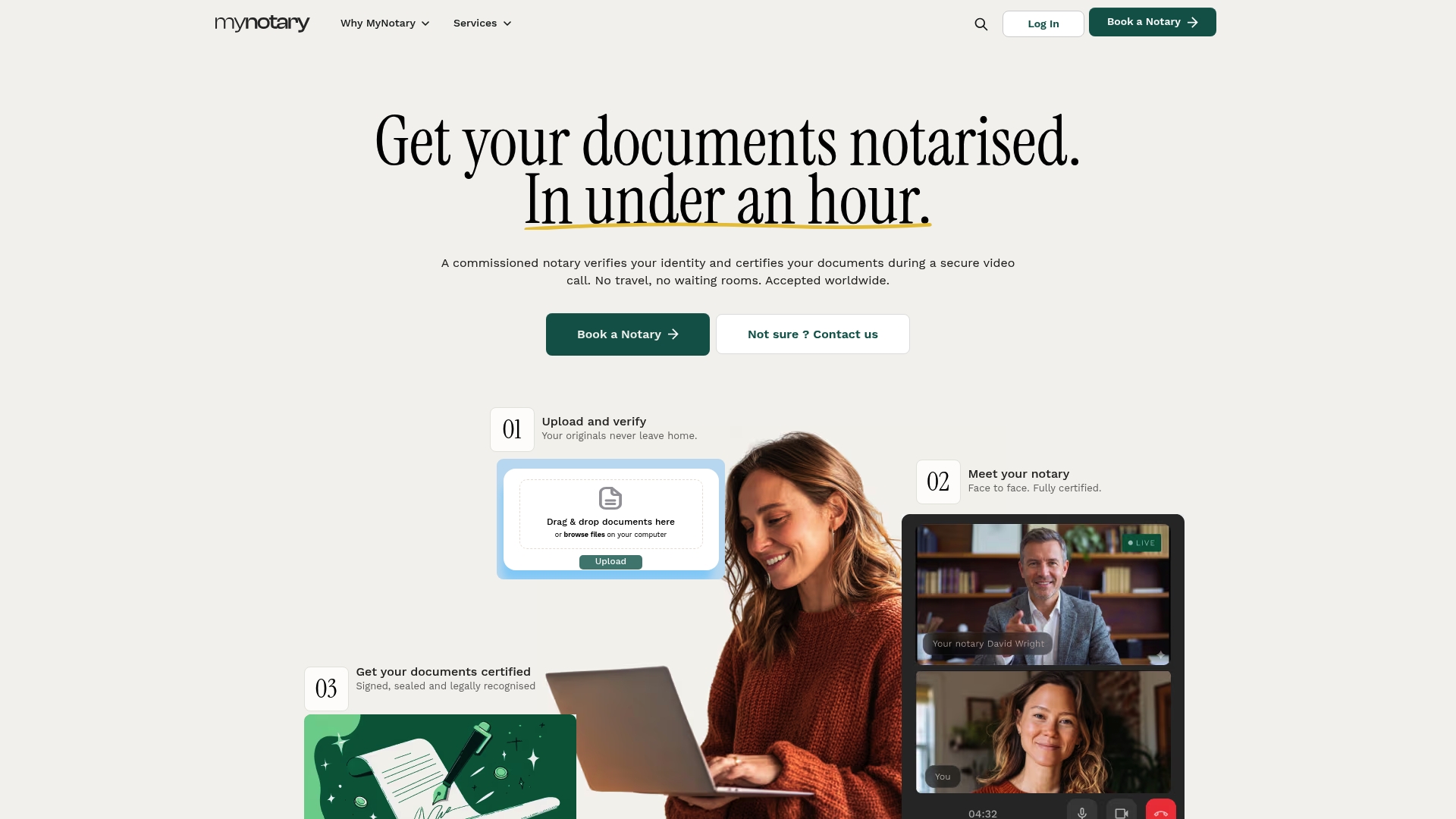
If you need a document certified quickly, whether it's a personal affidavit, a power of attorney, or a corporate document for a business deal, the same-day route starts with getting your paperwork right the first time. Prepare a clear scan of your ID and the document itself, then book a signature certification appointment or explore My Notary's online notarisation platform to see which service matches your document. For business documents specifically, the corporate document notarisation service is built for exactly this kind of turnaround pressure.
Sources
For primary detail, see the Faculty Office code of practice and the HCCH Apostille Convention pages.
- Faculty Office code of practice
- Hague Conference on Private International Law – Apostille Convention
- Faculty Office / e‑Apostille guidance via IALS resource
FAQ
Is a notary cheaper than a solicitor?
Notarial certification is typically a fixed, standalone fee for a specific act, such as certifying a signature or copy, while solicitor fees usually reflect broader legal advice and time billed at an hourly rate. For a straightforward document that only needs certification, a notary is generally the more cost-effective route.
Can I get an apostille in one day?
An e-apostille for an eligible document is often processed within 24 to 48 hours rather than strictly one day, though some providers offer premium same-day services subject to strict deadlines and proof of urgency. A standard paper apostille usually takes longer.
Can a solicitor notarise a document?
Notarisation and legal advice are distinct services performed by different specialists, and the two shouldn't be conflated when planning a document's timeline. An online notarisation platform such as My Notary connects you directly with a commissioned notary for the certification itself.
Can an apostille be done in one day?
For eligible documents, an e-apostille is generally processed within 24 to 48 hours, and some premium services offer genuine same-day turnaround if the document reaches the legalisation office by a strict cutoff. Paper apostilles almost always take longer, commonly several working days.
Recommended
Got questions? We’re on it.
Most questions are answered here, drawn from what people actually ask before booking. If yours isn’t, our team is in chat.
Notarial certification is typically a fixed, standalone fee for a specific act, such as certifying a signature or copy, while solicitor fees usually reflect broader legal advice and time billed at an hourly rate. For a straightforward document that only needs certification, a notary is generally the more cost-effective route.
Last updated: