How to Choose an Online Notary: 8 Checks Before You Book
By Jeremy Arhab, Founder · Published 21 October 2026 · Updated 21 October 2026
Learn how to choose an online notary in the UK: identity checks, the commissioned notary, recording, apostille and translation. Eight checks before you book.

To choose an online notary, check eight things before you pay: who will actually notarise your document, how your identity is verified, whether the session is recorded, what you receive at the end, whether the destination needs an apostille or translation, how long it takes, how the price is set out, and whether the provider will tell you what it cannot promise. This guide explains each check in plain terms, so you can compare services on facts rather than on adverts.
Online notarisation means the signing is witnessed over a live video call instead of in an office. The idea is simple. The details behind it are where services differ, and those details decide whether your document is useful to the person who asked for it.
TL;DR
- Confirm that a commissioned notary reviews your document and applies the seal, and that the platform says so plainly.
- Look for identity verification with a passport, a live video session and a recorded session with an audit trail.
- Ask where the document will be used. The receiving party decides whether a notarised document, an apostille or a certified translation is needed.
- Be wary of any provider that promises a document will be accepted. Only the receiving organisation can decide that.
- Compare delivery: a digital file the same day, plus a physical copy if the destination asks for paper.
Table of Contents
- What an online notary does, and what it does not
- Check 1: Who is the notary on the call?
- Check 2: How is your identity verified?
- Check 3: Is the session recorded and the file protected?
- Check 4: Does the electronic signature stand up?
- Check 5: Will the document work where you need it?
- Check 6: How long does it take, and what do you receive?
- Check 7: Is the pricing clear before you pay?
- Check 8: Does the provider tell you what it cannot promise?
- Choose by document type
- Online or in person: which suits you?
- Our view: what we would check if we were you
- Ready to book with MyNotary
- A short checklist before you book
- FAQ
- Sources
What an online notary does, and what it does not
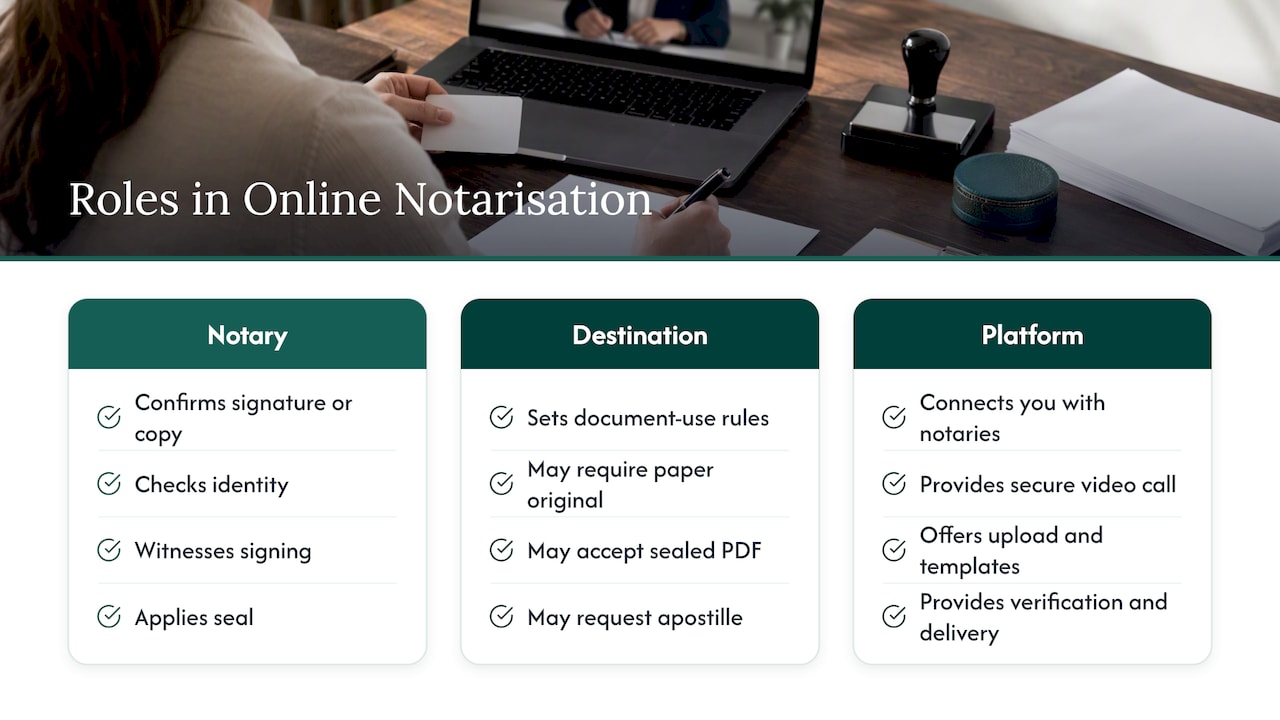
An online notary is a commissioned notary who meets you by video call. During the call, the notary checks who you are, sees you sign (or confirm your signature), and then applies their seal to the document. The result is a document that carries a notary's confirmation that the signature or the copy is genuine.
What an online notary does not do is decide how the receiving party will treat the document. A school in Spain, a consulate, a bank in Dubai or an employer in Canada each sets its own rules. Some want a paper original. Some accept a digitally sealed PDF. Some ask for an apostille on top. The notary confirms the signature. The destination confirms the use.
MyNotary is an online notarisation platform. We are not a notary firm. We connect you, by secure video call, with commissioned notaries, and we provide the tools around the call: document upload, templates, identity verification and delivery. Knowing the difference between a platform and the notary on the call is the first thing to look for in any service you compare.
Check 1: Who is the notary on the call?
Start with the person, not the website. Ask three questions:
- Is the person on the video call a commissioned notary?
- Will they review the document itself, or only watch you sign?
- Will their seal appear on the final document?
A service that stays vague here is hard to judge. A clear service describes the steps in the open: you upload an unsigned document, a notary reviews it, you meet on video, and the notary seals the finished file.
The unsigned point matters. You should not sign before the call. If you sign beforehand, the notary cannot see the signature being made, and many notarial acts depend on that observation. Our guide to how the online notary process works in the UK walks through the order of events.
Check 2: How is your identity verified?
This is the check that separates a serious service from a convenient one. The notary has to be sure you are the person named in the document. Online, that usually involves two layers.
- Document check. You present your passport. The platform reads it and checks that it looks genuine.
- Person check. The platform and the notary compare your face on camera with the passport photo, often with a biometric match, and confirm you are present live.
Good providers explain both layers. If the only check is an uploaded photo and an email address, ask what else happens. We explain the two layers in more detail in KYC for notarisation: two checks behind UK video ID.
A practical tip: use a valid passport, sit somewhere with even light, and make sure your camera and microphone work before you join. A failed identity check wastes time for everyone, and a careful notary will stop the session rather than proceed if they are not satisfied.
Check 3: Is the session recorded and the file protected?
Ask whether the video session is recorded and whether the record is stored securely. A recorded session with an audit trail gives you a way to show later what happened: when the call took place, who attended and what was signed.
Also look for:
- encrypted upload and storage of your documents;
- a clear statement of how long records are kept;
- a tamper-evident final file, so any later change can be detected.
This matters most for documents with money or family consequences, such as powers of attorney, declarations for companies and consent for a child's travel.
Check 4: Does the electronic signature stand up?
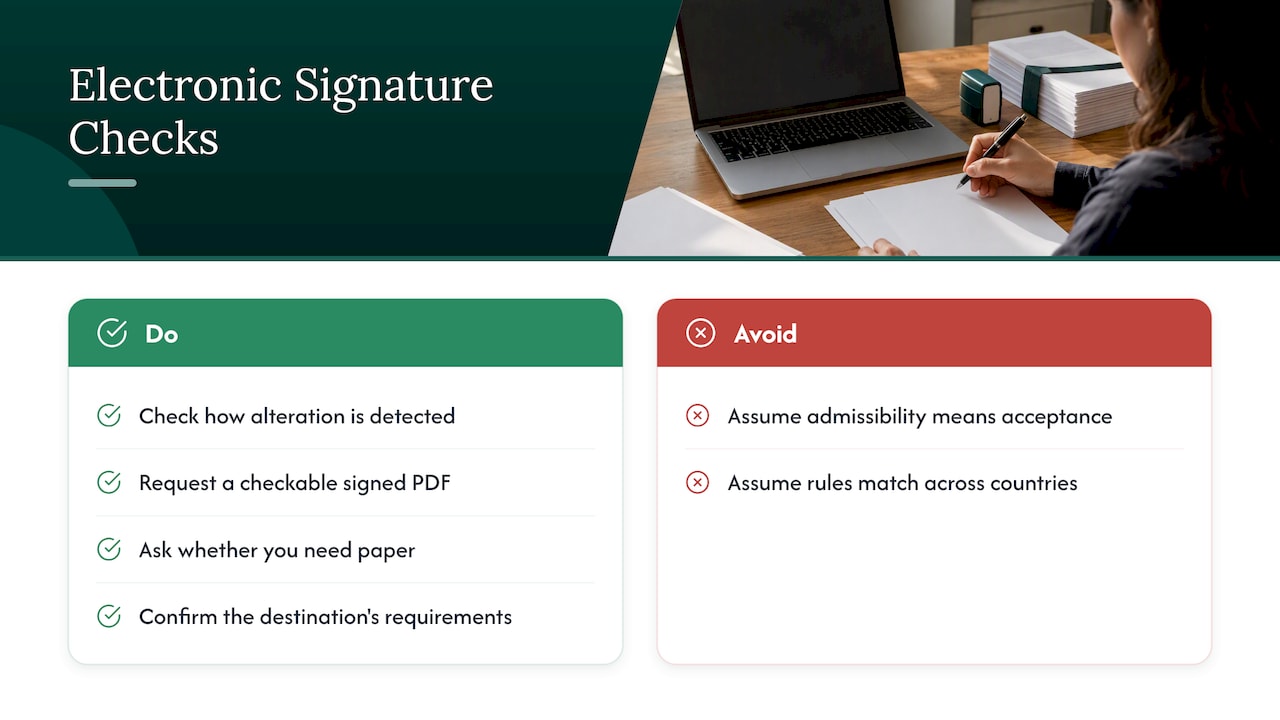
In the United Kingdom, section 7 of the Electronic Communications Act 2000 provides that an electronic signature can be admitted as evidence in legal proceedings. That is a useful starting point, but it is only a starting point. Admissible as evidence does not mean every organisation will accept the document without question.
So ask the provider two things. First, how does the platform show the document has not been altered since signing? Second, will you receive an electronically signed PDF that can be checked, as well as a paper version if you need one? Our article on what the 2000 Act does not guarantee sets out the limits in more detail.
If you will use the document outside the UK, remember that rules on electronic signatures differ from country to country. We state that our compliant electronic signatures are recognised in over 180 countries. Even so, the safest step is always to ask the receiving party what it wants to see.
Check 5: Will the document work where you need it?
This is the most expensive mistake to make, so it deserves its own section. A notarised document is only the first step for many international uses. Work backwards from the destination.
Ask the receiving party three questions
- Do you accept a digitally sealed document, or do you need paper?
- Do you need an apostille, or a longer legalisation process?
- Must the document be in a specific language, with a certified translation?
Write down the answers, or save the email. If the answer is "it depends", ask for the rule in writing.
Apostille and legalisation
An apostille is a single certificate that confirms the origin of a public document so that it can be used in another country that belongs to the Apostille Convention. The Hague Conference outline of the 1961 Apostille Convention describes it as a replacement for the older, multi-step legalisation chain, and notes that the Convention applies only to public documents. Countries outside the Convention may still require the longer process.
In practice, this means you should confirm whether your destination country is a party to the Convention and whether your type of document counts as a public document there. We can help you prepare notarised documents for apostille use, and our guide to preparing an apostille from abroad by video explains the preparation steps.
Certified translation
If the destination uses another language, the translation often needs a statement of accuracy, a date and the translator's details. Ask whether the receiving party wants the translation notarised as well. Some providers make you find a translator separately, then a notary, then an apostille service. Our article on handling translation, notary and apostille in one place covers that workflow.
Child travel consent: an example
Many parents first meet notarisation when a child is travelling. Some countries ask for written permission from a parent who is not travelling. As one example, the GOV.UK travel advice for Chile says that children travelling with one parent, a guardian or alone need permission from the non-travelling parent or parents. For another example, the travel advice for Bosnia and Herzegovina refers to a notarised letter for children aged 17 and under who travel unaccompanied or with an adult other than their parents.
These rules differ by destination and change over time. Always read the current entry requirements for your destination, and ask the airline or border authority if you are unsure. If you need a letter, we offer a Child Travel Consent service, and it suits separated parents and grandparents travelling with grandchildren, because each parent can join the call from a different place.
Check 6: How long does it take, and what do you receive?
Speed is one of the clearest benefits of online notarisation, but the figure that counts is the time until you hold a usable document. Compare these points:
| Point to compare | What to ask |
|---|---|
| Booking | Can you start now, or must you wait for an appointment slot? |
| Call length | How long does identity verification and signing take? |
| Delivery of the digital file | Same day, or after several days? |
| Physical copy | Is it available, and how is it sent? |
| Add-ons | Can apostille and translation be ordered in the same booking? |
Our platform delivers on the same day, and the average turnaround for a notarised document is about one hour. Our article on same day video notarisation with compliance checks explains what happens in that hour.
That figure applies to the notarisation itself. An apostille or a certified translation is a separate step with its own timing, so plan for it if your deadline is tight.
Check 7: Is the pricing clear before you pay?
A good provider shows what is included before you enter card details. Look for the following:
- a clear price for the notarisation itself;
- a separate, visible price for each add-on, such as translation or apostille;
- no charge that appears only on the final page;
- a plain explanation of what happens if the notary cannot complete the act, for example because identity cannot be verified.
Our current prices are on the services page, and we recommend you read that page rather than rely on any figure quoted in an article. Prices can change, and the page is the one that is kept up to date.
Check 8: Does the provider tell you what it cannot promise?
This check says the most about a provider's honesty. No service can promise that a school, a court, an embassy, a landlord or a foreign registry will accept your document. Each one applies its own rules.
Trustworthy providers say so. They also tell you when a document is not suitable for online notarisation, or when something must be done in person. Be careful with any site that uses words such as "guaranteed acceptance" or "accepted everywhere".
Choose by document type
Different documents put different weight on the checks above. This list shows what to focus on first.
- Certified true copy of a degree, diploma or certificate. Focus on the destination's rules, because some want an apostille. See our pages on certified diplomas for international use and degree certification for a visa application.
- Signatures on a contract, declaration or letter. Focus on identity checks and the live signing. See signature notarisation online.
- Company documents with several signatories. Focus on whether people in different places can join one session. See corporate document notarisation online.
- Copies of financial records. Focus on whether the notary sees the original and what the receiving bank requires. See the notarised copy of a bank statement.
- Identity verification forms. Focus on the strength of the passport and biometric check. See KYC identity verification.
- US documents for use in the UK. Focus on preparation before the call. Our guide to five steps for US documents covers it.
Online or in person: which suits you?
Online notarisation is not always the right choice. It suits people who cannot easily travel, who live abroad, who need a document quickly, or whose signatories are in different places. In person can be better when the receiving party insists on a wet ink original signed in front of a notary, or when you want to talk through a complex matter face to face.
A fair provider will tell you which case you are in. If you are unsure, ask before you book, and check what the receiving party wants first. Our comparison, best online notary services in the UK, sets out the criteria in more depth, and the section on what online notarisation means for UK users is a useful short read.
Our view: what we would check if we were you
We built MyNotary around one belief: online notarisation should be easy to start and just as careful as an office visit. The video call is the convenient part. The identity check, the review by a commissioned notary, the recorded session and the sealed document are the careful part.
If we were choosing, we would ask the provider to describe its process in four plain sentences: who the notary is, how identity is checked, what we receive and how long it takes. If the answers are clear, the service has probably thought about the same questions you have. If the answers are vague, or full of promises about acceptance, we would look elsewhere.
We would also decide the destination's requirements before booking anything. We see people lose time because they notarise first and ask the receiving party second. A short email to the school, bank, consulate or employer saves a second booking.
Our platform is designed for that careful route. It handles biometric identity verification, compliant electronic signatures, an audit trail and encrypted storage, and it lets us add a certified translation or an apostille when your destination calls for it.
— Jérémy
Ready to book with MyNotary
If your document is ready, you can upload it, verify your identity with your passport and meet a commissioned notary by video call on the same day. We cover personal, family, business and corporate documents, with optional certified translation and apostille support. See the full list on our services page, or start from the MyNotary home page.
A short checklist before you book
- Find out what the receiving party requires: paper or digital, apostille, translation.
- Keep your document unsigned until the call.
- Have a valid passport ready.
- Test your camera, microphone and connection.
- Gather every signatory and agree a time when all can attend.
- Check what you will receive and when.
- Read the price and the add-ons before you pay.
The process is short when you prepare. Most delays come from a missing passport, an unclear instruction from the receiving party or a document signed too early.
FAQ
Can I get a notary online in the UK?
Yes. A commissioned notary can meet you by video call, verify your identity and apply their seal to your document. The platform you use should explain how the session works, what is recorded and what you receive. Whether the receiving party accepts a remotely notarised document is a separate question that only they can answer.
What is the easiest way to get a document notarised?
Usually it is to upload the unsigned document to an online platform, verify your identity with your passport and join a video call. This avoids travel and waiting rooms. Before you start, check what the receiving party wants, so that you order the right service the first time.
Does an online notarised document need an apostille?
Sometimes. If you will use a public document in another country, that country may ask for an apostille or a longer legalisation process. The Hague Conference outline explains how the Apostille Convention works. Ask the receiving party what it needs before you order.
Is an electronic signature valid in the UK?
The Electronic Communications Act 2000 allows electronic signatures to be admitted as evidence in legal proceedings. That does not guarantee that every organisation will accept every electronically signed document. For overseas use, check the rules of the destination.
Can a notarised document be translated?
Yes. A certified translation can be added, and many authorities expect a statement of accuracy, a date and the translator's details. Ask the receiving party whether it also wants the translation notarised. We can arrange a notarised translation as part of your booking.
Sources
- Electronic Communications Act 2000, section 7, legislation.gov.uk
- Outline of the HCCH 1961 Apostille Convention, hcch.net
- Chile travel advice: entry requirements, GOV.UK
- Bosnia and Herzegovina travel advice: entry requirements, GOV.UK
Recommended
Got questions? We’re on it.
Most questions are answered here, drawn from what people actually ask before booking. If yours isn’t, our team is in chat.
Yes. A commissioned notary can meet you by video call, verify your identity and apply their seal to your document. The platform you use should explain how the session works, what is recorded and what you receive. Whether the receiving party accepts a remotely notarised document is a separate question that only they can answer.
Last updated: