Saudi Embassy Legalisation for UK Documents: What Applies Now
By Jeremy Arhab, Founder · Published 20 October 2026 · Updated 20 October 2026
Saudi Arabia joined the Apostille Convention in 2022. See what that means for UK documents, when notarisation comes first, and how to prepare them online.

Saudi Arabia has been a party to the Apostille Convention since 7 December 2022, so many UK public documents now need an apostille instead of the older embassy legalisation route. Some documents, such as copies and certificates, need notarising before the apostille can be added. Some agents and employers still ask for extra stamps, so you should confirm the exact requirement with whoever asked for your paperwork. This guide explains each step, in order, and where an online notarisation by video call fits.
TL;DR
- Saudi Arabia joined the 1961 Apostille Convention on 7 December 2022, so an apostille is the standard form of authentication between the UK and Saudi Arabia for public documents.
- Copies of originals, degree certificates and similar documents usually need certifying by a notary before an apostille can be attached.
- Terms such as legalisation, attestation and authentication are used loosely. Ask the Saudi employer, university or authority exactly which one it wants.
- We provide the notarisation step online: a video call with a commissioned notary, passport identity verification and same day delivery. We do not promise that any receiving body will accept a document.
Table of Contents
- Does Saudi Arabia still require embassy legalisation for UK documents?
- Legalisation, attestation, authentication: what each word means
- Which UK documents need notarising before the apostille
- How the process works for a UK document going to Saudi Arabia
- How online notarisation works with us
- Common document types for Saudi Arabia
- Perspective: where applications go wrong
- Start your notarisation online
- Travelling to Saudi Arabia: a separate question
- FAQ
- Sources
Does Saudi Arabia still require embassy legalisation for UK documents?
For a long time the answer was yes. A UK document went through a two or three stage chain: certification, then an apostille or legalisation stamp, then a stamp from the Saudi Embassy in London. That chain existed because Saudi Arabia was outside the Apostille Convention.
The position changed on 7 December 2022. The Hague Conference on Private International Law (HCCH) announced that the Convention entered into force for Saudi Arabia on that date. Between member states, the Convention replaces the chain of consular stamps with a single certificate, the apostille, issued by the authority of the country where the document was made.
In practice this means:
- For a public document issued in the UK and used in Saudi Arabia, the apostille is the formal authentication step.
- The separate embassy stamp that people used to describe as "Saudi embassy legalisation" is no longer the standard requirement between the two countries.
- Saudi Arabia has an e-register for checking apostilles, which lets a receiving party verify a certificate online. The HCCH notice lists this as operational from May 2026.
The search results for this topic are mixed. Some commercial sites still describe an embassy stage, and others say an apostille alone is enough. Rules around attestation can change without notice, so treat any single website, including this one, as a starting point. The reliable check is to ask the body that requested the document, and to ask in writing.
Legalisation, attestation, authentication: what each word means
These words cause most of the confusion. Authorities in different countries use them interchangeably, yet they can refer to different steps. The Foreign Office's own legalisation team has described this ambiguity, and the burden of confirming what is needed sits with the applicant.
A working vocabulary:
| Term | What it usually means | Who performs it |
|---|---|---|
| Notarisation or certification | A notary confirms a signature is genuine, or that a copy matches an original | A commissioned notary |
| Apostille | A certificate confirming the signature, seal or stamp on a public document is genuine, for use in another Convention country | The competent authority of the issuing country |
| Legalisation | The older chain of verification that ends with the destination country's embassy | Issuing country authority, then the embassy |
| Attestation | A general term, often used in the Gulf region for any of the above | Varies |
When a Saudi employer or university asks you to "attest" a UK degree, find out what they mean in that case. It may be a notarised copy with an apostille. It may also involve a step on the Saudi side, such as verification by the relevant ministry or cultural office. Only the requesting body can tell you.
Which UK documents need notarising before the apostille
An apostille confirms that the signature, seal or stamp on an official document is genuine. It does not make a photocopy official. GOV.UK guidance on documents for British people abroad explains that some documents cannot be legalised directly. Educational certificates and copies of originals often need prior certification by a qualified notary before they can go forward.
In general, the documents split into two groups.
Documents that are already public documents
These carry an official signature or seal and may go to apostille without notarisation. Examples include UK birth, marriage and death certificates issued by a registry office, and some official records. Check the specifics for your document with whoever issues the apostille.
Documents that need a notary first
These are private documents, copies, or documents where the issuer is not an official that the apostille authority can verify:
- Degree and diploma certificates, which usually need a certified true copy.
- Professional certificates.
- Affidavits and statutory declarations.
- Powers of attorney.
- Company documents, such as certificates and beneficial owner declarations.
- Copies of passports, bank statements and DBS certificates.
- Marital status declarations and similar personal statements.
Skipping the notary step is a common reason for rejection. If the document is a copy and no one has certified it, the apostille authority has no official signature to authenticate.
How the process works for a UK document going to Saudi Arabia
The order matters, because each stage depends on the one before it.
- Confirm the requirement. Ask the Saudi employer, university, ministry or agent what they need: an original, a notarised copy, an apostille, or something else. Get the answer in writing.
- Obtain the right original. For a degree, you need the original certificate or a document the issuer can confirm. For a criminal record or marriage certificate, check that the issue date meets the receiving body's limits, if it has any.
- Notarise the document, if required. A commissioned notary certifies the copy or witnesses the signature and applies a seal.
- Obtain the apostille. The apostille is attached to the notarised document. It must stay permanently attached. A separated apostille can invalidate the whole process.
- Translate if needed. Saudi bodies often want Arabic. A certified translation may need its own notarisation and apostille.
- Check the apostille. The recipient can verify it through the Saudi e-register.
- Send the document. Keep scans of everything before it travels.
The competent authority on the Saudi side is the Ministry of Foreign Affairs, which is listed by the HCCH as the designated authority under Article 6. This matters if a document comes from Saudi Arabia to the UK. For UK documents going the other way, the UK issues the apostille.
How online notarisation works with us
MyNotary is an online notarisation platform. We are not a law firm and we do not give legal advice. We provide the notarisation step by video call. Here is what happens:
- You upload your document and choose the service you need.
- You join a video call with a commissioned notary. The session is recorded.
- Your identity is verified by passport, with biometric checks.
- For documents that need your signature, you sign during the call. The document must be unsigned beforehand.
- The notary applies their seal and the certified document is returned. Delivery is the same day, and the average turnaround is about one hour.
- If you need an apostille or a certified translation, you can add it as an optional service.
This is useful if you are abroad and need to prepare UK documents, which our guide to preparing an apostille from abroad covers in more detail. It is also useful for people who work irregular hours or live far from a notary's office. Multi signatory documents, where several people sign from different places, are supported.
Common document types for Saudi Arabia
The documents below come up most often. For each, we describe the typical notarisation step, not a guarantee about what Saudi bodies will accept.
Degrees and diplomas
Employers and the Saudi education authorities often ask for a notarised copy of a UK degree, followed by an apostille. We offer degree certification for visa applications and certified diploma copies for international use. Professional qualifications follow the same pattern through our certified true copy of a professional certificate.
Police and background certificates
Work visa applications may ask for a criminal record certificate. A notarised copy of a DBS certificate is one route. Confirm first whether Saudi authorities accept a copy or require the original document to be apostilled.
Powers of attorney
If someone acts for you in Saudi Arabia, a power of attorney usually needs your signature witnessed by a notary and then an apostille. Our guide to the apostille for a power of attorney sets out the sequence.
Company documents
Business registrations, board resolutions and beneficial owner declarations can be handled through corporate document notarisation.
Identity and personal statements
Affidavits, marital status declarations and identity verification forms are common for residency and family matters. Our KYC identity verification service covers identity declarations.
Perspective: where applications go wrong
We see the same problems repeatedly. The first is working from an old checklist. Many websites written before December 2022 still describe the embassy route, and the text has simply stayed online. The second is treating "attestation" as one fixed step when it is a family of steps. The third is signing a document before the call. If you sign in advance, the notary cannot witness the signature, and you have to start again with a fresh copy.
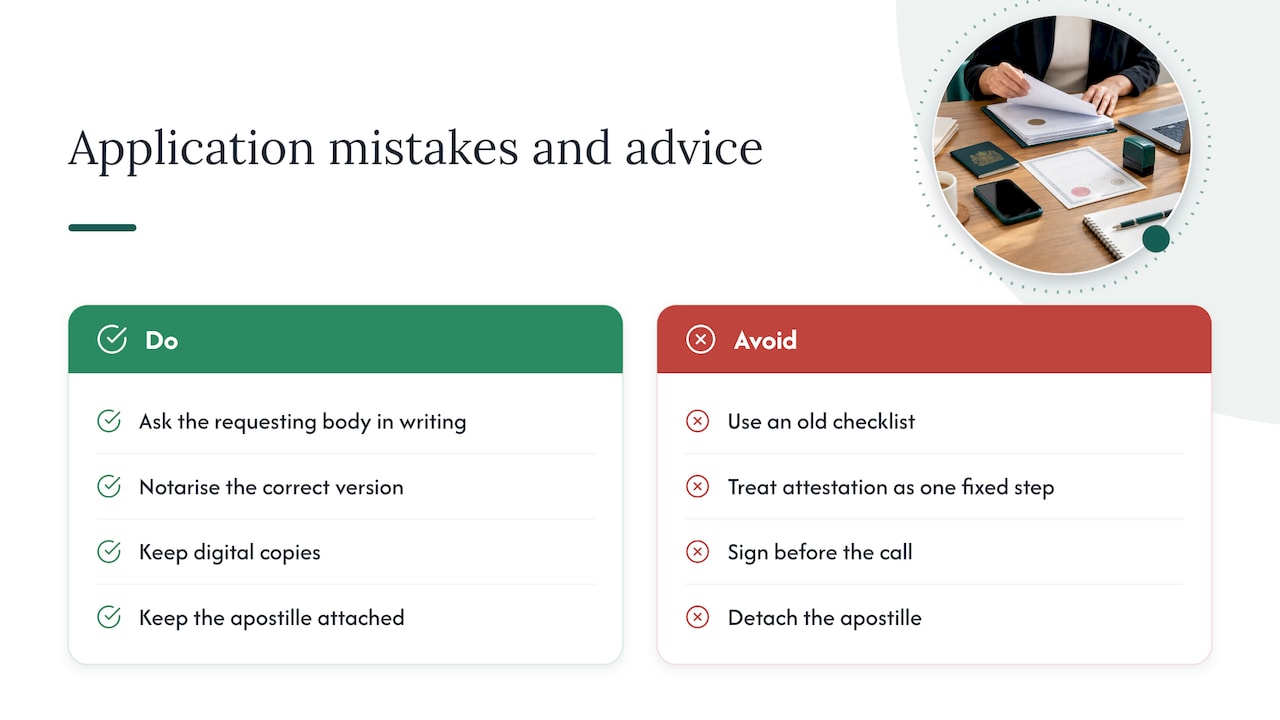
Our advice is practical. Ask the requesting body for their requirement in writing. Do the notarisation first, only once you know the document is the correct version. Keep digital copies. Do not detach the apostille. If a recipient later queries it, the e-register lets them verify the certificate themselves.
We also think people underestimate how much time the notarisation step can take when it depends on a visit to an office. Moving it to a recorded video call removes the travel and the waiting room, and that is the part of the process we can speak about with confidence. Our broader guide to the apostille process in the UK explains how that step connects to the rest.
— Jérémy
Start your notarisation online
If your Saudi document needs a certified copy, a witnessed signature or a notarised declaration before the apostille, you can arrange it from home. See the full list of documents on our services page, or read our guide to UK apostilles for Saudi Arabia first. If you also need a translation, our overview of translation, notary and apostille online shows how to combine the steps.
Travelling to Saudi Arabia: a separate question
Some readers searching this topic are really asking about visas. Document legalisation and entry permission are separate. GOV.UK travel advice states that British citizens need a valid visa, with options including an electronic travel authorisation, an e-visa or an electronic visa waiver. It also gives passport validity requirements, so check that page before you book. The same page says the UK government does not provide personalised advice on moving to or living in Saudi Arabia, and points people to the Saudi Embassy in London or the official visa platform for definitive information on residency and work permits.
British embassies abroad also offer very limited document services. GOV.UK guidance says it is usually cheaper and easier to use a local notary or lawyer.
FAQ
Do I still need the Saudi Embassy in London to legalise my UK documents?
Saudi Arabia has been a party to the Apostille Convention since 7 December 2022, so an apostille is now the standard authentication step for UK public documents. Some employers, agents or institutions may still ask for something additional. Ask the body that requested the document to confirm in writing what it requires.
Can I get my UK degree certificate attested for Saudi Arabia?
Usually the certificate is first copied and certified by a notary, then an apostille is added. Whether further verification is needed on the Saudi side depends on the employer or authority. We handle the notarised copy online by video call, and the apostille can be added as an optional service.
Is an apostille the same as legalisation?
Not exactly. An apostille is a single certificate used between countries in the Apostille Convention. Legalisation is the older, longer chain that ends with an embassy stamp. People often use the words as if they mean the same thing, which is why you should check what the requester wants.
Can the apostille be checked once it reaches Saudi Arabia?
Saudi Arabia has an online e-register for verifying apostilles, which the HCCH lists as operational from May 2026. The recipient can use it to look up the certificate. Keep the apostille attached to the document at all times.
Does MyNotary guarantee that Saudi authorities will accept my document?
No. We provide the notarisation: a recorded video call, passport identity verification and a notary's seal, with same day delivery. Acceptance is decided by the receiving body, so confirm its requirements before you start.
Sources
- HCCH: Apostille Convention enters into force for Saudi Arabia
- HCCH: Saudi Arabia competent authority
- Saudi e-register for apostille verification
- GOV.UK: Documents for British people abroad
- GOV.UK: Saudi Arabia entry requirements
Recommended
Got questions? We’re on it.
Most questions are answered here, drawn from what people actually ask before booking. If yours isn’t, our team is in chat.
Saudi Arabia has been a party to the Apostille Convention since 7 December 2022, so an apostille is now the standard authentication step for UK public documents. Some employers, agents or institutions may still ask for something additional. Ask the body that requested the document to confirm in writing what it requires.
Last updated: