Avoid Rejection: Qatar Apostille in the UK, 3 Steps, Fast Notarisation
By Jeremy Arhab, Founder · Published 4 September 2026 · Updated 4 September 2026
UK checklist: three steps to legalise documents for Qatar. Notarise (often in one hour), get a paper apostille, then embassy attestation.
Qatar is not part of the Hague Apostille Convention, so a UK apostille alone will not satisfy Qatar's authorities. Documents must be certified or notarised first, then apostilled by the UK Legalisation Office, then stamped by the Qatar Embassy in London. Before booking anything, check your document type and confirm whether it needs notarisation or a certified true copy.
***
TL;DR: - Documents must be certified or notarised in the UK before apostilling, as Qatar does not accept electronic apostilles. - Most delays occur during the certification step, which requires proper document format, correct signing, and separation of documents. - The paper apostille from the Legalisation Office can be obtained in one day with express service and is essential since Qatar rejects e-apostilles. - Final acceptance by Qatar depends on the embassy stamp confirming the apostille’s authenticity, which is verified by checking the reference number. - Using tracked postage and confirming document requirements beforehand reduces processing time and prevents common rejection errors.
***
Table of Contents
- Qatar apostille UK: the three-step process at a glance
- Which documents need Qatar legalisation and in what form?
- Step 1: how do you get a document certified or notarised in the UK?
- Step 2: getting the UK apostille from the Legalisation Office
- Step 3: submitting your documents to the Qatar Embassy in London
- How long does it take and what does it cost?
- DIY or hire a specialist for your Qatar apostille?
- How do you verify a document's authenticity after legalisation?
- What commonly delays a Qatar apostille and how do you avoid it?
- Do requirements differ across England, Scotland, Wales and Northern Ireland?
- MyNotary's approach to preparing documents for Qatar
- How My Notary fits into your Qatar apostille journey
- Sources
- FAQ
Qatar apostille UK: the three-step process at a glance
Getting this wrong usually means restarting the whole process, so it helps to see all three stages before you book anything.
- Step 1: Certify or notarise the document. Personal documents like a birth certificate often just need a certified true copy from the issuing body. Others, particularly powers of attorney or company paperwork, need signing in front of a notary.
- Step 2: Get a paper apostille. Send the certified document to the Legalisation Office for a physical apostille certificate. Qatar does not accept e-apostilles, so this must be the paper version.
- Step 3: Submit to the Qatar Embassy in London. The embassy attests the apostilled document, either by post or in person, before it can be used in Qatar.
Before you send anything anywhere, gather a covering letter, a self-addressed return envelope with the right postage, and payment for both the apostille fee and the embassy's own charge. Skipping any one of these three stages, or submitting documents out of order, is the single biggest reason applications get bounced back.
Which documents need Qatar legalisation and in what form?
Not every document follows the same path, and getting the format wrong at this stage is what causes most delays later on. What Qatar's authorities expect depends heavily on the document category.
- Personal certificates (birth, marriage, death, decree absolute): usually need the original document, or in some cases a certified copy from the General Register Office. Photocopies without certification are routinely rejected.
- Educational documents (degrees, transcripts, professional qualifications): some universities issue certified copies directly; others require notarisation of a photocopy against the original before it can go forward. Check with the degree certification service route if you are unsure which applies to your institution.
- Commercial documents (company incorporation papers, board resolutions, commercial invoices): these frequently need an additional Chamber of Commerce attestation before the apostille stage, on top of notarisation.
- Powers of attorney and Biometric Residence Permit (BRP) copies: almost always require formal certification or notarisation, since they carry legal weight in Qatar once used there.
If you are not certain which category your document falls into, ring the issuing body first. A quick call is far cheaper than paying twice for the wrong certification.
Step 1: how do you get a document certified or notarised in the UK?
This is where most delays actually start, not at the embassy. A notaire commissionné (a commissioned notary) verifies your identity, checks the document, and either certifies a true copy or witnesses your signature, depending on what the document requires.
- Confirm the certification type needed. A straightforward true copy of a certificate is different from a notarial act witnessing a signature on a power of attorney.
- Book with a certifier. Bring the original document, valid photo ID, and any supporting paperwork the Qatar Embassy specifies for that document type.
- Check the certificate wording. A proper certification includes a signature, an official seal or stamp, and a statement confirming the document is a true copy or that a signature was witnessed in the certifier's presence.
- Keep the document unbound. Do not staple or bind multiple documents together, since the Legalisation Office and the embassy each handle documents individually.
The most common rejection reasons at this stage are missing signature blocks, names that do not match across the document and your ID, and documents bundled together when they should be submitted separately.
Pro Tip: Book your notarisation before you contact the Legalisation Office, not after. A remote notarisation session with My Notary can usually be arranged the same day, which keeps the whole three-step timeline moving instead of stalling at the very first stage.
Step 2: getting the UK apostille from the Legalisation Office
Once your document is certified or notarised, it needs a physical apostille certificate, not a digital one.
The Legalisation Office accepts postal applications and, in some cases, in-person drop-off. You send the certified original, a completed application form, and the fee, and the office attaches a stamped apostille certificate confirming that the signature or seal on your document is genuine.
Qatar specifically requires a paper apostille. This matters because the e-apostille format is not accepted by every destination country, and Qatar is one of the jurisdictions that insists on the traditional paper version. If your certifier or solicitor mentions e-apostilles as an option, tell them you need the paper certificate, or you will have to start this step again.
Processing speed varies by service tier:
- Standard postal service: typically several working days, sometimes longer during busy periods.
- Premium or express handling: where available, this can compress the Legalisation Office stage down to around one working day, which materially shortens the overall turnaround when you are working to a deadline.
- In-person premium service: faster still, though it usually requires booking a slot in advance and travelling to the office in person.
Pack your documents flat, unfolded, and unbound, and always include a tracked return envelope. Untracked post is the most common reason people lose an already-apostilled original in transit, forcing them to redo the entire first two steps from scratch.
Step 3: submitting your documents to the Qatar Embassy in London
The final stage is consular attestation at the Embassy of the State of Qatar in London. This is the step that actually makes a UK document usable in Qatar, since the embassy's stamp confirms the apostille itself is genuine.
The embassy will only accept documents that have already been individually certified and apostilled. Submitting several documents bundled together, or sending anything that has not already been through steps one and two, is the fastest way to have your application returned.
- Complete the embassy's document legalisation covering letter and attach it to each submission.
- Include a pre-paid, recorded-delivery return envelope; the embassy will not cover return postage for you.
- Pay the embassy's fee per document, which varies depending on document type and applies individually rather than as a flat bundle rate.
- Choose postal submission for convenience, or in-person submission if you need a same-day check that your paperwork is complete.
Once the embassy stamps your document, it is generally ready to use in Qatar. In some cases, particularly for certain commercial or legal documents, Qatar's Ministry of Foreign Affairs requires a further attestation step once you are in Doha, so it is worth checking this with the receiving party in Qatar before you travel.
How long does it take and what does it cost?
Budgeting realistically for both time and money prevents the most common source of frustration: assuming the whole process takes a week when it can easily take three.
| Stage | Typical timing | Typical cost driver |
|---|---|---|
| Certification/notarisation | Same day to a few days | Notary or solicitor fee |
| Legalisation Office apostille | 1 day (express) to several working days (standard) | Apostille fee plus optional express charge |
| Qatar Embassy legalisation | A few working days by post, faster in person | Per-document embassy fee |
| Postage and return | 1 to 3 days each way | Tracked/recorded delivery cost |
Express handling at the Legalisation Office stage is the single biggest lever you have over total turnaround, since it can reduce that stage to a single working day instead of several. Beyond that, using tracked post throughout, checking your document category before booking a certifier, and never submitting documents in a bundle are the three habits that consistently shave days off the process.
DIY or hire a specialist for your Qatar apostille?
Handling this yourself works well when you have a single, straightforward document such as a birth certificate or a standard degree transcript, and no tight deadline. It gets harder with commercial paperwork, multiple documents needed at once, or an employer who needs everything sorted within a fixed window.
A reputable agent should give you a written checklist before taking any money, tell you their fees per document upfront, and provide a tracked return method as standard. If an agent offers to "bundle" your apostilles to save time, treat that as a warning sign rather than a shortcut, since the Qatar Embassy attests documents individually, not in batches. Applicants remain responsible for making sure prior certification and apostille steps are correct, even when a third-party agency is handling the paperwork on your behalf.
Pro Tip: Ask any agent for a written breakdown of exactly which fees cover which stage. If they cannot separate notary, apostille, and embassy costs clearly, that is usually a sign the process itself is not being handled correctly either.
This is where remote notarisation genuinely helps: booking, identity checks, and document review can all happen from home rather than requiring a physical appointment, which removes one of the more time-consuming steps in the chain.
How do you verify a document's authenticity after legalisation?
Once your document carries both an apostille and an embassy stamp, you can check its authenticity at two separate points, and it is worth doing both before you rely on the document for anything urgent, especially if you are navigating cross-border procedures like obtaining a NIE tax number in Spain.
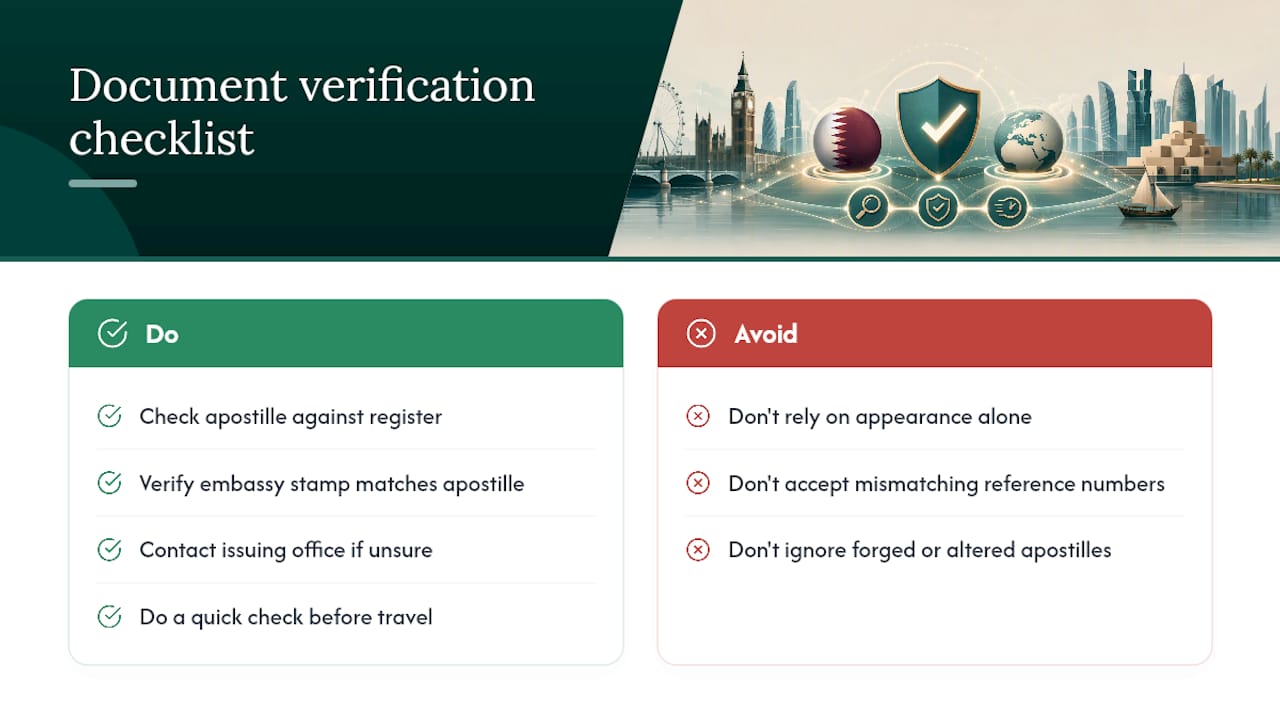
First, the apostille certificate itself can be checked against the issuing register. The Legalisation Office maintains records of apostilles it has issued, and a genuine certificate will match those records exactly, down to the reference number and date.
Second, the embassy stamp confirms that the Qatar Embassy in London has verified the apostille as genuine before attesting the document further. If you are receiving a document from someone else rather than legalising it yourself, a mismatch between the apostille reference number and what appears on the certificate itself is the clearest sign something is wrong.
If you are ever unsure whether a stamp or certificate is authentic, contact the issuing office directly rather than relying on the document's appearance alone. Forged or altered apostilles do exist, and they are far easier to catch by checking a reference number than by examining a signature or seal by eye.
A quick verification check before you travel or submit a document to a Qatari authority is worth the ten minutes it takes, particularly for documents that took weeks to prepare in the first place.
What commonly delays a Qatar apostille and how do you avoid it?
Most delays trace back to one of a handful of predictable mistakes, and nearly all of them are avoidable with a bit of planning.
Bundled documents are the most frequent cause of rejection. Both the Legalisation Office and the Qatar Embassy handle each document individually, so submitting several certificates stapled or clipped together as one package often results in the whole batch being returned unprocessed.
Name inconsistencies across a certificate, your ID, and any covering letter cause similar problems. A middle name included on your passport but missing from your birth certificate, for instance, can trigger a query that adds days to the process.
Missing return postage is a quieter but equally costly mistake. Neither the Legalisation Office nor the embassy will typically cover return postage on your behalf, and an application without a pre-paid, tracked envelope can sit in a queue far longer than one that arrives fully prepared.
Choosing the wrong certification type at the very first step is the most expensive error, because it is only caught once you reach the embassy stage, meaning you effectively restart the process from step one.
The fix for all four is largely the same: confirm document-specific requirements before you book anything, keep every document separate throughout, and always use tracked post for anything travelling to or from an official office.
Do requirements differ across England, Scotland, Wales and Northern Ireland?
The core three-step process, notarisation or certification, apostille, then embassy legalisation, applies UK-wide. Where things differ is in who issues the underlying certified copy in the first place.
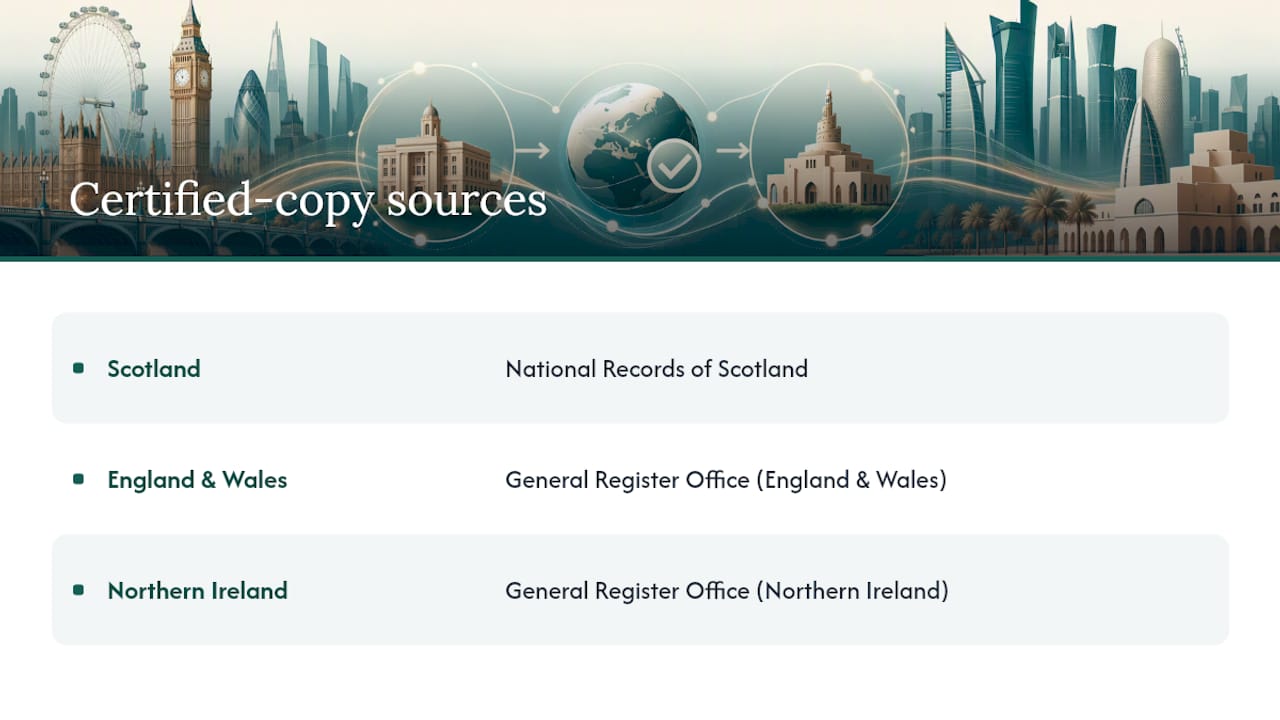
Birth, marriage, and death certificates issued in Scotland come from the National Records of Scotland rather than the General Register Office that covers England and Wales, and Scottish certificates sometimes use slightly different formatting that certifiers need to account for when preparing a certified copy. Northern Ireland similarly has its own General Register Office, separate from both.
This matters for the Qatar apostille process because the Legalisation Office apostilles documents based on where the original certification or notarisation took place, not where you currently live. If you were born in Scotland but now live in England, your birth certificate still needs to be sourced from the Scottish register before it can be certified and apostilled.
Educational documents follow a similar pattern: a degree from a Scottish university and one from an English university may have different internal certification procedures, so it is worth checking directly with the issuing institution rather than assuming the process is identical everywhere. The apostille and embassy stages themselves do not change based on where in the UK you are, only the route to obtaining the underlying certified document does.
MyNotary's approach to preparing documents for Qatar
The three steps do not change: certify or notarise, apostille, then embassy legalisation. Where the process usually breaks down is at the very first stage, booking a notary appointment, proving identity, and getting the certification wording right the first time.
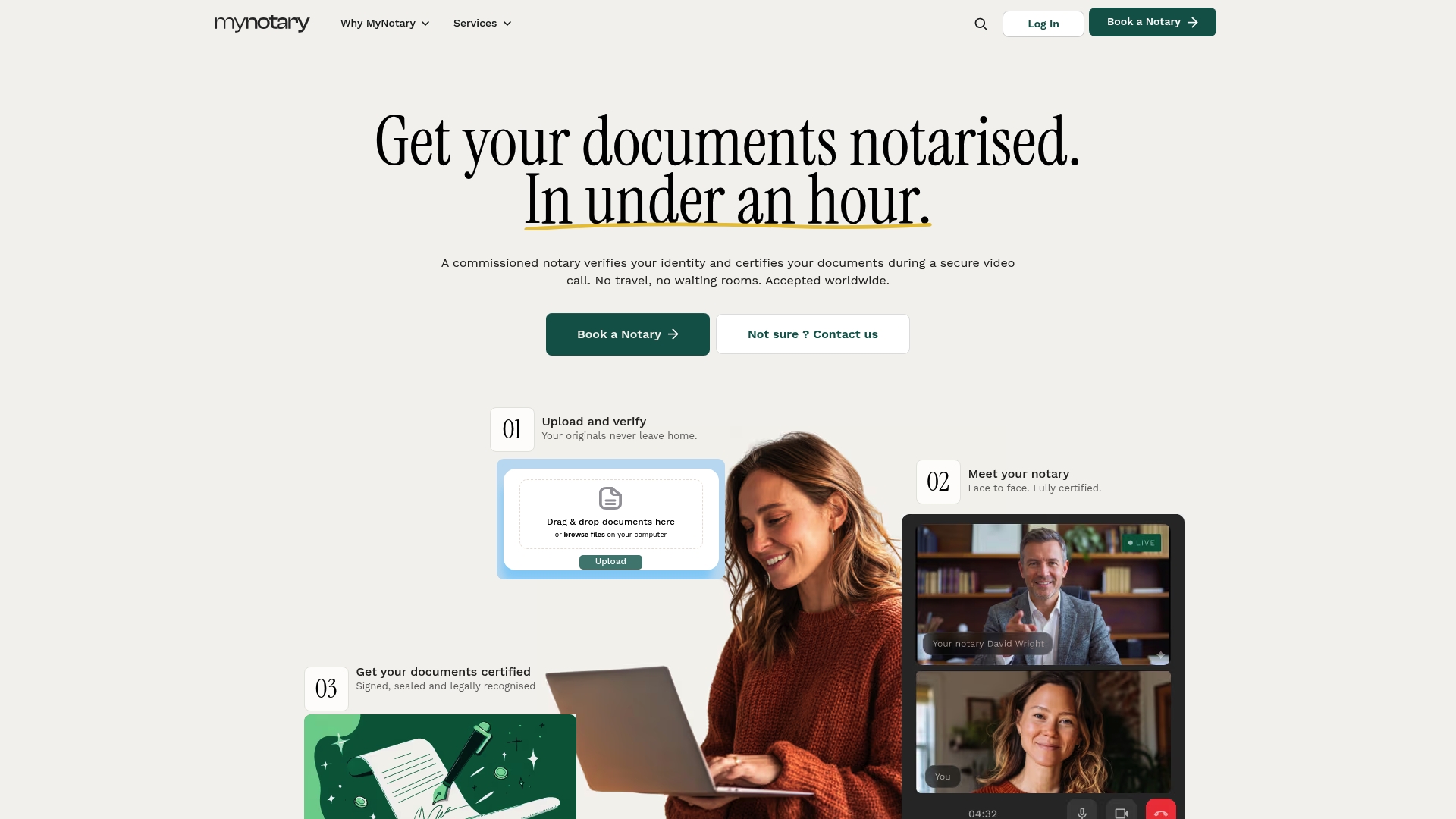
My Notary handles that stage remotely, using biometric identity verification and video-call sessions with a commissioned notary, with turnaround on notarised documents typically around one hour. That removes the scheduling bottleneck that often adds days to an otherwise straightforward application.
For readers working through document-specific requirements, our internal guides on apostilling powers of attorney and the UK apostille process walk through each stage in more detail than fits here.
— Jérémy
How My Notary fits into your Qatar apostille journey
Booking a notary in person can mean waiting days for an appointment before you have even reached the Legalisation Office stage. Some online notarisation services compress that first, most delay-prone step into a single video call completed from home, with certification turnaround times that can be faster than in-person appointments.
If your document is a power of attorney, a marital status affidavit, a degree certificate, or a corporate document, you can book directly through the relevant service page: power of attorney for banking, marital status affidavits, degree certification, or corporate document notarisation. BRP copies for expatriates preparing paperwork for Qatar can be handled through the certified BRP copy service.
To start, upload your document, complete biometric identity verification, and choose standard or express handling depending on your deadline. Once the notary session is complete, you receive an electronically signed certificate recognised in over 180 countries, ready to send on to the Legalisation Office for your apostille. Begin your notarisation through the online signature certification service to get the first step moving today.
Sources
FAQ
Can I get an apostille online in the UK?
You cannot get a fully paper apostille issued purely online, since Qatar requires the physical certificate, but you can complete the notarisation stage that precedes it entirely by video call through a service like My Notary.
Who can certify or notarise documents in the UK for Qatar?
A commissioned notary handles certification and notarisation, verifying your identity and the document before issuing a certified copy or witnessing a signature, depending on what the Qatar Embassy requires for that document type.
How do I apply for a Qatar apostille in the UK?
Get your document certified or notarised first, then send it to the Legalisation Office for a paper apostille, then submit the apostilled document to the Qatar Embassy in London for final attestation.
How long does the whole Qatar apostille UK process take?
Certification can take a day, the apostille stage ranges from one working day with express handling to several days standard, and embassy legalisation typically adds a further few working days by post.
Does Qatar accept e-apostilles?
No. Qatar requires a paper apostille certificate rather than the digital e-apostille format accepted by some other destinations.
Recommended
Got questions? We’re on it.
Most questions are answered here, drawn from what people actually ask before booking. If yours isn’t, our team is in chat.
You cannot get a fully paper apostille issued purely online, since Qatar requires the physical certificate, but you can complete the notarisation stage that precedes it entirely by video call through a service like My Notary.
Last updated: