Expat Document Notarisation: 6 Steps, With Online Video
By Jeremy Arhab, Founder · Published 14 October 2026 · Updated 14 October 2026
Need documents for use abroad? Confirm the receiving authority's rules, follow six steps, and check whether video notarisation or an apostille is required.

To use a document abroad, you usually need a commissioned notary to verify your identity and certify the document, and in many cases you also need an apostille to confirm that certification for a foreign authority. The fastest practical route is to confirm exactly what the receiving authority wants, then arrange the right notarisation by a commissioned notary, in person or by secure video, before adding any apostille or translation.
***
TL;DR: - Ask the receiving authority whether it requires an original, certified copy, apostille or e-Apostille, and translation; formats vary by country and institution. - A notarization appointment usually takes 15 to 30 minutes, but apostille processing can take days to weeks; e-Apostilles avoid postal transit only when accepted. - An e-Apostille may not work for certain civil registration certificates or criminal record checks, so confirm eligibility and electronic acceptance before choosing a digital route. - Home country notarization may be rejected for property, court, or family law matters; ask whether a local notary or consular involvement is required before booking. - Bring valid photo ID and leave the original unsigned until the notary witnesses the signature, or the certification may be invalid.
***
Table of Contents
- Checking requirements and getting your document notarised
- Apostille and e-Apostille: what they are and when you need one
- Costs and timelines you should expect
- Mistakes that cause rejections, and how to avoid them
- Whether a notary from your own country is enough
- How online notarisation actually works
- What I would do first if I were in your position
- How we can help with online notarisation
- FAQ
- Sources
Checking requirements and getting your document notarised
Before booking anything, confirm the receiving authority's exact requirements. Ask whether they need an original, a certified copy, an apostille or an e-Apostille, and whether a translation must accompany it. Formats and acceptance rules vary by country and by institution, so a single phone call or email can save weeks of delay.
Once you know what is required, follow this sequence:
- Confirm the receiving authority's exact paperwork and format preferences.
- Locate a commissioned notary and check they are qualified to certify your type of document.
- Gather your identity documents, unsigned originals and any certified translations.
- Attend the signing session, in person or by video, where required.
- Arrange any apostille, legalisation or translation once the notary has certified the document.
- Dispatch or deliver the certified document to the receiving authority.
What to bring to the signing itself typically includes:
- A valid passport or photo ID for identity verification.
- The original document, left unsigned until the notary witnesses the signature.
- A witness, if the receiving authority requires one.
- A certified translation, if the document is not in the destination country's language.
Remote or video notarisation is often acceptable for personal documents such as affidavits or powers of attorney, though some institutions still expect a paper-only process. A practical checklist for notarising documents abroad recommends confirming competent notaries and tracking dispatch as standard steps, alongside translating documents where required.
Pro Tip: Email the receiving authority a one-line question asking whether they accept notarised copies signed remotely, before you book any appointment.
Apostille and e-Apostille: what they are and when you need one
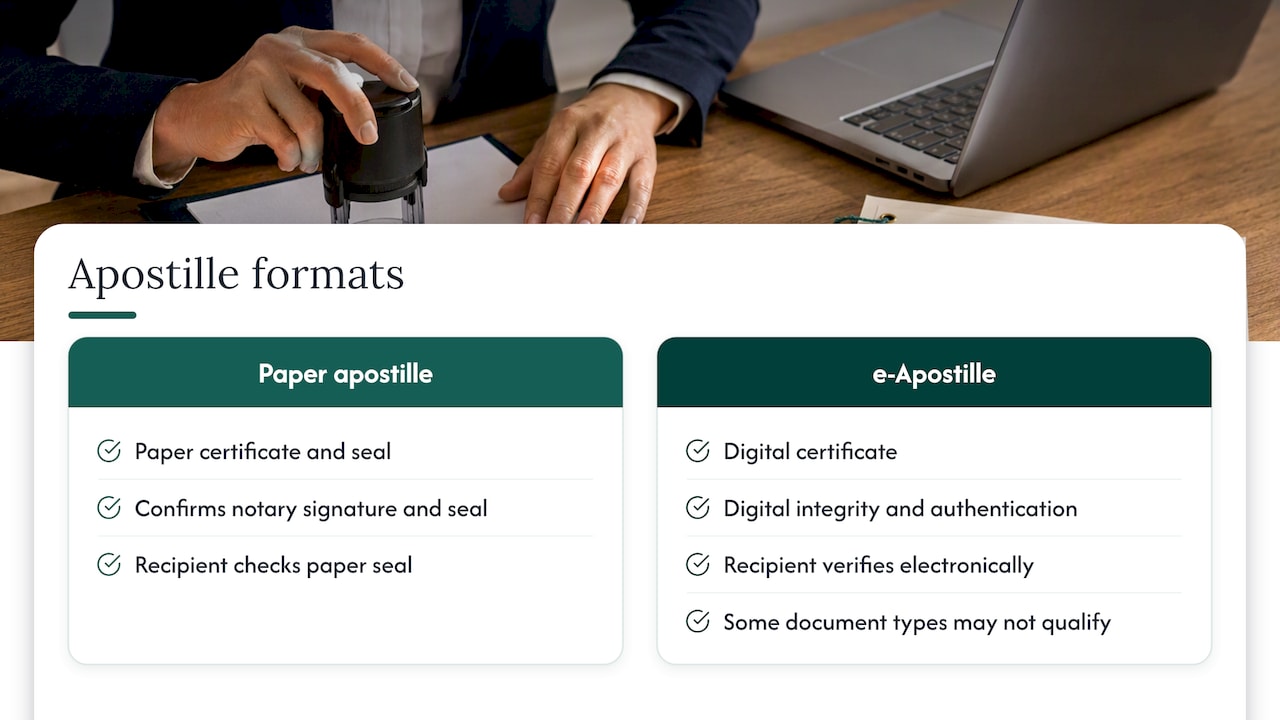
An apostille is an authentication certificate issued under the 1961 Hague Convention, recognised by 130 Contracting Parties, that replaces the older multi-step legalisation chain. It confirms that a notary's signature and seal are genuine, so the receiving country does not need to verify them separately.
An e-Apostille is the digital version. It carries a digital certificate that provides integrity and authentication, and recipients verify it electronically rather than by checking a paper seal, according to HCCH guidance on e-Apostille verification. Some recipients need to configure their PDF reader to trust the issuing authority's certificate to avoid a signature warning.
Not every document qualifies for an e-Apostille. Examples that are commonly excluded include certain civil registration certificates and criminal record checks, so it is worth checking before assuming a digital route will work.
One in 130 countries bound by the same Convention still means acceptance practices differ, because the Apostille Convention sets the certificate format but not every authority's internal workflow for handling it.
Costs and timelines you should expect
Notarisation and apostille timings vary depending on the document and the country involved, but a few patterns are consistent:
- A single notarisation appointment typically takes between 15 and 30 minutes once documents are ready.
- Apostille processing through a national competent authority can take from a few days to a few weeks, depending on volume.
- An e-Apostille, where accepted, removes postal transit time because verification happens online.
- Online notarisation providers can issue a certified digital document the same day, which shortens the overall chain before any apostille step.
Costs depend on the document type, the number of signatories and whether translation or apostille services are added, so it is sensible to ask for a clear quote before booking.
Mistakes that cause rejections, and how to avoid them
Most rejections come down to a handful of avoidable errors:
- Not confirming whether the receiving authority accepts electronic documents or e-Apostilles before submitting one.
- Signing the document before the notary witnesses it, which invalidates the certification.
- Turning up with expired or mismatched identity documents.
- Skipping a certified translation when the receiving country requires the document in its own language, a requirement covered in detail for one destination in this guide to certified translation rules in Bulgaria.
Pro Tip: Keep your document unsigned until you are in front of the notary, on screen or in person, since a pre-signed document usually cannot be certified.
Whether a notary from your own country is enough
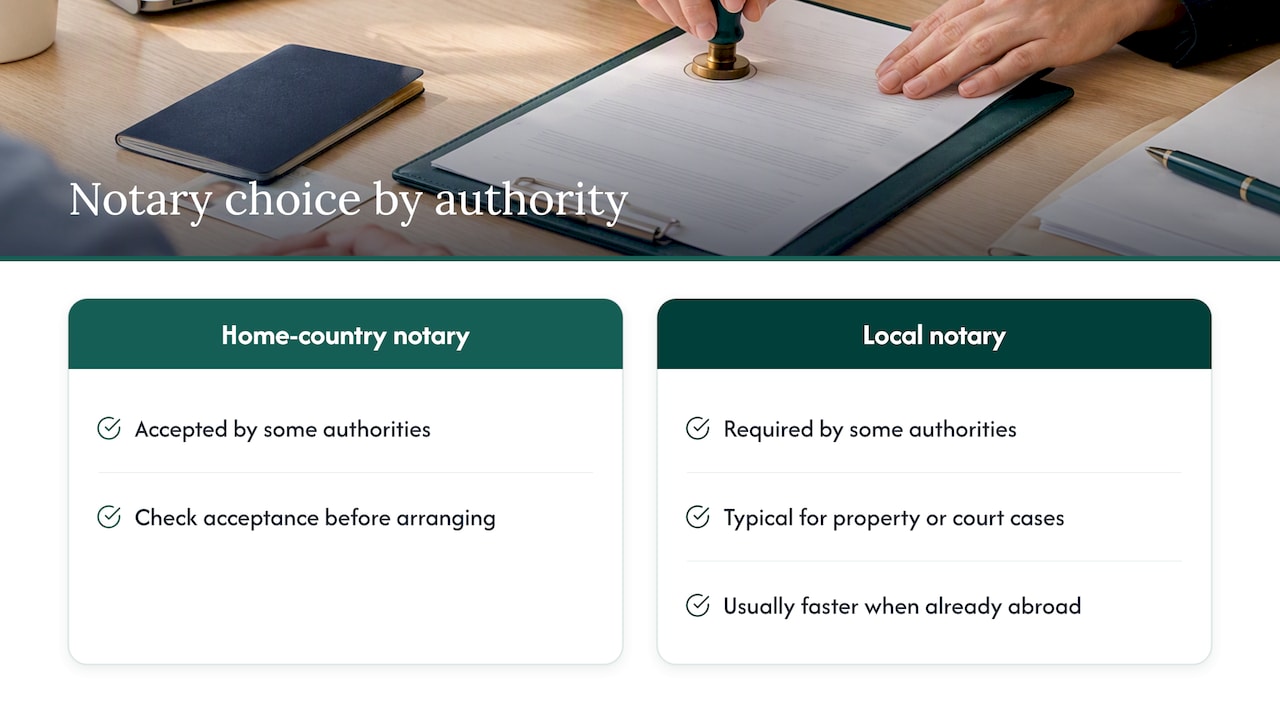
Some receiving authorities accept certification from a notary commissioned in your home country, while others insist on a notary local to the destination, particularly for property transactions or court proceedings. The only reliable way to know is to ask the receiving authority directly whether certification from your country of origin is acceptable, before arranging anything.
Typical cases that call for local notarisation or consular involvement include real estate transfers, certain family law matters and some court filings. For family law cases specifically, understanding which countries share the same Hague Convention framework can clarify whether cross-border recognition applies.
If you are already abroad and discover you need local notarisation, a notary practising in that country is usually faster to arrange than trying to coordinate certification from home.
How online notarisation actually works
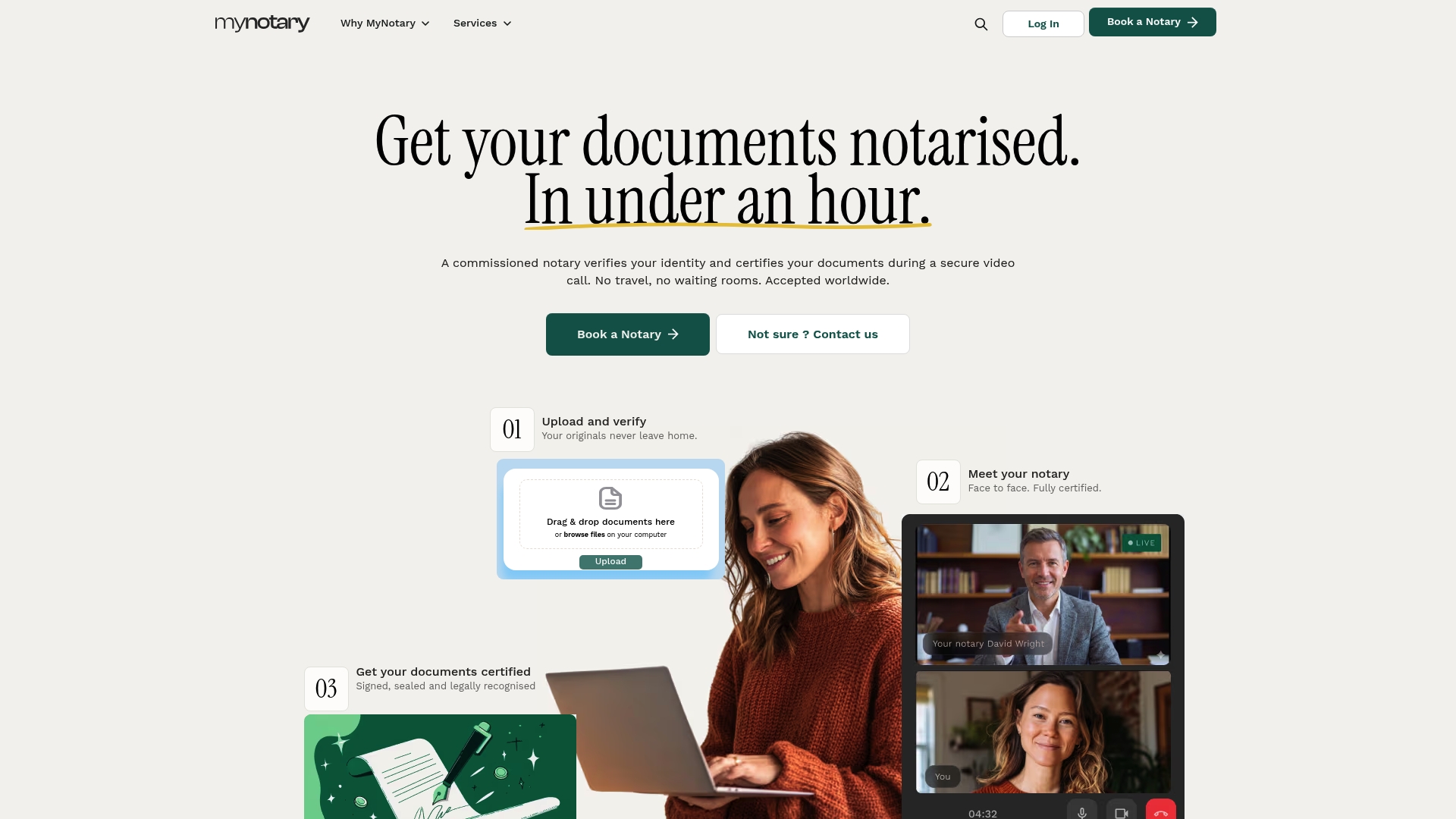
Online notarisation follows a fixed sequence designed to replace an in-person appointment without cutting corners on verification. You upload the document, join a recorded video session, and a commissioned notary checks your identity against your passport before certifying the document and applying their seal.
In practice, this means:
- Identity is confirmed through passport-based checks and biometric verification during the video call.
- The session itself is recorded, which supports the audit trail behind the certification.
- Once certified, the document can be delivered the same day, with apostille or translation added as a separate step where needed.
Pro Tip: Check whether the receiving authority explicitly accepts video-based notarisation before relying on it for property, probate or court documents, since some still require a paper-only process.
What I would do first if I were in your position
Try the online route first for personal documents such as affidavits or powers of attorney, since it is usually faster. For court filings, property or anything jurisdiction-sensitive, confirm acceptance with the receiving authority before booking, and prioritise consular advice if you are uncertain.
— Jérémy
How we can help with online notarisation
We handle notarisation entirely by video call, so you never need to visit an office or take time off to attend one in person. Our sessions include passport-based identity checks with biometric verification, and a commissioned notary certifies your document during a recorded call.
We offer various notarisation services with optional apostille and certified translation add-ons where your document needs them. Delivery is typically on the same day once the session is complete. Visit our services page to see the full list and book a session.
FAQ
Can I get a US document notarised while in the UK?
A commissioned notary can certify a document for use in the US, but the US recipient's exact requirements determine whether that certification, plus any apostille, will be accepted. Always confirm the specific format and apostille requirement with the receiving institution before booking.
What is the most common mistake people make with notarisation?
The most frequent error is not confirming the receiving authority's exact requirements for format, translation or apostille type before starting the process. This single step, checked early, prevents most rejections and delays.
Which immigration documents typically need notarisation?
Documents such as affidavits, powers of attorney, proof of residency and certificates of no impediment are commonly notarised for immigration purposes. The receiving immigration authority's own guidance determines whether an apostille or certified translation must accompany them.
Is a notarisation from one country automatically valid in another?
Not automatically. Recognition usually depends on whether an apostille has been added under the Hague Apostille Convention and whether the receiving country is a Contracting Party, so this should be confirmed case by case.
Sources
Recommended
Got questions? We’re on it.
Most questions are answered here, drawn from what people actually ask before booking. If yours isn’t, our team is in chat.
A commissioned notary can certify a document for use in the US, but the US recipient's exact requirements determine whether that certification, plus any apostille, will be accepted. Always confirm the specific format and apostille requirement with the receiving institution before booking.
Last updated: