Business Contract Notarisation: From Video ID Checks to Legalisation
By Jeremy Arhab, Founder · Published 15 October 2026 · Updated 15 October 2026
Find out when business contracts need notarisation, what recipients require, what to prepare, and how video ID checks and legalisation fit together.
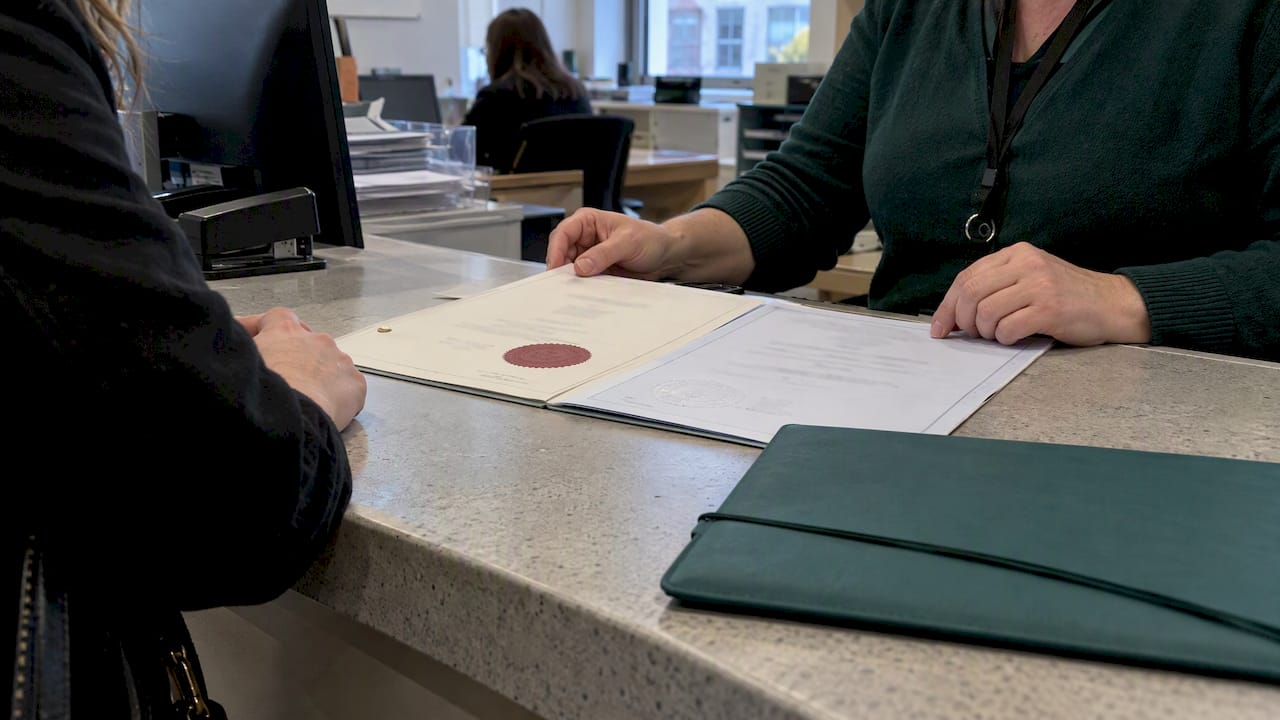
Most commercial contracts do not need notarisation to be valid and enforceable. Certain documents do require it, particularly deeds, and contracts intended for use abroad often need notarisation plus legalisation. Check what the recipient actually asks for, then gather identity and company evidence, and book a session with a commissioned notary once you know the requirement applies to you.
***
TL;DR: - Before booking, ask the receiving party whether it needs a notarised original, certified copy, apostille, translation, or particular certificate wording; requirements vary by authority. - Bring original, unexpired photo identification and evidence of company signing authority, and leave the document unsigned so the notary can witness your signature. - Deeds may require a physically present witness, so an online session alone may not meet the formalities for some property or commercial deeds. - For overseas use, notarisation may be only the first step; confirm whether the jurisdiction accepts a paper apostille or an electronic apostille.
***
Table of Contents
- When is notarisation required for business contracts and deeds
- Which business documents are commonly notarised
- What to prepare before notarising a contract
- How online and remote notarisation works for business contracts
- Apostille and legalisation: when notarisation is only step one
- Typical timelines and fees for notarisation and legalisation
- Common mistakes that cause rejection and how to avoid them
- What online notarisation changes for cross-border business work
- Getting your business contract notarised with MyNotary
- FAQ
- Sources
When is notarisation required for business contracts and deeds
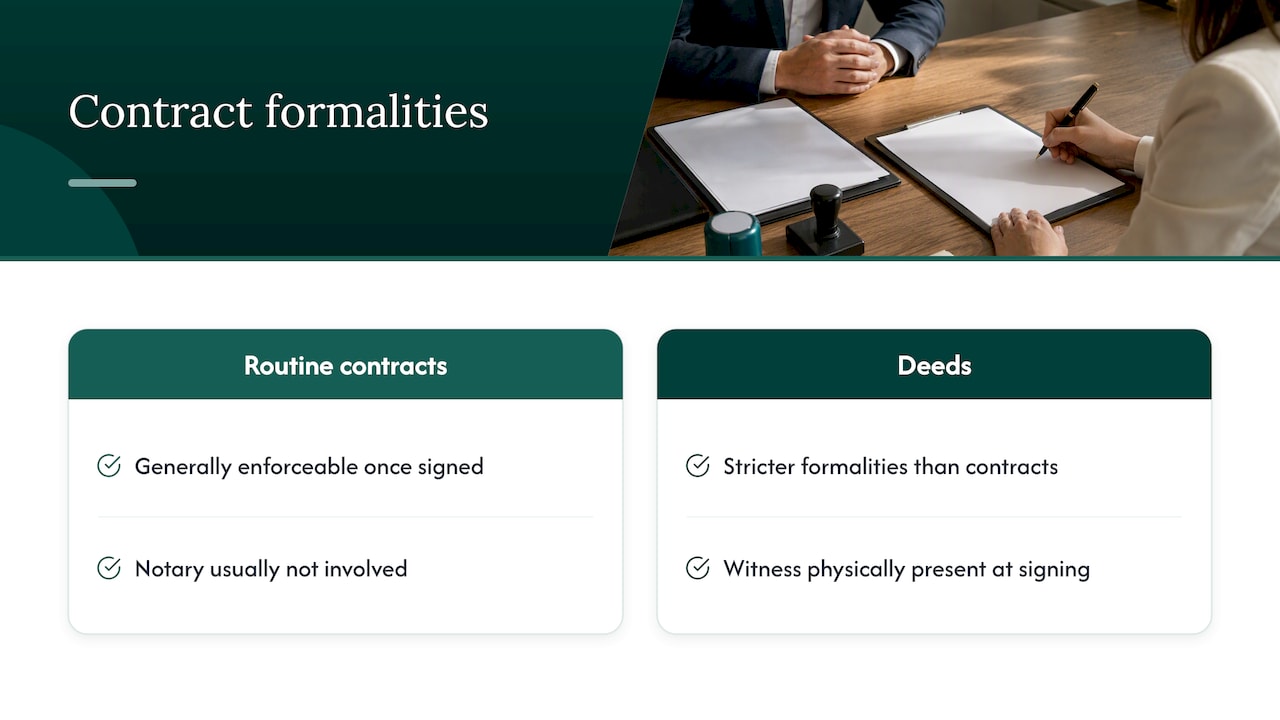
Routine commercial contracts, such as supplier agreements or service terms, are generally enforceable once signed, with no notary involved. A requirement for notarisation usually comes from somewhere else: a foreign counterparty's internal rules, a regulator's instructions, or the nature of the document itself.
Deeds sit in a different category. They carry stricter formalities than ordinary contracts, and the Law Commission's work on electronic execution confirms that electronic signatures are generally capable of executing documents in law, provided the signer intends to authenticate them and any required formalities are met. For deeds, that usually means a witness must be physically present when the document is signed, even where the rest of the transaction happens digitally.
Before you book anything, check with the counterparty or the receiving authority. A bank, government body or foreign registry will tell you exactly what form of certification it expects, and that answer should shape your preparation rather than assumptions about what "notarisation" generally involves.
Which business documents are commonly notarised
Some categories of business paperwork come up again and again when notarisation is requested. Recognising your document on this list is a useful first filter, though the recipient's own wording always has the final say.
- Powers of attorney granting authority to act on a company's behalf.
- Deeds, including property and certain commercial transaction deeds.
- Company incorporation documents and constitutional papers.
- Certified copies of company registers or statutory filings.
- Sale and purchase agreements involving overseas parties.
- Beneficial owner declarations required for compliance checks.
- Documents requested by foreign banks, regulators or government departments.
Certified copies are particularly common where a document needs to travel abroad or support a legalisation request, since many recipients will not accept an uncertified photocopy. If you are unsure which category your document falls into, the safest step is to ask the receiving party directly what wording or certification format they expect before you arrange anything.
What to prepare before notarising a contract
A session runs smoothly when the groundwork is done in advance. Work through this before you book:
- Identity documents: bring valid, original photographic ID, typically a passport, and proof of address if the notary or recipient asks for one.
- Company evidence: have Companies House filings, a board resolution, or other proof of signing authority ready if you are acting for a business.
- Certified copies: request these in advance if the recipient has specifically asked for certified rather than plain copies.
- Unsigned document: keep the contract unsigned until the session, since a commissioned notary generally needs to witness the signature taking place.
- Witness requirements: confirm whether any witnesses need to be physically present, particularly for deeds.
- Recipient wording: check the exact certification language the recipient expects, including whether translation or apostille will follow.
- Technical setup: for an online session, test your camera, microphone and internet connection beforehand.
Pro Tip: Keep your ID and company documents in the same format the recipient named in their request; a mismatch in document type is one of the easiest things to fix before a session and one of the hardest to fix after.
How online and remote notarisation works for business contracts
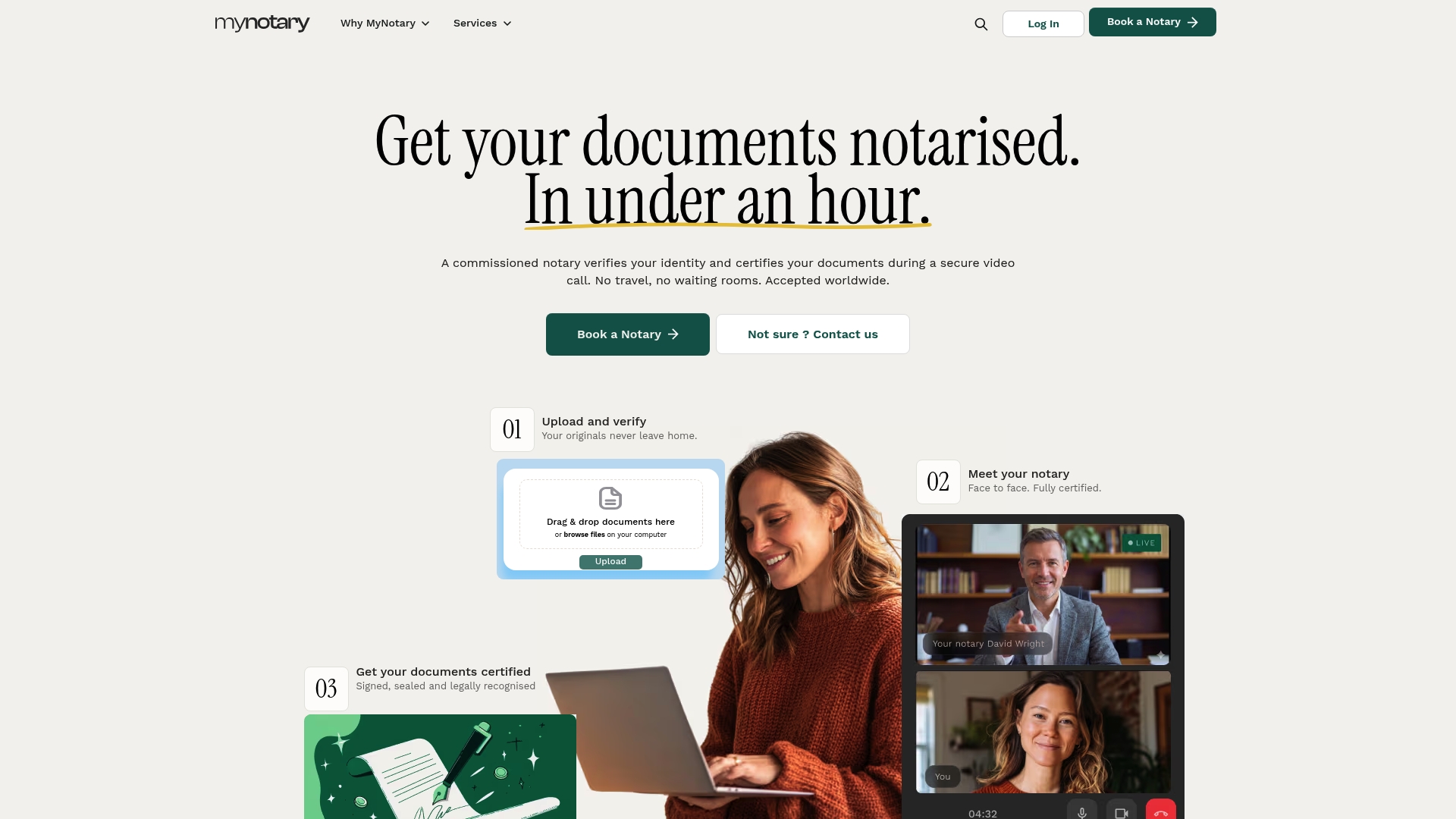
Online notarisation follows a structured sequence designed to preserve the same evidential weight as an in-person appointment. The notary needs to see you sign, verify who you are, and create a clear record of the session.
- You upload the contract or supporting documents ahead of the appointment.
- A live video session opens, during which the notary checks your identity against your passport, often supported by biometric verification.
- You sign the document while the notary watches in real time, since the document must still be unsigned when the session begins.
- The session is recorded, creating an audit trail that supports the notarisation later if it is ever questioned.
- The notary applies a seal or certificate to confirm the act, then arranges delivery of the certified document.
Our guide to UK online notarisation requirements sets out the identity and live-signing conditions in more detail. One limit worth noting: the Law Commission points out that deeds may still require a witness in physical presence, so some property or high-value commercial deeds are not fully suited to a remote-only process.
Apostille and legalisation: when notarisation is only step one
For contracts going abroad, notarisation is frequently just the first stage. Many foreign authorities will not accept a document until it carries an apostille, and Gov explains that the Legalisation Office checks the notary's signature, stamp or seal before issuing one. Skipping this step, or assuming a notarised document is automatically accepted overseas, is a common cause of delay.
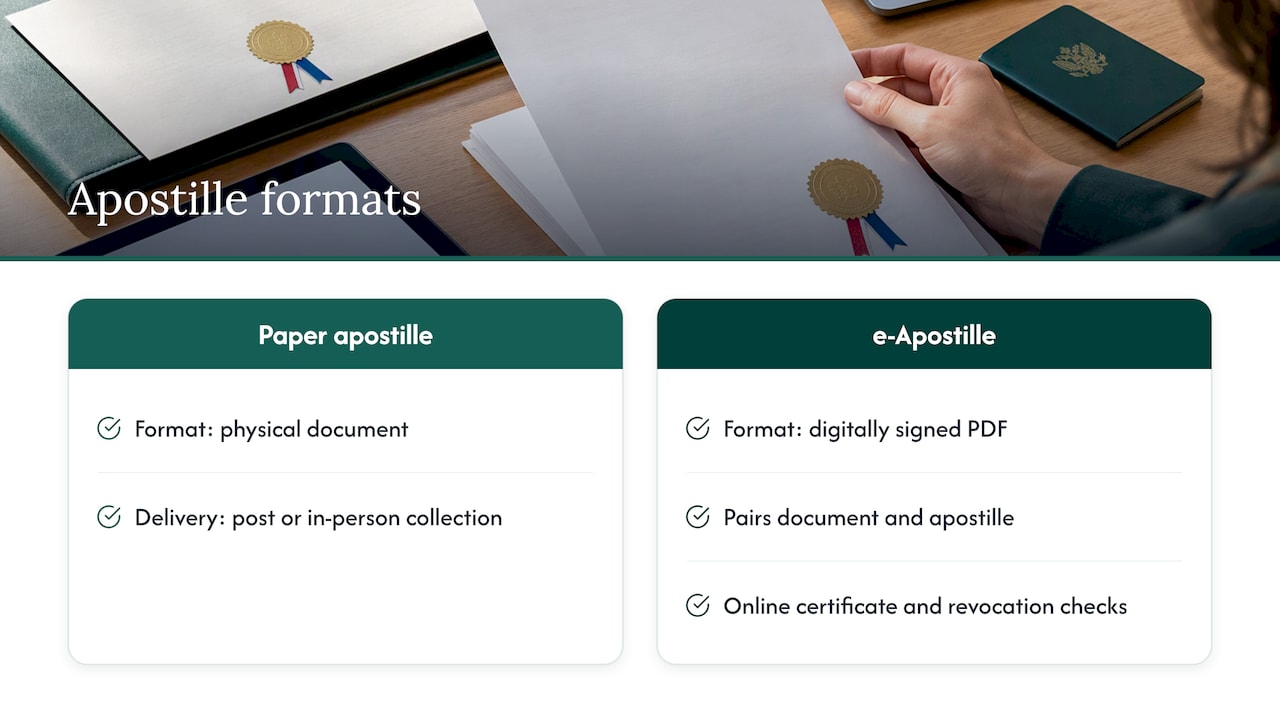
There are two formats to choose between. A paper apostille is a physical document sent by post or collected in person. An e-Apostille, by contrast, is issued as a single digitally signed PDF that pairs the document with the apostille and can be verified online. The HCCH's guidance on e-Apostille verification explains that Competent Authorities apply digital certificates to these files, and recipients can check the certificate and its revocation status directly. Which format you need depends on what the receiving jurisdiction will accept, so it is worth confirming that before you request one. Our breakdown of the UK apostille process walks through the practical steps.
Typical timelines and fees for notarisation and legalisation
Once your documents and ID are ready, an online notarisation session can be arranged. Processing time depends on the service and your circumstances. Legalisation adds further processing time on top of that, since the apostille step happens separately after notarisation.
GOV.UK's guidance on legalisation services explains the legalisation process. If your document needs translation, courier delivery or a recipient-specific check afterwards, build extra time into your plan rather than assuming the notarisation step alone finishes the job.
Common mistakes that cause rejection and how to avoid them
Most rejections trace back to a handful of avoidable errors. The most frequent:
- Bringing expired or non-original identity documents to the session.
- Signing the contract before the appointment, when the notary needs to witness the act itself.
- Missing the company evidence needed to confirm signing authority.
- Skipping a check on whether the recipient needs an apostille or specific wording.
Avoiding these comes down to preparation rather than luck. Work from a checklist, confirm the recipient's exact requirements before you book, arrange certified translations in advance if needed, and test your video setup and documents the day before. A commissioned notary can, and will, refuse to proceed if your identity or signing authority cannot be properly verified, so getting this right beforehand saves a wasted appointment.
Pro Tip: If your contract involves more than one signatory, confirm each person's availability and ID readiness before booking a joint session; a missing signatory on the day usually means starting again.
What online notarisation changes for cross-border business work
Video notarisation has made cross-border commercial work noticeably more practical for businesses that previously had to schedule in-person appointments around time zones and travel. The two-step logic, notarisation first, legalisation only when the recipient requires it, still holds regardless of how the first step happens. What changes is the friction: a properly run online session with recorded identity checks can replace a physical meeting without weakening the evidential record. The part that still needs a human decision is confirming, early, exactly what the recipient will accept.
— Jérémy
Getting your business contract notarised with MyNotary
We built MyNotary around the parts of this process that cause the most friction: proving who you are, getting a document witnessed properly, and getting a certified result back fast. Our corporate document notarisation service runs over video, with biometric identity checks.
We also support signature notarisation, identity verification, and certified copies for documents that need to travel abroad, with digital and physical delivery arranged once the session is complete. If your contract needs company authority evidence or a beneficial owner declaration alongside it, our full services list covers those too. Check what your recipient needs, then book a session that fits your schedule.
FAQ
Why would a document need to be notarised?
A document typically needs notarisation when a recipient, such as a foreign authority, bank or regulator, requires independent verification of a signature or copy before accepting it. Deeds also carry this requirement by their legal nature, regardless of who is receiving them.
What is the most common mistake made during notarisation?
The most frequent error is presenting a document that has already been signed, when the notary needs to witness the signature taking place. Expired identity documents and missing company authority evidence are the next most common causes of a failed appointment.
Who can notarise a business document?
A commissioned notary carries out notarisation, verifying your identity and witnessing the signing of the document before applying a seal or certificate. For online sessions, this happens over a recorded video call rather than in person.
Are business contracts always required to be notarised?
No. Most commercial contracts are valid and enforceable without notarisation, and only specific documents, such as deeds or papers destined for foreign authorities, typically require it. Checking the recipient's own requirement is the most reliable way to confirm whether your contract needs it.
Sources
- Gov
- Electronic execution of documents – Law Commission
- HCCH | FAQ on the issuance and verification of an e-Apostille
Recommended
Got questions? We’re on it.
Most questions are answered here, drawn from what people actually ask before booking. If yours isn’t, our team is in chat.
A document typically needs notarisation when a recipient, such as a foreign authority, bank or regulator, requires independent verification of a signature or copy before accepting it. Deeds also carry this requirement by their legal nature, regardless of who is receiving them.
Last updated: