Sponsor Letter Notarisation: When It Helps and How It Works
By Jeremy Arhab, Founder · Published 19 October 2026 · Updated 19 October 2026
Does a sponsor letter need notarising? See when it helps, what the letter must contain, and how online notarisation by video call works for it.

A sponsor letter does not always need to be notarised. Notarisation adds a verified signature and identity check to the letter. It does not turn unsupported statements into proof, and it does not decide whether the receiving authority accepts the document. This guide explains when notarisation is worth doing, what the letter should say, and how an online session with a commissioned notary works.
TL;DR
- Most receiving authorities judge a sponsor letter by its content and the evidence behind it. Notarisation strengthens the signature and identity evidence only.
- For a UK visitor application, GOV.UK guidance asks for evidence of what the sponsor pays for, how, and the sponsor's ability to afford it. A polished letter without matching bank statements is a common weakness.
- A child travel consent letter is a different document from a financial sponsor letter, and notarisation never replaces the agreement of everyone with parental responsibility.
- An apostille is a separate step. Check whether the destination asks for one before you order it.
- Our online notarisation takes place by video call, with passport verification and a notary's seal. Delivery is the same day.
Table of Contents
- What a sponsor letter is and who asks for it
- Does a sponsor letter need to be notarised?
- What a sponsor letter should contain
- When the letter is really a child travel consent
- How online notarisation of a sponsor letter works
- Do you also need an apostille or a translation?
- Common mistakes to avoid
- Our perspective
- Notarise your sponsor letter online
- FAQ
- Sources
What a sponsor letter is and who asks for it
A sponsor letter is a signed statement from a person who agrees to pay for, or support, part of someone else's trip, stay or studies. The sponsor may cover flights, living costs, accommodation or all three. The letter is addressed to a visa authority, a university, an embassy or an employer, and it usually accompanies the application.
People search for this topic under several names: sponsorship letter, letter of support, declaration of sponsorship, affidavit of support. The label matters less than the job the document does. It explains who is paying, for what, why, and for how long.
Typical situations in which readers in the UK need one:
- A relative abroad is applying to visit you, and you will pay for their stay.
- You are abroad and a relative in the UK is sponsoring your visa application.
- A parent is funding a student's living costs overseas.
- A freelancer or small business is sponsoring a contractor's business trip.
The rules differ by country and by visa category. The sections below use UK visitor guidance as a worked example, because it is public and specific. If your letter is for another country, ask that country's embassy or application centre what it requires before you spend money on any certification.
Does a sponsor letter need to be notarised?
Usually the answer is no, but it depends on who receives it. Many visa routes do not set notarisation as a rule for a sponsor letter. Some embassies, universities or banks do ask for a notarised or witnessed version. A few people choose to notarise anyway because it shows the signature belongs to a verified person.
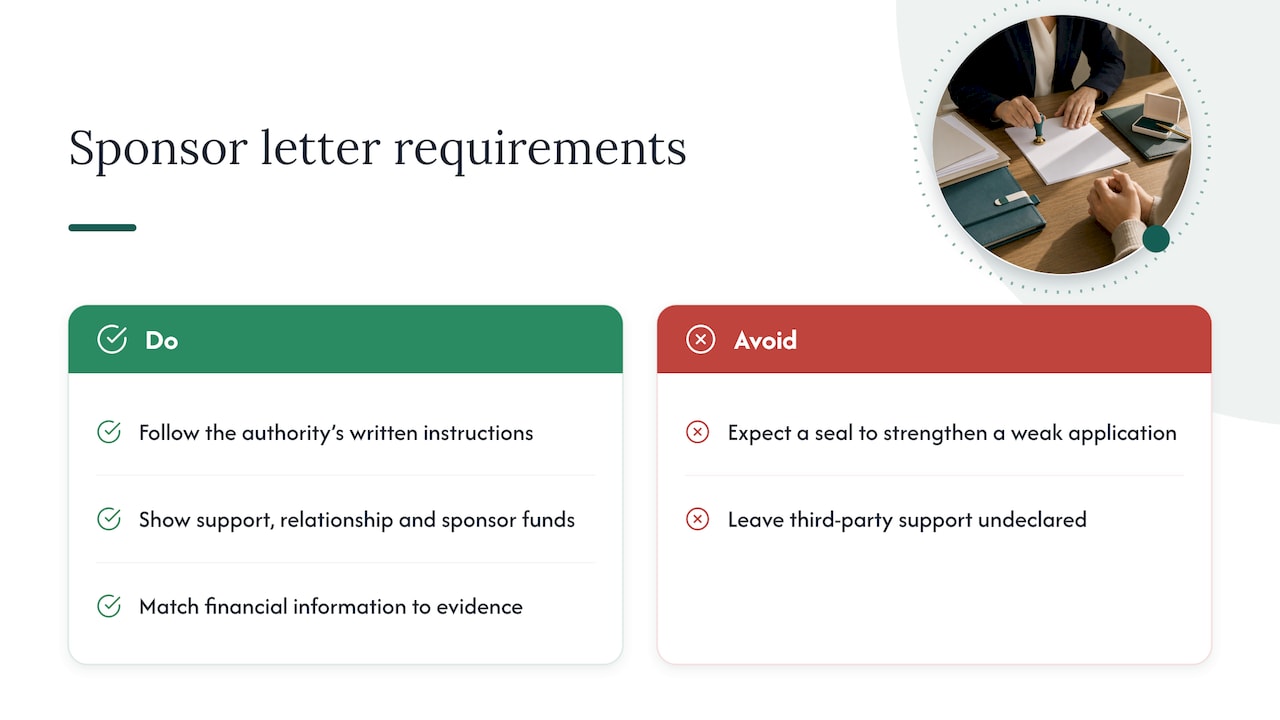
The practical rule is simple: follow the written instructions of the authority that will read the letter. If the instructions say "notarised", notarise. If they say nothing, notarisation is optional and will not make a weak application strong.
Why substance matters more than a stamp. The GOV.UK guide to supporting documents for visitors says that when a sponsor provides travel, maintenance or accommodation, you should show what support is provided, whether it extends to dependants, and how it is provided. The same guidance expects evidence of the relationship with the sponsor and of the sponsor's funds. None of those items is satisfied by a notary's seal.
UK Visas and Immigration caseworker guidance, updated in January 2025, also points out that financial information should match the supporting documents. It states that bank statements should show where funds come from, and that third-party support which is not declared may be disregarded. Consistency across the whole application is what counts.
What notarisation does add
Notarisation by a commissioned notary confirms three things:
- The person signing is the person named, checked against identity documents.
- The signature was made in the notary's presence, in our case over a live video call.
- The notary has applied their seal to the document.
That can help when the receiving party is abroad and cannot easily judge whether a signature is genuine. It helps less when the real question is whether the sponsor can afford the support.
What notarisation does not do
- It does not prove the contents are true.
- It does not replace bank statements, payslips or proof of accommodation.
- It does not guarantee acceptance by any authority. We never promise acceptance, and no provider can.
- It does not settle disagreements, for example between parents over a child's travel.
What a sponsor letter should contain
Write the letter so that a caseworker who has never met you can follow the story in one reading. The research above and the GOV.UK Standard Visitor application page suggest the following checklist. The application asks for travel dates, accommodation, expected costs and details of anyone paying, so the letter should use the same facts.
| Element | What to write | Why it matters |
|---|---|---|
| Sponsor details | Full name, address, date of birth, passport or ID number, contact details | Lets the reader identify and, if needed, contact the sponsor |
| Applicant details | Full name, date of birth, passport number, nationality | Links the letter to the application |
| Relationship | How you know each other and for how long | Genuine relationships are part of the visitor requirements |
| What is covered | Flights, accommodation, daily costs, insurance, or a stated share of them | Shows exactly what the sponsor is responsible for |
| Dates and place | Arrival and departure dates, address where the applicant will stay | Must match the application form |
| Financial ability | Income source and a reference to the attached statements | Supports the sponsor's ability to pay |
| Status | The sponsor's lawful status in the UK, where relevant | The guidance asks for it where the sponsor is in the UK |
| Signature and date | Handwritten or electronic, dated | The part notarisation can verify |
Keep every number consistent
Check the dates, the address and the amounts against the application form and the bank statements before the sponsor signs. A notarised letter that contradicts the form is harder to defend than an unnotarised one that matches. If the letter says the sponsor will pay for everything, the application should say so too.
The sponsor's evidence is separate from the letter. Typical attachments are recent bank statements, payslips or business accounts, proof of address, and a copy of the sponsor's passport or residence document. For applications that need a certified copy of a bank statement, we offer a notarised copy of a bank statement, but ask the receiving authority first whether it wants certified copies at all.
A note on how sponsor obligations differ by context
The word "sponsor" carries different obligations in different systems. A visa sponsor, a student sponsor and a financial guarantor in another country do not owe the same things. For a contrast, one US provider explains who can act as an immigration bond sponsor and what they owe, which is a US court process and unrelated to UK visa letters. It is a useful reminder to check which regime your letter belongs to before you copy a template.
When the letter is really a child travel consent
Some readers who search for a sponsor letter actually need permission for a child to travel. That is a consent letter, not a financial statement.
GOV.UK guidance on taking a child abroad says a letter from the person with parental responsibility is usually enough to show permission. It should include trip details and contact details for the person giving consent. Carry evidence of the relationship, such as a birth or adoption certificate, and marriage, divorce or name-change documents where surnames differ.
For separated or divorced parents, there are extra checks:
- Confirm who has parental responsibility. GOV.UK explains that major decisions, such as moving a child abroad, need everyone with parental responsibility to agree in writing.
- Check for any Child Arrangements Order, Prohibited Steps Order or other court order before you plan the trip.
- If parents disagree, the answer is not a notarised letter. GOV.UK's guidance on international parental child abduction advises contacting a suitably qualified family lawyer where there is a concern about a child being taken abroad.
Notarisation can witness the signature of a parent who does agree. It cannot create agreement. If you need the full process, read our guides on the child travel consent letter and on notarising a parental consent letter online.
An exception to know about
The current UK consent form for a child applying for an emergency travel document must be completed by every person with parental responsibility in certain cases, and it requires a handwritten signature on each page. For that form, do not use an online workflow unless the receiving authority confirms it will accept one. Our guide on when passport consent needs notarisation covers related cases.
How online notarisation of a sponsor letter works
Our service is an online notarisation platform. You do not need to travel or sit in a waiting room. The sequence is the same for most documents.
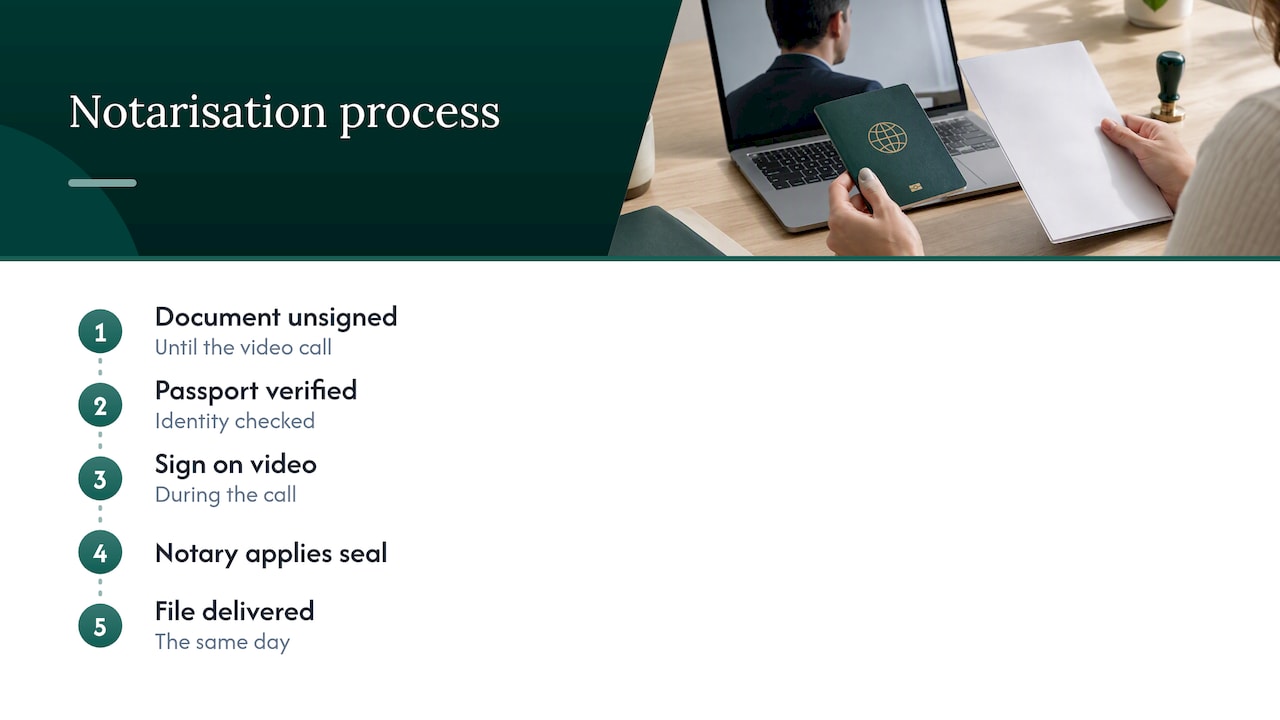
- Prepare the letter. Write it using the checklist above, but do not sign it. The notary must see you sign during the session.
- Upload the document. Add the unsigned PDF to the platform. Templates and upload tools are available if you need a starting point.
- Verify your identity. You confirm who you are with your passport and a biometric check.
- Join the video call. A commissioned notary sees you, checks your identity and watches you sign. The session is recorded.
- Receive the notarised document. The notary applies their seal. You receive a certified digital copy the same day, and a physical copy can be sent if the receiving party wants paper.
Our average turnaround for a notarised document is one hour. The three conditions that matter most are described in our guide to online notarisation requirements in the UK: valid identification, live signing and the identity check.
Multiple signatories
Some sponsorship documents have more than one signature, for example two parents sponsoring a student, or a family and a business sharing costs. The platform supports documents signed by several people in different places. Each signer joins the session and is verified separately.
Timing at a glance
| Stage | Typical time | What you do |
|---|---|---|
| Drafting the letter | 30 to 60 minutes | Gather the facts and check them against the application |
| Upload and identity check | 10 to 15 minutes | Photograph your passport and complete the biometric check |
| Video session with the notary | A short call | Confirm your identity and sign |
| Delivery of the certified document | Same day | Download the notarised PDF |
The drafting and upload times are our own planning estimates for a simple letter. They will be longer if the sponsor still has to gather statements.
Do you also need an apostille or a translation?
Only if the destination asks for them. They are separate steps, and ordering them too early wastes time.
An apostille authenticates the signature, the capacity of the person who signed, and the seal or stamp on a public document. The HCCH page on the Apostille Convention explains that the Convention replaces the older chain of legalisation between its member states. Notarial acts and official authentications of private signatures can fall within its scope, as the Convention's full text sets out.
Three points to keep in mind:
- An apostille is not notarisation. In the usual sequence, you notarise first and then ask whether an apostille is needed.
- An apostille does not certify that the sponsor's financial statements are true.
- The destination authority still sets its own rules on language, format and whether it wants a paper original.
If the letter must be read in another language, a certified translation may also be required. Ask the receiving body whether it wants the translation to be notarised, and in what order. Our guides on the UK apostille process and on combining translation, notarisation and apostille show how the steps fit together.
Common mistakes to avoid
- Signing before the session. If the sponsor signs in advance, the notary cannot witness the signature.
- Mismatched details. A different address or date between the letter and the form invites questions.
- No supporting evidence. The letter says the sponsor will pay, yet no statements show they can.
- Undeclared support. UKVI caseworker guidance says undeclared third-party support may be disregarded, so declare the sponsorship in the application itself.
- Assuming notarisation is mandatory. Read the authority's instructions first. You may not need it.
- Vague wording. "I will support the applicant" says little. State what is paid, for how long and how.
Our perspective
We see two kinds of customers asking about sponsor letters. The first has been told, often by a friend, to get everything stamped. The second has a real instruction from an embassy, a university or a bank that asks for a notarised signature. We help the second group quickly, and we tell the first group to read the instructions before paying for anything.
A notarised signature answers one question: did this person, whose identity was checked, sign this document? Our process is built around that question. The session is held over video, the passport is verified, the document is unsigned until the call, the notary applies a seal and the file is delivered the same day. Those are facts we can describe and stand behind.
What we cannot do is decide for you whether a particular authority will accept the letter. That decision belongs to the authority. So our advice is the same each time: get the requirement in writing, make the letter specific, attach evidence that matches it, and use notarisation where it is asked for or where a verified signature genuinely helps.
For families, the same honesty applies. If parents disagree about travel, or a court order exists, a notarised letter does not solve the problem. A family lawyer does.
— Jérémy
Notarise your sponsor letter online
If the receiving authority has asked for a notarised sponsor letter, you can complete it from home. Upload your unsigned letter, verify your passport and sign in front of a commissioned notary on a video call. Our signature notarisation service is the right starting point for most sponsor letters, and the full list of services includes affidavits, statutory declarations and a marital status affidavit for visa applications. Our marital status affidavit for visa applications is a common companion document when you need to show family ties.
FAQ
Does a sponsorship letter for a UK visa have to be notarised?
Not as a general rule. GOV.UK guidance focuses on what the sponsor provides and the evidence of how it is provided, rather than on notarisation. If a specific authority or application centre asks for it, follow that instruction. Otherwise, a clear signed letter with matching financial evidence carries more weight.
Can a sponsor letter be notarised by video call?
Yes, in our process. The sponsor uploads the unsigned letter, verifies identity with a passport, and signs during a recorded video session with a commissioned notary. Check first that the receiving authority accepts a document notarised online, because that is their decision.
Is a sponsor letter the same as a child travel consent letter?
No. A sponsor letter explains who pays for a trip or stay. A child travel consent letter records that a person with parental responsibility agrees to the child travelling, and GOV.UK says it should include trip and contact details. Separated parents should check for court orders before relying on either document.
Do I need an apostille on my notarised sponsor letter?
Only if the destination country or organisation asks for one. The apostille authenticates the signature, capacity and seal on the document, and it does not prove the letter's contents. Confirm the requirements, including language and paper or digital format, before you order it.
How long does it take to get a sponsor letter notarised online?
Our average turnaround for notarised documents is one hour, and delivery of the certified document is the same day. The overall time depends mostly on how quickly the sponsor can finish the letter and gather identity documents.
Sources
- Visiting the UK: guide to supporting documents, GOV.UK
- Visit caseworker guidance, GOV.UK
- Apply for a Standard Visitor visa, GOV.UK
- Get permission to take a child abroad, GOV.UK
- What parental responsibility is, GOV.UK
- International parental child abduction, GOV.UK
- Consent form for a child applying for an emergency travel document, GOV.UK
- HCCH Apostille Section
- HCCH Apostille Convention, full text
Recommended
Got questions? We’re on it.
Most questions are answered here, drawn from what people actually ask before booking. If yours isn’t, our team is in chat.
Not as a general rule. GOV.UK guidance focuses on what the sponsor provides and the evidence of how it is provided, rather than on notarisation. If a specific authority or application centre asks for it, follow that instruction. Otherwise, a clear signed letter with matching financial evidence carries more weight.
Last updated: