Authorization letter notarization: UK guide for individuals and businesses
By Jeremy Arhab, Founder · Published 8 August 2026 · Updated 8 August 2026
Navigate authorization letter notarization with our UK guide. Learn when it's needed, preparation tips, and fast, valid options!

An authorisation letter does not automatically require notarisation for routine domestic tasks in the UK. For most everyday purposes, a signed letter on its own is sufficient. The rule changes when an overseas authority, foreign bank, or third party explicitly requests a notarised document: at that point, notarisation is not optional, and you may also need an apostille or further legalisation before the document is accepted. If you are unsure whether your letter needs notarising, the fastest way to find out is to ask the recipient directly before you draft anything.
This guide covers when notarisation is required, who can carry it out, how to prepare your letter, sample wording, and how to compare in-person and online options so you can choose the fastest valid route.
***
Key takeaways
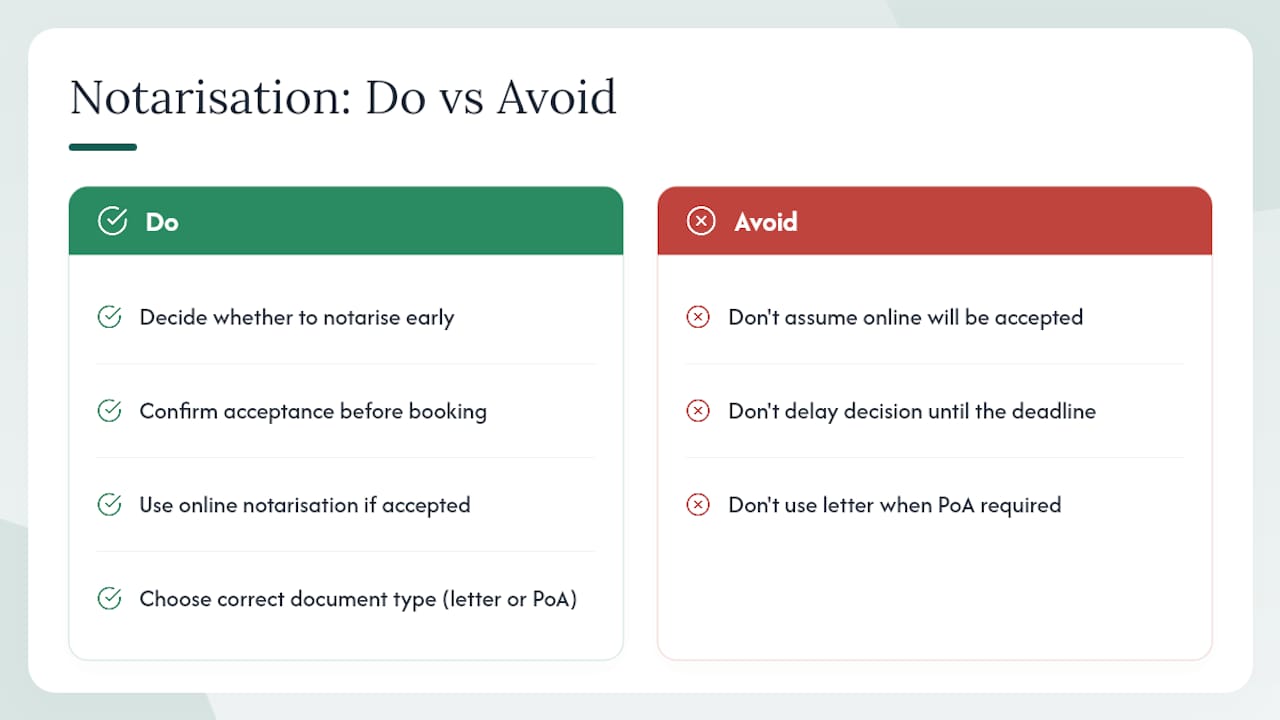
A notarised authorisation letter is required when the receiving authority asks for one, most commonly for overseas use, and the process follows a clear sequence: draft precisely, verify recipient requirements, prepare ID, and book notarisation.
| Point | Details |
|---|---|
| Notarisation is conditional | Most domestic letters do not need notarisation; overseas or third-party requests are the trigger. |
| Specificity prevents rejection | Every letter must state who is authorised, to do exactly what, and until when. |
| Correct process order for overseas use | Notarise first, then obtain an apostille, then consular legalisation if required. |
| LOA vs power of attorney | Use a letter of authority for narrow, time-bound tasks; use a power of attorney for signing authority or long-term arrangements. |
| My Notary online option | My Notary offers video-call notarisation with biometric ID checks, certified digital delivery, and optional apostille, with turnaround as fast as one hour. |
***
Table of Contents
- When does an authorisation letter actually need notarisation?
- Who can notarise or witness an authorisation letter, and what ID will they need?
- How to get an authorisation letter notarised, step by step
- Sample wording and templates for personal and business letters of authority
- Letter of authority vs power of attorney: which do you need?
- Why authorisation letters get rejected, and how to avoid it
- Typical costs and how long notarisation takes
- How online notarisation works in practice
- Why the speed of online notarisation changes the calculation
- Get your authorisation letter notarised with My Notary
- Useful sources and next steps
- FAQ
When does an authorisation letter actually need notarisation?
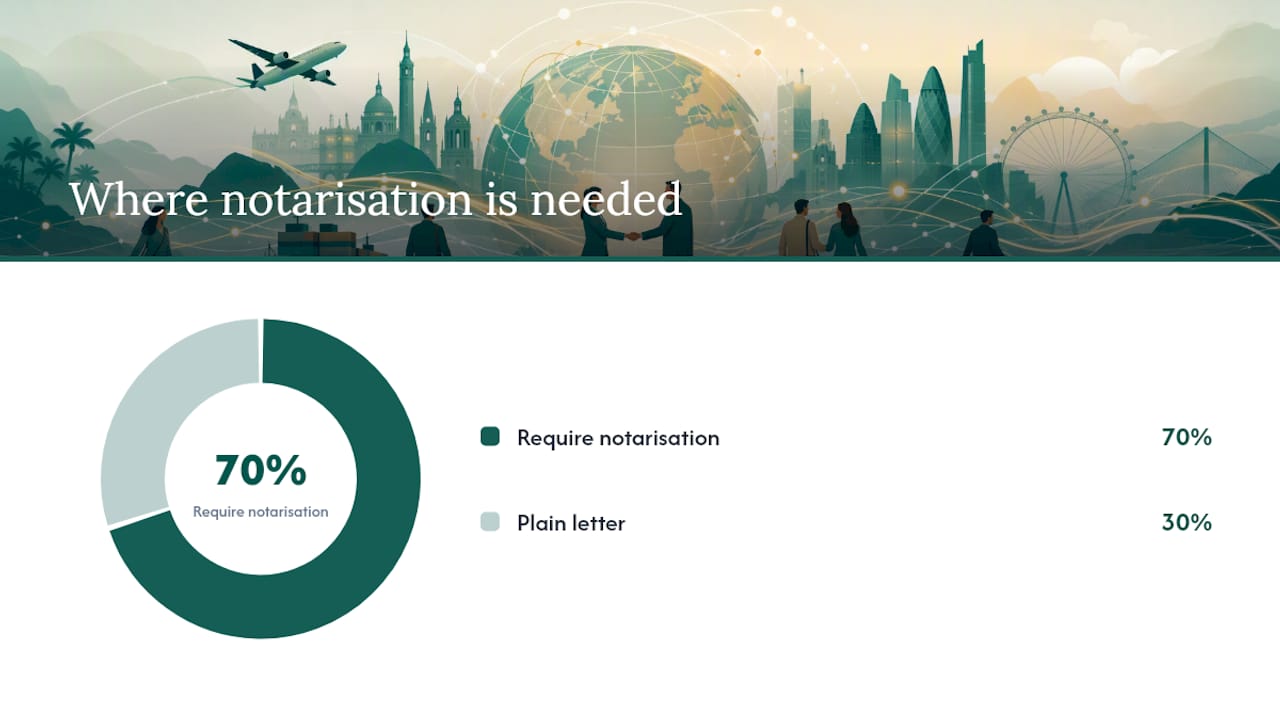
The answer depends almost entirely on who is receiving the document and where it will be used. Notarisation involves identity and capacity checks, witnessing, and the issuance of a notarial certificate and seal, and it is most commonly requested for documents intended for use abroad.
Scenarios that typically require a notarised authorisation letter:
- Overseas property transactions (authorising a representative to sign on your behalf at a foreign notary or land registry)
- Foreign bank account instructions or financial institution requirements
- Immigration and visa applications where a sponsor or parent authorises a third party
- Legal proceedings abroad, including court submissions and foreign regulatory filings
- Corporate authorisations for overseas subsidiaries, contracts, or regulatory bodies
- Some international educational admissions processes (particularly for degree verification or enrolment)
- No objection certificate (NOC) notarisation for employment abroad or visa sponsorship
Situations where a plain signed letter usually suffices:
- Collecting a parcel, prescription, or low-value goods on someone's behalf domestically
- Simple internal business permissions (e.g. authorising a colleague to attend a meeting)
- Low-risk administrative tasks where the recipient has no formal witnessing requirement
Always contact the receiving authority before you notarise. Requirements vary by country, institution, and document type, and notarising unnecessarily adds cost and time without improving acceptance.
***
Who can notarise or witness an authorisation letter, and what ID will they need?
For domestic UK use, a solicitor or commissioner for oaths can sometimes certify documents, but for overseas use and attestations intended for foreign authorities, a commissioned notary is commonly required.
A commissioned notary performs the full notarial act: verifying your identity, confirming your understanding and legal capacity, witnessing your signature, and affixing a notarial certificate and seal. This is the standard that most foreign authorities and overseas institutions expect. A solicitor or commissioner for oaths may certify copies for domestic purposes, but their certification is generally not accepted as a notarial act by overseas bodies.
ID and document checklist for your notarisation appointment:
- Valid passport (preferred) or photo driving licence
- Proof of address dated within three months (utility bill, bank statement, or official letter)
- The final, unsigned version of the authorisation letter
- Any written instructions from the recipient specifying required wording or format
- For corporate signatories: company registration number, letterhead, and evidence of signing authority (board resolution or company signing policy)
- For parental or guardian delegations: birth certificate or equivalent proof of relationship
Capacity matters as much as identity. If you are signing as a company director, the notary will check that you have authority to bind the company. Including a verification contact in the letter itself, for example a line such as "Queries may be directed to [name] at [email/phone]", helps third parties confirm authenticity quickly.
Pro Tip: Bring the recipient's exact requirements in writing to your appointment. A notary can tailor the notarial certificate wording to match what the overseas authority expects, which reduces the risk of rejection at the other end.
***
How to get an authorisation letter notarised, step by step
In-person vs online notarisation
| Stage | In-person appointment | Online notarisation (e.g. My Notary) |
|---|---|---|
| Document preparation | Bring printed, unsigned letter | Upload unsigned document via secure portal |
| Identity verification | Present original ID in person | Biometric verification and live video check |
| Signing | Sign in front of notary | Sign electronically during video session |
| Notarial certificate | Physical seal and wet signature | Certified digital copy; physical copy available on request |
| Turnaround | Same day to several days | As fast as one hour for standard documents |
| Apostille add-on | Arranged separately after appointment | Can be bundled at booking |
| Suitable for overseas use | Yes, subject to recipient acceptance | Yes, subject to recipient confirming electronic acceptance |
For most overseas recipients, both routes produce a valid notarised document. The key question is whether the receiving authority accepts electronically notarised documents. Confirm this before you book. For guidance on electronic notarisation checks, My Notary's blog sets out what individuals and businesses need to verify.
***
Sample wording and templates for personal and business letters of authority
A notary letter of authorisation template for England and Wales typically includes detailed identification of both parties, an explicit description of the powers granted, a defined duration, and may require apostille certification for international use. The templates below are short starting points: adapt them to your specific situation and confirm the final wording with your notary before signing.
Personal authorisation letter (collecting documents or travel consent)
Letter of Authorisation I, [Full Legal Name], of [Full Address], date of birth [DD/MM/YYYY], passport number [XXXXXX], hereby authorise [Authorised Person's Full Name], of [Authorised Person's Address], date of birth [DD/MM/YYYY], to act on my behalf for the following purpose only: [Precise description, e.g. "To collect my original degree certificate from [Institution Name] on [Date or between Date A and Date B]."] This authorisation is valid from [Start Date] to [End Date] and does not extend to any other act or transaction. It may be revoked by written notice from me at any time. Queries may be directed to me at [email/phone]. Signed: ________ Date: ____ [Notarial certificate to follow]
Business authorisation letter (acting on behalf of a company)
Letter of Authorisation — [Company Name] (Company No. [XXXXXXXX]) [Company Name], a company registered in England and Wales, acting through [Authorised Signatory Name], [Job Title], hereby authorises [Authorised Representative's Full Name] to act on behalf of [Company Name] for the following purpose only: [Precise description, e.g. "To submit VAT registration documents to [Authority Name] and to collect any correspondence relating to that application, between [Start Date] and [End Date]."] This authorisation does not confer authority to sign contracts, incur financial obligations, or act beyond the scope stated above. It expires on [End Date] and may be revoked in writing at any time by [Company Name]. Queries may be directed to [Contact Name] at [email/phone]. Signed on behalf of [Company Name]: ________ Date: ____ [Notarial certificate to follow]
Essential clauses to include in every letter:
- Full legal names and addresses of both the principal and the authorised person
- Precise scope of authority (what the person is authorised to do)
- Explicit limits and exclusions (what they are not authorised to do)
- Start and end dates
- Revocation clause
- Verification contact details
- How the authorised person should sign when acting under the letter (e.g. "Signed by [Name] as authorised representative of [Principal]")
Sample notarised authorisation templates confirm these are the elements third parties consistently expect to see. For additional formatting guidance, My Notary's notarised letter format guide covers execution and supporting ID requirements in detail.
Pro Tip: The single most effective way to avoid rejection is to answer three questions in the letter itself: who is authorised, to do exactly what, and until when. Vague scope is the most common reason third parties refuse to accept a letter of authority.
***
Letter of authority vs power of attorney: which do you need?
Use a letter of authority when:
- The task is specific, short-term, and low-risk (collecting documents, submitting a form, attending a single meeting)
- No binding contracts or financial obligations will be created
- The authorisation can be fully described in one or two sentences
Use a power of attorney when:
- The authorised person needs to sign deeds, contracts, or legally binding documents
- The arrangement is open-ended or covers multiple transactions over time
- Financial accounts, property transfers, or long-term business decisions are involved
- The receiving authority specifically requires a power of attorney rather than a letter
Seek legal advice when:
- You are unsure whether the task falls within the scope of a letter of authority
- The authorised person will be making decisions that could create significant financial or legal liability
- The document will be used for property transactions, court proceedings, or regulated financial activity
For readers who need a formal instrument, My Notary offers limited power of attorney notarisation and power of attorney for banking as online services. For country-specific guidance, such as executing a power of attorney for use in Italy, this practical guide for foreigners covers the local requirements in detail.
***
Why authorisation letters get rejected, and how to avoid it
An authority to act must be specific about who is authorised, what they are authorised to do, and for how long. Ambiguity is the most consistent cause of rejection.
Common rejection reasons:
- Vague or overly broad scope ("to act on my behalf in all matters")
- Missing or incomplete identity details for either party
- Signatory lacks documented authority to sign on behalf of the company
- Wrong signing format (not signing "as authorised representative of [Principal]")
- No expiry date or revocation clause
- Incorrect format for overseas use (missing apostille, wrong notarial wording)
- Electronic notarisation not accepted by the recipient
Pre-submission verification checklist:
- Confirm with the recipient whether notarisation is required and what form it must take
- Ask whether electronic notarisation is accepted or whether a wet-ink original is needed
- Confirm whether an apostille or consular legalisation is required
- Ask for any prescribed wording or template the recipient uses
- Check whether the recipient requires sight of the signatory's ID alongside the letter
- For corporate letters: confirm whether a company registry extract or board resolution is needed
Sample verification questions to send the recipient:
- "Does this letter require notarisation, and if so, do you accept electronically notarised documents?"
- "Is an apostille or consular legalisation required for this document?"
- "Do you have a prescribed template or required wording for the authorisation?"
- "What ID do you require alongside the letter?"
***
Typical costs and how long notarisation takes
Fees for notarisation vary by notary, document complexity, and any additional services required. Confirm the exact fee when you book rather than relying on general estimates, as costs differ depending on whether you need a single document or multiple copies, certified translation, or apostille.
Factors that affect cost:
- Number of documents or copies to be notarised
- Whether certified translation is required
- Whether an apostille is needed (this is an additional step with its own fee)
- Whether physical delivery of the notarised document is required
- Urgency (same-day or expedited services typically carry a premium)
Typical timelines:
- In-person appointment: same day if you attend and the document is straightforward; allow several days if the notary needs to review corporate documents or if apostille is required separately.
- Online notarisation: as fast as one hour for standard documents via platforms such as My Notary, with physical copies dispatched by post if needed.
- Apostille: processing times vary; allow additional working days on top of the notarisation step.
Bundling services where possible, for example booking apostille at the same time as notarisation, reduces the overall time and avoids a second appointment or submission.
***
How online notarisation works in practice
Online notarisation follows a clear, auditable sequence. My Notary's workflow illustrates the typical steps:
- Upload your document — via the secure portal. My Notary provides templates to help you draft a compliant letter before uploading.
- Identity verification: — biometric checks confirm your identity before the session begins.
| Service | Available online via My Notary |
|---|---|
| Authorisation letter notarisation | Yes |
| Corporate document notarisation | Yes |
| Identity verification (KYC) | Yes |
| Certified translation | Yes (add-on) |
| Apostille | Yes (add-on) |
| Physical document delivery | Yes |
My Notary's electronic signatures and identity checks are recognised in over 180 countries. Many overseas recipients accept online notarisation, but you should always confirm acceptance with the receiving authority before booking. For a full overview of the online process, the My Notary online notarisation guide covers acceptance considerations and practical steps in detail.
***
Why the speed of online notarisation changes the calculation
Most people approach notarisation as a bureaucratic hurdle: something to endure rather than plan. That framing leads to avoidable delays. The decision about whether to notarise, and how, is worth making early, not after the document is drafted and the deadline is close.
The practical case for online notarisation is straightforward when the recipient accepts it. Biometric identity verification, a live video session with a commissioned notary, and a certified digital copy issued within the hour removes the scheduling friction that makes traditional appointments feel slow. The audit trail is also cleaner: every step is recorded, which matters when a foreign authority later questions the provenance of the document.
Where online notarisation genuinely falls short is when the recipient has not confirmed acceptance. Some overseas authorities, particularly in jurisdictions with strict requirements for wet-ink originals or physical seals, will not accept an electronically notarised document regardless of its technical validity. Confirming acceptance before booking is not a formality: it is the single most important step in the whole process.
The other underestimated point is the difference between a letter of authority and a power of attorney. Many people reach for a letter of authority when the task they are describing actually requires a formal power of attorney, particularly where signing authority or financial commitments are involved. Getting that distinction right at the drafting stage saves significant time and cost later.
***
Get your authorisation letter notarised with My Notary
Getting a notarised authorisation letter no longer requires a half-day out of the office. My Notary handles the entire process via secure video call: upload your document, complete biometric identity verification, attend a short session with a commissioned notary, and receive your certified digital copy, often within one hour. Physical copies, certified translations, and apostille are all available as add-ons at the same booking.
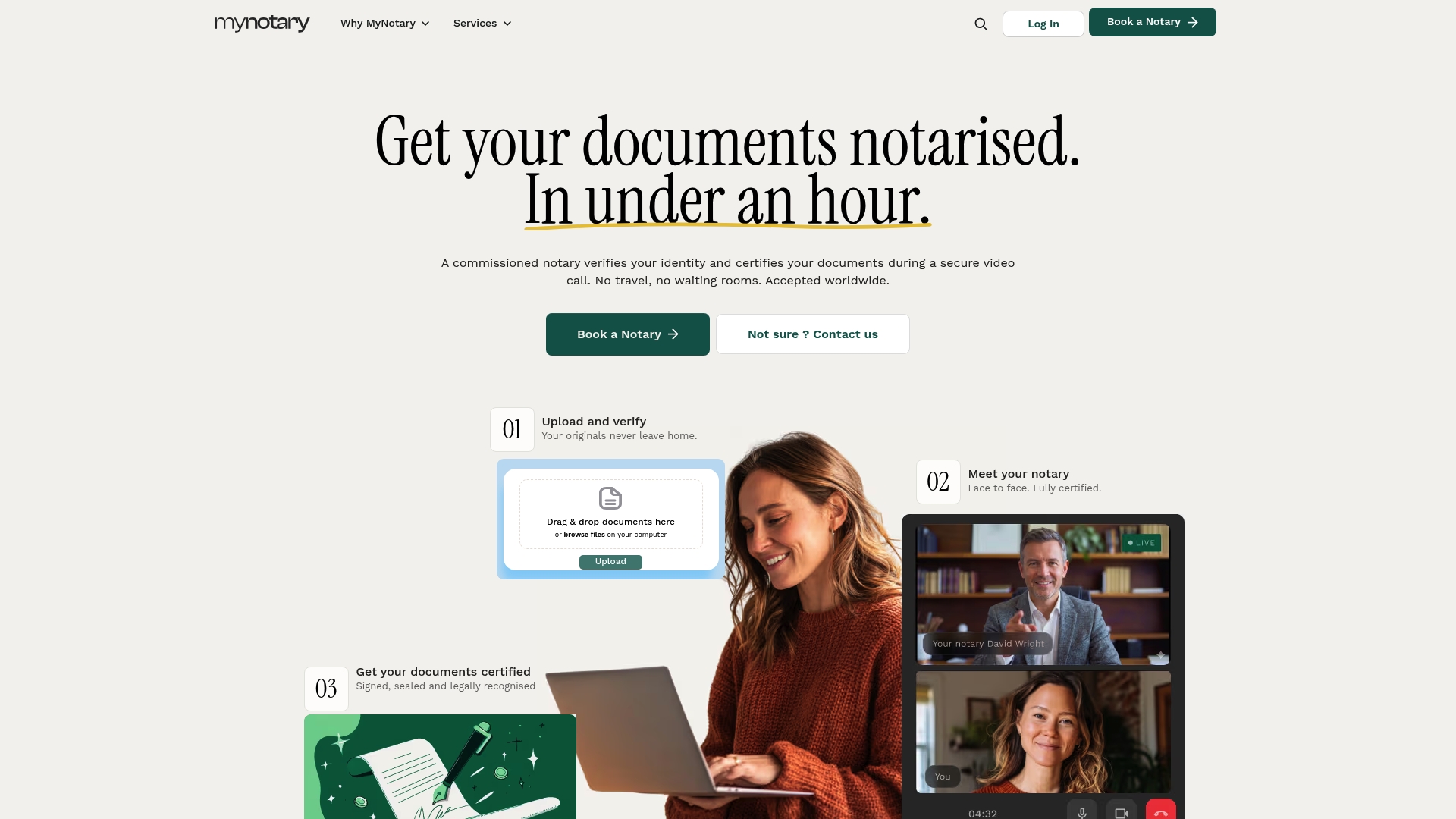
The service covers personal authorisations, business and corporate documents, and specialist instruments including limited powers of attorney and parental delegations. For readers who need online signature certification or corporate document notarisation, both are available directly through the platform. Templates and formatting guidance are available on the My Notary blog. To get started, confirm that your recipient accepts online notarisation, then book a session or request a quote at uk.mynotary.io.
***
Useful sources and next steps
- What Is An Authority to Act Form? | Sprintlaw UK
- Power of authority letter in the UK | Sprintlaw UK
- Sample Notarized Letter Of Authorization PDF Template
- Download Notary Letter Of Authorisation | England and Wales
- Notarized letter format: templates and UK guide
Suggested next steps:
For high-risk or long-term delegations, particularly those involving property, financial accounts, or legal proceedings, seek tailored legal advice before proceeding.
This article provides general information about notarisation processes and is not legal advice. Requirements vary by jurisdiction and recipient. Confirm current rules with the relevant authority or a qualified legal professional before acting.
***
FAQ
Does an authorisation letter need to be notarised in the UK?
Not for routine domestic tasks. Notarisation is typically required when the receiving authority, particularly an overseas body, explicitly requests a notarised document.
How do you write a notarised authorisation letter?
Draft the letter with full identity details for both parties, a precise scope of authority, start and end dates, and a revocation clause, then sign it in the presence of a commissioned notary who will witness the signature and issue a notarial certificate.
Who can notarise a letter in the UK?
A commissioned notary can perform the full notarial act required for overseas use. For domestic certification only, a solicitor or commissioner for oaths may suffice, but their certification is not generally accepted as a notarial act by foreign authorities.
How do I write a simple letter of authorisation?
State your full name and address, name the person you are authorising, describe the specific task they are permitted to carry out, set a clear end date, and include a line confirming the authorisation can be revoked in writing. Keep the scope narrow and specific.
Can I get an authorisation letter notarised online?
Yes. Platforms such as My Notary offer video-call notarisation with biometric identity verification, producing a certified digital copy, often within one hour. Always confirm with the recipient that they accept electronically notarised documents before booking.
Recommended
Got questions? We’re on it.
Most questions are answered here, drawn from what people actually ask before booking. If yours isn’t, our team is in chat.
Not for routine domestic tasks. Notarisation is typically required when the receiving authority, particularly an overseas body, explicitly requests a notarised document.
Last updated: