Do you need to notarise an invitation letter for a visa?
By Jeremy Arhab, Founder · Published 27 August 2026 · Updated 27 August 2026
Discover if you need to notarise your invitation letter for a visa. Understand when it's required and streamline your application process.

For most standard visitor visa applications, a notarised invitation letter is not required. UK Visas and Immigration guidance treats the letter as supporting evidence, not a legal instrument that needs a notary's certification. What actually matters is whether the letter's claims stand up against verifiable documents: proof of address, bank statements, payslips.
There are narrow exceptions. Some consulates or specific business-visitor routes may ask for notarisation, and Canadian guidance notes that certain visa offices can request a notarised business invitation letter. Outside those cases, notarising a routine visitor letter often adds cost and delay without improving the application.
This guide covers:
- What a credible invitation or sponsorship letter should contain
- When notarisation or an apostille genuinely applies
- Step-by-step notarisation, in person and online
- A practical checklist and template outline you can use today
Key Takeaways
Most standard visitor invitation letters need no notarisation at all; the applications that succeed are the ones where every claim in the letter is backed by a matching, verifiable document.
| Point | Details |
|---|---|
| Check before you notarise | Standard UK visitor invitation letters do not need notarisation by default; confirm with the specific visa office first. |
| Watch for exceptions | Business-visitor letters and certain Canadian visa offices may specifically request notarisation or legalisation. |
| Evidence beats certification | Match every claim in the letter to a real document: proof of address, bank statements, payslips. |
| Apostilles are rarely needed | Apostilles apply to documents needing legal effect abroad, not routine visitor invitation letters. |
| Use online notarisation when required | My Notary completes identity checks, signing, and certification over video call, typically within an hour. |
Table of Contents
- What is a letter of invitation and what should it contain?
- When is notarisation or an apostille actually needed?
- How to notarise an invitation letter step by step
- Apostille and legalisation: when do they matter?
- Checklist and template outline for an invitation letter
- How fast online notarisation actually works
- What the guidance gets wrong about invitation letters
- Get your invitation letter certified without leaving home
- Sources
- FAQ
What is a letter of invitation and what should it contain?
A letter of invitation, sometimes called a sponsorship letter, is a document from a host confirming they are inviting someone to visit and, where relevant, supporting their stay. It serves as evidence: a caseworker reads it alongside bank statements, tenancy agreements, and payslips to judge whether the visit is genuine and adequately funded.
A credible letter should include, following a detailed China tourist visa checklist for supporting documents:
- Full names and dates of birth of both host and visitor
- Contact details and current address of the host
- The relationship between host and visitor
- The purpose of the visit and exact travel dates
- Accommodation arrangements for the stay
- Any financial support being offered, stated clearly
- The host's signature and the date the letter was written
Every claim in the letter needs to match a primary document. If the letter states the host earns a certain income, a payslip or bank statement should confirm it. Any supporting document not in English or Welsh needs a full, certified translation, with the translator confirming accuracy and providing contact details, as UK guidance specifies.
When is notarisation or an apostille actually needed?
Notarisation is the exception, not the default. UK Visas and Immigration guidance does not ask for a notarised invitation letter for a standard visitor visa, and practitioner advice consistently warns against notarising one unless specifically told to. A signed, dated letter with the host's genuine details is normally sufficient.
Three situations change that:
- Business-visitor letters: some visa offices apply local rules requiring a notarised company invitation letter, particularly for business visitors to Canada.
- Specific consular instructions: a small number of consulates request notarisation as part of their own checklist, separate from general visa category rules.
- Receiving-country legalisation demands: occasionally a destination requires a document to carry full legal effect, which pushes the requirement toward apostille rather than simple notarisation.
Canadian guidance is explicit that some visa offices may request a notarised letter, and the responsible office should always be checked directly rather than relying on generic forum advice.
Notarising unnecessarily can backfire. A notarised foreign document sometimes prompts a consular officer to request further verification, which adds processing time rather than removing doubt. If your visa office guidance is silent on notarisation, the safer, faster route is usually to strengthen the letter with verifiable evidence instead.
How to notarise an invitation letter step by step
If your visa office genuinely requires notarisation, the process is straightforward whether you go in person or online.
Preparation, before you book anything:
- Draft the invitation letter with all required fields: names, dates of birth, relationship, purpose, dates, accommodation, and any financial support.
- Gather supporting evidence that corroborates every claim: proof of address, recent payslips, bank statements.
- Arrange certified translations for any document not in English, including the translator's confirmation of accuracy.
In-person notarisation:
- Book an appointment with a commissioned notary.
- Bring original documents, since a notary cannot certify a letter based on a photocopy alone.
- Sign the letter in front of the notary, who verifies your identity and witnesses the signature.
- Receive a signed, certified original or a certified true copy, depending on what your visa office asked for.
Online notarisation:
- Upload the letter and supporting documents through a secure platform.
- Complete a biometric identity check, matching your face and ID document electronically.
- Join a video call with a commissioned notary, who reviews the documents and witnesses the signing.
- Sign electronically and receive a certified digital copy, usually within the hour.
If your case needs an apostille after notarisation, that request goes to a separate authority and typically adds several working days, plus an extra fee on top of the notarisation cost itself.
Pro Tip: Before booking any notarisation appointment, re-read your specific visa office's checklist word for word. A five-minute check can save you the cost of an apostille you never needed.
Turnaround for notarisation itself is often the fastest part of the process; the bigger time risk is chasing legalisation that was never required. A common troubleshooting issue is a mismatched address between the invitation letter and a utility bill or bank statement. Fix that inconsistency before anything gets certified, not after.
Apostille and legalisation: when do they matter?
An apostille is a certificate that confirms a public document's origin so it can be legally recognised in another country under the Hague Convention. A notary's certification confirms a signature and identity at the point of signing. An apostille goes further, authenticating the notary's own signature and seal for use abroad.
For standard visitor visa invitation letters, an apostille is rarely necessary. Specialist immigration guidance confirms that chasing an apostille for a routine invitation letter often wastes time without improving the application.
Apostilles matter more when a document must have formal legal effect in another jurisdiction, such as:
- Corporate documents used to register a business abroad
- Powers of attorney executed for use in another country
- Educational or professional certificates required by a foreign authority
If an apostille genuinely applies to your case, expect it to add several working days to the process and a separate fee from the notarisation charge itself. Always confirm the requirement with the receiving authority before applying, rather than assuming legalisation is needed by default.
Checklist and template outline for an invitation letter
Before sending an application, gather everything the letter's claims depend on.
Checklist:
- Signed, dated invitation letter with all required fields
- Proof of address (utility bill or tenancy agreement, dated recently)
- Recent bank statements showing financial capacity
- Payslips or employment confirmation, if financial support is offered
- Certified translation for any non-English document
- A copy of the host's photo ID
- One original plus at least one certified copy, if the visa office asks for certification
Template outline:
To whom it may concern, My name is [host name], and I am writing to confirm that I am inviting [visitor name] to visit me at [address] from [start date] to [end date]. [Visitor name] is my [relationship]. During the visit, I will provide accommodation at my address and cover [travel/daily/all] costs, as shown in the attached bank statements. Please contact me at [phone/email] with any questions. Yours faithfully, [Host signature and date]
Submit certified copies with the application itself, and bring the original documents to border control in case an officer asks to see them directly. If a document was signed abroad, check whether the visa office's guidance requires a certified copy of a bank statement rather than the original, since some offices prefer not to retain financial originals.
How fast online notarisation actually works
When notarisation genuinely is required, the process no longer means taking time off work to sit in a notary's office. My Notary runs the entire process over a video call: you upload the document, complete a biometric identity check, and connect with a commissioned notary who witnesses the signature electronically.
- Average turnaround is around one hour from booking to certified copy
- Identity verification happens through biometric checks rather than a physical ID inspection
- Templates and format guidance are available to help draft a letter that holds up to scrutiny
Pro Tip: Have your proof of address and bank statements ready before the call starts. A notary can only certify what's consistent, so aligning your documents in advance keeps the call short.
For readers who confirm their visa office genuinely needs notarisation, this removes the appointment-booking friction that in-person routes carry.

What the guidance gets wrong about invitation letters
Most advice on this topic treats notarisation as a safety net: "it can't hurt to get it certified." That instinct is understandable but often backwards. A notarised document sometimes invites more scrutiny, not less, because a caseworker may wonder why a routine letter was formally certified when the guidance didn't ask for it.
The conventional advice underrates the actual decisive factor: verifiability. A host's name and address matching a utility bill does more for an application than a notary's stamp ever will. The letter is not the persuasive document; the evidence behind it is.
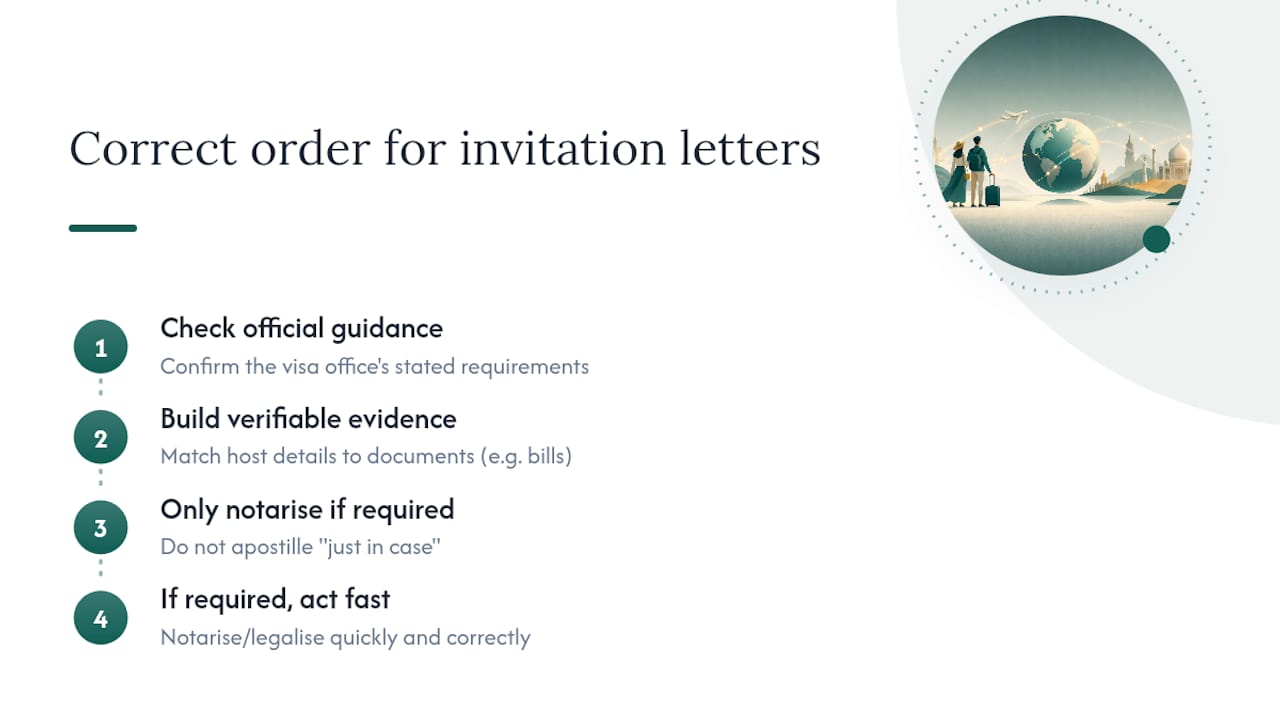
Where I'd push back hardest is on the "just in case" apostille. Readers chase legalisation for visitor letters that were never going to need it, adding days of delay to applications that had a tight enough timeline already. The right sequence is: check the specific visa office's own guidance first, build a tightly evidenced letter second, and only look at notarisation or apostille if a named requirement actually demands it.
Where notarisation is genuinely required, whether for a business-visitor letter or a specific consular request, doing it quickly and correctly matters far more than doing it "extra thoroughly." That's where a fast, verifiable process earns its keep.
— Jérémy
Get your invitation letter certified without leaving home
If your visa office has told you a notarised invitation letter is required, My Notary is the alternative to booking round a solicitor's diary or losing a morning to an in-person appointment. The entire process runs over a secure video call: upload your letter and supporting documents, complete a biometric identity check, and sign electronically in front of a commissioned notary, with a certified copy typically ready within the hour.
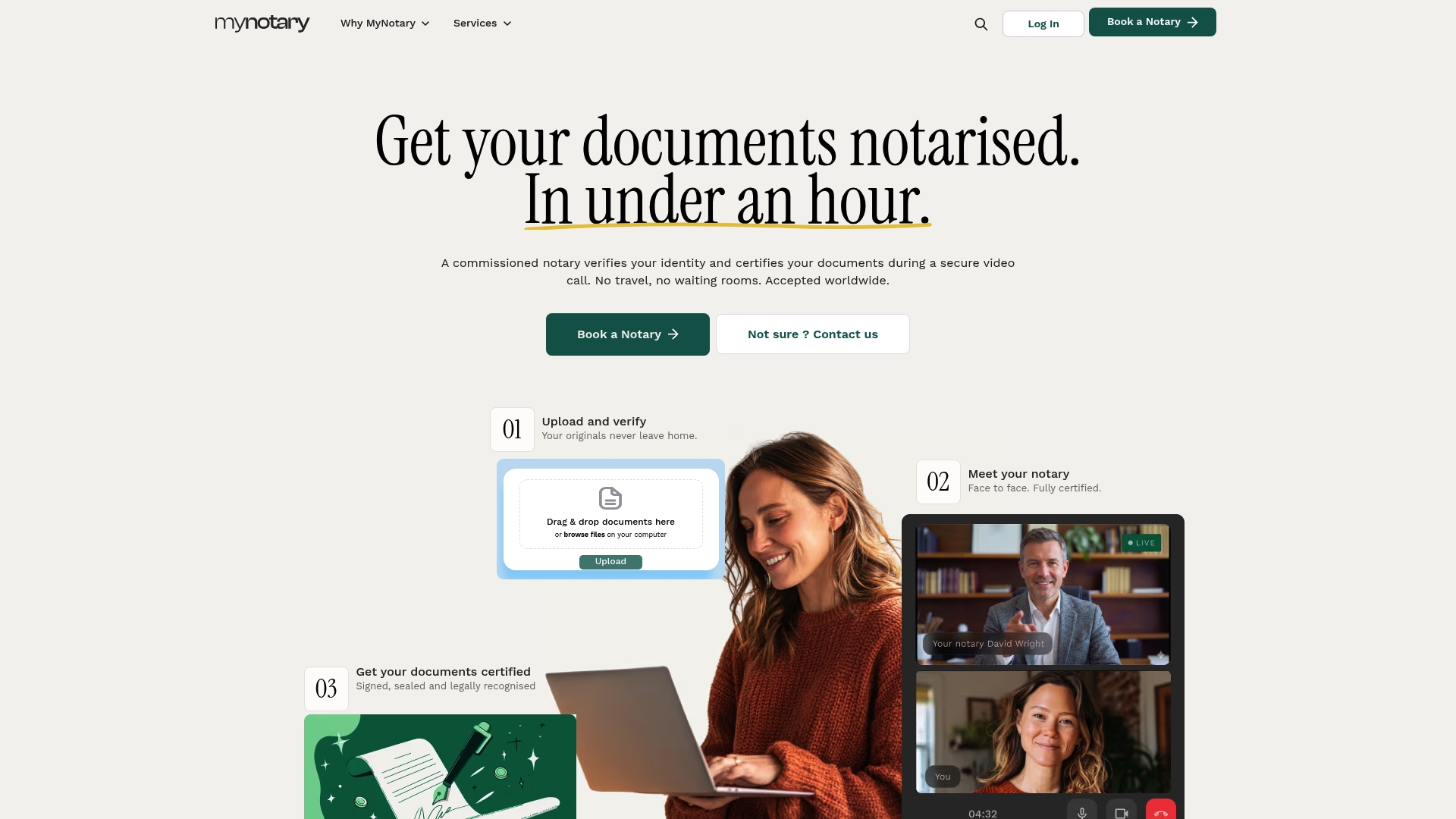
This suits anyone who has confirmed notarisation is genuinely needed and wants it done without disrupting their day. It also works well alongside supporting evidence such as a notarised copy of a bank statement if your visa office wants financial documents certified too. Electronic signatures completed through My Notary are recognised in over 180 countries, which matters if your host or visitor is applying from outside the UK.
Start by visiting the notary services page to check availability and book a video call at a time that suits you.
Sources
- Gov
- Invitation letter for UK visitor visa: guidance — Whytecroft Ford
- Does a UK Invitation Letter Need an Apostille? — SureshotVisa
FAQ
Does an immigration letter need to be notarised?
Generally no, for standard UK visitor visas, since UKVI guidance treats it as supporting evidence rather than a document requiring certification. Some business-visitor routes and specific consular instructions are exceptions, so always check your visa office directly.
How do I write a letter that needs to be notarised?
Draft the letter with all required details: names, dates of birth, relationship, purpose, dates, and financial or accommodation support, then sign it in front of a commissioned notary, either in person or via a video call, so the signature can be witnessed and certified.
What happens if my invitation letter details don't match my supporting documents?
Mismatches, such as a different address on a utility bill, are one of the most common reasons applications face delays or extra scrutiny, so it's worth checking every detail before submission.
Do I need an apostille for a UK visitor invitation letter?
Almost never. Specialist guidance confirms apostilles are for documents needing formal legal effect abroad, which routine visitor letters do not require.
How long does online notarisation of an invitation letter take?
Through My Notary, the typical turnaround from booking to receiving a certified copy is around one hour, once identity verification and the video call are complete.
Recommended
Got questions? We’re on it.
Most questions are answered here, drawn from what people actually ask before booking. If yours isn’t, our team is in chat.
Generally no, for standard UK visitor visas, since UKVI guidance treats it as supporting evidence rather than a document requiring certification. Some business-visitor routes and specific consular instructions are exceptions, so always check your visa office directly.
Last updated: