Medical Consent Letters: Check First, Then Notarise by Video in the UK
By Jeremy Arhab, Founder · Published 18 October 2026 · Updated 18 October 2026
Learn when a child’s medical consent letter needs notarisation in the UK, what to include, and how online video sessions offer a documented route.

A notarised medical consent letter is not always required, but receiving organisations and overseas authorities often ask for one when they need a signature authenticated. Your first step is to draft a short signed letter with the essential details, then ask the receiving body what it will accept. If you need notarisation quickly, a commissioned notary or an online visio session can arrange it.
***
TL;DR: - Before paying, ask the receiving organization whether it needs an original, witnessed signature, notarization, or apostille; notarization verifies identity and signature but does not guarantee acceptance. - Include the child’s full name and birth date, the authorized adult’s name and contact details, permitted care, exact dates, your reachable number, and relevant allergies and medications. - One parent with parental responsibility can generally consent, but clinicians may rely on a capable child’s own decision, especially from age 16. - Set exact start and end dates, review ongoing permissions as health details change, and withdraw consent in writing with the authorized adult and organization. - A notarized letter verifies your identity and signature, but it cannot grant authority you lack or override a clinician’s judgment during treatment.
***
Table of Contents
- What should a medical consent letter include?
- Who can give consent: parental responsibility and child capacity
- When are notarisation and an apostille needed?
- How do you get a medical consent letter notarised, step by step?
- How do you prepare for the notarisation session?
- How long is a medical consent letter valid, and can you cancel it?
- What is the legal weight of a notarised medical consent letter?
- What is the difference between notarisation and witnessing?
- How does online notarisation protect your privacy and data?
- A note from the author on the practical side
- How can we help with your parental consent letter?
- FAQ
- Sources
What should a medical consent letter include?
A good letter is short, specific and easy for a stranger to act on. Doctors, nurses and school staff do not know your family, so the letter has to answer their questions before they ask. Include these fields:
- The child's full name and date of birth.
- Your full name, and the other parent's if relevant, with your relationship to the child.
- The full name and contact details of the person you are authorising.
- The scope of consent: a medical examination, routine treatment, or emergency care.
- The dates or duration the authorisation covers.
- Known allergies, regular medications and your GP's contact details.
- A clear statement that the named person may consent to treatment on your behalf.
- Your signature and the date.
Some organisations ask for an original signed on paper rather than a scan. HM Passport Office guidance shows that, when extra written consent is needed for a passport application, it may ask for a wet signature sent by post and will check the signature and identity before accepting it. Medical settings can be just as particular, so ask early whether a typed, signed letter or a hand-signed original is expected.
Here is a short template you can adapt:
I, [parent's full name], parent of [child's full name], born [date of birth], authorise [adult's full name], telephone [number], to consent to routine medical examination and treatment for my child from [start date] to [end date]. My child's known allergies are [details]. I can be reached on [number]. Signed: [signature]. Date: [date].
For longer trips or more complex health needs, use a detailed version. Number each part so a reader can find what they need quickly:
- Child's details: full name, date of birth, address and any NHS number you wish to share.
- Parent or guardian details: full names, relationship, address and a telephone number that will be answered.
- Authorised adult's details: full name, relationship to the child and contact information.
- Scope of consent: examination, routine treatment, emergency treatment, and any procedure you specifically exclude.
- Medical background: allergies, regular medication with doses, long-term conditions and your GP's name and number.
- Emergency instructions: who to contact first, and your wishes if you cannot be reached.
- Duration: exact start and end dates.
- Signature and date, ideally witnessed or notarised if the receiving body asks.
Keep the wording plain. A letter that a busy receptionist can read quickly is more useful than a long legal one. If you want a worked example of a related document, our post on notarising a UK parental consent letter online walks through the same approach.
Who can give consent: parental responsibility and child capacity
Before you write the letter, it helps to know what makes consent valid in the first place. NHS guidance on consent to treatment sets out three core requirements. Consent must be:
- Voluntary: given freely, without pressure.
- Informed: the person understands the risks, benefits and alternatives.
- Given with capacity: the person can make that specific decision.
If any one of these is missing, the consent is not valid. This matters for your letter because the person you authorise will be acting on your consent, so the letter should show that you gave it knowingly and willingly.
For children, the rules turn on parental responsibility. NHS guidance for children and young people explains that clinicians generally accept consent from one person with parental responsibility. A person with parental responsibility has the legal right to make decisions about a child's upbringing, including agreeing to medical treatment. Gov, and notes that for some major steps everyone with parental responsibility may need to agree in writing. If parents disagree and cannot settle it informally, the matter can eventually go to court. Medical teams aim for a joint discussion with the child, parents and clinicians, and treat the courts as a last resort.
Children can also have a say of their own. The same NHS guidance explains that a child under 16 may consent to their own treatment if assessed as Gillick competent, meaning they understand enough to make that decision. Once a child is 16 or 17, they are generally presumed able to consent to medical care.
What does this mean for your letter?
- A letter helps most with younger children, where an adult other than you is acting for the child.
- For a mature child or a 16 or 17 year old, the clinician may speak to the young person directly, so your letter supports the conversation rather than replacing it.
- In an emergency, clinicians can treat without consent where a child's life is at risk or serious deterioration is imminent, under the doctrine of necessity. A letter still helps by giving them allergies, medication and contacts quickly.
When are notarisation and an apostille needed?
Most medical consent letters used inside the UK never need notarisation. A GP surgery, school or clinic will often accept a signed letter, and the NHS notes that consent can be given verbally, non-verbally or in writing, with written consent more common for complex or pre-planned treatment, as one NHS surgery's consent policy describes.
Notarisation becomes useful when a third party wants proof that the signature is genuine. Common reasons include:
- A hospital, school or authority abroad asking for an authenticated signature.
- An organisation that will not accept a plain letter from someone it cannot verify.
- Travel arrangements where a child will be in the care of someone who is not their parent.
- A situation where you cannot attend in person, and the receiving body wants identity checked.
For documents used overseas, an apostille may follow notarisation. The 1961 Hague Apostille Convention replaces traditional legalisation for many public documents used abroad, and the Hague Conference reports 130 contracting parties. A commissioned notary can authenticate the signature, and in many cases an apostille is then added so the document is recognised in another member country.
Fact worth knowing: 130 states are contracting parties to the Apostille Convention, which is why one certificate can replace a longer chain of legalisation for many destinations.
The most practical advice is also the simplest. Before you pay for any extra service, ask the receiving organisation exactly what it wants:
- An original or a certified copy?
- A notarised signature, or is a witnessed one enough?
- An apostille, or not?
Some bodies ask for less than you expect, and some for more. A short email now can save a delay later. Our guide to child travel consent letters and border control shows how this question plays out for travel.
How do you get a medical consent letter notarised, step by step?
You have two routes: meeting a commissioned notary in person, or using an online visio session. Both end with the notary's seal and signature on your document.
In person with a commissioned notary
- Prepare the letter, but leave it unsigned. The notary needs to see you sign.
- Bring your original photo ID, such as a passport.
- Meet the notary and sign in their presence if they ask you to.
- The notary checks your identity, applies their seal and adds their signature.
- Ask for a certified copy if you want one to keep.
Online with a visio session
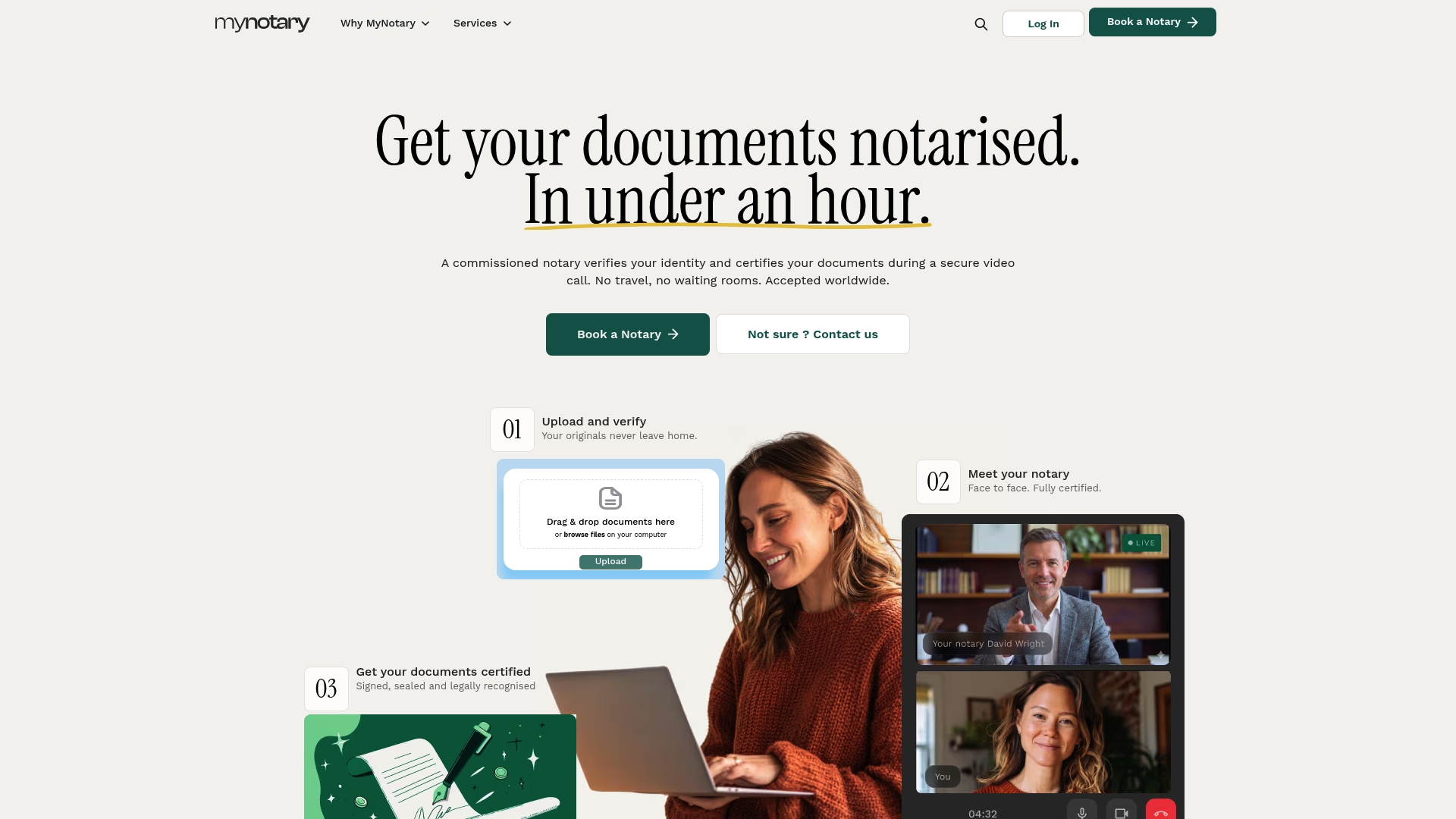
- Upload your unsigned document to the platform.
- Verify your identity with your passport and biometric checks.
- Join a live video session with a commissioned notary.
- Sign or confirm the document as the notary instructs.
- Receive your certified output, digitally or on paper, with delivery on the same day.
Online notarisation has a few practical advantages for busy families. The session is recorded, which gives you a documented record of the process. Identity is checked against your passport, and you do not have to travel or wait in a queue. Our blog post on when UK passport consent needs notarisation shows how quickly this can work when time is short.
A word of caution that applies to both routes: notarisation does not by itself guarantee that every authority will accept your document. It proves your signature and identity were checked. What the receiving body does with that is its own decision.
Pro Tip: Send the receiving organisation a photo of your draft letter before you notarise it, and ask whether the wording is acceptable. Changing a signed and sealed document means starting again.
How do you prepare for the notarisation session?
A little preparation prevents most delays. Use this checklist.
Identification
- A valid passport or government photo ID for you as the signatory.
- The same for any authorised adult who will also attend.
- For an online session, a clear scan or photo of your passport saved and ready to upload.
Documents
- The unsigned original letter.
- Copies for your records.
- Any supporting medical notes, or your GP's contact details, if the letter refers to them.
- A written list of allergies and regular medication, so the letter matches what you say.
Common pitfalls
- Expecting notarisation to guarantee acceptance by every organisation.
- Writing names in a different format from your ID, such as a missing middle name.
- Having no proof of parental responsibility to hand when the receiving body asks for it.
- Relying on a handwritten letter when the organisation requires a typed, signed version.
Names are the most frequent snag. If your passport shows two middle names and your letter shows none, the notary may ask you to correct it before going ahead.
Pro Tip: Read your letter aloud against your passport, line by line, before the session starts. This can help catch name mismatches.
How long is a medical consent letter valid, and can you cancel it?
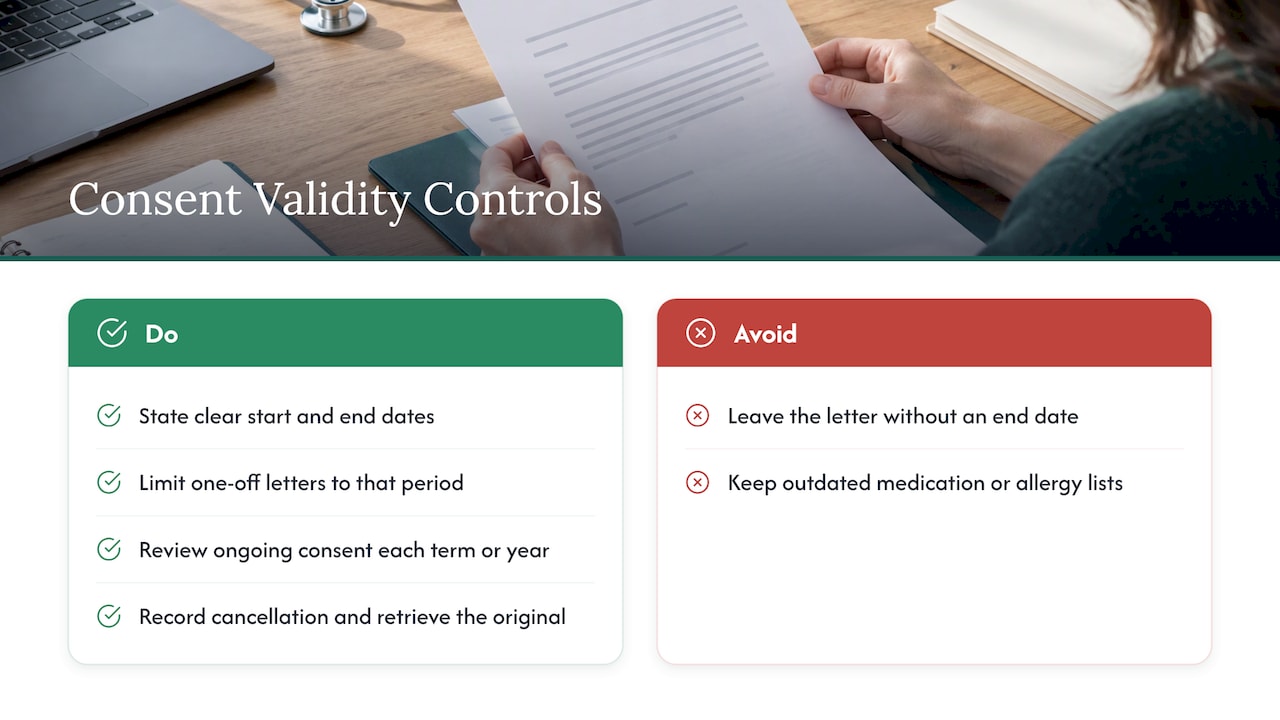
A medical consent letter has no fixed legal lifespan. Its validity is set by what you write in it, which is why the dates in your letter matter so much. State a clear start and end date, and the person relying on it can see at a glance whether it still applies. A letter with no end date invites questions, and many organisations will treat an old one with caution.
For a one-off trip or procedure, make the letter cover that period only. For ongoing care, such as a grandparent who collects a child from school every week, consider reviewing and re-signing it each term or year. Medication and allergies change, and an outdated list is a safety risk.
You can withdraw your consent at any time. The simplest way is to tell the authorised adult and the receiving organisation in writing, and to ask them to destroy or return the original. If you notarised the letter, the seal does not stop you from cancelling it. The notarisation proves who signed and when, not that the authority lasts forever.
Keep a record of when and how you cancelled. A short dated note to the school, clinic or surgery is enough. If the authorised adult holds a paper original, ask for it back, because a document that still looks valid can cause confusion later.
What is the legal weight of a notarised medical consent letter?
A notarised letter is strong evidence that you signed it, that your identity was checked and that you did so on a stated date. That is useful, but it is not the same as a court order or a statutory form. The letter shows your wishes and your authority to give them; it does not override the clinical judgement of the treating team.
In practice, a clinician will still decide what treatment is appropriate and safe. They may speak to the child, contact you if they can, and weigh the urgency. As NHS guidance for children explains, in an emergency where a child's life is at risk, professionals can act under the doctrine of necessity without waiting for parental consent. The same principle appears in hospital policy on unaccompanied children, where the extent of the emergency decides whether treatment can proceed.
So the letter works best as a clear, credible statement that makes the clinician's job easier. It does not guarantee a particular outcome. It also cannot give someone authority you do not hold yourself. If you do not have parental responsibility, your letter has no force. For questions about a specific case, such as a dispute between parents, speak to a qualified legal professional.
What is the difference between notarisation and witnessing?
The two are often confused, but they do different jobs.
A witness watches you sign and then adds their own signature to confirm they saw it. The witness is usually someone you know, and no special qualification is required. Witnessing says that you signed, but it does not independently check who you are.
A notarisation is carried out by a commissioned notary, who checks your identity against your ID, confirms you are signing willingly, and then applies a seal and signature. The notary is a trained official whose stamp other authorities are used to recognising, including overseas.
| Feature | Witnessing | Notarisation |
|---|---|---|
| Who does it | Any suitable adult | A commissioned notary |
| Identity check | Not formally required | Checked against passport or photo ID |
| Seal | None | Notary's seal and signature |
| Typical use | Everyday letters inside the country | Documents a third party or authority abroad must trust |
For a medical consent letter used locally, a witnessed signature is often enough, provided the receiving body says so. When an overseas hospital, embassy or authority asks for formal proof, notarisation is the safer choice. Always check which one is being requested before you decide.
How does online notarisation protect your privacy and data?
A medical consent letter holds sensitive details: your child's name, date of birth, health conditions and medication. It is reasonable to ask how that information is handled when you notarise online.
Here is what we do to protect it:
- Our sessions run over secure, encrypted connections.
- Your identity is checked against your passport, so the notary knows who they are dealing with.
- The session is recorded, which creates an audit trail of what happened and when.
- Your document is handled as part of the notarisation process.
Share only what the letter needs. If the receiving organisation does not need a full medical history, leave it out and refer to your GP instead. The less sensitive detail a document contains, the less there is to protect once it is in circulation.
Before you book any online service, ask how long documents and recordings are kept and who can see them. You can also reduce risk by saving your certified copy somewhere secure and sharing it only with the people who must have it.
A note from the author on the practical side
Most parents who come to this topic are short of time, not short of understanding. The pattern is familiar: a trip, a school activity or a hospital appointment is close, and a request for a notarised letter arrives late. A recorded online session helps because it removes the travel and the waiting, and it gives you a record you can point to if anyone asks how the document was produced.
The thing I would stress is to check acceptance before you act. A school, an embassy and a foreign clinic can each want something different. Ask them in writing what they require, then prepare your letter and ID in advance so that nothing is left to the last hour. A calm, early start is the best protection against a stressful afternoon.
— Jérémy
How can we help with your parental consent letter?
We offer online notarisation by video call with a commissioned notary. You upload your unsigned letter, we verify your identity with your passport, and the session is recorded. You then receive certified digital or physical output, with delivery on the same day. Before you book, confirm with the receiving organisation exactly what it will accept, since notarisation cannot guarantee acceptance. Then prepare your unsigned letter and your ID, and book an online session through our services page.
This article is general information, not a substitute for advice from a qualified doctor. Consult a qualified healthcare professional about your own circumstances before acting on anything here.
FAQ
How do you write a letter giving consent?
Write a short, clear letter naming the child, the authorised adult and the type of care covered. Add the dates, allergies, medication and your contact details, then sign and date it. Keep the wording plain so a busy clinician can act on it quickly.
Who can notarise a document in the UK?
A commissioned notary carries out notarisation. They check your identity, watch or confirm your signature, and apply their seal and signature. Ask the receiving organisation whether it needs a notarised signature or accepts a witnessed one.
What are the three requirements of consent?
Consent must be voluntary, informed and given by someone with capacity. NHS guidance says that if any of these is missing, the consent is not valid. Your letter should reflect that you gave it freely and understood what you were agreeing to.
Can a travel consent form be handwritten?
It can be, but some organisations insist on a typed, signed version, so check first. A clear typed letter is usually easier to read and to verify. If an authority specifically asks for a wet signature, sign the original by hand in the notary's presence.
Sources
Recommended
Got questions? We’re on it.
Most questions are answered here, drawn from what people actually ask before booking. If yours isn’t, our team is in chat.
Write a short, clear letter naming the child, the authorised adult and the type of care covered. Add the dates, allergies, medication and your contact details, then sign and date it. Keep the wording plain so a busy clinician can act on it quickly.
Last updated: