India attestation UK: apostille rules, costs and steps
By Jeremy Arhab, Founder · Published 26 August 2026 · Updated 5 September 2026
Discover the essential steps and costs for India attestation in the UK. Ensure your documents are ready for international use with ease.

An apostille is normally all you need to use a document between the UK and India. Both countries belong to the Hague Apostille Convention, so a certificate stamped by the correct issuing authority is accepted by the other country without further consular attestation in most cases.
For UK-issued documents heading to India, that authority is the UK Legalisation Office. For India-issued documents heading to the UK, it is India's Ministry of External Affairs (MEA). Neither country generally requires you to visit the other's embassy once the apostille is stamped.
There are exceptions worth flagging early:
- Some Indian institutions still request additional verification out of habit, despite the apostille being legally sufficient.
- Documents destined for a third, non-Hague country may need a different chain of legalisation entirely.
- A handful of legal acts (certain powers of attorney, some affidavits) still call for personal appearance before a consular officer.
Quick fact: because both nations signed the 1961 Hague Convention, a document apostilled by its issuing country is normally accepted by the other without additional consular sign-off.
Key Takeaways
Apostilles from the UK Legalisation Office and India's MEA are normally sufficient for documents moving between the two countries, provided the correct pre-apostille steps, notarisation, translation, or state authentication, are completed first.
| Point | Details |
|---|---|
| Apostille is usually enough | Both countries are Hague Convention members, so a valid apostille normally replaces consular attestation. |
| Confirm the exact route first | Ask the receiving Indian institution whether they need paper or e-Apostille before applying. |
| Notarisation often comes first | Powers of attorney, affidavits, and many commercial documents must be notarised before they qualify for apostille. |
| India has extra pre-steps | Some documents need state authentication before the MEA will apostille them. |
| Remote notarisation speeds things up | My Notary notarises documents by video call with biometric checks, typically within about an hour, ahead of your apostille application. |
Table of Contents
- What you need before you start Indian document attestation in UK
- How do I apostille UK documents for use in India?
- How do I apostille Indian documents for use in the UK?
- Do different document types need different attestation steps?
- How long does attestation take and what does it cost?
- When will the High Commission or Consulate still get involved?
- Getting document preparation right the first time
- Where does online notarisation fit into the apostille process?
- How this article's guidance holds up in practice
- Get your document notarised remotely before you apostille it
- Sources
- FAQ
What you need before you start Indian document attestation in UK
Rushing into an application without the right paperwork is the single biggest cause of delay. Before you approach the Legalisation Office, the MEA, or a notary, work through this list.
- Confirm original vs certified copy. Some receiving bodies in India insist on the original document; others accept a certified true copy. Ask before you send anything, because sending the wrong version means starting again.
- Check whether notarisation comes first. Powers of attorney, affidavits, and many commercial documents must be signed before a commissioned notary before they qualify for an apostille. Birth, marriage, and educational certificates issued by a government body usually skip this step.
- Establish if you need a certified translation. Any document not in English (or, for the Indian side, not in the required language for the receiving authority) will usually need a certified translation bundled alongside the original.
- Gather proof of identity and residence, plus passport-style photos and the correct fee, if a consular appointment is also required.
Pro Tip: Email or call the receiving institution in India before you pay for anything. A university admissions office, a bank, or a state property registrar can tell you in two minutes whether they want a paper apostille, an e-Apostille, or a certified translation. That single call regularly saves weeks.
How do I apostille UK documents for use in India?
Getting a UK-issued document ready for India follows a fixed sequence, and skipping a step is the most common reason applications bounce back.
- Establish whether notarisation is required first. Personal declarations, powers of attorney, and most commercial documents need to be signed in front of a commissioned notary, who verifies your identity and witnesses the signature. Public documents, such as GRO-issued birth certificates, generally do not.
- Apply to the Legalisation Office. You can apply online for either a paper apostille (which requires posting the original document) or an e-Apostille, which is available when the document has been electronically signed in a form the FCDO will apostille.
- Check e-Apostille eligibility before choosing that route. Certain document types, including specific General Register Office certificates, are excluded from the e-Apostille scheme and must go through the paper process instead.
- Post or courier your originals carefully if applying on paper. Use a tracked, signed-for service, and mark the envelope clearly with a return address, since lost original certificates are far harder to replace than digital ones.
- Confirm acceptance format with the Indian recipient before you commit to paper or electronic. A property registrar in Chennai and a university in Mumbai may have entirely different preferences, and asking upfront avoids a second application.
Practical points worth building into your planning:
- E-Apostilles are faster and cheaper to send internationally, but many Indian institutions that process paper files still prefer an original with a physical apostille attached.
- If your document needs both notarisation and translation, get the translation certified after notarisation, not before, unless the receiving body specifies otherwise.
- Keep a scanned copy of every document at each stage, in case a physical apostille goes missing in transit.
How do I apostille Indian documents for use in the UK?
Documents issued in India follow a different chain, run through the Ministry of External Affairs rather than a single central office.
- Identify any pre-apostille steps. Certain document categories, including some educational certificates and commercial papers, require state-level authentication or Home Department attestation before the MEA will apostille them. Skipping this step is one of the most common causes of rejection.
- Submit through an authorised outsourced service provider or regional passport office (RPO). The MEA does not operate a single walk-in counter for apostilles; instead, applications go through a decentralised network of RPOs and branch secretariats, often via outsourced collection and courier agents.
- Track your application and confirm collection or courier return. Most providers offer status tracking, and it is worth confirming the return method (courier vs collection) before submitting, particularly for time-sensitive documents.
- Verify the apostille once it arrives in the UK. If a UK authority, employer, or institution questions the validity of an Indian apostille, the receiving body can typically confirm authenticity through the MEA's own verification channels, since the apostille carries a unique reference number.
A few things worth knowing before you start:
- MEA apostille fees are modest, but the outsourced agency handling collection, scanning, and courier return will add its own service charge on top.
- Documents that have already passed through state authentication move faster through the MEA stage than those still needing that groundwork.
- If your Indian document has already been notarised in India, check whether that notarisation still satisfies UK requirements, since the underlying signature and identity checks matter more than the stamp itself.
Do different document types need different attestation steps?
Attestation for India isn't a single, uniform process. The correct route depends heavily on what the document actually is.
Powers of attorney and affidavits. These almost always need notarisation before apostille, because a notary confirms the signatory's identity and witnesses execution. If the power of attorney concerns property in India, it may also require registration or stamping in the relevant Indian state before local registries will accept it, even after apostille.
Birth, marriage and death certificates. Certain General Register Office documents cannot use the e-Apostille scheme and must be apostilled on paper instead. A marriage certificate attestation for India, for instance, often needs a certified translation if the marriage took place somewhere the certificate wasn't issued in English.
Educational certificates. Degree certificates typically need certified copying or notarisation before apostille. Employers and universities receiving them may also expect ENIC equivalency documentation alongside the apostilled certificate, particularly for professional registration purposes.
Commercial documents. Company incorporation papers, board resolutions and commercial contracts usually need notarisation first, and some Indian authorities expect an additional registry filing once the apostilled document lands in India, particularly for company formation or property transactions.
How long does attestation take and what does it cost?
Timelines and fees vary sharply depending on which direction you're working and how urgent the deadline is.
UK Legalisation Office processing for a paper apostille typically runs to several working days once the application and originals arrive, with postage adding further time on each end. E-Apostilles are usually issued faster because there's no physical document to post, though courier return of any accompanying originals still needs factoring in.
MEA fees are nominal, but the outsourced service providers in India handling collection, scanning and courier return charge their own fee on top, which varies by provider and urgency.
Private expedited services exist on both sides and can justify their higher cost when a property transaction, visa deadline, or court date is imminent, but they're rarely worth paying for on a routine application.
The most common causes of delay are avoidable:
- Sending a certified copy when the original was required, or vice versa.
- Missing a required pre-apostille step, such as state authentication in India.
- Choosing e-Apostille for a document type that's excluded from the scheme.
- Poor postage practices, including unsecured envelopes or no tracking on original documents.
When will the High Commission or Consulate still get involved?
Apostilled documents generally remove the need for consular re-attestation, because the Consulate General of India in Birmingham confirms that documents apostilled by a competent authority are normally recognised without further consular sign-off. A handful of situations still require direct involvement, though.
- Presentation to a non-Hague country. If the document will ultimately be used somewhere outside the Apostille Convention, a different legalisation chain applies, and consular attestation may still be necessary.
- Personal appearance for specific legal acts. Certain powers of attorney and legal declarations require you to appear in person before a consular officer, who verifies your identity directly. Processing for these is typically quoted as taking a couple of working days, alongside a modest fee, according to consular guidance.
- Booking the appointment. Appointments can be made with the High Commission of India in London, the Consulate General in Birmingham, or the Consulate in Edinburgh, depending on your region and the service required. Each office runs its own booking system, so check the specific mission's page before travelling.
Getting document preparation right the first time
The apostille itself is a formality that confirms a signature or seal is genuine. Everything that goes wrong tends to happen at the preparation stage, before the document ever reaches the Legalisation Office or the MEA.
A commissioned notary's job is narrow but exacting: verify your identity, watch you sign (or acknowledge a signature you've already made), and record that act correctly. The Legalisation Office isn't checking the content of your affidavit or power of attorney. It's confirming that the notary's own signature and seal are genuine, which is why getting the notarisation itself right matters more than people expect.
When it comes to originals versus certified copies, present them exactly as instructed by the receiving authority, and bundle related documents together with a clear covering note rather than sending loose pages. If a certified translation is required, it should include a signed translator's affidavit confirming accuracy, attached to (not replacing) the original-language document.
Five mistakes account for most returned applications:
- Submitting a photocopy where an original or certified true copy was specified.
- Skipping notarisation for a document type that required it.
- Choosing e-Apostille for a document excluded from that scheme.
- Missing a required pre-apostille step in India, such as state authentication.
- Failing to confirm with the receiving institution whether their specific department has additional, informal requirements beyond the apostille itself.
Pro Tip: Photograph every document at each stage, before notarisation, after apostille, and again before posting. If something goes missing in transit, you'll have proof of exactly what you sent and when, which speeds up any replacement request considerably.
Where does online notarisation fit into the apostille process?
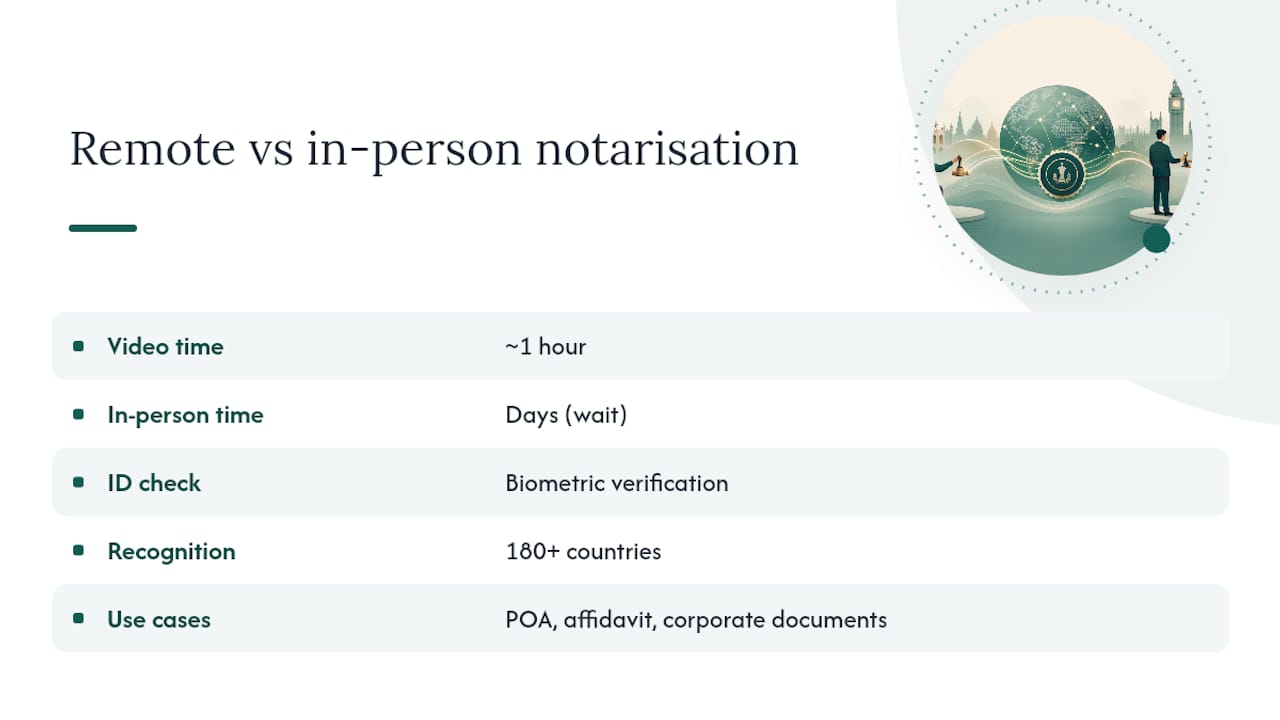
The notarisation step is often the slowest part of the whole chain, mainly because it traditionally requires booking an in-person appointment and travelling to see a notary face to face. My Notary handles that step remotely, over a secure video call, with biometric identity verification and an electronically signed document delivered at the end.
That matters directly for the apostille process, because an electronic notarial signature accepted by the FCDO is exactly what qualifies a document for the e-Apostille route at the Legalisation Office, when that document type is eligible. For document types excluded from e-Apostille, My Notary can still notarise the document; you then post the physical original for a paper apostille rather than applying online.
Document types commonly notarised through this route before apostille include:
- Powers of attorney for property or banking matters in India.
- Affidavits, including marital status declarations for visa purposes.
- Certified copies of degree certificates, transcripts, and professional qualifications.
- Corporate resolutions and commercial documents requiring notarised execution.
Turnaround for the notarisation itself typically runs to around one hour, which leaves the Legalisation Office or MEA stage as the main variable in your overall timeline.
How this article's guidance holds up in practice
The advice repeated most often online treats attestation as a single, generic process: apply for an apostille, done. That's broadly true, but it glosses over the part that actually costs people time: figuring out which pre-steps their specific document needs before the apostille stage even starts.
Notarisation gets undersold. People assume it's a rubber stamp, when in fact the entire apostille rests on the Legalisation Office trusting that the notary's signature is genuine. Get that step wrong, use the wrong notary, skip it when required, and everything downstream fails regardless of how correctly you handle the apostille application itself.
My honest read: the reader's first move should always be a phone call or email to the receiving institution in India, not a booking with a notary or an application to the Legalisation Office. Confirming exact requirements upfront, paper or e-Apostille, translation or not, notarisation or not, saves more time than any expedited service ever will.
— Jérémy
Get your document notarised remotely before you apostille it
If notarisation is the step standing between you and an apostille application, booking an in-person appointment is rarely the fastest route anymore. My Notary lets you complete that step from home, over a secure video call, with your identity verified biometrically and your document electronically signed, typically within about an hour, rather than waiting days for a face-to-face slot.
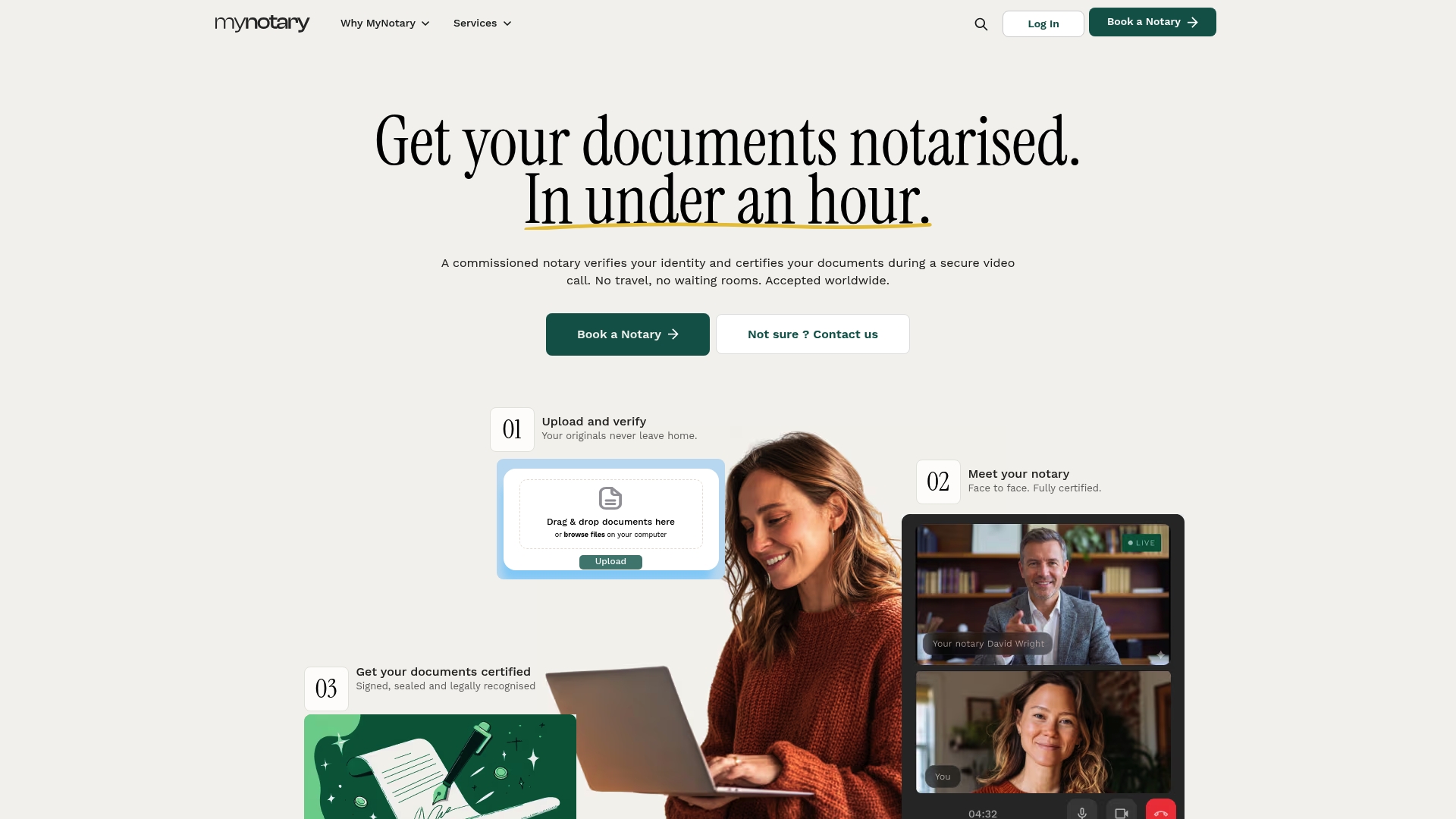
This suits UK-based individuals preparing a power of attorney for property in India, a marital status affidavit for a visa application, or a company preparing corporate documents for an Indian counterparty, all of which usually require notarisation before they qualify for an apostille. My Notary's electronic signatures are recognised across more than 180 countries, which covers the e-Apostille eligibility requirement directly where that route applies.
If you need a power of attorney notarised for banking purposes or a marital status affidavit for a visa application, you can book a video call session today and have the signed, notarised document ready to post for your apostille the same day.
Sources
Check these official pages directly before booking any appointment or posting original documents, since requirements can be updated without wide notice.
- Miscellaneous Consular Information — High Commission of India, London
- Gov
- Attestation / Apostille | Ministry of External Affairs, Government of India
FAQ
Can I get an apostille for Indian documents in the UK?
No. Indian documents are apostilled by India's Ministry of External Affairs, not by any UK authority. UK-issued documents, by contrast, are apostilled by the UK Legalisation Office.
How do I book an appointment with the Indian High Commission in the UK?
Appointments with the High Commission of India in London, the Consulate General in Birmingham, or the Consulate in Edinburgh are booked through each mission's own online appointment system, and requirements vary by service requested.
Can I get a power of attorney attested at the Indian Consulate in Edinburgh?
Some powers of attorney require personal appearance before a consular officer, and the Edinburgh consulate can handle this for eligible cases, though most PoAs only need notarisation followed by a UK apostille. Check the specific requirement with the consulate before booking.
Is an Indian marriage certificate valid in the UK?
Yes, once it carries a valid MEA apostille, an Indian marriage certificate is normally accepted in the UK without further consular attestation, though a certified translation may be needed if the certificate isn't in English.
Can My Notary handle the notarisation step before I apply for an apostille?
Yes. My Notary notarises documents like powers of attorney, affidavits and certified copies remotely by video call, with an electronic signature that can support e-Apostille applications where that document type is eligible.
Recommended
Got questions? We’re on it.
Most questions are answered here, drawn from what people actually ask before booking. If yours isn’t, our team is in chat.
No. Indian documents are apostilled by India's Ministry of External Affairs, not by any UK authority. UK-issued documents, by contrast, are apostilled by the UK Legalisation Office.
Last updated: