Avoid Weeks of Delay: Apostille vs Notarisation for UK Documents
By Jeremy Arhab, Founder · Published 21 September 2026 · Updated 21 September 2026
Know when UK documents need notarisation, an apostille, or both. Learn the correct sequence, verification checks, and how online notaries cut delays.

Notarisation verifies the act of signing. An apostille verifies the official who witnessed or certified that signing. For most documents heading overseas, you need a commissioned notary first and an apostille second, since the apostille authenticates the notary's signature and seal rather than the paperwork itself. Some public records skip notarisation entirely and go straight to apostille.
***
TL;DR: - Notarisation verifies the signer’s identity, capacity, willingness, and document completeness, but does not authenticate the document's content or validity abroad. - An apostille certifies only the authority and signature of the notary or official, not the factual accuracy of the document itself. - Only documents from Hague Convention countries generally require an apostille, with private records needing notarisation beforehand, and public records often going straight to apostille. - The sequence of steps—getting notarised first, then applying for an apostille—is crucial to avoid delays or unusable documents. - Online notarisation platforms can speed up the process by providing same-day notarisation, which is especially valuable under tight deadlines.
***
Table of Contents
- Apostille vs notarization: what does notarisation actually check?
- What is an apostille and how does the Hague Convention work?
- Apostille vs notarisation: a side-by-side comparison
- When do you need notarisation, an apostille, or both?
- How to get a document notarised and apostilled, step by step
- How do you verify that an apostille is genuine?
- What mistakes cause apostille rejections, and how do you avoid them?
- The sequence matters more than most people expect
- Get your documents notarised online before you apply for an apostille
- Sources
- FAQ
Apostille vs notarization: what does notarisation actually check?
Notarisation is the act of a commissioned notary confirming who you are, that you understand what you're signing, and that you're signing it willingly. It's a check on the person and the moment, not on whether the document's contents are true or legally sound elsewhere.
A notarial act can take several forms. The notary might witness you sign a document and add a certificate confirming that. They might take a sworn statement from you, known as a jurat, where you swear the contents are true. Or they might certify that a copy of an original document is a true and accurate reproduction, which is what's usually meant by a certified true copy.
What a commissioned notary actually checks, every time, comes down to four things:
- Identity: usually verified against a passport or other government-issued photo ID.
- Capacity: confirming you're legally able to sign, meaning you're of sound mind and old enough to enter into the agreement.
- Willingness: making sure nobody is signing under pressure or duress.
- Documentation: checking the paperwork is complete, correctly dated, and in the right format before any signature goes on it.
Documents that commonly need notarisation, and nothing more, include affidavits used within the UK, statutory declarations for domestic purposes, and signature witnessing for contracts between parties who trust the notary's certification alone. If the document never leaves the country and the receiving party accepts a notary's certificate at face value, notarisation is often the end of the process.
The moment a document is destined for a foreign authority, that's usually where the story doesn't end. A notary's seal carries weight domestically, but a government office in another country generally has no way to verify that a specific notary is who they claim to be. That's the gap an apostille closes.
What is an apostille and how does the Hague Convention work?
An apostille is a certificate that authenticates the signature and seal of the notary or public official who signed a document. Crucially, it says nothing about whether the document's content is accurate or legally valid; it confirms only that the person who signed it holds the authority they claim to hold. Practical Law's glossary makes this distinction explicit: an apostille authenticates the official, not the substance of the paperwork.
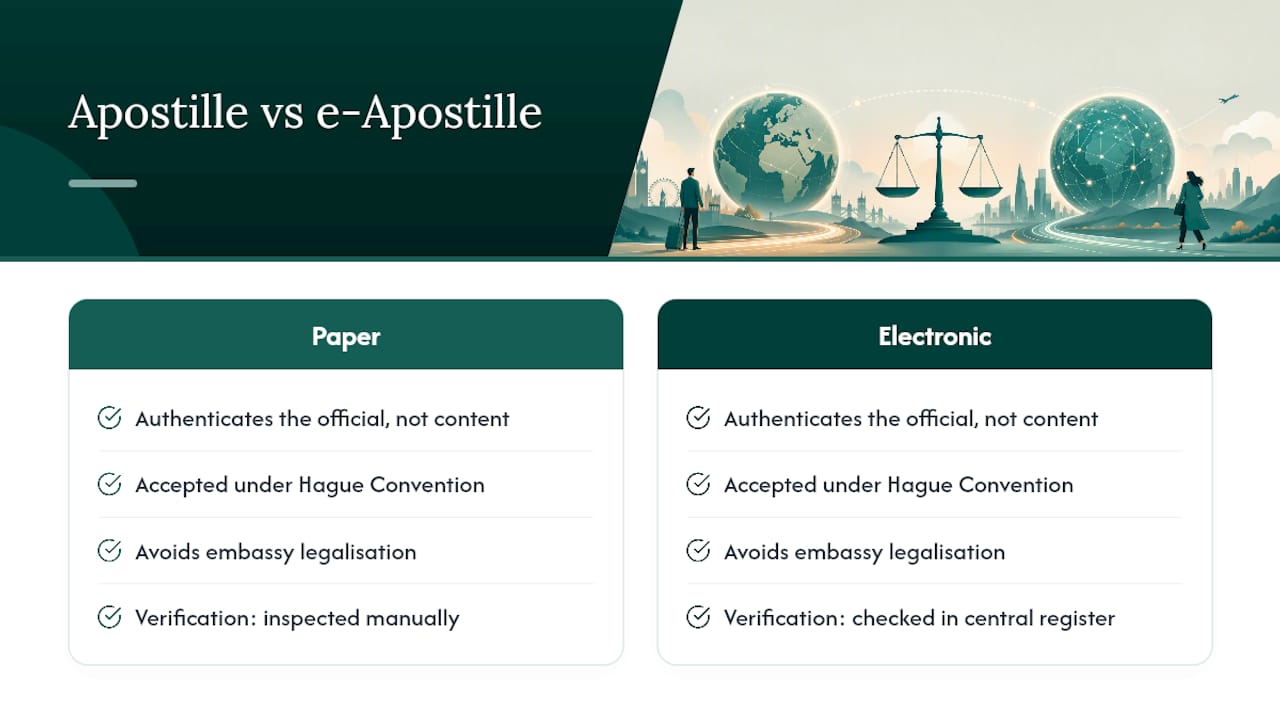
This entire system exists because of one treaty. The Hague Apostille Convention, administered by the Hague Conference on Private International Law (HCCH), lets contracting states accept each other's apostilles without demanding a separate round of embassy legalisation. Instead of a document being verified by a chain of officials in the country of origin and then again by the destination country's embassy, a single apostille from a designated competent authority is meant to be enough.
The apostille system now includes an electronic layer. Under the HCCH's electronic Apostille Programme (e-APP), contracting states can issue e-Apostilles, digital certificates that carry the same legal weight as paper ones.
What the treaty says about e-Apostilles: according to the HCCH, e-Apostilles are valid and must be accepted by contracting states purely on the same basis as paper versions. A receiving authority cannot refuse one simply because it's electronic.
That matters practically. E-Apostilles typically process faster than paper ones, and they come with a built-in advantage: verification. A paper apostille can be inspected but not easily checked against a central register from a distance. A properly issued e-Apostille sits in a database that the receiving party can check without waiting for post to arrive.
Apostille vs notarisation: a side-by-side comparison
Confusion between the two usually comes from the fact that they're not competing options. They're sequential layers, each authenticating something different.
- Purpose: notarisation confirms the signing act; an apostille confirms the notary's authority to have done so.
- Issuer: a commissioned notary carries out notarisation; a designated competent authority in the country of origin issues the apostille.
- What's certified: notarisation certifies identity, willingness, and capacity at the point of signing; an apostille certifies the notary's signature and seal.
- Typical use: notarisation alone suits domestic contracts and UK-only affidavits; an apostille is required when a notarised document travels to another Hague Convention country.
- International effect: notarisation carries limited weight abroad on its own; an apostille gives the document standing that other contracting states are expected to recognise.
The overlap is easy to misread. An apostille cannot exist in isolation from an underlying official act. There has to be a notarised document, a certified copy, or another form of public official's signature for the apostille to authenticate in the first place. You cannot apostille a blank contract or an unsigned form.
The exception worth remembering: certain public records, such as birth certificates or court orders issued directly by a government body, may go straight to apostille without a separate notarisation step, since the issuing authority's own signature is already the official act the apostille verifies.
When do you need notarisation, an apostille, or both?
The right path depends on three things: where the document is going, what type of document it is, and what the receiving authority demands. Here's a practical framework.
- Check whether the destination country is a Hague Convention member. If it is, an apostille is generally the route. If it isn't, the document usually needs full consular or embassy legalisation instead, which is a separate and typically slower process.
- Identify whether the document is private or a public record. Private documents, such as a power of attorney, a signed affidavit, or a company resolution, almost always need notarisation before an apostille can be issued. Public records like birth, marriage, or death certificates issued directly by a government registrar may need only the apostille.
- Confirm what the receiving institution actually asks for. A foreign university, land registry, or bank may have its own specific requirements on top of the apostille, including certified translation or particular wording in the notarial certificate.
Some concrete examples make this clearer. A power of attorney for use in a foreign property transaction typically needs notarisation followed by an apostille, since it's a private document created for a specific purpose. Our guide to apostille for power of attorney walks through this exact case. Academic documents, such as degree certificates going to an overseas employer, generally need notarisation of a true copy first. Corporate documents, like a certificate of incorporation, usually require notarisation before the apostille stage. For a full list of which destinations fall under the convention, the apostille countries list is worth checking before you start.
How to get a document notarised and apostilled, step by step
Getting the sequence right saves weeks. Here's the practical order.
- Confirm the correct document form first. Some receiving authorities want an original signed document; others want a certified true copy. Get this wrong and you may have to restart the entire process, so check with the receiving institution before booking anything.
- Arrange certified translation if needed. If the destination country doesn't use English, many receiving authorities require a certified translation bound to the original, sometimes notarised itself.
- Complete notarisation. This can happen online by video call or in person. Either way, expect the notary to verify your identity against a passport, record the session, and apply the correct notarial wording and seal to the document.
- Submit the notarised document to the relevant competent authority for the apostille. This might be a postal submission or, increasingly, an electronic route where the underlying document supports e-Apostille issuance.
- Track the timeline and build in a buffer. Processing times vary by competent authority and by document volume, and postal delays are one of the most common reasons deadlines slip.
Bottlenecks tend to show up in predictable places: incomplete notarial wording, submitting an uncertified copy instead of an original, or sending the wrong version of a multi-page document. Our step-by-step guide to getting an apostille and the process breakdown at apostille after notarisation both cover this handoff in more detail, including what the competent authority typically expects to see on arrival.
Pro Tip: Book the notarisation session and confirm the apostille submission route on the same day. Documents that sit for a week between the two steps are far more likely to have an expired ID check or a missed page than ones processed back to back.
How do you verify that an apostille is genuine?
E-Apostilles matter here because they solve a problem paper certificates never fully addressed: quick, independent verification. A paper apostille asks the recipient to trust a stamp and a signature. An e-Apostille lets them check a register instead.
The most straightforward way to confirm a certificate is genuine is to use an official apostille verification service, which lets you check that a specific apostille was actually issued and registered as claimed.
When checking a certificate, look for:
- A reference number on the apostille that matches what the verification service holds on file.
- The name of the signing notary or official matching exactly what's recorded.
- The date of issue, since some receiving authorities reject apostilles issued outside a certain window, often six or twelve months, before submission.
e-Apostilles cannot be refused for being electronic. The HCCH confirms that contracting states must accept e-Apostilles on the same footing as paper ones, and verification through an official register is part of what makes that acceptance workable at speed.
Institutions increasingly prefer e-Apostilles precisely because verification takes minutes rather than a phone call or a letter. If you're unsure whether a certificate you've received is legitimate, our guide on verifying apostille certificates walks through the check in more detail.
What mistakes cause apostille rejections, and how do you avoid them?
Most rejections trace back to a handful of avoidable errors. Practitioner guidance is consistent on this point: skipping the correct sequence or submitting the wrong document version causes the majority of delays.
The recurring culprits include:
- Submitting an uncertified copy when the receiving authority wanted a notarised original or a certified true copy.
- Missing or incorrect notarial wording, where the certificate doesn't state clearly enough what the notary actually witnessed or certified.
- Attempting to apostille a document that should have gone through as a public record, or the reverse, treating a public record as though it needed notarisation first.
- Unsigned pages or missing initials on multi-page documents, which some notaries and competent authorities will flag immediately.
Before you submit anything, run through a short checklist: confirm the document type matches what the receiving authority asked for, check every page is signed and dated, verify the notarial certificate uses standard wording, and confirm you have the right number of certified copies. If a document does come back rejected, the fix is usually to identify which of these four categories caused it and correct only that element, rather than restarting the whole process from scratch.
The sequence matters more than most people expect
Getting the order wrong is the single most expensive mistake in this process, not because either step is complicated on its own, but because fixing a sequencing error usually means starting again from notarisation. A document apostilled before it carries the correct notarial wording is often unusable, and by the time that's discovered, the applicant has lost the postal turnaround, the notary's availability, and often a submission deadline.
A workflow-first mindset avoids this. Know the destination, confirm what the receiving authority wants in writing, and only then book the notary. It's a duller approach than treating apostilles as an afterthought, but it's the one that consistently works.
— Jérémy
Get your documents notarised online before you apply for an apostille
An online platform can provide a faster route to the notarisation step that has to happen before most apostille applications, without booking an in-person appointment or travelling anywhere. These sessions typically run by video call, feature identity verification against a passport, and the entire session is recorded to support the notarial certificate that follows.
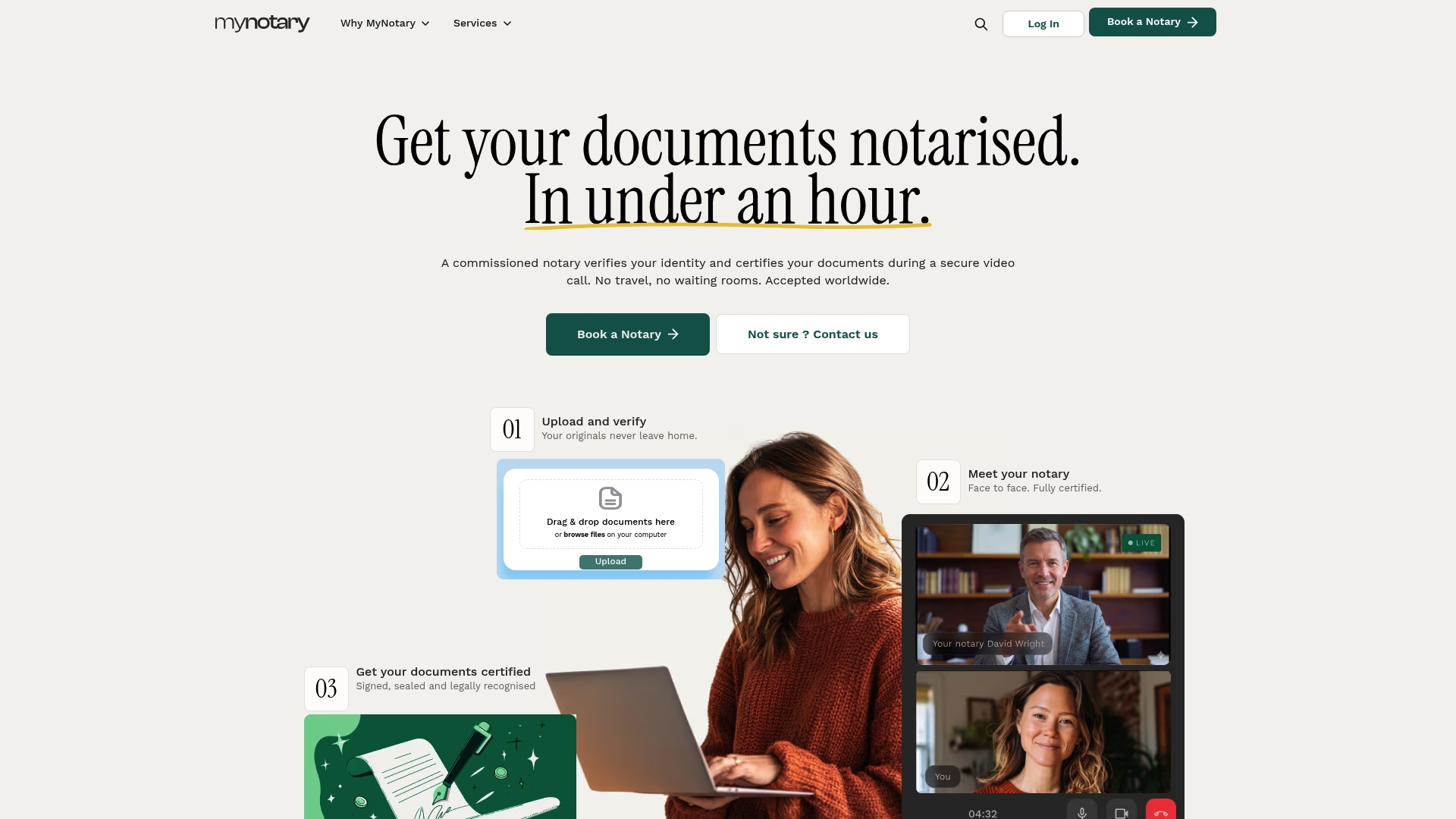
The process acknowledges that most delays happen at the notarisation stage, not the apostille stage. A commissioned notary confirms identity, witnesses the signing, applies the correct notarial wording and seal, and the certified document is often ready the same day, with optional assistance preparing it for apostille submission afterwards. That's a meaningful difference if you're working against a visa deadline or a property completion date and can't afford a week's wait for an in-person slot.
My Notary's service pages list the full range of notarisations available, including signature notarisation and corporate document notarisation. Check the relevant page for your document type and book a session to get the notarised original you'll need before submitting for an apostille.
Sources
- HCCH | Apostille section
- Verify apostille service
- Apostille - Practical Law
- Apostille vs notarization - FormMyCompany
FAQ
Is notarised and apostilled the same thing?
No. Notarisation confirms the identity and signing act of the person on the document, while an apostille confirms the authority and signature of the notary or official who carried out that notarisation. They're sequential steps, not interchangeable terms.
Can a document be apostilled without being notarised?
Yes, in specific cases. Public records such as birth or marriage certificates issued directly by a government registrar can often go straight to apostille, since the issuing official's signature is already the act the apostille authenticates. Private documents like affidavits or powers of attorney almost always need notarisation first.
Can I get a notarisation and apostille arranged from the UK?
You can complete the notarisation step through an online notary service like My Notary, which verifies your identity by passport and records the session before applying the notarial seal. The notarised document then needs to be submitted separately to the relevant competent authority for the apostille itself.
Do documents need to be notarised before they are apostilled?
Most private documents do, since the apostille authenticates the notary's signature and seal rather than the document's content, as Practical Law confirms. Public records issued by government bodies are the main exception, as they can often be apostilled directly.
Recommended
Got questions? We’re on it.
Most questions are answered here, drawn from what people actually ask before booking. If yours isn’t, our team is in chat.
No. Notarisation confirms the identity and signing act of the person on the document, while an apostille confirms the authority and signature of the notary or official who carried out that notarisation. They're sequential steps, not interchangeable terms.
Last updated: