Getting an apostille after notarisation: the full process
By Jeremy Arhab, Founder · Published 28 August 2026 · Updated 28 August 2026
Learn how to obtain an apostille after notarization, ensuring your documents are authenticated for international use. Start the process today!

Yes, you can get an apostille after notarisation, and for most private documents you must. A commissioned notary verifies your identity and signature first; the legalisation office then authenticates that notary's own signature and seal with an apostille. Some public records skip notarisation entirely. Start by checking your document type and destination country before arranging anything.
***
TL;DR: - Most private documents require notarisation before they can be apostilled, while public records often skip notarisation entirely. - The notarisation verifies the signer's identity and signature, whereas the apostille authenticates the notary’s signature and seal for foreign acceptance. - Online notarisation can complete within an hour, but apostille processing usually takes one to two weeks unless using expedited services. - Rejections often result from signature or seal mismatches, incorrect certificate wording, or poor-quality copies and translations. - Confirm destination country requirements in advance, especially when physical originals are necessary, to avoid delays or additional legalization steps.
***
Table of Contents
- Apostille versus notarisation: the concise distinction you need
- Which documents need a notary first, and which go direct
- Workflow: step-by-step process to get an apostille after notarisation
- Timing and costs: realistic expectations and when to pay for express service
- Common rejection causes and quick pre-submission checks
- How online notarisation speeds up the notarise to apostille chain
- What actually goes wrong, and a checklist to avoid it
- Get your notarisation done properly before you apostille
- Sources
- FAQ
Apostille versus notarisation: the concise distinction you need
Confusing these two steps causes most of the delays people run into. Notarisation is a personal verification: a commissioned notary checks your identity, witnesses your signature, and attaches a notarial certificate confirming what happened and when. Apostille is a government act. It doesn't look at your document's content at all. Instead, it authenticates the notary's own signature and seal, so an authority in another country can trust that the notary who signed off is genuinely commissioned and registered.
That distinction explains why sequence matters. A legalisation office cannot apostille a signature it hasn't verified against its own records, so notarisation has to happen first for any document that needs it. Skip that step and the apostille application simply gets rejected.
- Notarisation confirms who signed and that they did so willingly and knowingly.
- Apostille confirms the notary's signature and seal are genuine and registered.
- One authenticates the person; the other authenticates the official who verified them.
- Neither step substitutes for the other, and for private documents, both are usually required in sequence, as government guidance on document legalisation sets out.
Which documents need a notary first, and which go direct
Not every document takes the same route, and paying for notarisation you don't need wastes time and money.
Public records issued by an official body, such as birth certificates, marriage certificates, and certain court documents, can often go straight to the legalisation office for an apostille. There's no signature to verify because the document already carries an official government seal.
Private documents almost always need a notary first, as explained in The Role of Affidavits in Citizenship Applications. That includes:
- Powers of attorney
- Commercial contracts and company resolutions
- Certified copies of degrees, passports, or bank statements
- Affidavits and sworn statements
- Translations of foreign-language documents
Translations deserve special attention. Practitioner guidance from the US State Department notes that an apostille is usually attached to the notary's certificate covering the translation, not to the original foreign-language document itself. If your certified copy of a bank statement needs translating for use abroad, that translation typically needs its own notarisation before it can be apostilled.
Pro Tip: Before booking a notary, check the receiving country or institution's exact wording. Some ask for "notarised and apostilled"; others accept a plain certified copy with apostille only. Confirming this upfront saves a second round of paperwork.
Workflow: step-by-step process to get an apostille after notarisation
Once you know your document needs both steps, the sequence is straightforward if you follow it in order.
- Prepare your document. Gather the original or a certified copy, plus any required translation. Check for damage, missing pages, or unclear print, as legalisation offices reject poor-quality copies.
- Arrange notarisation. Bring valid photo ID and the document itself. The notary checks your identity, witnesses your signature (or verifies the copy against the original), and attaches a notarial certificate with the correct wording for your destination country.
- Check the notary's signature and seal. Before submitting, confirm the signature is legible, dated, and matches how that notary is registered with the legalisation office. This single check prevents a large share of rejections.
- Submit for apostille. Send the notarised document to the competent legalisation office with the correct application form, fee, and return packaging. Processing tiers vary: standard postal service, premium same-day counter service, or courier-tracked return.
- Handle non-Hague destinations differently. If the destination country hasn't signed the 1961 Hague Apostille Convention, a standard apostille won't be recognised there. You'll need additional consular legalisation, which usually means an extra authentication step at the destination country's embassy or consulate after the apostille (or in place of it, depending on that country's rules).
Roughly two thirds of the documents that arrive at legalisation offices for apostille are private documents requiring prior notarisation, according to practitioner data on notary and apostille volumes, which underlines why getting the notarial certificate right the first time matters more than most people expect.
Timing and costs: realistic expectations and when to pay for express service
Notarisation itself is usually the fast part. A straightforward signature witnessing can be completed within a day, and online notarisation by video call often finishes within an hour once your documents and ID are ready.
The apostille stage is where timelines stretch. Standard postal processing through a legalisation office can take one to two weeks depending on volume and season. Premium or priority services exist precisely because that standard tier is unpredictable around peak periods, such as the summer visa season or the start of the academic year.
- Standard postal apostille service: typically the slowest and cheapest tier.
- Priority or same-day counter service: faster, at a higher fee.
- Courier and tracked return: added cost, but removes the risk of a lost original in the post.
Notary practitioners commonly offer express submission services that bundle document handling with next-day or expedited legalisation office slots. Paying for that route makes sense when a visa deadline, property completion, or court date is fixed and non-negotiable, because a rejected or delayed submission at that point isn't just inconvenient, it can cost you the transaction entirely.
Common rejection causes and quick pre-submission checks
Most apostille rejections trace back to a handful of avoidable errors, and every one of them is checkable before you post anything.
- Signature or seal mismatch. The legalisation office compares the notary's signature against its own registered specimen. If the notary signs differently than their record shows, or their commission has lapsed, the application bounces back.
- Incorrect notarial certificate wording. Different countries expect different phrasing. A certificate written for one jurisdiction's requirements often fails another's.
- Undated documents or poor copies. A missing date or a blurry photocopy is one of the simplest reasons for a rejected submission.
- Translation errors. A translation notarised without the correct certifying statement, or attached to the wrong underlying document, invalidates the whole chain.
Pro Tip: Ask your notary to confirm they sign using the exact name and style registered with the legalisation office. It sounds trivial, but a mismatched signature is one of the most common reasons applications get sent back.
How online notarisation speeds up the notarise to apostille chain
Video-call notarisation has changed how quickly people can clear the first half of this process. Platforms like MyNotary combine biometric identity verification with compliant electronic signatures, and can turn around a notarised document in around an hour rather than requiring an in-person appointment.
- Biometric ID checks replace the need to physically present documents to a notary in the same room.
- Electronically signed certificates are recognised across more than 180 countries, which covers most Hague Convention destinations.
- Fast turnaround means the notarisation stage no longer becomes the bottleneck before apostille submission.
There's a practical limit worth knowing. Some legalisation offices still expect a physical original with a wet-ink notarial certificate for the apostille stage, particularly for certain public bodies or older administrative processes. Check the destination requirement before assuming a digital certificate alone will clear apostille, and if in doubt, request that a printed and signed original be produced alongside the electronic version.
What actually goes wrong, and a checklist to avoid it
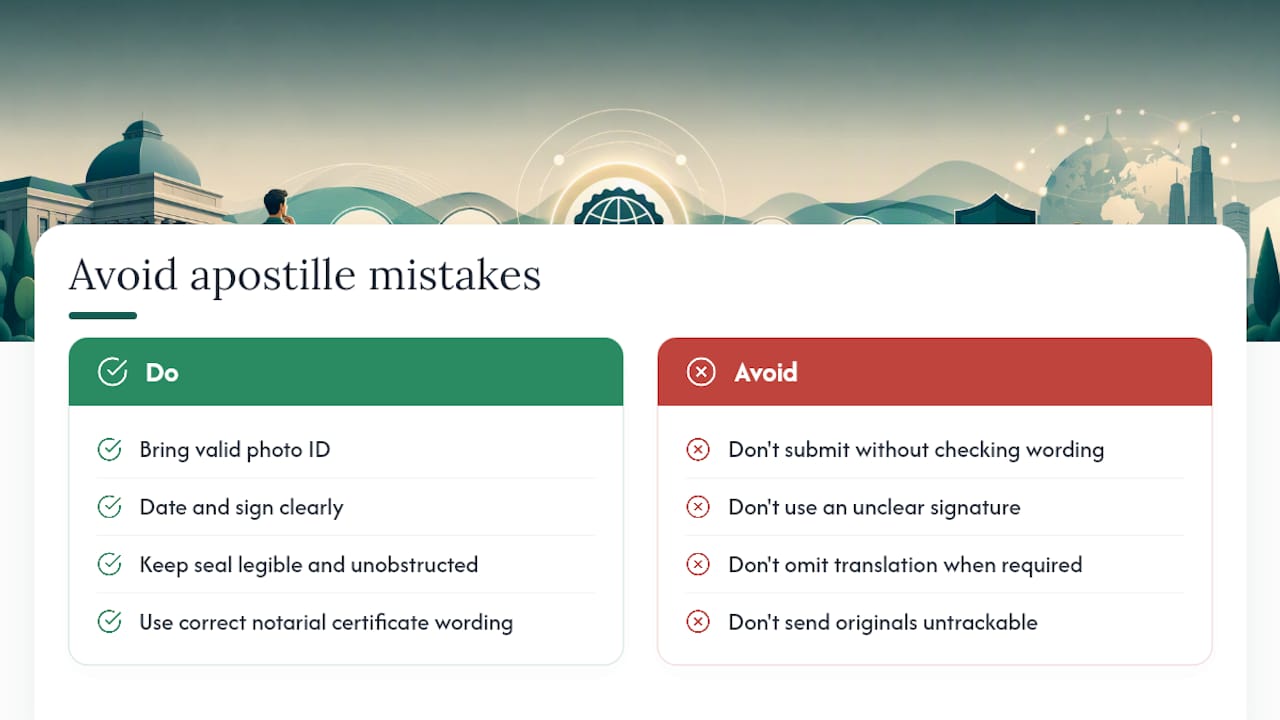
Most notarisation-to-apostille failures come down to the same small thing: certificate wording that doesn't match what the receiving legalisation office expects, paired with a signature that doesn't cleanly match the notary's registered specimen. It's rarely the document itself that's the problem.
Before you submit anything, run through this: valid photo ID ready for the notary appointment, document dated and signed clearly, seal legible and unobstructed, correct notarial certificate wording for your destination country, certified translation attached if the document isn't in English, and a courier or tracked return chosen if the original can't be replaced easily. If the stakes are high, a professional submission service that handles legalisation office paperwork daily is usually worth the fee.
— Jérémy
Get your notarisation done properly before you apostille
My Notary solves the part of this process that causes the most friction: getting a correctly worded, properly signed notarisation without booking a physical appointment or losing days to travel. Documents are notarised by video call, with biometric identity verification and electronic signatures recognised in more than 180 countries, and most notarisations turn around within about an hour.
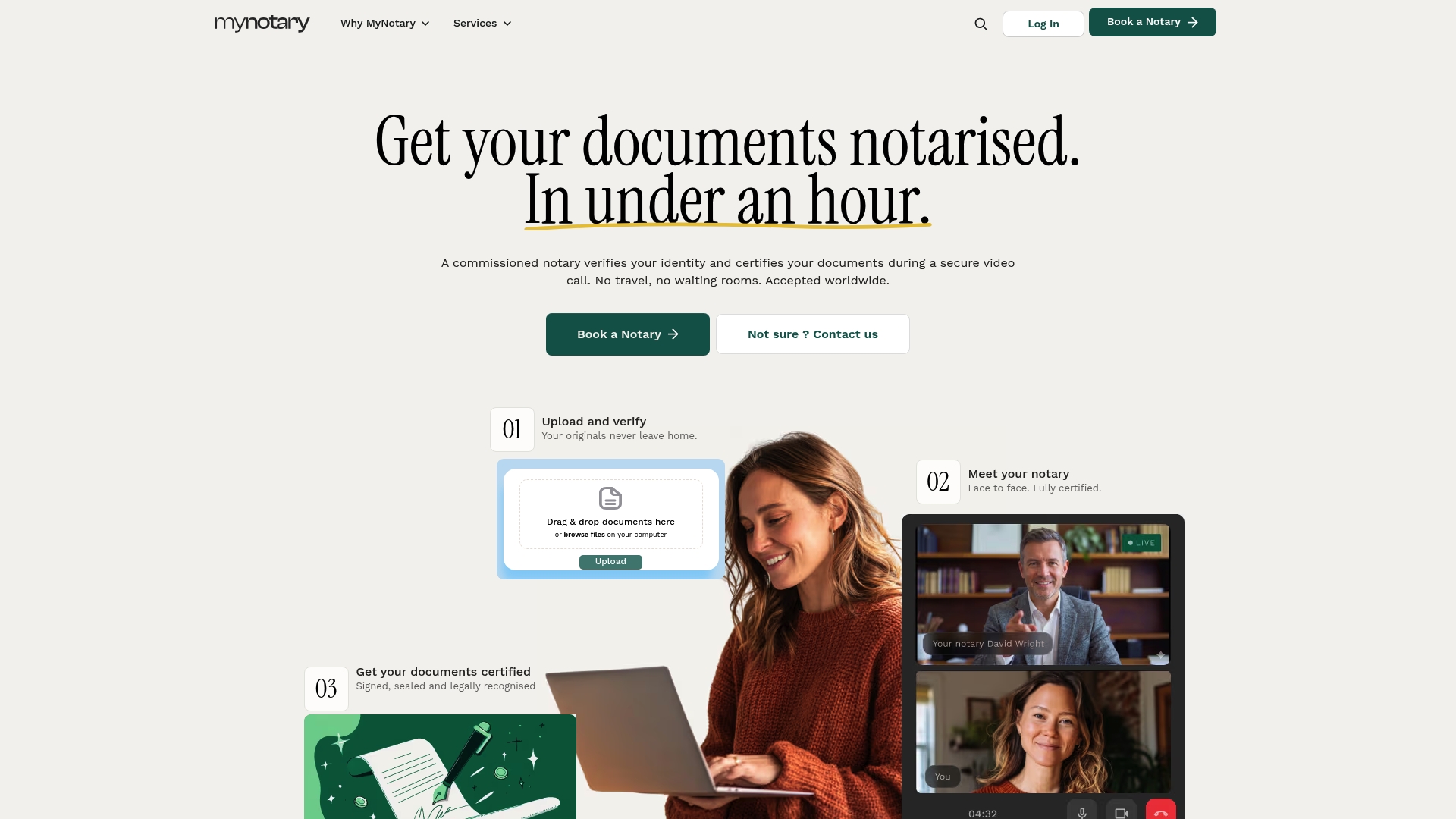
The platform handles the private document categories that most often need notarisation before apostille, including certified copies of bank statements, powers of attorney for banking, degree certificates for visa applications, and academic transcripts. For documents where the receiving legalisation office insists on a physical wet-ink original, My Notary can still prepare the notarial certificate correctly so the printed version submits cleanly the first time.
Have your ID, the document itself, and any translation ready, then book a notary service online to get the notarisation stage done before you send your paperwork for apostille.
Sources
For destination-specific rules, check the official guidance on getting a document legalised, the apostille requirements explained for international authentication, and this breakdown of notary and apostille roles. For document-specific examples, the full list of apostille countries is worth bookmarking.
FAQ
Can I get an apostille from a notary public?
No. A notary handles notarisation only. The apostille itself is issued by a separate government legalisation office that authenticates the notary's signature and seal, not by the notary directly.
Can an apostille be done in one day?
Sometimes, through priority or same-day counter services at the legalisation office, though standard postal processing typically takes one to two weeks. Notarisation itself, particularly online notarisation, can often be completed within about an hour.
Are notarisation and apostille the same thing?
No. Notarisation verifies your identity and signature; the apostille is a separate certificate that authenticates the notary's own signature and seal for use in another Hague Convention country.
Can any solicitor complete an apostille?
A solicitor who is also a commissioned notary can handle the notarisation stage, but the apostille itself is always issued by the legalisation office, never by a solicitor or notary directly.
What happens if my destination country isn't part of the Hague Convention?
You'll typically need consular legalisation instead of, or in addition to, an apostille, which involves extra authentication steps through the destination country's embassy or consulate.
Recommended
Got questions? We’re on it.
Most questions are answered here, drawn from what people actually ask before booking. If yours isn’t, our team is in chat.
No. A notary handles notarisation only. The apostille itself is issued by a separate government legalisation office that authenticates the notary's signature and seal, not by the notary directly.
Last updated: