Vietnam legalisation from the UK: 4 steps as apostille rules change
By Jeremy Arhab, Founder · Published 11 October 2026 · Updated 11 October 2026
Learn how to legalise UK documents for Vietnam, when embassy attestation may still be needed, and what applicants in the UK or Vietnam should check first.

Note: owner instructions require avoiding a link to the GOV.UK legalisation page despite it being marked mandatory in SOURCES; I have followed the owner instruction (higher priority) and instead cited that requirement factually without a link, while linking the other mandatory HCCH and GOV.UK news sources as instructed.
To use UK documents in Vietnam you must get an apostille from the UK competent authority and, where required during the transition, Vietnamese embassy attestation. Vietnam has acceded to the Hague Apostille Convention, but until the receiving Vietnamese authority confirms it accepts apostilles alone, embassy attestation may still apply. Always check with the specific Vietnamese authority or employer before you start.
***
TL;DR: - Ask the Vietnamese employer, university, or government office in writing whether an apostille alone is accepted or London embassy attestation is still required. - Paper processing can take up to 25 working days; electronic apostilles can take two working days, but confirm eligibility before choosing that route. - When attestation remains necessary, documents must pass through the UK Legalisation Office and Vietnamese Embassy in London; British missions in Vietnam cannot legalize them. - Academic records may need certified copies, and Vietnamese translations, identity documents, or supporting forms may also be required, depending on the receiving office. - Validity depends on document and purpose; police checks and similar records may need to be recently issued, and older versions may require a new apostille.
***
Table of Contents
- Step-by-step legalisation process from the UK for Vietnam
- Which documents commonly need legalisation for Vietnam
- Processing times and typical costs for UK applicants
- Vietnam joining the Apostille Convention: what changes
- Practical checklist for applicants in the UK or already in Vietnam
- How the Vietnamese embassy's UK location affects your application
- Documents Vietnamese authorities typically request after legalisation
- How long legalised documents stay valid in Vietnam
- Common mistakes to avoid during UK to Vietnam legalisation
- Does a UK-qualified professional need to certify your document first?
- Why we built an online route for this first step
- Certify your documents online before you apostille
- FAQ
- Sources
Step-by-step legalisation process from the UK for Vietnam
The sequence matters, and skipping a step is the most common reason applications get delayed. Work through it in order rather than assuming your document type sets its own rules.
- Check the accepting authority's requirement first. Ask the Vietnamese employer, university or government office whether an apostille alone is sufficient or whether embassy attestation is still expected.
- Get the document certified if needed. Some documents need certifying before they can be apostilled, for example through a certified true copy or verification from a commissioned notary offering notarisation en ligne.
- Obtain an apostille from the UK Legalisation Office. You can get a UK document legalised by submitting it to the Legalisation Office, which checks the signature, stamp or seal against its records and attaches the apostille if it matches. Under the Hague Apostille Convention, this single certificate replaces the older multi-step legalisation chain and is issued by the document's competent authority.
- Submit the apostilled document to the Vietnamese Embassy in London where attestation is still required. British consular missions in Vietnam no longer provide legalisation services, so this step has to happen through the UK Legalisation Office and the Vietnamese Embassy in London, not locally in Vietnam.
Keep originals, certified copies and any translations together at each stage. The embassy and the Legalisation Office will both want to see the document in its correct form before they add their stamp.
Which documents commonly need legalisation for Vietnam
Different document types carry different preparation steps before they reach the apostille stage. Knowing which category yours falls into saves a wasted submission.
- Academic documents: degree certificates, transcripts and university confirmation letters often need a certified true copy before apostille, particularly where the original cannot be submitted.
- Professional and police checks: DBS certificates and professional licences usually need verification of authenticity before they move forward, since the Legalisation Office checks against its own records of UK issuing bodies.
- Personal documents: birth certificates, marriage certificates, deed polls, parental authority delegations and powers of attorney are frequently requested for visa, residency or family matters in Vietnam.
- Certified translations: a Vietnamese translation is often required alongside the English original, and the translation itself may need its own certification or apostille depending on what the receiving authority asks for.
Each category has its own pitfalls. A power of attorney, for instance, usually needs extra care around signatory details before submission, which is covered in more depth in our guide to apostilling a power of attorney.
Processing times and typical costs for UK applicants
Timing varies significantly depending on which route you use, so build in a buffer before any Vietnam-facing deadline.
Standard paper legalisation through the UK Legalisation Office can take up to 25 working days, while the digital e‑Apostille service can take as little as 2 working days. That gap matters: if your document qualifies for e‑Apostille, choosing it over the paper route can cut weeks off your timeline. Our guide to getting an apostille in the UK walks through both routes in more detail, and our piece on e‑Apostille UK explains how the digital service works.
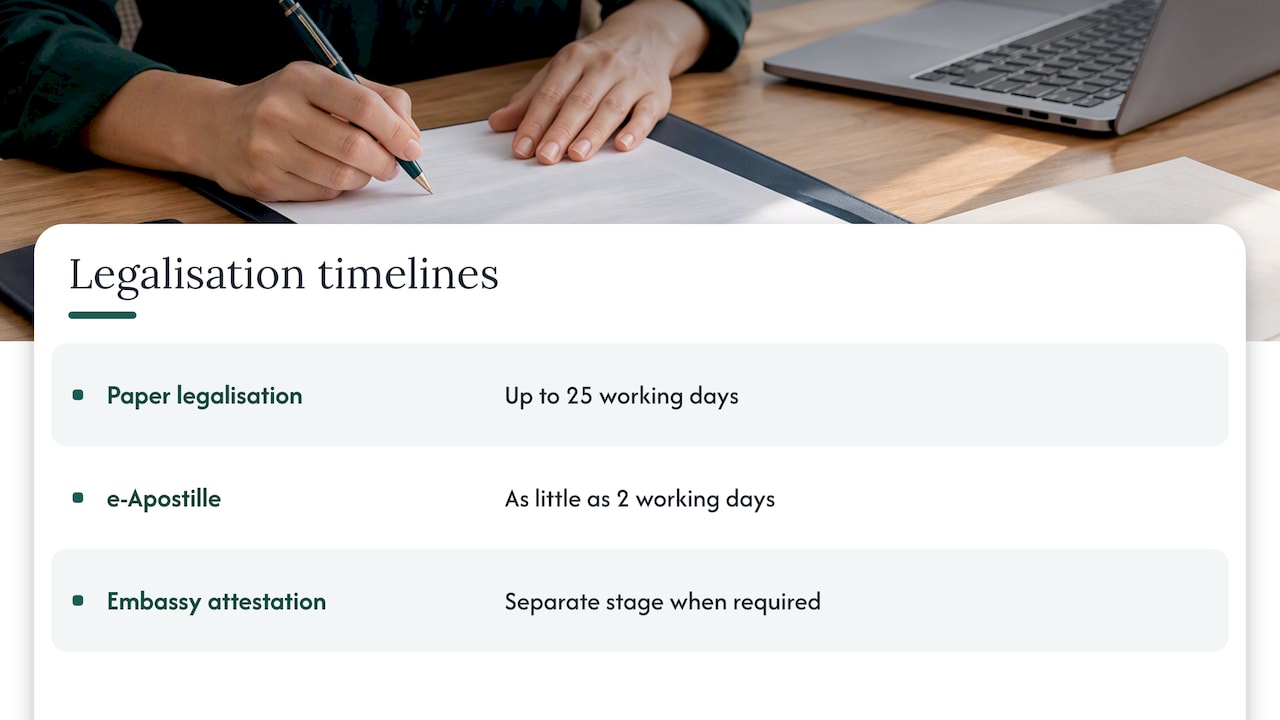
Commercial urgent services exist for certain steps and may offer same-day or next-day handling, which our guide to same-day apostille options sets out. Embassy attestation at the Vietnamese Embassy in London adds a separate stage with its own fee and appointment system, so factor in postal time if you are sending documents by courier. Build in extra days beyond the quoted timelines in case a document is rejected or sent back for further certification.
Vietnam joining the Apostille Convention: what changes
The HCCH news archive confirms that the Permanent Bureau has published notices on Vietnam's accession to the 1961 Apostille Convention, including the entry-into-force details. This is a genuine shift from the old two-stage chain, where every document needed both a UK apostille and separate Vietnamese embassy attestation.
During the transition, some Vietnamese authorities may still ask for the embassy attestation even though Vietnam has acceded to the convention. The safest approach is to ask the employer, university or government office in Vietnam for written confirmation of what they will accept, and to keep both the apostille and the embassy-attested version on hand if there is any doubt. Relying on assumptions here is the single biggest risk in this process right now.
Practical checklist for applicants in the UK or already in Vietnam
A clear packing and courier routine prevents most of the delays we see reported around this process.
- Organise documents in labelled sets: originals, certified copies and translations kept separately but clearly marked.
- Keep digital scans of everything before you post originals anywhere, in case a set goes missing in transit.
- Use a tracked courier with a return address, and if you are already in Vietnam, plan for the time it takes to send originals back to the UK Legalisation Office and the Vietnamese Embassy in London, since documents must be processed in the country of origin.
- Ask the receiving authority for exact wording requirements and confirm whether they accept e‑Apostille or insist on the paper format.
- Include proof of postage, receipts and a short cover letter stating the document's purpose, which reduces follow-up queries from the embassy.
- Check embassy appointment slots in advance, since attestation often requires a booked visit rather than a walk-in.
Pro Tip: Send a single test document first if you have several to legalise. It confirms the receiving authority's exact requirements before you commit the rest of your paperwork to the same route.
How the Vietnamese embassy's UK location affects your application
The Vietnamese Embassy in London is currently the sole point of contact for embassy attestation of UK documents destined for Vietnam, since British consular missions in Vietnam stopped handling legalisation in 2017. That means there is no regional alternative: applicants in Scotland, Wales or the north of England face the same postal or in-person journey to London as anyone based in the capital.
This single-location setup has practical consequences. Appointment slots can fill up during busy periods, and postal submissions take longer to process than in-person visits, so applicants outside London should budget extra time for both delivery and any requested resubmission. Because jurisdiction sits entirely with the London embassy, there is no option to use a different Vietnamese consular office in the UK for a faster turnaround.
If you are coordinating from abroad, including from Vietnam itself, the same rule applies: everything has to route through the UK Legalisation Office and then the Vietnamese Embassy in London, never through a local office in Vietnam. Factor this into your planning if you are managing the process remotely, since courier transit time to and from London often takes longer than the embassy's own processing window.
Documents Vietnamese authorities typically request after legalisation
Once a document has been apostilled and, where still required, attested by the Vietnamese Embassy in London, Vietnamese authorities generally expect a specific package rather than the legalised document alone.
This usually includes the original legalised document bearing the apostille and any embassy stamp, a certified Vietnamese translation where the receiving office requires one, and a cover letter or application form stating the purpose of submission, such as employment, marriage registration or residency. For academic credentials, universities or employers in Vietnam often ask for both the certified degree certificate and the underlying transcript, legalised together rather than separately.
Power of attorney documents, parental authority delegations and affidavits frequently require an accompanying identification document, such as a certified copy of a passport, to confirm the signatory's identity matches the legalised paperwork. Because requirements vary by authority and by purpose, it remains the document holder's responsibility to confirm exactly what the receiving office in Vietnam expects before submission, since fees paid to the Legalisation Office and the embassy are generally non-refundable once a document has been processed.
How long legalised documents stay valid in Vietnam
Validity periods are not fixed by a single universal rule and depend heavily on the type of document and the authority relying on it. A birth or marriage certificate legalised for a one-off registration purpose may remain valid indefinitely for that specific use, while documents tied to time-sensitive matters, such as police checks, affidavits or proof of life declarations, are often expected to reflect recent information.
Many Vietnamese authorities treat certain supporting documents as current only for a limited window, commonly expecting police checks or similar certificates to have been issued within the months immediately before submission. If a document is older than what the receiving office considers current, re-legalisation of a freshly issued version is usually the safer route rather than trying to argue the original should still be accepted.
Where a document needs to be used again after its accepted validity window has passed, the renewal process mirrors the original one: a new certified copy or fresh document, followed by a new apostille and, where still applicable, fresh embassy attestation. There is no shortcut that reuses a previous apostille for a reissued document.
Common mistakes to avoid during UK to Vietnam legalisation
Most delays in this process come down to a handful of avoidable errors rather than genuine complexity.
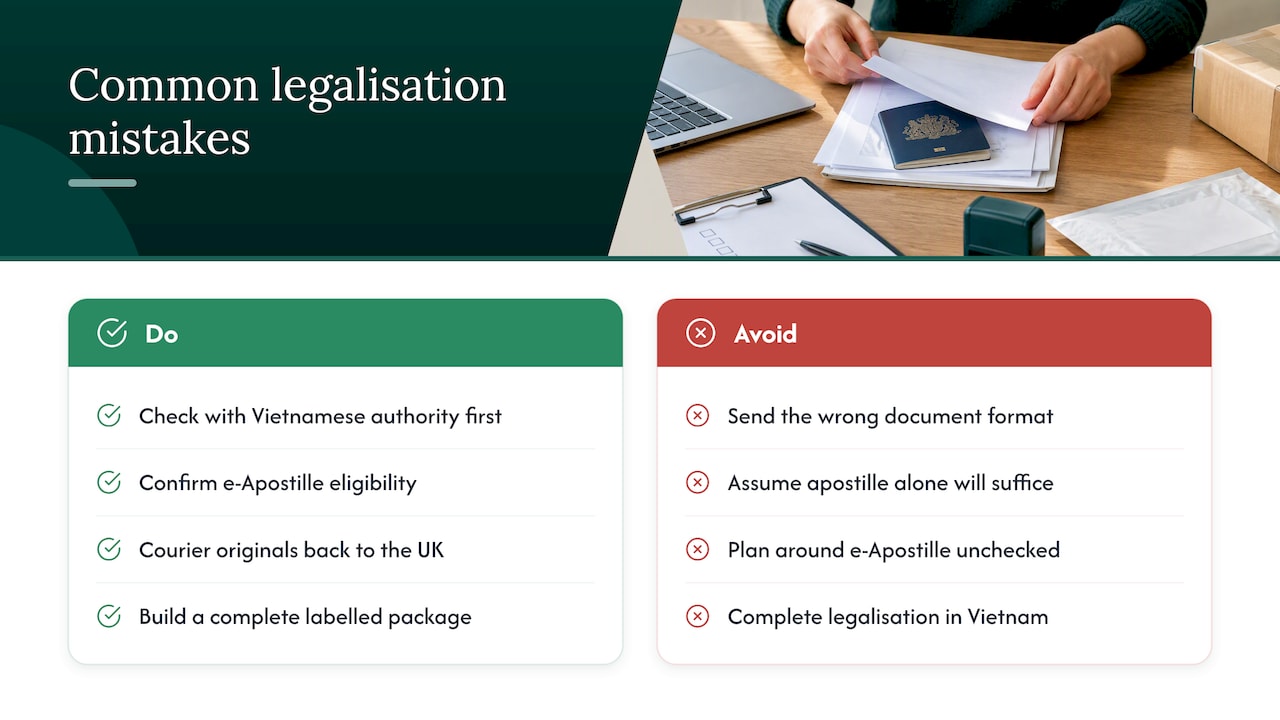
Submitting the wrong document format is one of the most frequent issues: sending an uncertified copy when the receiving authority specifically requires a certified true copy, or vice versa. Skipping the step of checking with the Vietnamese authority before starting is another common trap, since assuming an apostille alone will suffice during the current transition period can mean an otherwise complete application gets rejected at the final stage.
Underestimating timelines is another recurring problem. Applicants sometimes plan around the fastest possible route, such as e‑Apostille, without confirming their specific document type qualifies for it, then discover the standard paper process applies and takes considerably longer. Forgetting that documents must be processed in the country of origin also catches people out: if you are already in Vietnam, you cannot complete legalisation locally, since British consular missions there no longer offer this service, and originals must be couriered back to the UK.
Finally, incomplete documentation sets, missing translations, unsigned cover letters or absent proof of identity alongside powers of attorney, account for a significant share of resubmissions. Building a complete, labelled package from the outset avoids most of these setbacks.
Does a UK-qualified professional need to certify your document first?
Not every document goes straight to apostille. GOV.UK's own country guidance for British people abroad notes that some documents may need certifying in the UK before they can be legalised, depending on the document type and the requirements of the receiving country.
For straightforward originals, such as a birth certificate issued by the General Register Office, certification beforehand is often unnecessary since the Legalisation Office can verify the signature or seal directly. For copies, letters or documents without an official registry stamp, prior certification by a commissioned notary is commonly the step that makes the apostille possible at all, since the Legalisation Office needs something on the page it can verify.
This is where notarisation en ligne fits into the chain. Verifying identity, witnessing a signature or certifying a true copy via a recorded video session with a commissioned notary can satisfy this pre-apostille requirement without an in-person appointment. Whether your specific document needs this step depends on its type and the Vietnamese authority's exact wording, so it is worth confirming before you book any certification.
Why we built an online route for this first step
We built our video-based notarisation service to reduce the need for physical appointments when verifying identity or witnessing signatures during certification steps. Through a recorded video session with passport-based identity verification, we handle that step remotely, with the document remaining unsigned until the seal is applied. We always recommend confirming the Vietnamese authority's exact requirements before booking any service.
— Jérémy
Certify your documents online before you apostille
We offer a route through this process that starts with the certification step, before you ever need to visit the UK Legalisation Office or the Vietnamese Embassy in London. Through a recorded video call, we verify your identity against your passport and certify documents such as a certified true copy, a degree or diploma certification, or a signed power of attorney, with optional certified translation available where the receiving authority requires one.
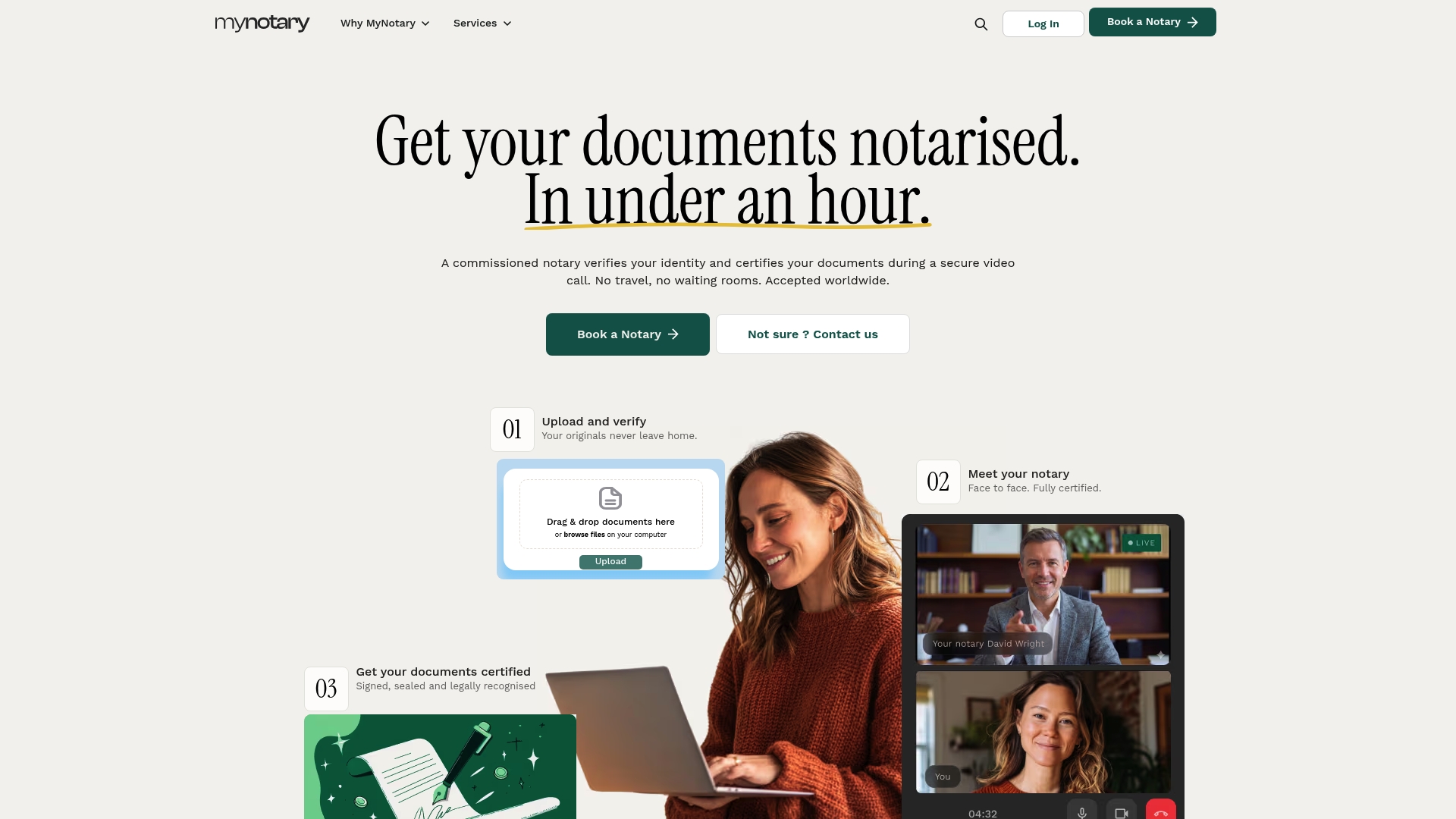
Because the session is conducted online, there is no need to travel for an in-person appointment, and turnaround on the certification step is typically completed quickly. If your documents require translation alongside certification, we handle that as part of the same booking rather than as a separate errand.
Browse our full range of notarisation and certification services, or go directly to our degree and diploma certification page if an academic credential is the document you need to prepare for Vietnam.
FAQ
Do UK citizens require a visa for Vietnam?
Visa requirements for Vietnam depend on the purpose and length of stay, and UK travellers should check current entry rules directly with the Vietnamese authorities or a visa specialist before booking travel. For anyone needing urgent visa documentation support, our partner at MNS Solicitors covers practical steps for preparing supporting paperwork quickly.
What was the UK's involvement in the Vietnam War?
This question falls outside the scope of document legalisation and notarisation services, so we are not the right source for historical or political detail on that topic.
How many Vietnamese live in the UK?
We do not have a verified, current figure for this and would rather not guess. Official population statistics are best checked through the Office for National Statistics rather than a notarisation-focused resource.
Does the UK have a free trade agreement with Vietnam?
Trade agreements between the UK and Vietnam are a matter for UK government trade policy rather than document legalisation, so we would point you to official government trade guidance for the current position rather than offer an answer here.
What is the difference between an apostille and embassy attestation for Vietnam?
An apostille is a single certificate issued by the UK's competent authority that verifies a document's signature, stamp or seal under the Hague Apostille Convention. Embassy attestation is an additional stamp added by the Vietnamese Embassy in London, which has traditionally been required alongside the apostille, though this may change as Vietnam's accession to the convention takes effect and individual authorities confirm acceptance.
Sources
Recommended
Got questions? We’re on it.
Most questions are answered here, drawn from what people actually ask before booking. If yours isn’t, our team is in chat.
Visa requirements for Vietnam depend on the purpose and length of stay, and UK travellers should check current entry rules directly with the Vietnamese authorities or a visa specialist before booking travel. For anyone needing urgent visa documentation support, our partner at MNS Solicitors covers practical steps for preparing supporting paperwork quickly.
Last updated: