Avoid TM16 Delays: Same Day Notarisation for UK Trademark Assignments
By Jeremy Arhab, Founder · Published 9 October 2026 · Updated 9 October 2026
When UK trademark ownership crosses borders, notarised assignments and same day online notarisation prevent TM16 rejections and speed recordal.

Notarisation is not a statutory requirement for a trademark assignment to be legally valid, but it often becomes essential for foreign registries, banks or courts to accept the document. The immediate next step is practical, not legal: sign the assignment agreement, then prepare TM16 to record the change of ownership under the Trade Marks Act 1994. When a certified copy or notarised signature is required, online notarisation through a secure platform can produce one within hours.
***
TL;DR: - UK law requires a written, signed assignment, but no notarisation domestically; foreign registries, banks, or courts may require independent certification and an apostille. - The signed assignment agreement transfers ownership; TM16 records a full transfer, while TM16P records a partial one, and neither form replaces the contract. - TM16 and TM16P each cost £60; enter a transfer date matching the agreement and provide a contact address in the UK, Gibraltar, or Channel Islands. - If one party cannot sign TM16, submit a notarised copy of the executed agreement as supporting evidence; it does not cure an unsigned contract. - Check the receiving country’s rules before arranging notarisation, since an apostille may also be required; online sessions can provide certified copies the same day.
***
Table of Contents
- What a trademark assignment is and which documents matter
- What you must prepare: paperwork, signatures, dates and evidence
- Does an assignment need notarisation? When and why notarise
- How to get a trademark assignment notarised (step-by-step, including online notarisation)
- Recording the change of ownership with the registry: TM16 / TM16P explained
- Checklist and common pitfalls when preparing an assignment for notarisation and recordal
- Why a faster notarisation workflow matters for assignments
- How MyNotary supports notarising your assignment documents
- FAQ
- Sources
What a trademark assignment is and which documents matter
A trademark assignment transfers ownership of a registered mark from one party to another, whether through a sale, a merger, a restructuring or an internal transfer between related companies. Assignments can be full (covering the entire mark) or partial, where ownership transfers only for specified goods or services.
The assignment agreement is the legal contract that actually moves ownership. The recordal form, whether TM16 for a full transfer or TM16P for a partial one, is an administrative filing that tells the registry the transfer happened. Gov is clear that this filing does not replace the underlying agreement.
- Full assignment: the entire trademark registration changes hands.
- Partial assignment: ownership transfers for only some goods or services classes.
- Internal transfer: ownership moves between related entities, often during restructuring.
Section 24 of the Trade Marks Act 1994 requires that an assignment be in writing and signed by or on behalf of the assignor. Without that signed document, no recordal form can fix the gap.
What you must prepare: paperwork, signatures, dates and evidence
Before anyone touches a recordal form, the parties need a signed assignment agreement in hand. Where the assignor is a company, that signature is usually backed by board minutes or a director's resolution confirming authority to transfer the asset.
TM16 itself asks for specific details: the date of transfer, the names of both parties or their representatives, and a contact address in the UK, Gibraltar, or the Channel Islands. Section 9 of the form requires signatures, which can be typed or handwritten, according to the TM16 form guidance.
Gather these before you start:
- The signed assignment agreement itself, dated and executed by both parties.
- Corporate resolutions or board minutes where a company is assigning or receiving the mark.
- Valid identity documents for signatories or their authorised representatives.
- A confirmed date of transfer that matches the agreement, not the filing date.
When both parties cannot provide a signature on TM16 directly, a notarised copy of the assignment agreement becomes useful supporting evidence rather than a bureaucratic afterthought.
Does an assignment need notarisation? When and why notarise
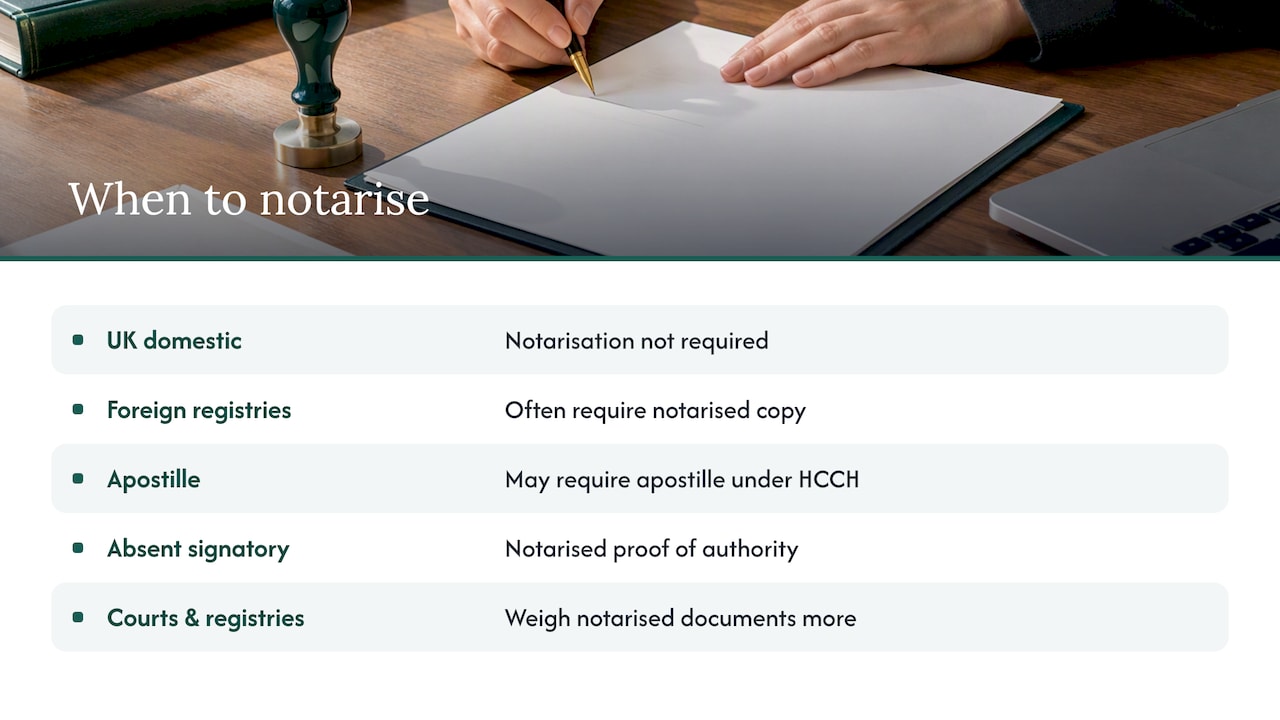
Nothing in the Trade Marks Act 1994 requires notarisation for a UK trademark assignment to be valid domestically. Section 24 asks only for a written, signed document, and a straightforward UK-to-UK transfer between parties who can both sign generally needs nothing more.
The gap most readers miss is cross-border acceptance. A signed assignment agreement that satisfies UK law may not satisfy a foreign trademark office, a bank reviewing ownership history, or a court assessing a dispute. Many overseas registries expect a notarised copy, and some then require an apostille under the Hague Convention before they will recognise the document at all, a process explained by HCCH.
Notarisation also matters when one signatory is unavailable. If a representative signs on behalf of an absent party, a notarised statement or certified copy can stand in as evidence that the signature was properly authorised. Courts and registries both tend to weigh notarised documents more heavily when ownership is contested, since the notary has independently verified identity at the point of signing.
How to get a trademark assignment notarised (step-by-step, including online notarisation)
Notarising an assignment agreement follows a predictable sequence whether you choose an in-person appointment or an online notarisation session.
- Prepare the assignment agreement unsigned, along with valid photo identification for every signatory.
- Confirm whether each party will sign in person or remotely, since this decides which notarisation mode fits.
- Choose in-person or online visio notarisation. An in-person appointment produces a sealed paper copy; an online session produces a recorded video session plus a certified digital copy.
- During the session, the notary verifies identity against a passport, watches the document being signed, then applies a seal and signature to confirm the act took place.
- Request an apostille or certified translation afterwards if the document will be used in a country that requires one.
Pro Tip: Book the notarisation session only after both parties have agreed every clause in the assignment, since a notary certifies the signing event, not the contract's terms.
Online sessions tend to suit assignments involving signatories in different countries, since no one needs to travel, and biometric identity checks against a passport add a layer of verification that paper-based signing cannot match. A same-day turnaround is often realistic once identity checks clear.
Recording the change of ownership with the registry: TM16 / TM16P explained
Once the assignment is signed, and notarised if your situation calls for it, the next step is telling the registry. Use TM16 for a full assignment and TM16P for a partial one; TM21A applies to different types of change and is not interchangeable with these.
- TM16 and TM16P both carry a fee of £60 per the IPO's forms and fees table.
- Section 9 of TM16 requires signatures from both parties or their representatives, typed or handwritten.
- The contact address field must be a UK, Gibraltar or Channel Islands address, a common point of rejection when overlooked.
- The date of transfer on the form must match the date on the signed assignment agreement, not the filing date.
If one party cannot sign TM16 directly, submitting a notarised copy of the underlying assignment agreement alongside the form gives the registry independent evidence that the transfer occurred as described. The assignment agreement remains the primary legal proof throughout. TM16 only records that a transfer happened; it does not create the transfer itself.
Checklist and common pitfalls when preparing an assignment for notarisation and recordal
Most rejections and delays trace back to a handful of avoidable errors.
- Confirm the assignment agreement is signed and dated before filing TM16, since the form records an event that must already have occurred.
- Check the transfer date on TM16 matches the agreement exactly, not the date you happen to submit the form.
- Attach corporate resolutions whenever a company is a party, since registries and notaries both expect proof of signing authority.
- Arrange an apostille in advance if the document will be used in a Hague Convention country, since timing varies by destination.
- Where TM16 cannot carry both signatures, submit a notarised copy of the agreement as supporting evidence rather than leaving the gap unaddressed.
A notarised copy never replaces a properly executed assignment agreement, but it closes evidential gaps that a half-signed form cannot.
Why a faster notarisation workflow matters for assignments
Trademark deals rarely wait for a notary's diary. A merger, licence renegotiation or corporate restructuring often needs the assignment finalised and recorded within days, and a slow notarisation appointment becomes the bottleneck rather than the legal work itself. An online visio session with biometric identity checks against a passport removes the scheduling friction that paper-based notarisation carries, which matters most when signatories sit in different countries.
— Jérémy
How MyNotary supports notarising your assignment documents
We built our platform around the exact bottleneck described above: getting a signature witnessed and certified without anyone travelling anywhere. Users upload the unsigned assignment agreement, complete identity verification by passport, and join a recorded video session where a commissioned notary witnesses the signing and applies their seal.
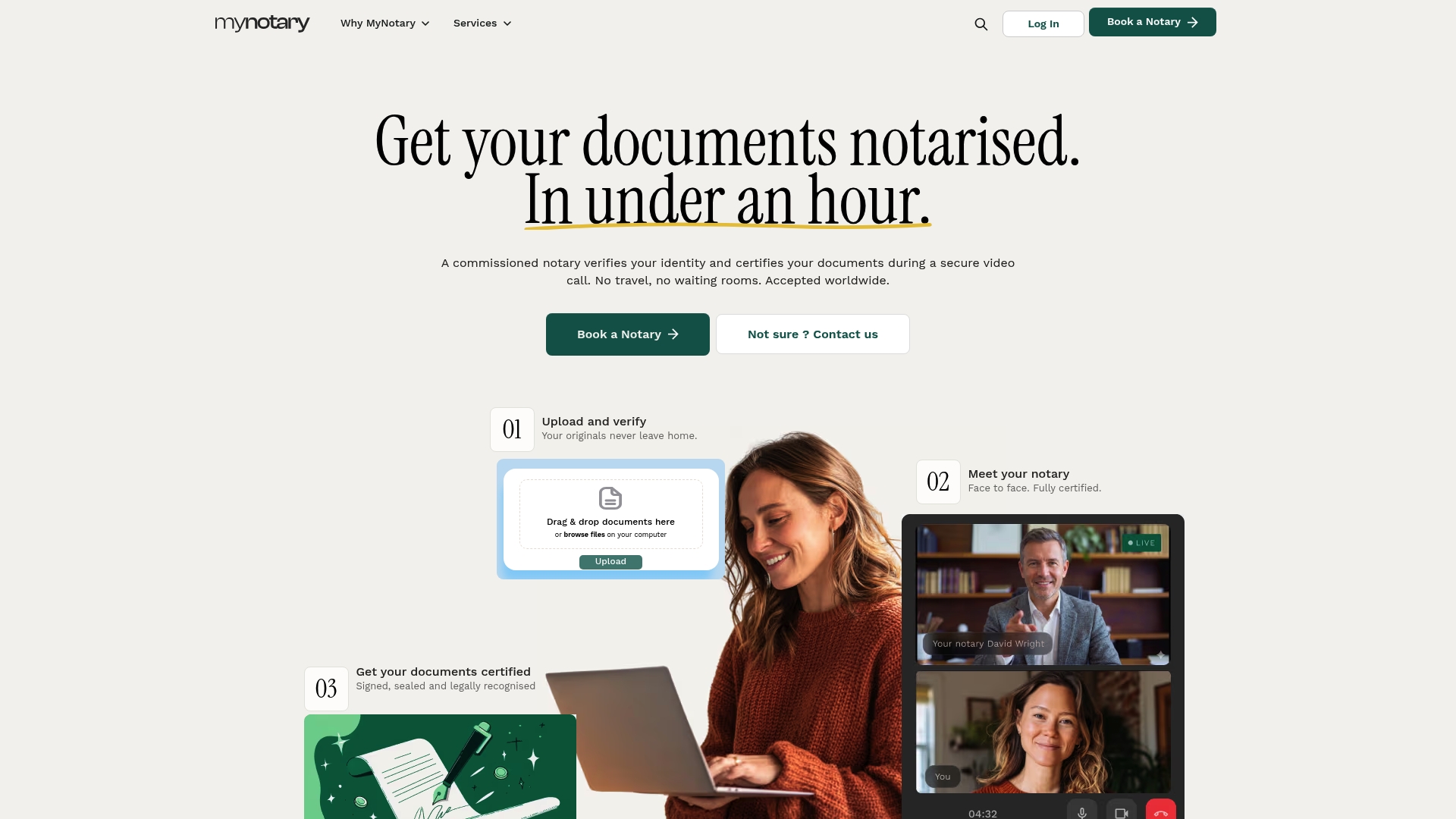
That workflow fits naturally around trademark assignments in a few situations:
- You need a notarised copy accepted by a foreign registry alongside your domestic recordal.
- One signatory cannot provide a signature directly on TM16 and you need notarised evidence to support the filing instead.
- A bank, court or counterparty wants independent verification that the signing took place as described.
- You are working across time zones and cannot coordinate an in-person notary appointment.
We deliver certified copies the same day the session is recorded, so the document is ready to attach to your TM16 filing or send abroad without the usual wait. Visit our services page to see how we handle commercial and corporate document notarisation, including assignment agreements.
This article is general information, not a substitute for advice from a qualified lawyer. Consult a qualified legal professional about your own circumstances before acting on anything here.
FAQ
Does a trademark assignment legally need to be notarised in the UK?
No. Section 24 of the Trade Marks Act 1994 only requires the assignment to be in writing and signed. Notarisation becomes useful mainly when a foreign registry, bank or court needs independent evidence of the signing.
What is the difference between TM16 and the assignment agreement?
The assignment agreement is the contract that actually transfers ownership, while TM16 is the form that records that transfer with the registry. GOV.UK guidance is explicit that the form does not substitute for the agreement itself.
How much does it cost to record a trademark assignment?
The IPO fee for TM16 or TM16P is £60 per application, separate from any cost of notarising the underlying assignment agreement. Notarisation fees depend on the provider and document type.
Do I need an apostille as well as notarisation?
Only if the receiving country requires one under the Hague Convention, in which case notarisation is typically the first step before apostille. Rules and timing differ by destination, so check with the receiving authority before arranging either.
What happens if only one party can sign TM16?
Submit a notarised copy of the signed assignment agreement alongside the form as supporting evidence of the transfer. This does not replace the requirement for a properly executed assignment agreement but helps address a gap in signatures on the form itself.
Sources
Recommended
Got questions? We’re on it.
Most questions are answered here, drawn from what people actually ask before booking. If yours isn’t, our team is in chat.
No. Section 24 of the Trade Marks Act 1994 only requires the assignment to be in writing and signed. Notarisation becomes useful mainly when a foreign registry, bank or court needs independent evidence of the signing.
Last updated: