Notarise a Certificate of Good Standing: 7 Steps for UK Use
By Jeremy Arhab, Founder · Published 6 October 2026 · Updated 6 October 2026
Practical UK workflow from Companies House to apostille. Seven steps to get a notarised certificate without delays or extra fees.

Whether a certificate of good standing needs notarisation depends entirely on who is asking for it. Companies House issues the document itself; a commissioned notary attests the signature or copy if the receiving authority demands it; an apostille or legalisation step follows only when the destination requires formal authentication. Before ordering anything, we recommend confirming the exact chain with whoever is requesting the document.
***
TL;DR: - A certificate of good standing from Companies House is conditional and only issued if a company's filings and officer details are current. - Notarisation, certified copies, and apostilles are requested mainly for foreign authorities and are not interchangeable; always specify which is required. - The notarisation process involves verifying identity via video call, recording the session, and attaching a seal, with turnaround often within an hour. - An apostille authenticates a notarised document for use in Hague Convention countries, but legalisation is necessary for non-convention countries. - Costs vary across stages, from about £22 for a standard certified copy to over £70 for online notarisation, with processing times from same-day to several days.
***
Table of Contents
- What a certificate of good standing actually confirms
- When notarisation, certified copies or an apostille get requested
- Step by step: from Companies House order to notarised document
- Apostille and legalisation: the chain after notarisation
- Timeline and fees to budget for
- Getting a certificate ready for notarisation without delays
- How we handle corporate document notarisation at MyNotary
- FAQ
- Sources
What a certificate of good standing actually confirms
Companies House no longer calls this document a "good standing statement". It is now officially the summary statement, and it confirms that a company has existed continuously and that no action is currently under way to strike it from the register. This matters because the summary statement is conditional, not automatic.
Companies House will only issue it when the company's filings and officer details are current. A company with overdue accounts or a confirmation statement in arrears will not receive one until the record is corrected, so checking the register first saves time and avoids paying twice.
You can order several related documents from Companies House:
- A certificate with certified facts, including the summary statement where eligible
- A certified copy of filed documents such as the certificate of incorporation or articles
- Copies of specific filings relevant to the requesting authority
When notarisation, certified copies or an apostille get requested
Companies House documents are accepted at face value by most UK organisations. Overseas banks, foreign courts, tender panels and immigration departments often want more, because they cannot verify a UK register directly.
Typical triggers include:
- Opening a bank account abroad or satisfying UAE company stamp requirements or overseas KYC checks
- Signing a contract with a foreign counterparty who wants proof of the signatory's authority
- Submitting a tender or licence application in another jurisdiction
- Supporting a court filing or visa application tied to the company
The format requested varies. A certified copy confirms the document matches the original. A notarised copy adds a commissioned notary's attestation of identity or signature. An apostille authenticates the notary's or official's signature for use abroad. These are not interchangeable, and a certified company registration copy will not satisfy a request that specifically asks for notarisation. Always ask the receiving authority which one they mean before paying for the wrong service.
Step by step: from Companies House order to notarised document
Getting from a blank request to a ready document follows a predictable sequence.
- Check the register first. Confirm filings, officer details and the confirmation statement are current, since the summary statement depends on this.
- Order the certificate or certified copy through Companies House's certified document service, choosing standard or same-day processing depending on your deadline.
- Read the request letter carefully to establish whether they want an original, a certified copy, a notarised copy or an apostilled document.
- Gather supporting material, including proof of the signatory's authority and any translation the destination requires.
- Choose between in-person and online notarisation. Online notarisation suits most corporate documents where the signer can join a video call with a passport for identity checks.
- Complete the notarisation. In an online session, the notary verifies identity, records the call, and attaches a seal and statement to the document. The underlying document is often left unsigned until the notary confirms the process, as the attestation covers the identity check and the copy itself.
- Confirm the delivery format the authority accepts: digital PDF, physical copy, or both.
Pro Tip: Ask the requesting authority, in writing, exactly which combination of certified copy, notarisation and apostille they need before you book anything, since a mismatched document means starting the process again.
Apostille and legalisation: the chain after notarisation
An apostille authenticates a public document for use in another country under the Hague Convention, administered nationally and referenced by the convention's own secretariat, hcch.net. It does not replace notarisation; it confirms the notary's or official signatory's authority, so it typically follows the notarisation step rather than substituting for it.
An apostille only works between countries that are party to the Hague Convention. Where the destination country has not joined the convention, consular legalisation takes its place, meaning the document passes through the relevant embassy or consulate instead of receiving an apostille stamp.
Points worth checking before you commit to either route:
- Whether the destination country is a Hague Convention member
- Whether the apostille or legalisation office requires the notarised original or accepts a certified copy
- Whether the receiving authority specifies a notary in the UK or one local to the destination, a distinction GOV.UK's notary guidance highlights directly
Destination rules differ enough that assuming the same process works everywhere causes delays. Confirming the chain with the requesting authority before ordering anything remains the most reliable way to avoid rework.
Timeline and fees to budget for
Costs and turnaround stack up across three separate stages: Companies House, notarisation, and apostille or legalisation.
| Stage | Typical cost | Typical turnaround |
|---|---|---|
| Certified copy by post | £22 | Standard post |
| Same-day certified copy by post | £65 | Same day |
| Online notarisation (per document) | from £70 | Typically within an hour once the session is booked |
| Apostille or legalisation | Varies by issuing authority | Varies; expedited options often available |
Companies House same-day fees apply when the request is submitted within its cut-off time, so same-day processing only works if you order early. Online notarisation sessions are generally the fastest stage in the chain, since no travel or office visit is involved.
Getting a certificate ready for notarisation without delays
Most corporate good standing documents are straightforward enough for online notarisation, provided the signer can join a video call and present a passport for identity verification. In-person or embassy notarisation still makes more sense for destinations that explicitly reject remote sessions, which is why checking acceptance first matters more than convenience.
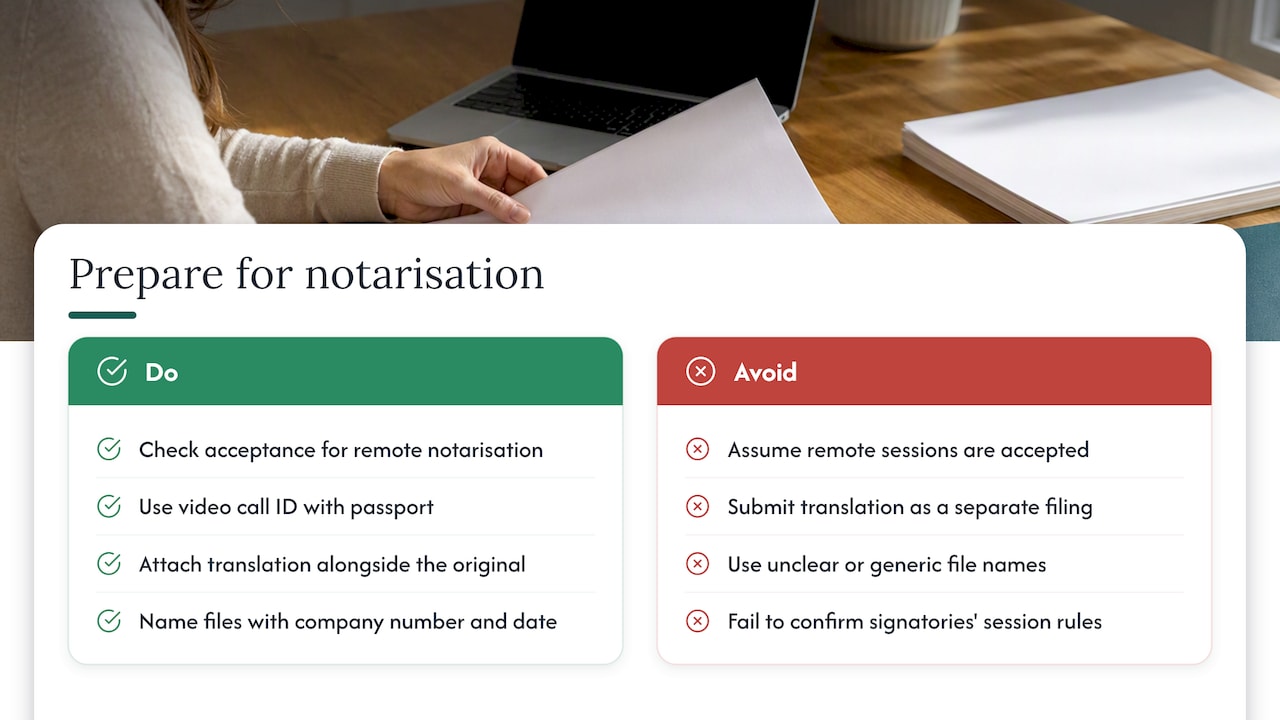
Presentation affects how smoothly a requesting authority processes the document. A clear cover note stating the purpose, destination, and company number reduces follow-up queries. Where a translation is needed, attach it alongside the notarised original rather than as a separate submission.
Pro Tip: Name files clearly with the company number and date, and if multiple signatories are involved, confirm whether they can each join separate video sessions or must appear together.
— Jérémy
How we handle corporate document notarisation at MyNotary
We built our corporate document notarisation service around exactly this kind of request: a company representative who needs a signature or copy attested quickly, without booking an office visit.
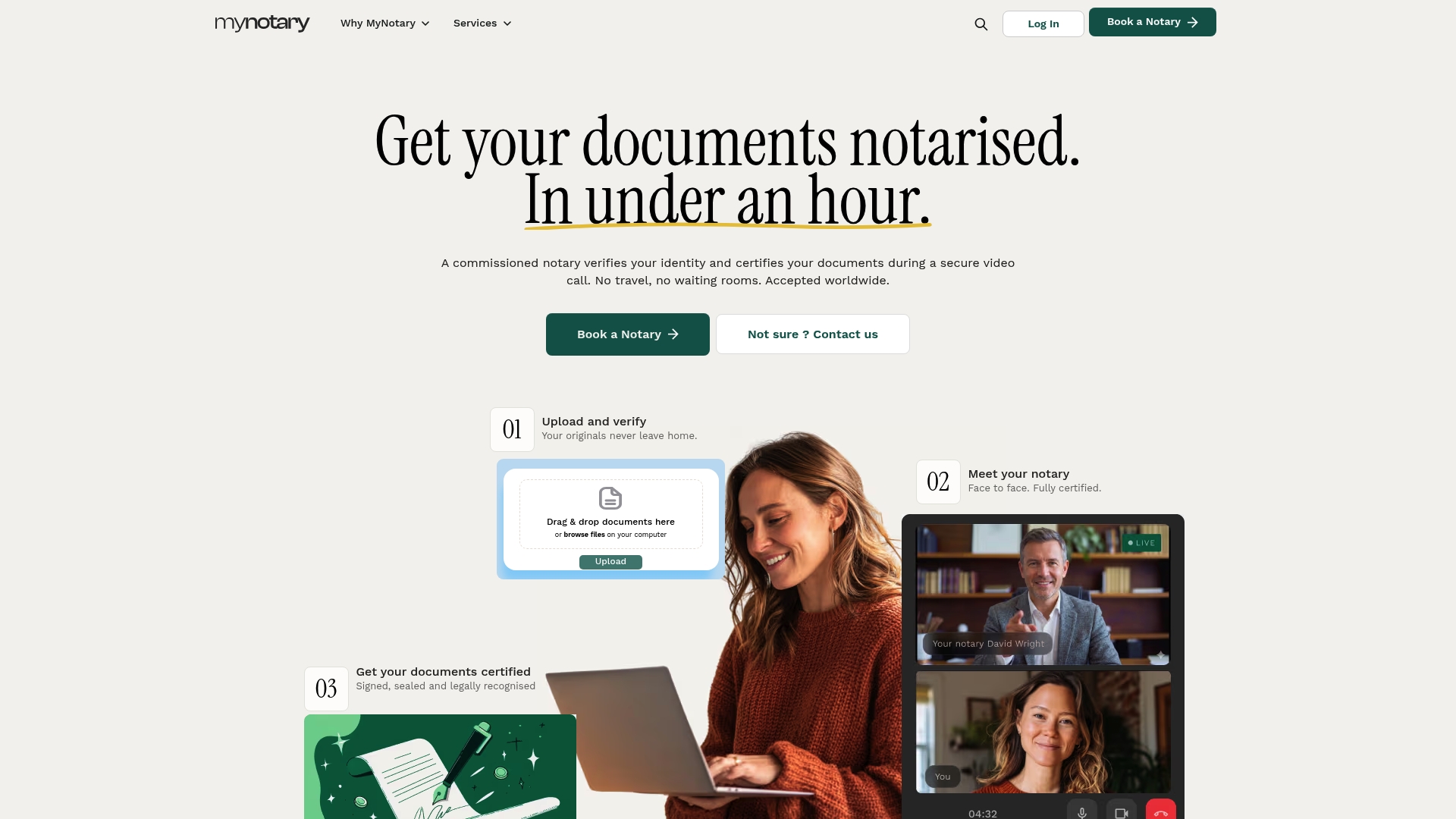
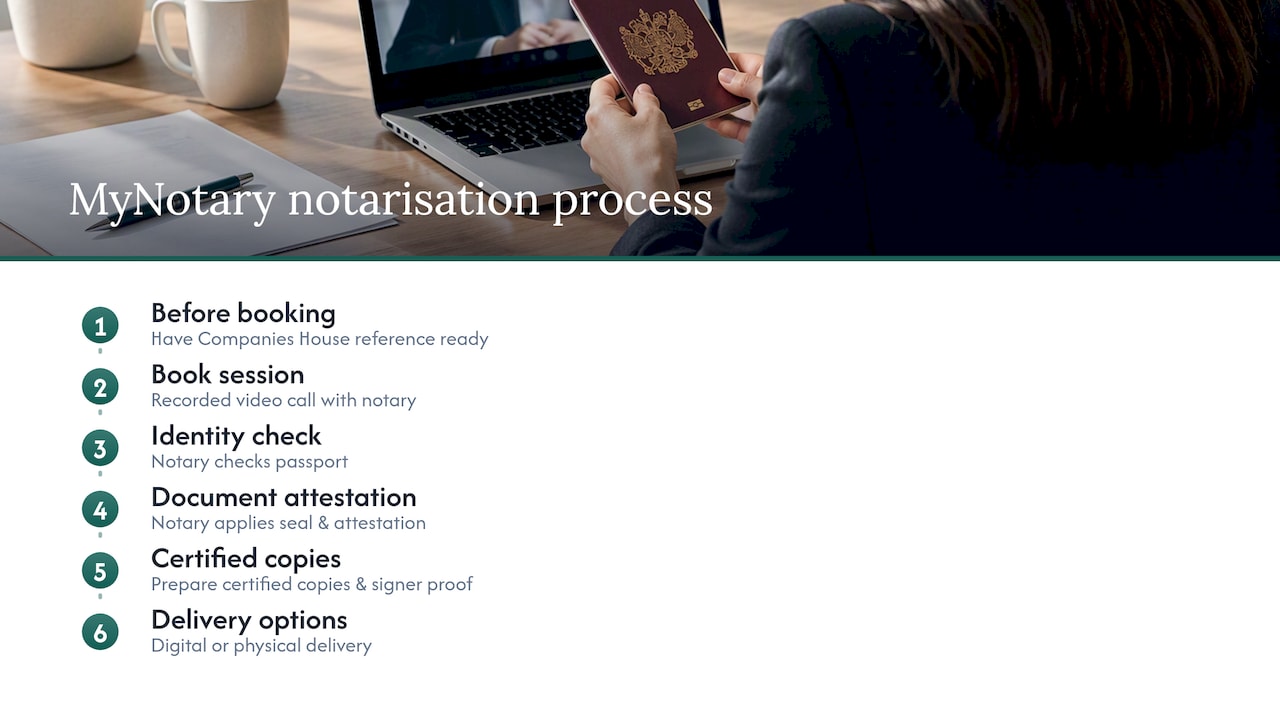
Our process runs over a recorded video call. A commissioned notary verifies your identity against your passport, reviews the document, and applies the notary's seal and attestation. We also handle certified true copies and identity verification where the requesting authority asks for proof of who signed. Turnaround on most notarised documents is typically fast once your session is booked, and delivery options include digital and physical copies depending on destination requirements.
Before you book, have your Companies House reference and the exact wording of the authority's request ready. If the destination falls outside the Hague Convention, check our guide to online notarisation acceptance first, or visit our services page to see which option fits your document.
FAQ
Is there another name for a certificate of good standing?
Companies House now calls this document the summary statement, replacing the older "good standing statement" label. The content is the same: confirmation that the company exists continuously and faces no strike-off action.
Can any notary notarise a document for use abroad?
A notary is qualified to authenticate documents for overseas use, but GOV.UK guidance notes that some receiving authorities require a notary based in the destination country rather than the issuing country. Always confirm this detail with the requesting authority before booking a session.
How do I request a certificate of good standing from Companies House?
You order it as part of the certified document service, choosing standard or same-day processing. The summary statement is only included if your filings and officer details are up to date on the register.
What is a notarised letter?
A notarised letter is a document where a commissioned notary has verified the signer's identity and witnessed the signature, then attached a seal and statement confirming this. For corporate documents, this often accompanies a certified copy when a bank, court or foreign authority needs formal proof of authenticity.
Sources
Recommended
Got questions? We’re on it.
Most questions are answered here, drawn from what people actually ask before booking. If yours isn’t, our team is in chat.
Companies House now calls this document the summary statement, replacing the older "good standing statement" label. The content is the same: confirmation that the company exists continuously and faces no strike-off action.
Last updated: