Avoid 4–6 Week Delays: UK Degree Certificate Notarisation Online
By Jeremy Arhab, Founder · Published 31 August 2026 · Updated 5 September 2026
A UK checklist to certify and legalise degree certificates, plus an end to end online notarisation option to avoid 4–6 week delays.

To use your degree certificate abroad, get it certified by a commissioned notary or solicitor, then legalised with an apostille where the destination country accepts one, or with embassy attestation where it does not. Original certificates can usually go straight to apostille; photocopies and transcripts typically need certification first. My Notary offers one way to handle the certification and identity checks remotely.
***
TL;DR: - Only certified signatures registered with the legalisation office are accepted for apostille or embassy attestation, so verifying the certifier’s registration is essential. - Original certificates can usually go directly to apostille, but photocopies or transcripts generally require certification first, and certification must precede the apostille application to avoid rejection. - Standard postal processing for an apostille takes four to six weeks, while expedited services can deliver in as little as one working day at higher costs. - Handling certification online through remote notarisation speeds up and simplifies the process, eliminating the need for in-person visits and reducing turnaround times. - Always confirm the recipient’s exact document and translation requirements, and keep scanned copies and proof of postage to prevent delays if documents go missing.
***
Table of Contents
- What to prepare before you book degree certificate notarisation
- Who can certify your degree, and will the legalisation office accept them?
- Step by step: certification, apostille and embassy legalisation in order
- Common pitfalls that cause rejections and delays
- How long does degree certificate notarisation take, and what does it cost?
- How an online notarisation workflow simplifies the whole process
- Your practical checklist for getting started
- How My Notary handles degree certification and legalisation
- Sources
- FAQ
What to prepare before you book degree certificate notarisation
Get your paperwork in order before you contact anyone. Missing an item at this stage is the single biggest cause of delay once a document is already in the legalisation queue.
Gather the following:
- Your original degree certificate, plus a sealed transcript if the recipient has asked for one specifically
- A valid passport or driving licence for identity verification
- Proof of any name change (marriage certificate, deed poll) if it doesn't match your certificate
- Written instructions from the recipient stating exactly what they need certified and how
A certified true copy is fine when the recipient only needs proof the qualification exists, such as many employer background checks. Universities, some visa routes and certain professional registration bodies often insist on the original or on university verification instead. If your certificate needs to travel with an official translation, arrange this before certification, not after, since the certifier may need to sign both documents together.
Pro Tip: Scan and photograph every document before you post it anywhere. If a certificate goes missing at the legalisation office or in transit, you'll need proof of exactly what you sent.
Who can certify your degree, and will the legalisation office accept them?
A commissioned notary and a solicitor can both certify a degree certificate as a true copy, but the practical distinction matters less than one detail most people skip: whether that individual's signature is actually registered with the legalisation office. The office checks signatures, stamps and seals against its own records before it will attach an apostille, and it can only legalise documents where a recognised certifier's signature is present.
Before you commit to anyone, check:
- Whether their signature is currently held on the legalisation office's register
- Whether the certification slip states their full name, firm, and professional status clearly, since the office relies on that detail to match signatures against its records
- Whether your university supports HEDD (Higher Education Degree Datacheck) verification, or whether the certifier needs to confirm the award directly with the registry
- Whether the recipient country has any additional certifier requirements beyond standard notarisation
Not every certifier's signature is registered, and using one that isn't is a common, entirely avoidable cause of rejection.
Step by step: certification, apostille and embassy legalisation in order
Sequencing errors, particularly sending a document for apostille before it has been properly certified, are one of the most common reasons legalisation gets rejected. Follow this order and you avoid the vast majority of problems.
- Confirm the recipient country and exact document list. Ask explicitly whether a transcript is required alongside the certificate, and whether they need an original, a certified copy, or both.
- Decide original versus certified copy, then certify. Original certificates can usually go straight to apostille. Photocopies or unofficial transcripts typically need solicitor or notary certification first, and if your university runs HEDD checks, that route can support the certification too.
- Apply for the apostille if the destination is a Hague Convention country. This confirms the certifier's signature is genuine, not the content of the degree itself.
- Route to embassy or consular legalisation for non-Hague countries. This follows the apostille stage and sometimes involves in-country steps once the document arrives, such as additional stamping by a local ministry.
Timing matters here. Standard postal apostille processing runs about four to six weeks, while many professional services can offer expedited routes down to a single working day for urgent cases.
For anything time-sensitive, use a tracked courier both ways rather than standard post, and never send a certificate for apostille before its certification is complete and dated. Mis-sequencing these two steps is the fastest way to lose weeks you don't have.
Common pitfalls that cause rejections and delays
Most rejections trace back to one of a handful of avoidable mistakes, and nearly all of them show up before the document even reaches the legalisation office.
- An unregistered certifier signature, missed because nobody checked the register first
- Sending a plain photocopy when the recipient or office needed the original, or omitting a required translation
- Applying for apostille before certification is complete
- Assuming HEDD verification applies when your university doesn't actually support it
Pro Tip: If a document is rejected, don't resubmit blindly. Ask the legalisation office exactly which check failed, fix that specific issue, and only then resend, otherwise you risk repeating the same delay twice.
If you've lost your original certificate entirely, ordering a replacement from your university is usually faster and cheaper than trying to certify a photocopy through extra verification steps.
How long does degree certificate notarisation take, and what does it cost?
Budget for two very different timelines depending on how you submit. Standard postal apostille applications typically take four to six weeks, while expedited agent-handled routes can bring that down to as little as one working day.
Costs vary by provider, but as a rough guide:
- Apostille fees for an original certificate
- Solicitor or notary certification fees, which vary by firm and turnaround speed
- Embassy attestation fees where a country requires them, plus courier charges both ways
These figures move depending on urgency and provider, so treat them as planning estimates rather than fixed prices. Paying for expedited or end-to-end handling tends to be worth it when a visa deadline or job start date is close, since a single missed step in the standard route can cost more time than the expedited fee.
How an online notarisation workflow simplifies the whole process
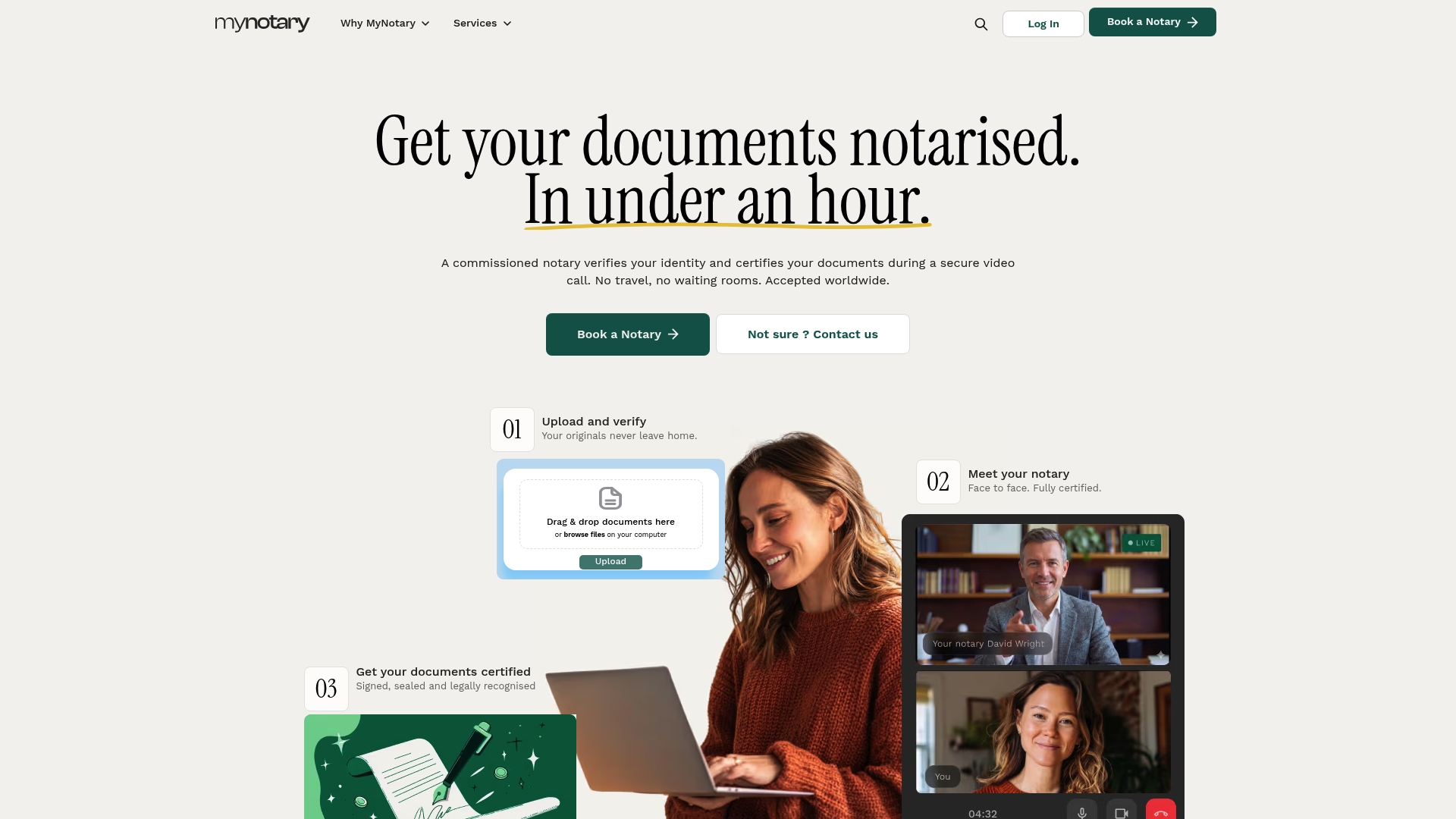
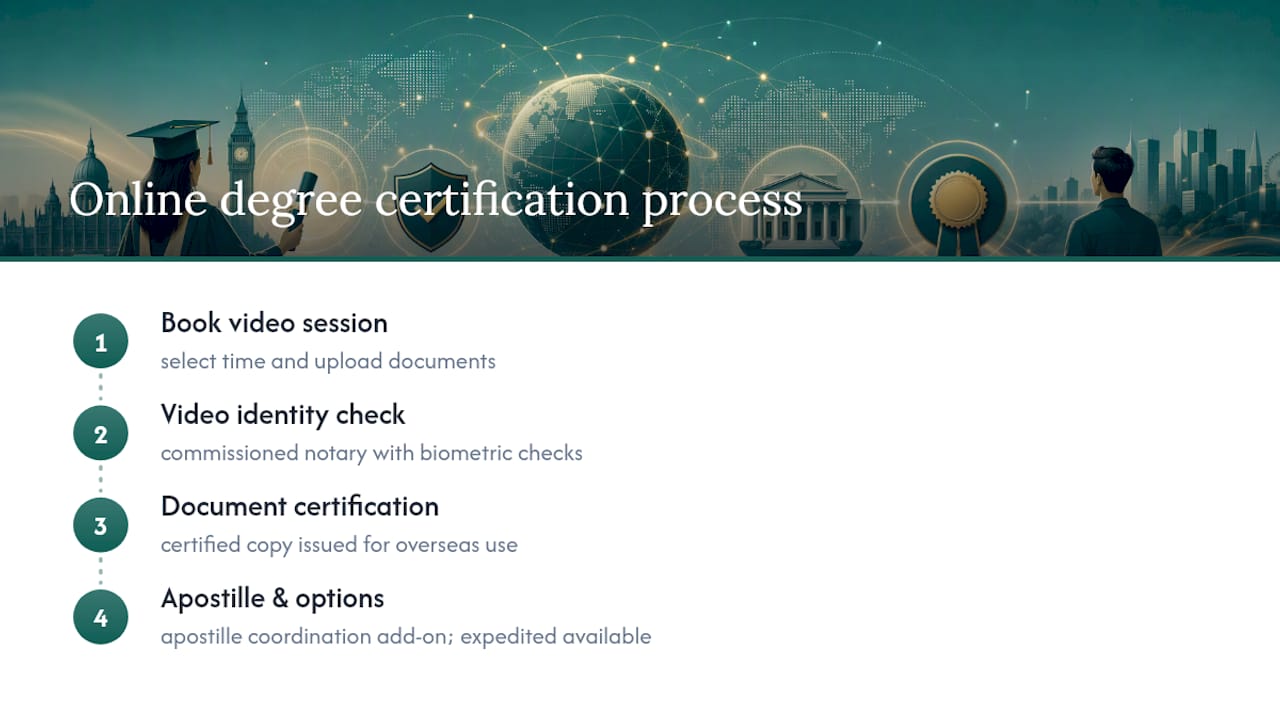
Handling certification and identity checks online removes the part of this process most people find hardest to schedule: physically visiting a notary. An online workflow typically runs through secure document upload, video-based identity verification, and signing by a commissioned notary, with the option to coordinate apostille handling afterwards.
The practical gains are straightforward. You avoid travel and waiting-room appointments, turnaround is faster because certification happens on video call rather than by post, and the entire step sequence sits with one provider instead of being split across a notary, a courier and a separate apostille agent. Online notarisation with biometric identity checks can replicate the in-person certifier step closely, provided the receiving authority accepts remote certification.
Your practical checklist for getting started
Three things matter more than anything else once you've decided to move forward. First, confirm exactly what the recipient requires: original or certified copy, transcript or not, and whether a translation is expected. Second, check the certifier's signature is actually registered with the legalisation office before you book anything. Third, book your certification slot, whether that's an in-person notary or an online session, only once those first two answers are settled.
Keep tracked proof of posting for every document you send, and keep your own scanned copies of everything before it leaves your hands. Documents do occasionally go missing in transit, and a scan is the only proof you'll have of exactly what was submitted.
— Jérémy
How My Notary handles degree certification and legalisation
My Notary replaces the multi-stop trip to a notary's office, a courier, and a separate apostille agent with one video call and a single coordinated process. For UK residents needing a degree certified for an overseas employer, university or visa application, that means booking a session, verifying your identity with a commissioned notary over video, and getting a certified document without ever leaving the house.
The service covers the situations this article has walked through: degree certification for visa applications, certified diplomas for international use, and certified academic transcripts where a recipient asks for one alongside the certificate. Identity verification uses biometric checks, and the resulting certification is designed to be recognised by legalisation offices, with apostille coordination available as an add-on rather than a separate errand. Turnaround runs considerably faster than posting documents back and forth to a traditional notary, with expedited options for anyone working against a visa or start-date deadline.
If you're ready to move, book a video session for your degree certificate and let the platform handle identity verification and certification in one sitting.
Sources
For country-specific requirements, check the official legalisation service before you submit anything, since recipient rules vary and change. For a broader look at how notarisation differs from later authentication steps, this overview of notarising documents for overseas use covers the general distinctions clearly. Always confirm the recipient country's exact rules first.
- Gov
- Legalisation of documents - Registry Services
- Degree & Diploma Apostille UK: Complete Guide 2026 | LegaliseNow
FAQ
How do I certify my degree certificate?
Take your original certificate to a commissioned notary or solicitor whose signature is registered with the legalisation office, or complete the equivalent process remotely through a service like My Notary.
How do I get my documents notarised in the UK?
You can notarise documents in person with a commissioned notary or solicitor, or via a secure online video session that verifies your identity and applies a legally recognised electronic signature.
How can I authenticate my degree certificate?
Authentication (legalisation) usually means certification first, followed by an apostille for Hague Convention countries or embassy attestation for countries that require it.
Can I notarise documents online?
Yes. Platforms such as My Notary allow you to upload a document, verify your identity by video, and have a commissioned notary certify it remotely, without visiting an office in person.
What's the difference between notarisation, certification and apostille?
Certification confirms a copy matches the original; notarisation is a formal certification carried out by a commissioned notary; an apostille confirms the certifier's signature is genuine so the document is recognised abroad.
Recommended
Got questions? We’re on it.
Most questions are answered here, drawn from what people actually ask before booking. If yours isn’t, our team is in chat.
Take your original certificate to a commissioned notary or solicitor whose signature is registered with the legalisation office, or complete the equivalent process remotely through a service like My Notary.
Last updated: