UK £1,000 Stamp Duty: When a Stock Transfer Form Needs Notarisation
By Jeremy Arhab, Founder · Published 3 October 2026 · Updated 3 October 2026
UK stock transfer forms rarely need notarisation for domestic registration. Learn when the £1,000 Stamp Duty trigger, an apostille, or online notarisation...

UK law does not require notarisation for a domestic stock transfer form to be valid. The two steps that actually matter are paying Stamp Duty to HMRC where it applies and lodging the signed form with the company so the transferee's name goes onto the register of members. Notarisation only tends to come into play when a foreign recipient or registry asks for it, and that is a separate question covered later in this guide.
***
TL;DR: - UK law only requires the transferor’s signature, payment of Stamp Duty, and company registration to validate a stock transfer; notarisation is unnecessary. - Foreign recipients or regulators may request notarisation or an apostille, which depends on their jurisdiction and is not mandated by UK law. - Properly completing the transfer form, including accurate signatures, consideration details, and timely submission, prevents delays and transfer rejection. - Online notarisation offers a quick, secure way to certify documents for overseas use, with same-day delivery, but acceptance is subject to the recipient’s jurisdiction. - Stamp Duty is only payable on transactions above £1,000 at a rate of 0.5%, rounded to the nearest five pounds, with submission required within 30 days.
***
Table of Contents
- Does UK law require notarisation or attestation of a stock transfer form?
- When a foreign buyer or regulator asks for notarisation or an apostille
- How to complete, sign and prepare a stock transfer form for stamping and lodging
- Stamp Duty: thresholds, rate, rounding and how to submit to HMRC
- Lodging the transfer with the company: registration timing and the point of title transfer
- How to get a document notarised in the UK and how online notarisation works
- Why an online notarisation route helps UK readers
- If you need an online notarisation or certified copy: MyNotary services
- Authoritative legislation and HMRC pages to keep for stamping and registration
- Sources
- FAQ
Does UK law require notarisation or attestation of a stock transfer form?
The Stock Transfer Act 1963, section 1 sets out exactly what makes a stock transfer form valid in the UK. Under the Act, the instrument of transfer can be executed by the transferor alone, and that execution does not need to be attested by a witness. There is no statutory requirement for a notary, a solicitor or any third party to watch the signature happen.
This surprises a lot of people, because share transfers feel like the sort of thing that ought to need extra formality. In practice, validity under UK company law depends on three things: the form being correctly completed and signed by the transferor, Stamp Duty being paid where the transaction exceeds the threshold, and the company accepting the instrument and updating its register. Notarisation is not one of the three.
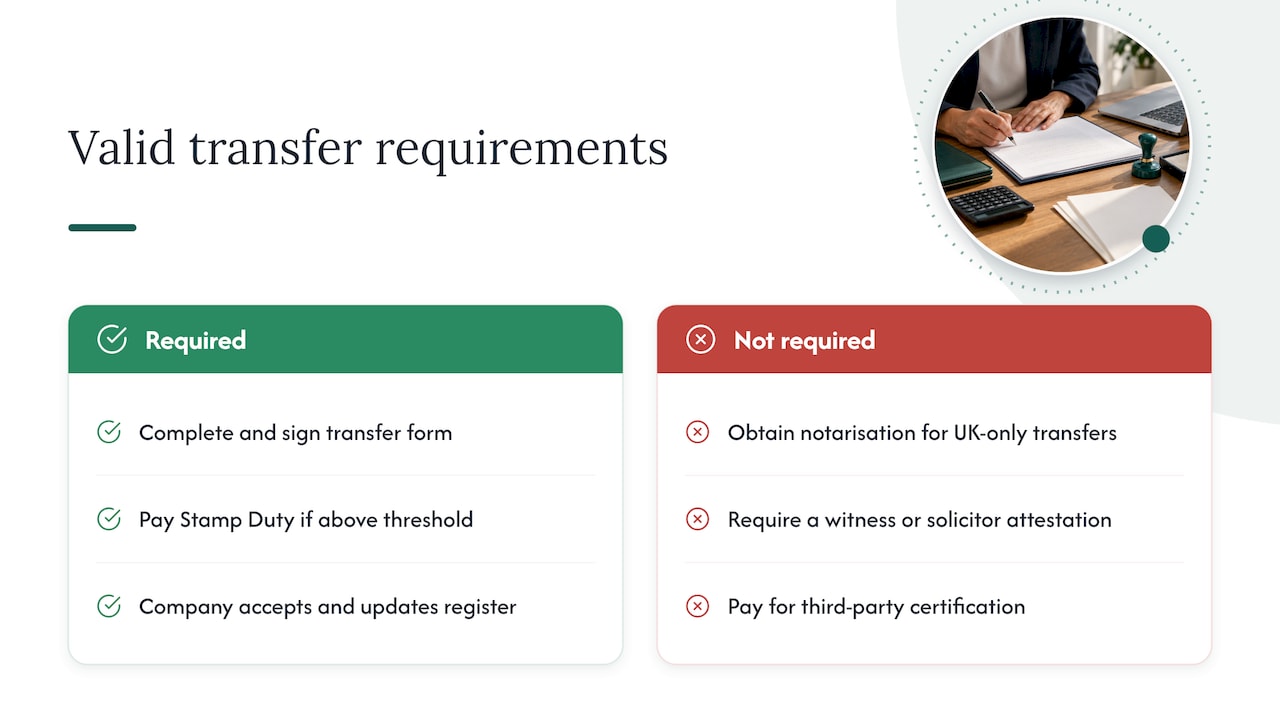
Take a straightforward example. A shareholder in a private UK company sells 500 shares to a colleague for £2,000. The transferor signs the stock transfer form, the pair work out the Stamp Duty due, HMRC processes the stamping, and the company registers the new owner. Nobody involved needs a notary at any point in that chain. The transfer is legally sound the moment those three steps are completed properly.
Where confusion creeps in is when people conflate "formal" with "notarised". A stock transfer form is a formal legal document, but formality in UK transfer law means correct execution and proper submission, not independent certification by a notary. That distinction matters when you are dealing with a UK-only transaction, because paying for notarisation you do not need wastes time and money without adding any legal weight to the transfer.
When a foreign buyer or regulator asks for notarisation or an apostille
Requests for notarisation almost always come from the recipient side of a transaction, not from UK law itself. A foreign company registry, an overseas bank, or an international buyer may have their own procedural rules that ask for a notarised copy before they will accept a UK document, even though the underlying transfer is already valid here. This is a recipient requirement, not a UK legal one.
Separately, some recipients will also ask for an apostille. An apostille is a certificate issued under the Hague Apostille Convention that confirms a document's origin so it can be recognised in another country that is party to the Convention, as explained in the guidance on legalising documents. Whether you need one depends entirely on where the document is going and what that country's registry or institution specifically requires.
When a counterparty raises notarisation, it helps to work through the options methodically:
- Ask the recipient exactly what they need: a certified copy, a notarised signature, an apostille, or full legalisation.
- Check whether their country accepts an e-apostille or insists on a paper version.
- Get the precise requirement in writing before booking any certification, so you do not pay for a step that was never actually needed.
Pro Tip: Email the recipient's registry or bank directly and ask them to confirm the exact wording of their requirement. "Notarised" means different things in different jurisdictions, and a five-minute email can save you an unnecessary certification.
How to complete, sign and prepare a stock transfer form for stamping and lodging
Getting the paperwork right the first time avoids the most common cause of delay: a transfer bounced back by HMRC or the company registrar because a field was missed or a signature was dated incorrectly.
- Enter the full name and address of the transferor and transferee exactly as they appear on the company's register of members.
- State the company name, the class of shares, and the exact number of shares being transferred.
- Record the consideration paid, which is the figure HMRC uses to calculate Stamp Duty.
- Have the transferor sign and date the form. Under the Stock Transfer Act 1963, only the transferor needs to sign, and no witness attestation is required.
- Where someone signs under a power of attorney, attach evidence of that authority alongside the form.
- Keep the signed date visible and accurate, since it starts the 30 day window for submitting to HMRC.
The most common filing mistakes are a missing consideration figure, a mismatch between the shareholder's name on the form and the name already on the register, and submitting after the 30 day deadline has passed. Each of these typically results in HMRC or the company sending the paperwork back, which adds weeks to a process that should take days.
Stamp Duty: thresholds, rate, rounding and how to submit to HMRC
Stamp Duty applies to most share transfers where the transaction value is above the threshold set out in HMRC's guidance on stamp duty on shares. Below that figure, no duty is payable at all.
The £1,000 threshold and 0.5% rate drive almost every Stamp Duty calculation on a private share transfer. According to HMRC, duty is payable once the transaction value exceeds £1,000, charged at 0.5% of that value, and the resulting figure is rounded up to the nearest £5. A transfer valued at £2,000, for instance, attracts duty of £10 once rounded.
To submit to HMRC, you will typically need:
- The signed and dated stock transfer form, as a scanned PDF.
- Evidence of payment of the duty owed.
- A copy of the share purchase agreement where the consideration is not a simple cash figure.
HMRC accepts electronic submission, including e-signatures and scanned documents, through its dedicated stamping process set out in the stock transfer form guidance. The form must be sent to HMRC within 30 days of the signing date. Once HMRC has processed the submission, it issues confirmation that the registrar can rely on to proceed with registering the transfer.
Lodging the transfer with the company: registration timing and the point of title transfer
Paying Stamp Duty does not itself transfer legal title. Title passes only when the company enters the transferee's name on its register of members, which makes this the final and decisive step in the whole process.
Directors have the power to refuse registration, typically where they suspect fraud or where the paperwork does not meet the company's own requirements, a point that flows from company law duties around maintaining an accurate register. Because of that discretion, it pays to send a complete package the first time:
- The stamped, signed stock transfer form.
- Any HMRC confirmation codes or stamped letter received after submission.
- Supporting documents such as the share purchase agreement, if the company asks for it.
A clean submission reduces the chance of a directors' query and gets the transferee onto the register without unnecessary back and forth.
How to get a document notarised in the UK and how online notarisation works
Once you know a recipient genuinely needs notarisation, the practical question becomes how to arrange it without losing days to appointments and travel. A commissioned notary can certify copies of documents, attest signatures, and keep a recorded session as part of the audit trail for the certification, which is exactly what most overseas recipients are looking for when they ask for a notarised document.
An online notarisation session generally follows a consistent workflow:
- Identity verification, usually by passport, carried out before the session begins.
- A recorded video call with a commissioned notary, during which the document is reviewed.
- The document is shown to the notary unsigned where a signature is to be attested live.
- The notary applies their seal or certificate to confirm the certification.
- Delivery of the certified document, usually within the same day.
Pro Tip: If you expect the document will also need an apostille, ask the notary provider whether certification and apostille can be arranged as a single sequence, so you are not restarting the process with a second provider.
This sequence fits naturally ahead of an apostille step, since the apostille authority is confirming the notary's certification, not the original document itself. For UK readers dealing with an overseas buyer, bank or registry, this online route removes the need to track down a notary's office and wait for an in-person slot.
Why an online notarisation route helps UK readers
For a shareholder juggling an overseas buyer's paperwork demands, an online notary session saves the days that a physical appointment would cost. It does not, however, guarantee that the recipient will accept the result. Final acceptance always rests with the jurisdiction or institution asking for the document, so confirm their exact requirement before you book anything.
— Jérémy
If you need an online notarisation or certified copy: MyNotary services
When a stock transfer needs certifying for an overseas recipient, booking a video call with a commissioned notary is usually quicker than finding a local office with availability. Some online notarisation providers handle identity verification by passport, provide a recorded notarisation session, and deliver the certified document, sometimes with turnaround times within the hour after the session ends.
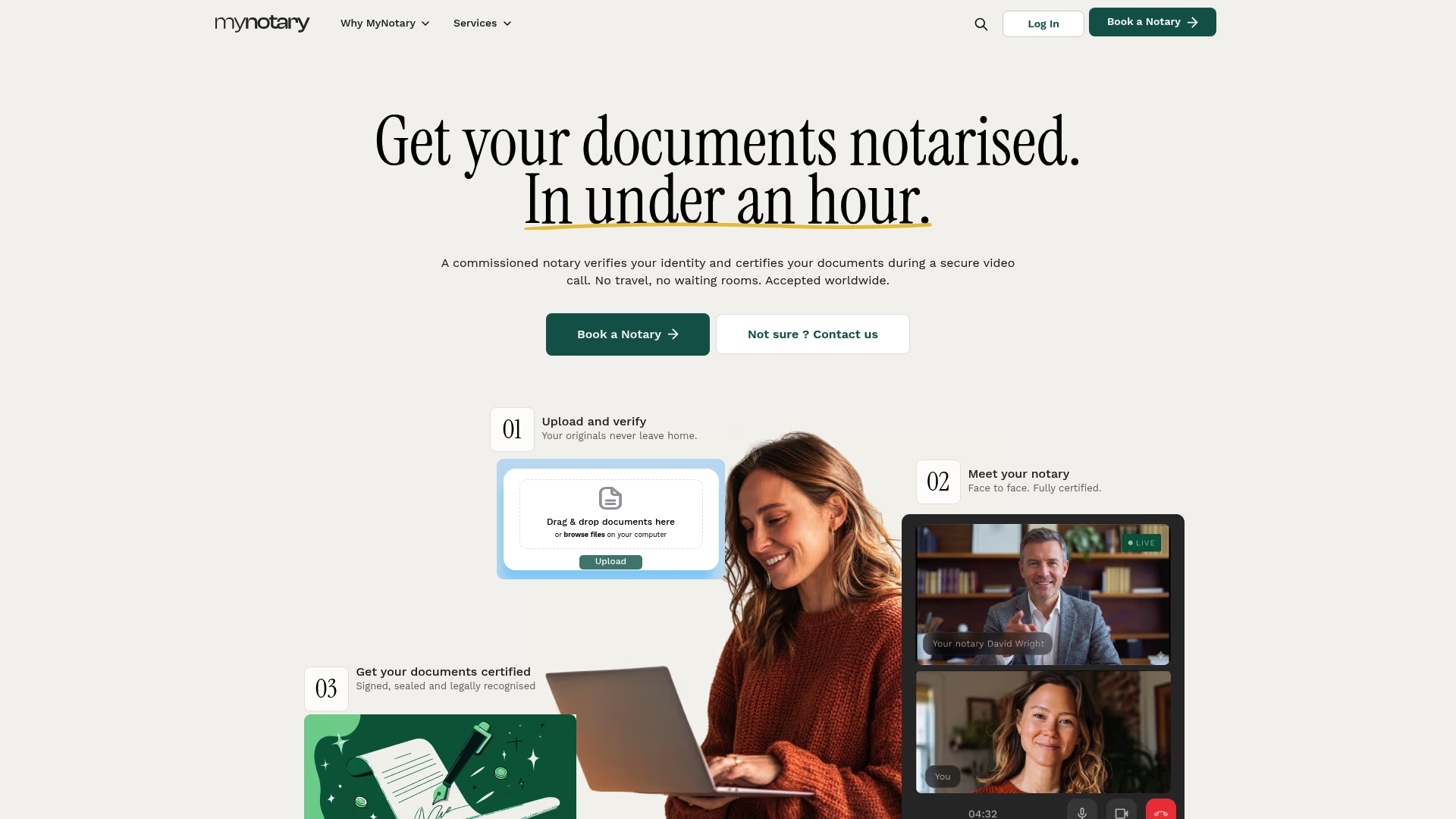
For share and company paperwork specifically, MyNotary's corporate document notarisation service covers certification of business documents, and its signature notarisation service covers attesting a signature where a recipient asks for that specific form of certification. Where a buyer wants a certified copy of supporting company records, the certified company registration copy service is built for exactly that request. Full pricing and the complete list of services, including Corporate Document Notarisation from £70 one off, is on the MyNotary services page.
Authoritative legislation and HMRC pages to keep for stamping and registration
Keep these pages to hand when you are preparing a transfer:
- Stock Transfer Act 1963, section 1, for the execution rules that make a transfer valid.
- Stamp duty on shares: use a stock transfer form and stamp duty on shares, for HMRC's submission process, rates and deadlines.
- Get a document legalised, for apostille requirements under the Hague Apostille Convention when a document is going abroad.
If the consideration for the transfer is non-cash or the valuation is disputed, a specialist explainer on how HMRC values shares in a private UK company sets out the approaches HMRC typically applies.
Sources
FAQ
How can I get a document notarised in the UK?
You can arrange notarisation by booking a session with a commissioned notary, either in person or through an online video call that includes identity verification and a recorded session. Online providers typically deliver the certified document the same day once the session is complete.
Who can notarize a document in the UK online?
A commissioned notary can carry out notarisation remotely through a video call platform, verifying your identity by passport before reviewing and certifying the document. Online platforms such as MyNotary handle this process end to end, from booking through to delivery of the certified file.
How do I get a document apostilled in the UK?
An apostille is issued under the Hague Apostille Convention to confirm a document's origin for use in another member country, as set out in GOV.UK's guidance. The exact route depends on whether the recipient country accepts an e-apostille or requires a paper version, so check their requirement first.
How much does notarisation cost in the UK?
Costs vary by provider and the type of document involved. MyNotary's notarisation services, including Corporate Document Notarisation and Signature Notarisation, start from £70 one off, as listed on its services page.
Do I need to pay Stamp Duty on every share transfer?
Stamp Duty only applies once the transaction value exceeds £1,000, as confirmed by HMRC's guidance. Where it does apply, the rate is 0.5% of the transaction value, rounded up to the nearest £5.
Recommended
Got questions? We’re on it.
Most questions are answered here, drawn from what people actually ask before booking. If yours isn’t, our team is in chat.
You can arrange notarisation by booking a session with a commissioned notary, either in person or through an online video call that includes identity verification and a recorded session. Online providers typically deliver the certified document the same day once the session is complete.
Last updated: