Get UK Bank Documents Notarised in an Hour, Online, Branch or Local
By Jeremy Arhab, Founder · Published 12 September 2026 · Updated 12 September 2026
Compare branch, commissioned notary, and online options to notarise UK bank documents. Follow the five minute prep checklist, avoid wasted trips, and get...

Most high street banks will notarise only a narrow set of bank-related paperwork, and only for existing customers, so relying on a branch appointment is often the slowest option. A commissioned notary or an online notarisation service tends to work faster and covers a wider range of documents. If your bank cannot help, check recipient requirements, bring your ID and every page of the document, and consider online notarisation when you need same-day results.
***
TL;DR: - Most bank branches limit notarisation to existing customers and only for bank-specific documents, often requiring an appointment and in-person attendance. - Commonly notarised bank documents include powers of attorney, certified bank statements, mortgage agreements, letters of guarantee, and corporate resolutions. - Using a commissioned notary or an online service allows for broader document coverage, faster turnaround, and no need for travel or appointments. - Always confirm with the recipient if an electronically notarised PDF or an apostille is acceptable before proceeding to avoid costly rework. - Signing a document before notarisation is the most common mistake; verifying requirements in advance prevents wasted trips and delays.
***
Table of Contents
- Do banks notarise bank documents? typical policies and limits
- Which bank documents commonly need notarisation?
- How do you get a bank document notarised at a branch or with a notary?
- Online notarisation: how it works and where it fits
- When do you need an apostille after notarisation?
- Which route should you choose: branch, local notary, or online?
- What I've learned about avoiding wasted trips
- How My Notary handles bank document notarisation online
- Selected further reading and primary sources
- Sources
- FAQ
Do banks notarise bank documents? typical policies and limits
Some banks still offer notarisation as a courtesy, but the service is usually restricted. Most branches will only notarise documents for existing account holders, and only for bank-related paperwork rather than general legal documents. You will almost always need to book an appointment rather than walk in.
Branch staff typically require every signer to attend in person with acceptable photographic identification, and they may refuse to handle documents that are not on a recognised bank form. Bank help pages commonly stress that notarisation is customer-only and varies branch by branch, which means the service you get in one location may not be offered ten miles away.
Before you travel to a branch, confirm:
- Whether the branch still offers notarisation at all (many have quietly withdrawn the service)
- Whether it is limited to existing customers
- Whether an appointment is required, and how far in advance
- Whether they will notarise the specific document type you have
If a branch cannot help, a commissioned notary or an online notarisation platform will usually notarise a far broader range of bank documents without the customer-only restriction.
Which bank documents commonly need notarisation?
Notary firms in the UK routinely list certain bank-related items among their most requested work. These documents tend to need either a full notarisation or a certified true copy, depending on what the receiving bank asks for.
Typical examples include:
- Power of attorney for banking, used when someone else needs to operate your account
- Certified copies of bank statements, often requested for visa, mortgage, or overseas account applications
- Mortgage and loan agreements, particularly for cross-border property purchases
- Letters of guarantee, used in commercial lending arrangements
- Corporate resolutions authorising a company representative to open or manage bank accounts
Notary firms confirm that bank statements, powers of attorney and corporate documents are among the matters they handle most often. A certified true copy is usually enough when the bank simply wants proof that a copy matches the original. Full notarisation, sometimes with a witness present, is generally required when the document creates a legal power, such as a power of attorney.
How do you get a bank document notarised at a branch or with a notary?
Getting this right the first time saves you a wasted appointment. Follow these steps in order:
- Do not sign the document early. Most notaries need to watch you sign, so signing beforehand can mean starting again.
- Gather original photographic ID. A passport is preferred; a driving licence is often accepted as a backup.
- Bring every page of the document, including any schedules or annexes, plus contact details for any required witness.
- Call ahead to book. Confirm the branch or notary's office will handle your specific document type, whether non-customers are served, and what fees apply.
- Attend with all signers present. The notary or bank official will check your ID, confirm the document meets the recipient's requirements, and witness the signing. A typical appointment runs around 30 minutes.
- If the branch says no, contact a commissioned notary directly. Ask about same-day availability, since many can turn documents around quickly once booked.
A UK notary public exists specifically to provide authentication that banks and foreign authorities often require for cross-border financial paperwork, which is why a local notary is usually a safe fallback when a branch cannot assist.
Online notarisation: how it works and where it fits
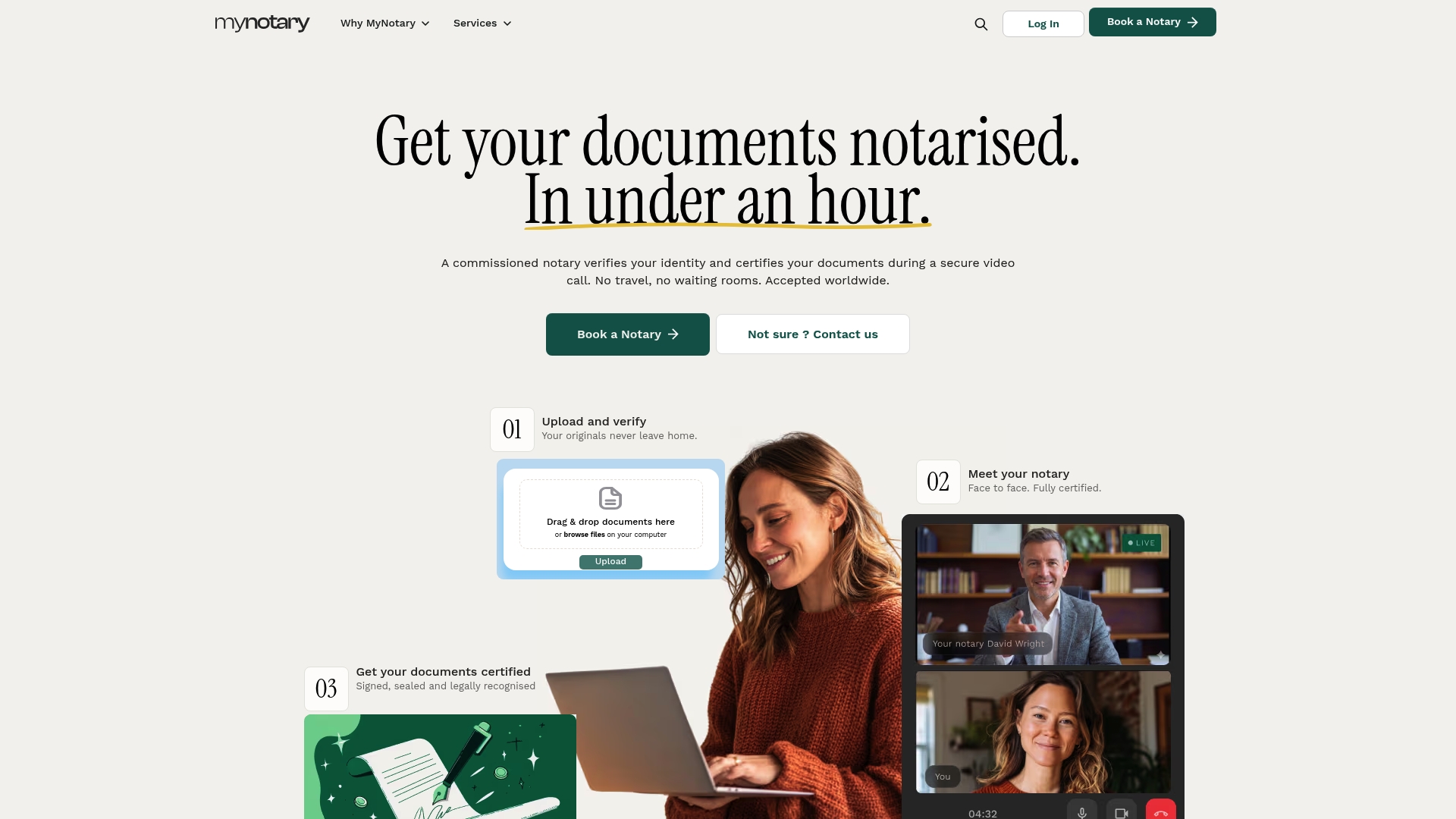
Online commissioned-notary services follow a consistent workflow: you upload the document, complete identity verification using your passport and biometric checks, then join a video session with a commissioned notary who watches you sign and applies their seal. The session is recorded, and a sealed digital copy is delivered the same day.
The practical benefits are speed, no travel, and a recorded session that gives the recipient verifiable proof of how the signing took place. Providers report that this process can be completed in about an hour from start to finish, against a branch appointment that might take days to book.
The main limitation is recipient acceptance. Some banks and foreign authorities still insist on a physical apostille or a wet ink stamp, so:
- Always ask the recipient bank whether they accept an electronically notarised PDF before you start
- Confirm whether they need a physical apostille stamped on a paper copy
- Check whether the notary must be commissioned in a specific jurisdiction
Pro Tip: Email the recipient's compliance or mortgage team directly and ask them to confirm acceptance in writing before you book any notarisation. A five-minute email can save you a second appointment.
Services such as MyNotary's power of attorney for banking page describe exactly this flow: passport checks, a recorded video session, and same-day delivery, which makes it a practical option for banking powers of attorney specifically.
When do you need an apostille after notarisation?
An apostille is the certificate used under the Hague Convention to legalise a document for use in another signatory country. It confirms to a foreign authority that the notary's seal and signature are genuine.
Not every bank document needs one. Many UK banks accept a notarised document on its own, but overseas banks and some mortgage lenders ask for the apostille as an extra layer of proof. An e-Apostille service exists in many jurisdictions, sitting on top of the standard paper process.
The sensible order is:
- Notarise the document first
- Ask the recipient whether they specifically require an apostille
- Request the apostille only if they confirm it is needed, since skipping this step wastes time and money
Which route should you choose: branch, local notary, or online?
Match the route to what the recipient actually demands, not to habit. If the recipient's paperwork explicitly states the document must be witnessed by an in-branch notary, a bank branch is your only option, restrictive hours and all. If your document is complex, needs a witness, or involves multiple parties who can meet in one place, a local commissioned notary tends to handle it more flexibly than a branch. If you are short on time, dealing with remote signers, or need a recorded identity check as extra proof, online notarisation is usually the fastest fit.
Before arranging anything, ask the bank or recipient:
- Do you accept electronically notarised PDF documents?
- Do you require a physical apostille as well as notarisation?
- Must the notary be commissioned in a particular country or jurisdiction?
Watch for two red flags: a recipient who cannot give you a clear answer, and instructions that change between phone calls. Get any special requirement confirmed in writing before you book.
Pro Tip: If two people at the same bank give you different answers about acceptance, ask for the requirement in an email. Verbal confirmations are not worth much if the document is rejected later.
What I've learned about avoiding wasted trips
The single biggest mistake readers make is signing the document before their notary appointment. It feels efficient, but it usually means starting from scratch. The second most common mistake is skipping the phone call to the recipient bank, then discovering afterwards that they wanted a physical apostille rather than a digital PDF.
Work through the decision checklist above before you book anything. It takes five minutes and prevents the far more frustrating experience of turning up twice.
— Jérémy
How My Notary handles bank document notarisation online
An online notarisation service allows you to get your bank paperwork notarised without the branch queue, customer-only restriction, or the wait for an appointment slot. You upload your document, complete identity verification by passport, and join a recorded video session with a commissioned notary who checks the document and applies their seal, all typically finished the same day.
The service covers common banking needs directly, including power of attorney for banking and certified copies for supporting documents, alongside broader signature notarisation for other paperwork. Businesses arranging corporate banking documents can use the corporate document notarisation service for resolutions and related filings.
Before booking, check with your recipient bank whether they accept an electronically notarised PDF and whether an apostille is required, since acceptance rules vary by lender and by country. My Notary does not promise acceptance by any specific recipient. Once you have confirmed that, have your passport and the full, unsigned document ready, then book your session to get started.
Selected further reading and primary sources
- Notary and apostille services for banking documents — Wilkes
- Notarypublic
- Hague Conference on Private International Law (HCCH)
- Secured loan eligibility for UK homeowners — Loanable
Sources
- Notary & Apostille services — Wilkes
- Notarypublic
- Hague Conference on Private International Law (HCCH)
- Secured loan eligibility for UK homeowners — Loanable
FAQ
Can a local bank notarise a document?
Some banks still notarise bank-related documents, but usually only for existing customers and only by appointment. Call ahead to confirm before travelling to a branch.
How can I get a document notarised in the UK?
You can use a bank that still offers the service, book a commissioned notary in person, or use an online notarisation platform such as My Notary for a same-day video session.
Where can I get a document notarised for free in the UK?
A bank may notarise certain bank-related documents free of charge for existing customers, though this varies by branch and is not guaranteed. Independent notaries and online services generally charge a fee for their time and the notary's seal.
How much does it cost to get a document notarised in the UK?
Costs vary by notary and by document complexity, since fees are set individually rather than fixed nationally. Ask for a quote before booking, whether you choose a local notary or an online platform.
Does a notarised bank document need an apostille?
Only if the recipient specifically requires one. Ask the receiving bank or authority before you notarise, since not all overseas recipients need the extra legalisation step.
Recommended
Got questions? We’re on it.
Most questions are answered here, drawn from what people actually ask before booking. If yours isn’t, our team is in chat.
Some banks still notarise bank-related documents, but usually only for existing customers and only by appointment. Call ahead to confirm before travelling to a branch.
Last updated: