Apostille UK company documents faster with online notarisation
By Jeremy Arhab, Founder · Published 29 September 2026 · Updated 29 September 2026
Get UK company documents apostilled without needless delay. Learn when to order Companies House certified copies, when private papers need notarising, and...

Yes, you can apostille most UK company documents. You choose between a paper apostille and an e‑Apostille, and the Legalisation Office issues both for qualifying UK documents. Your first move is to work out whether the paper is a Companies House document or a private corporate document, then ask the overseas recipient whether they want paper or electronic.
***
TL;DR: - The process for apostilling UK company documents requires separate steps for public register and private documents, affecting timing and certification needs. - Public-register documents from Companies House need certified copies first, which can take up to 10 working days, before applying for the apostille. - Private documents must be certified or notarised before the apostille application, with notarisation often being the slowest stage due to coordination delays. - Whether an electronic or paper apostille is accepted depends on the recipient country's preference, but both carry the same legal status within the Hague Convention. - Fast-track services for same-day or next-day apostilles are available but only for the application step, not for obtaining certified copies or notarisation parts of the process.
***
Table of Contents
- What an apostille is and why the Hague Apostille Convention matters
- Which company documents commonly require an apostille
- Step-by-step workflow to apostille company documents in the UK
- Costs and timing: Companies House fees versus Legalisation Office options
- Common pitfalls and a short pre-submission checklist
- Publisher perspective: getting private company documents ready faster
- How MyNotary prepares company documents for apostille
- Sources
- FAQ
What an apostille is and why the Hague Apostille Convention matters
An apostille is a certificate that confirms a UK public document is genuine, so it can be used abroad without further embassy checks. The framework behind it comes from the Hague Apostille Convention, which replaced longer legalisation chains with a single certificate recognised across Contracting Parties.
Two things follow from that:
- An e‑Apostille carries the same legal standing as a paper one among Contracting Parties, and should not be refused simply for being electronic.
- Some recipients still prefer paper, so it is worth asking before you apply. An apostille is usually sufficient on its own. When the destination country has not joined the Convention, an apostille will not be enough, and the document may need further embassy or foreign ministry authentication.
Which company documents commonly require an apostille
Company documents split into two categories that behave differently once you start the process. Public-register documents come from Companies House and already carry an official certification. Private documents are drafted and signed by the business itself, so they need certifying or notarising before they can be apostilled.
- Public-register examples: certificate of incorporation, certificate of good standing, certified copies of filed accounts.
- Private examples: board resolutions, powers of attorney, beneficial owner declarations, commercial contracts.
If the document sits on the public register, you generally order a certified copy or certificate from Companies House first. If it is a private document, it needs certification or notarisation before it goes anywhere near the Legalisation Office. This matters for timing as much as process: ordering from Companies House and getting an apostille are two separate stages with their own queues, so they need to be planned one after the other, not treated as a single step.
Step-by-step workflow to apostille company documents in the UK
Once you know which category your document falls into, the rest of the process follows a fairly fixed order.
- Confirm with the overseas recipient whether they need a paper apostille or accept an e‑Apostille, whether translation is required, and whether the destination country is a Convention member.
- Obtain the right document: order a certified copy from Companies House for public-register items, or arrange certification or notarisation for private documents such as board resolutions and powers of attorney.
- Decide between paper and e‑Apostille based on the recipient's answer, then apply online to the Legalisation Office, posting the original for paper or uploading a PDF for e‑Apostille.
- Arrange any certified translation, then send the apostilled document by courier or email, and confirm with the recipient that the format has been accepted.
Pro Tip: Ask the recipient about their format preference before you order any documents, since a paper‑only requirement can add days you had not budgeted for.
Businesses with signatories working remotely or across time zones often find the private-document stage the slowest part, since getting an original signature witnessed can mean chasing diaries rather than paperwork. A related comparison of Companies House and notary routes walks through how to sequence the two paths for a typical company document. If you decide the e‑Apostille route suits your deadline, a guide to getting an e‑Apostille right covers the upload requirements in more detail.
Costs and timing: Companies House fees versus Legalisation Office options
Budgeting for an apostilled company document means adding two separate fee structures together, plus any extras.
- Companies House charges £22 for a standard certified copy, aimed at 10 working days, while a certified copy of incorporation documents costs £44, and faster services are available at higher fees.
- The Legalisation Office charges £45 for a standard paper apostille and £35 for an e‑Apostille, with some next-day options and urgent services available at higher fees for registered businesses.
- Courier and translation costs are additional to the official fee schedules and often need to be budgeted separately.
A standard certified Companies House document costs £22 and is aimed at 10 working days, which means the certified copy alone can take longer than the apostille that follows it. Treat the two stages as sequential rather than parallel when you set a deadline, since a same‑day apostille service will not help if the underlying certified copy has not arrived yet.
Common pitfalls and a short pre-submission checklist
Most delays come from the same handful of avoidable errors, so a short check before you submit saves a resubmission later.
- Confirm the signature is original or the copy carries a proper certification, not a plain photocopy.
- Check you have ordered the correct certified copy from Companies House when the document is a public-register item.
- Make sure private documents have been certified or notarised before applying for the apostille.
- Prepare the right number of copies and any required translations in advance.
- Confirm the recipient's preferred format one more time before you submit.
Red flags that tend to cause rejection include documents issued outside the UK, seals or signatures that do not match official records, poor-quality scans submitted as originals, and missing return address details on a paper application. If anything is unclear, the Legalisation Office can be contacted directly through the GOV.UK application service before you submit, which is faster than correcting a rejected application afterwards.
Pro Tip: Keep a spare certified copy on hand when ordering from Companies House, since a rejected apostille application often means starting the certification step again from scratch.
Publisher perspective: getting private company documents ready faster
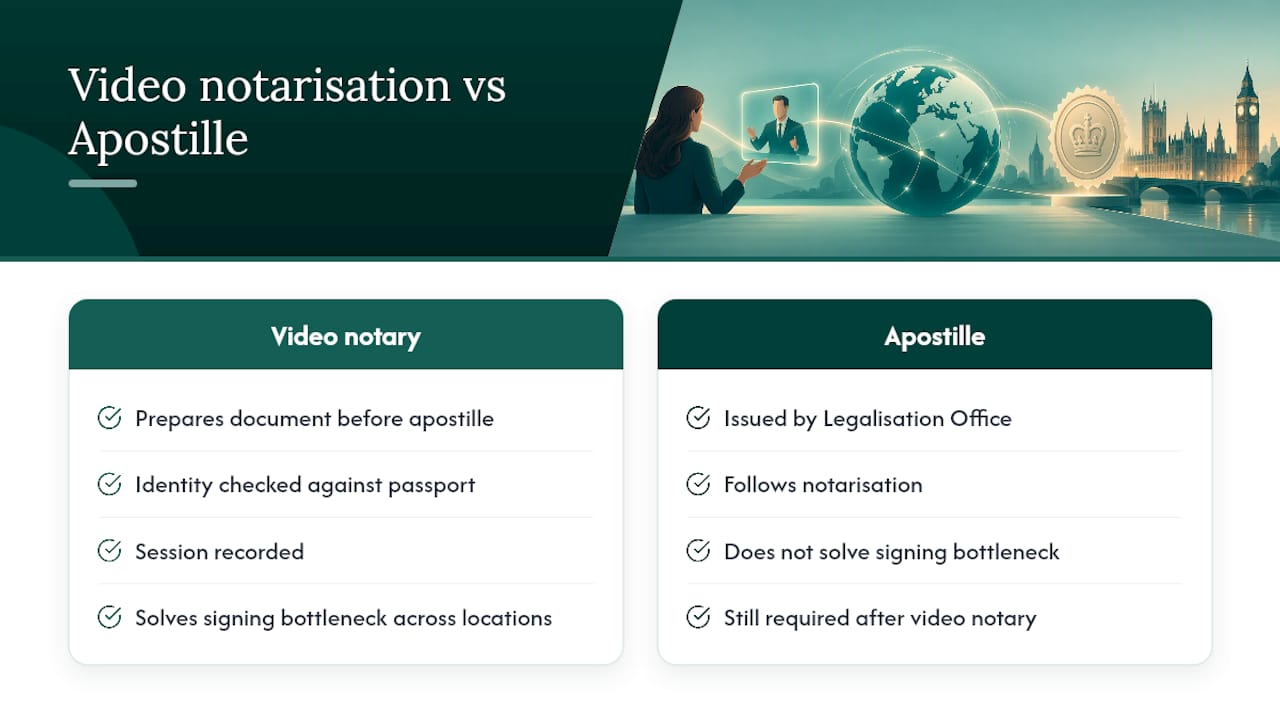
The slowest part of this process is rarely the apostille itself. It is getting a private document properly signed and certified before it ever reaches the Legalisation Office, particularly when signatories are spread across different offices or countries. Notarisation carried out by video call, with identity checked against a passport and the session recorded, addresses that specific bottleneck rather than the apostille stage. It does not replace the apostille: the notarisation prepares the document, and the Legalisation Office still issues the apostille afterwards.
This route is worth considering when a deadline is tight, when signatories cannot meet in person, or when a document needs several signatures from people in different locations.
— Jérémy
How MyNotary prepares company documents for apostille
Once you know a private document needs certifying before it can be apostilled, this preparation stage can be handled online without the travel or waiting room that traditional notarisation usually involves.
- Notarisation by video call, with identity verified against a passport and the session recorded for the file.
- Corporate document notarisation covering board resolutions, powers of attorney and other private company papers.
- Secure document upload and, where needed, certified translation as part of the same process.
We cannot promise that any overseas recipient will accept a given document, since acceptance always depends on the destination authority. What we can offer is a faster route to a properly certified document, ready for the apostille stage that follows. Our corporate document notarisation service is built for exactly this, and the full range of notarisation services covers related needs such as certified copies and identity verification for businesses working to a deadline.
Sources
Before submitting anything, it is worth checking the primary sources directly:
FAQ
How can I get a document apostilled in the UK?
You apply online through the Legalisation Office, choosing either a paper apostille sent by post or an e‑Apostille uploaded as a PDF. Public-register documents need a certified copy from Companies House first, while private documents need certifying or notarising beforehand.
How long does it take to get documents apostilled in the UK?
Timing depends on which stage you are in. A standard certified copy from Companies House is aimed at 10 working days, and the apostille application itself follows as a separate step with its own standard, next‑day or e‑Apostille options.
Who is qualified to apostille my documents?
Only the Legalisation Office issues apostilles for UK documents. Private documents typically need certifying or notarising by a commissioned notary before they qualify for that step.
Can I get an apostille in one day?
Same‑day or next‑day options exist for some documents through the Legalisation Office, often at a higher fee and sometimes restricted to registered businesses. This timeline covers the apostille stage only, so any certified copy or notarisation still needs to be arranged beforehand.
Recommended
Got questions? We’re on it.
Most questions are answered here, drawn from what people actually ask before booking. If yours isn’t, our team is in chat.
You apply online through the Legalisation Office, choosing either a paper apostille sent by post or an e‑Apostille uploaded as a PDF. Public-register documents need a certified copy from Companies House first, while private documents need certifying or notarising beforehand.
Last updated: