Getting a notarised certificate of incorporation copy
By Jeremy Arhab, Founder · Published 25 August 2026 · Updated 25 August 2026
Learn how to obtain a notarised certificate of incorporation copy quickly and easily, ensuring its acceptance by banks and authorities.

A notarised certificate of incorporation copy is your certificate of incorporation authenticated by a notary, complete with signature and official seal, so a bank or overseas authority can rely on it as genuine. You need one whenever an institution won't accept a plain printout: banks opening corporate accounts, foreign regulators processing a subsidiary registration, courts or counterparties in a legal matter.
There are two practical routes. You can visit a notary in person with your original paperwork, or complete the process remotely through a secure video call with a commissioned notary. Both produce a legally valid notarised copy; the difference is mostly speed and convenience.
- In person: book a local notary, bring your documents and ID, wait for an appointment slot.
- Online: upload your certificate, verify your identity, join a video call, receive your notarised copy digitally or by post.
Online providers such as My Notary report a fast turnaround for notarised documents, making the remote route the faster option for most directors and company secretaries working to a deadline.
Key Takeaways
Getting a valid notarised certificate of incorporation copy comes down to sourcing a clean document, confirming the receiving authority's exact requirements, and choosing a notarisation route that meets your deadline.
| Point | Details |
|---|---|
| Source the document first | Download a clean PDF of your incorporation certificate from your company's filing history before booking a notary. |
| Confirm requirements in writing | Ask the bank or overseas authority to specify exactly what wording, apostille, or translation they need before you start. |
| Check Hague Convention status | An apostille alone works for Hague signatory countries; non-Hague destinations need embassy legalisation too. |
| Avoid the common rejection triggers | Name mismatches, unsigned originals, and low-quality scans cause most delays and repeat appointments. |
| Consider online notarisation for speed | My Notary offers video-call notarisation with biometric ID checks and a fast turnaround. |
Table of Contents
- What documents and ID a notary will ask for
- How do you actually get a notarised copy?
- Do you need an apostille to use it abroad?
- Why do notarised copies get rejected?
- Why the "just go to a solicitor" advice misses the point
- Get your notarised copy without the waiting room
- Sources
- FAQ
What documents and ID a notary will ask for
Before you book anything, get your paperwork in order. Notaries work from originals or clear certified copies, and they need proof that you're authorised to request the certification in the first place.
You'll typically need:
- A printed PDF of your certificate of incorporation, downloaded from your company's filing history, or the original paper certificate if you still hold it.
- Your company's articles of association, if the receiving authority has asked for them alongside the incorporation certificate.
- Personal photo ID for the person attending, either a passport or a photocard driving licence.
- Proof of authority to act for the company, such as a director's ID matched against the company register, a board resolution, or a power of attorney if someone other than a director is handling the request.
- A certified translation, if the destination country doesn't accept English-language documents. Some foreign banks and registrars insist on this even when the notarised copy itself is otherwise complete.
Companies House explains how to find and download the PDF of your incorporation documents from your filing history, which is usually the quickest way to get a clean source document before notarisation. Note that Companies House won't reissue your original certificate; it can only supply certified copies of what's on file.
Pro Tip: Check the exact wording the receiving bank or authority expects before you book your notary appointment. Some require the phrase "true copy of the original" on the certification; others want the notary's seal visible on every page. Getting this wrong is the single most common cause of a second, unnecessary appointment.

How do you actually get a notarised copy?
The mechanics differ depending on whether you go in person or online, but both follow a similar logical sequence: source the document, prove who you are, get it certified, receive the finished copy — a process well explained in the notary process in Spain that highlights how local rules vary internationally.
In-person route:
- Locate a commissioned notary, either through a local search or a recommendation from your solicitor or accountant.
- Book an appointment and confirm what to bring, since some notaries want originals rather than downloaded PDFs.
- Attend with your certificate of incorporation, personal ID, and any proof of authority (board resolution, director ID).
- The notary examines the documents, certifies the copy, applies their signature and official seal.
- Collect the notarised copy, sometimes same day, sometimes with a short wait if the notary needs to verify company details separately.
Online route:
- Upload a scanned or downloaded PDF of your certificate of incorporation to the notary platform.
- Complete identity verification, typically biometric checks against your passport or driving licence.
- Join a video call with a commissioned notary, who reviews the document and confirms your identity live.
- Receive your notarised digital copy, with a printed and posted hard copy available as an add-on for authorities that insist on physical paperwork.
Costs vary by route and provider. Companies House itself charges standard and same-day fees for certified copies and certificates of incorporation documents ordered directly from the register, which is separate from notarisation but often the first stop if you need a clean source PDF. Notary fees for the certification itself sit on top of that, with in-person appointments often taking several days to schedule and online sessions completing in far less time. My Notary cites a fast turnaround for a notarised document once the video call is booked, which matters if a bank has set a tight deadline for opening an account.
Do you need an apostille to use it abroad?
Whether your notarised copy needs anything further depends entirely on the destination country, and this is where most delays happen. If the receiving country is a signatory to the Hague Apostille Convention, a single apostille stamp from the relevant UK authority is usually enough to make the notarised copy valid there. If it isn't, you'll need additional embassy legalisation on top of the apostille, and sometimes a certified translation as well.
The Ginkgo Advisory guide to UK certificate of incorporation apostilles sets out this Hague versus non-Hague distinction clearly, and it's worth checking your specific destination against a current list of Hague Convention signatory countries before you commit to a process.
The typical route runs like this:
- Get the document notarised (and certified as a true copy, if the destination specifically asks for that wording).
- Apply for a UK apostille through the appropriate national authority.
- Arrange embassy legalisation and, where needed, a certified translation if the country falls outside the Hague Convention.
Pro Tip: Email the receiving bank, registrar, or court and ask them to confirm in writing exactly what they need, apostille only, apostille plus legalisation, or apostille plus translation, before you start. It's a five-minute email that can save weeks. For related cross-border document work, our power of attorney apostille guide walks through the same legalisation logic step by step.
Why do notarised copies get rejected?
Rejections are almost always avoidable, and they nearly always come down to the same handful of mistakes. Knowing them in advance saves you a second appointment and a second fee.
- Name mismatches between the certificate of incorporation and the company name as registered with the requesting bank or authority, often due to a rebrand or a trading name confusion.
- Unsigned or unsealed originals, where the source document presented to the notary wasn't itself complete.
- Low-quality scans, particularly faded Companies House PDFs that don't reproduce clearly once certified and copied again.
- Missing apostille or translation, where the notarised copy is technically correct but incomplete for the destination country's requirements.
- Outdated documents, where the receiving authority wants a copy issued or notarised within a recent window, often three or six months.
If a copy is rejected after certification, you generally can't amend the existing notarisation. You'll need a fresh certified source document and a new appointment, so it pays to verify acceptance wording with the bank or foreign authority before you book rather than after. For a wider view of what counts as an acceptable certified copy in the UK more broadly, our certified true copy guide covers the distinctions between solicitor and notarial certification.
Why the "just go to a solicitor" advice misses the point
Most guidance on this topic still assumes the reader will drive to an office, wait for an appointment, and accept whatever timeline the notary offers. That advice made sense a decade ago. It doesn't reflect how banks and overseas registrars actually operate now, and it ignores that video notarisation is a recognised, working method rather than a workaround.
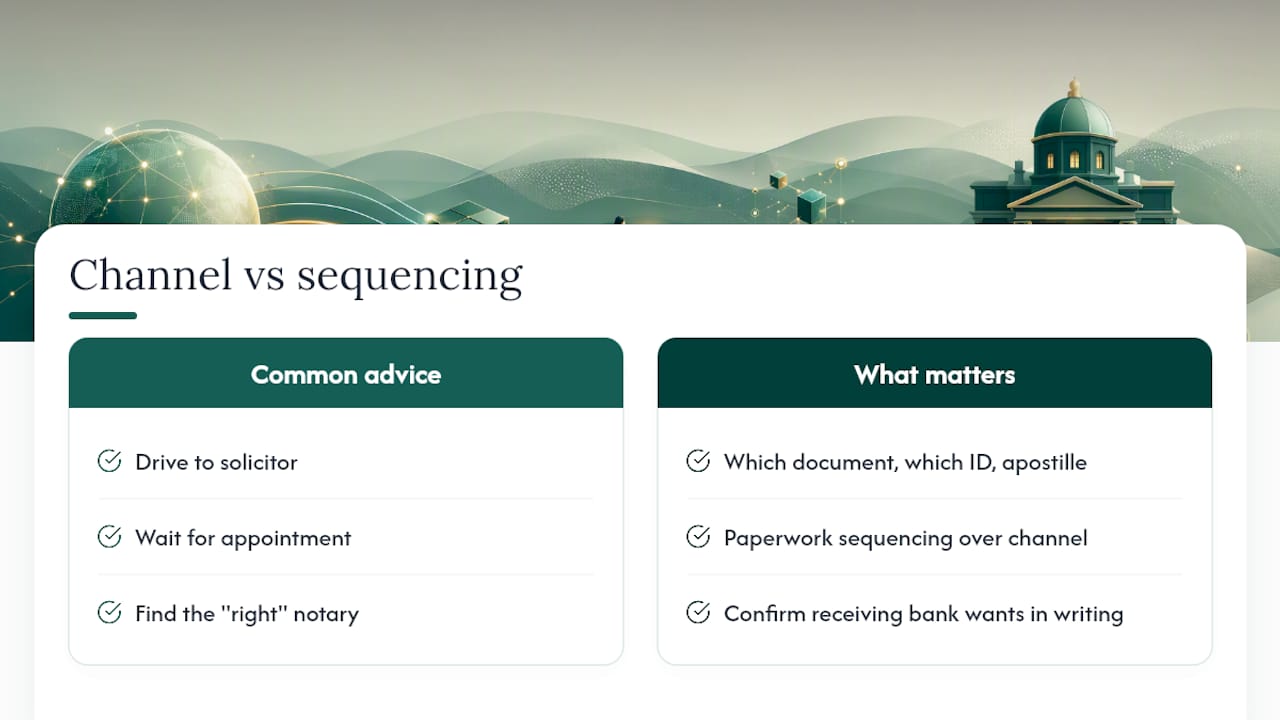
What the research here actually supports is a sequencing problem, not a channel problem. The paperwork side, working out which document, which ID, whether an apostille applies, matters more than whether you sit across a desk from a notary or across a screen. Get that wrong and it doesn't matter how you book the appointment; you'll be back at square one. Get it right and the Notaries Society's own description of what a notary's seal and signature actually certify tells you why receiving authorities trust the result regardless of whether it happened in an office or on a video call.
My honest read: readers overinvest in finding the "right" notary and underinvest in confirming what the receiving bank actually wants in writing. Fix that second problem first.
— Jérémy
Get your notarised copy without the waiting room
Booking a local notary usually means checking their diary, taking time off work, and hoping the appointment produces exactly the wording your bank wants first time. My Notary removes that scheduling bottleneck entirely: you complete the entire process over a secure video call with a commissioned notary, with biometric identity verification built in and an average turnaround of one hour from booking to certified document.
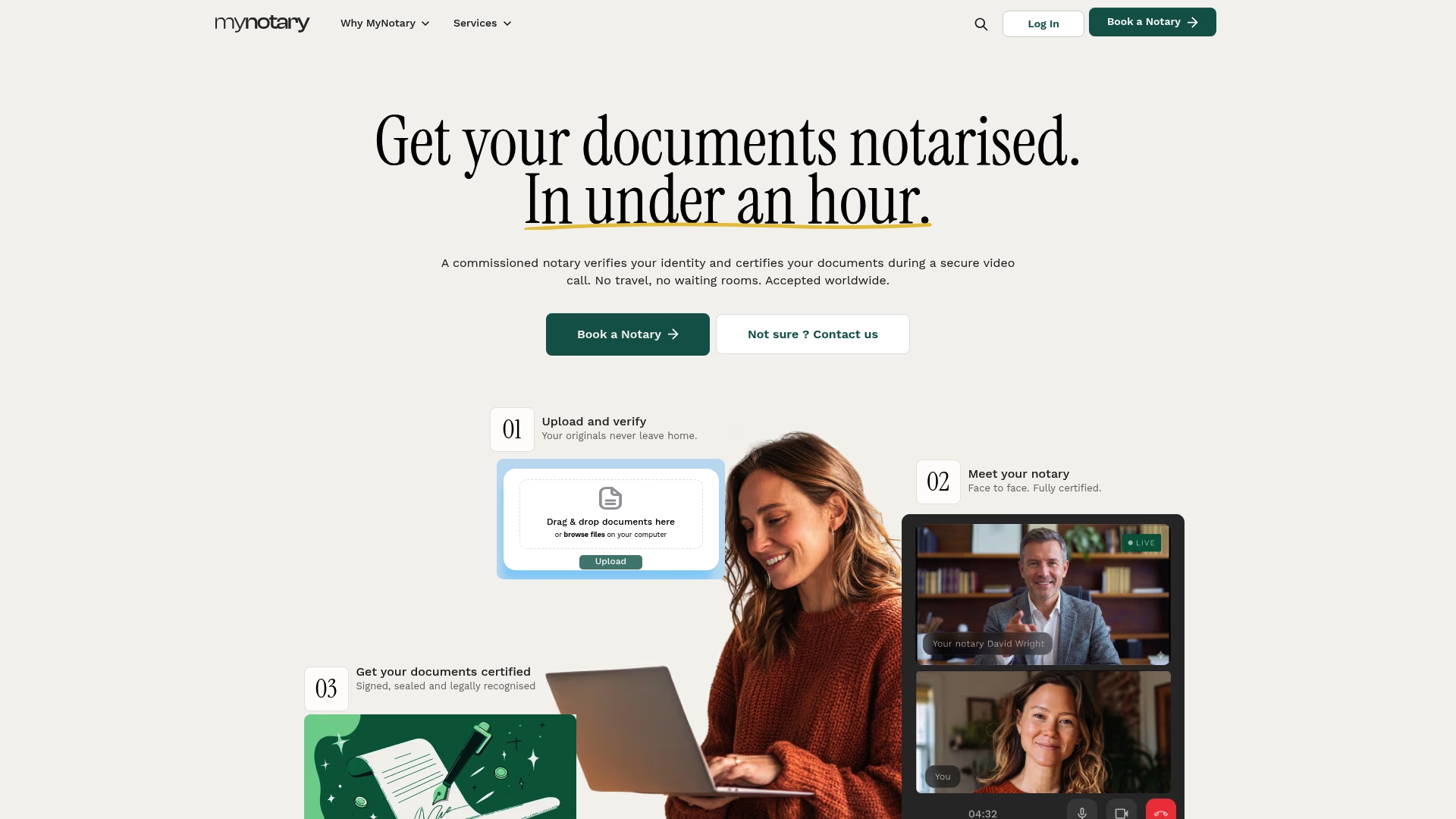
For a certificate of incorporation, the certified company registration copy service is the direct route, built specifically for this document type. If your business also needs other paperwork notarised alongside it, board resolutions, powers of attorney, commercial contracts, the corporate document notarisation service covers the wider set in one process.
Have your certificate of incorporation PDF, valid photo ID, and any proof of authority ready before you start. If you also need an apostille or certified translation, flag it at booking so both can be arranged together rather than as a second round trip. Book your session and get the certified copy your bank or overseas authority is waiting for.
Sources
- Gov
- The Notary leaflet — The Notaries Society (2023)
- UK Certificate of Incorporation Apostille (2026 Guide) — Ginkgo Advisory
FAQ
What is a notarised certificate of incorporation copy?
It's your certificate of incorporation authenticated by a notary, who applies their signature and official seal to confirm it's a true copy of the original, as described in the Notaries Society's own guidance on the role.
Can I get a notarised copy without visiting a notary in person?
Yes. Secure video notarisation services such as My Notary let you complete identity verification and certification remotely, with a fast turnaround.
Do I need an apostille as well as notarisation?
Only if the destination country requires it. Hague Convention countries generally accept an apostille alongside the notarised copy, while non-Hague countries typically need additional embassy legalisation.
How much does it cost to get a certified copy from Companies House?
Companies House charges standard and same-day fees for certified copies and certificates, which is separate from the cost of notarisation itself.
Why would a bank reject my notarised copy?
Common causes include name mismatches, unsigned source documents, low-quality scans, or a missing apostille or translation the receiving authority specifically requires.
Recommended
Got questions? We’re on it.
Most questions are answered here, drawn from what people actually ask before booking. If yours isn’t, our team is in chat.
It's your certificate of incorporation authenticated by a notary, who applies their signature and official seal to confirm it's a true copy of the original, as described in the Notaries Society's own guidance on the role.
Last updated: