Avoid Rejections: Notarised University Documents in the UK HEDD Checks
By Jeremy Arhab, Founder · Published 29 August 2026 · Updated 29 August 2026
UK guide to get notarised university documents right. Use HEDD or your registrar, follow the apostille sequence correctly, and consider online...

If a foreign employer, university, or regulator has asked you for notarised documents for university records, you will usually need a notary's certificate followed by an apostille or, for a small number of destinations, consular legalisation. The right first move is not booking an appointment. It is checking the recipient's exact wording, because that single sentence determines whether a certified copy is enough or whether you need the full notarisation and legalisation chain.
***
TL;DR: - Most countries require notarisation combined with an apostille or consular legalisation, depending on whether they signed the Hague Convention. - Verifying the specific wording and instructions from the recipient is crucial, as requirements for notarised documents vary widely between countries and institutions. - University verification can be a bottleneck, especially if the institution does not support instant HEDD checks, which can take minutes instead of days. - Online notarisation services, such as video-call-based methods, can deliver certified documents within an hour, but some destinations still demand original, sealed transcripts. - The most common errors involve incorrect sequencing, such as apostilling before notarising or opening sealed transcripts, leading to document rejection or delays.
***
Table of Contents
- What counts as a notarised university document
- When you'll actually be asked for this
- How universities and notaries verify your degree is real
- The step-by-step process: from original to legalised copy
- Apostille or consular legalisation: how to tell which one you need
- Can you notarise university documents online?
- Costs, timescales, and the mistakes that cause rejections
- What I've learnt watching university documents get rejected
- How MyNotary handles university document notarisation
- Where to check the rules before you start
- Sources
- FAQ
What counts as a notarised university document
A notarised copy is a document where a notary has confirmed your identity and witnessed either your signature or the copying of an original, then attached a notarial certificate recording what they saw. This is different from a jurat, where you swear or affirm the contents are true in the notary's presence, and different again from your university's own sealed transcript, which the institution certifies itself. A notary does not check whether your degree is genuine or accredited; that verification happens separately, through the university or HEDD.
Documents that typically go through this process include:
- Degree certificates
- Academic transcripts
- Enrolment or confirmation letters
- Diploma supplements
When you'll actually be asked for this
Recipients rarely ask for notarisation as a formality. It tends to come up in specific scenarios:
- Overseas job offers where the employer needs proof of your qualification
- Visa or residence applications requiring evidence of prior study
- Applying to a foreign university for further study or credit transfer
- Registering with a professional body abroad that requires verified academic history
Before you book anything, read the recipient's instructions line by line. Some accept a solicitor-certified copy; others explicitly demand a notarial certificate plus an apostille. If you can find a sample acceptance letter or checklist from the receiving body, use it to confirm exactly what "notarised" means to them, since the term gets used loosely and inconsistently across countries.
How universities and notaries verify your degree is real
A notary confirming your identity is only half the picture. Most receiving authorities also want confidence that the underlying qualification is genuine, and that's where verification routes matter. HEDD is the UK's degree verification service, and some universities support instant HEDD checks, while others still require direct contact with the awarding institution. Knowing which category your university falls into changes your timeline considerably, since instant checks take minutes and registrar contact can take days or weeks.
University registry offices often ask for a signed consent form before responding to a third-party verification request, and may charge a small fee for issuing a sealed transcript or confirming your record. Practical steps worth taking early:
- Find your registrar's contact details before you need them urgently
- Request a sealed transcript in advance if your recipient specifically asks for one
- Sign any consent form the university requires so they can speak to the notary or verifier directly
Pro Tip: Email your university's registry the moment you know legalisation is likely, even before you've booked a notary. Verification is almost always the slowest part of the chain, not the notarisation itself.
The step-by-step process: from original to legalised copy
Getting this right is mostly about sequencing. Do the steps out of order and you risk a rejected document weeks after you thought you were finished.
- Decide originals versus certified copies. If your recipient wants a certified copy rather than your only original, order one from your university's registry first, since some registries take days to issue a fresh sealed copy.
- Gather what you need for the notary appointment. Bring photo ID, proof of address, the original document, a copy for certification, and a printed version of the recipient's exact requirements.
- Attend the notarisation. The notary checks your identity, examines the original against the copy, and issues either a jurat (for a sworn statement) or a notarial certificate confirming the copy is a true likeness. They may contact your university directly if the recipient requires independent verification.
- Apply for an apostille if your destination is a Hague Convention country. The Legalisation Office checks the notary's signature and seal against its records before attaching the apostille.
- Arrange consular legalisation if the destination is not a Hague signatory. This adds an extra stage at the relevant embassy or consulate, on top of the apostille.
- Ask about expedited services at each stage if you're working to a deadline; both the Legalisation Office and many notary providers offer faster turnaround for an additional fee.
Skipping straight to apostille before notarisation, or assuming every country accepts the same route, are the two most common ways this process goes wrong. A workflow built around biometric ID checks and video-call notarisation can complete the notarisation stage in around an hour on average, which shortens the part of the process you actually control.
Apostille or consular legalisation: how to tell which one you need
This is the decision point where most delays start. An apostille is a certificate the Legalisation Office attaches to a document already certified by a UK public official, such as a notary or solicitor, and it works for any destination that has signed the Hague Convention. If your destination country hasn't signed, you'll need consular legalisation instead, which means an additional visit to that country's embassy or consulate in the UK after the apostille stage, adding both time and cost.
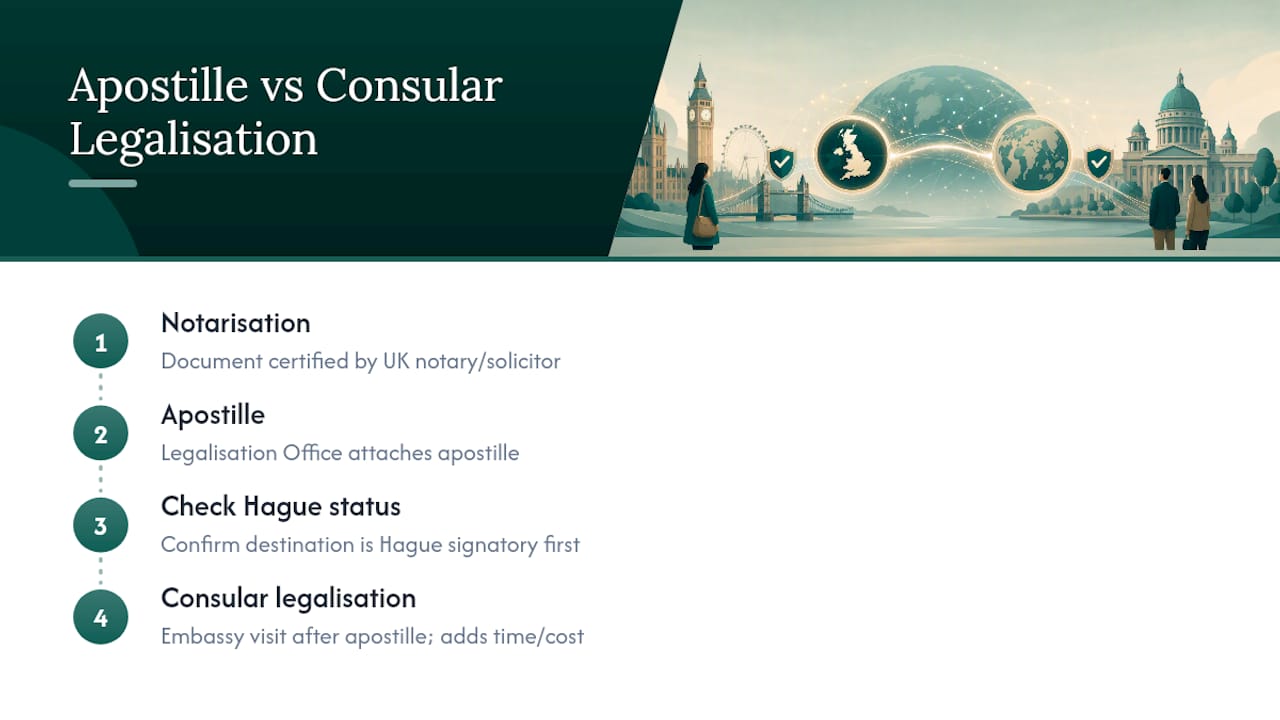
Checking the full list of Hague Convention countries before you start saves a wasted trip. The most common sequencing error is applying for consular legalisation before the apostille is issued, or assuming a country is a Hague signatory when it isn't. Always confirm your destination's status first, then follow the correct order: notarisation, then apostille, then consular legalisation only if required.
Can you notarise university documents online?
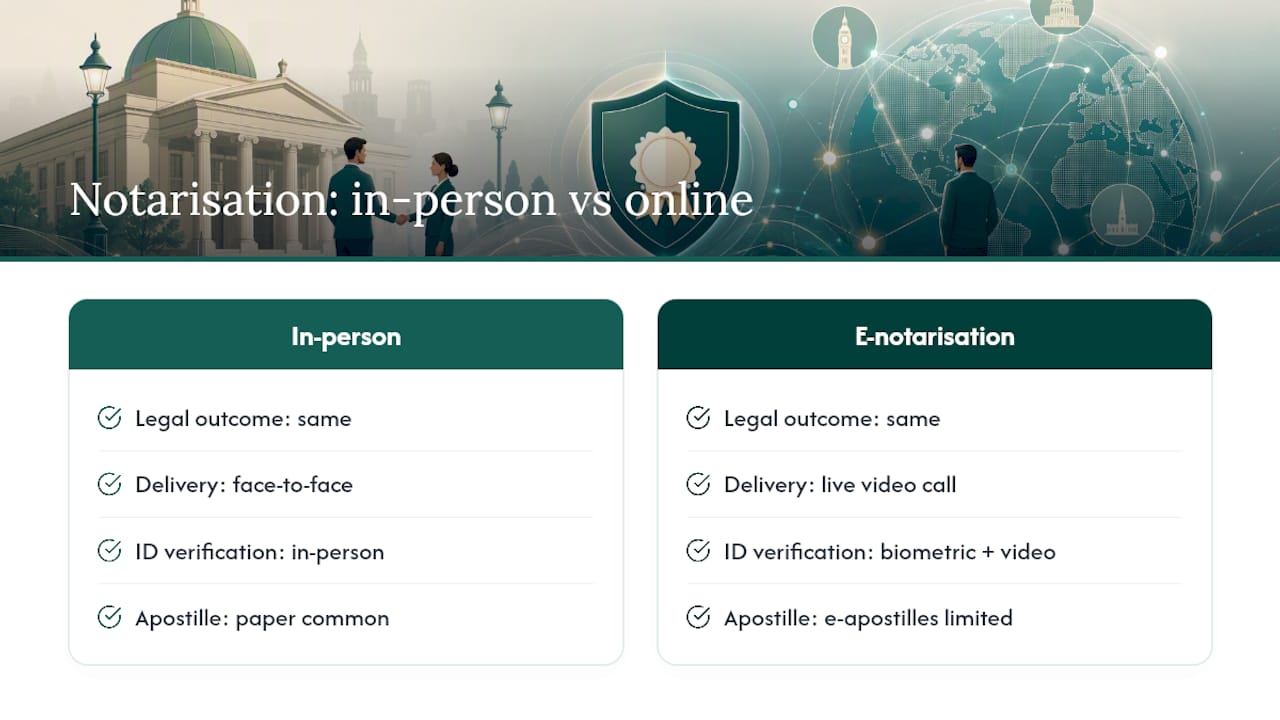
In-person notarisation and e-notarisation achieve the same legal outcome. The difference is delivery: e-notarisation happens over a live video call rather than face-to-face, with the notary still verifying your identity and witnessing the document in real time. E-apostilles exist in some jurisdictions, but coverage is inconsistent, and many receiving countries still expect a paper apostille physically attached to your notarised document.
Where online notarisation fits well is speed and convenience for the notarial certificate itself, though some recipients still insist on seeing a physical, sealed university transcript rather than a digital copy, so it's worth confirming this before you commit to an entirely paper-free route. MyNotary's online notarisation service combines biometric identity verification with video-call witnessing and typically turns around notarised degree certificates and transcripts in about an hour, with electronic signatures recognised across more than 180 countries.
Pro Tip: If your recipient hasn't explicitly said "original only" or "wet ink signature required", ask them directly whether an electronically signed, notarised PDF is acceptable before assuming you need to post a physical document.
Costs, timescales, and the mistakes that cause rejections
Expect several separate charges rather than one flat fee: a notary fee for the certification itself, a possible university verification charge, an apostille fee from the Legalisation Office, and, where relevant, embassy fees plus courier costs for physical delivery. Exact figures vary by provider and destination, so treat any quote as a range rather than a fixed number until you've confirmed every stage your specific country requires.
University verification is usually the bottleneck, not the notarisation or apostille stages, particularly where a university doesn't support instant HEDD checks and needs to be contacted directly.
The most frequent rejection reasons are worth checking against your paperwork before you submit anything:
- A name mismatch between your ID, your degree certificate, and your application form
- Opening a sealed transcript envelope before it reaches the recipient, which invalidates the seal
- Using the wrong certification type, such as a plain certified copy where a full notarial certificate was required
- Submitting a digitally certified document where the recipient specifically demanded a physical original
What I've learnt watching university documents get rejected
The pattern I see most often isn't fraud or dishonesty. It's sequencing. People apostille a document before it's properly notarised, or they open a sealed transcript to check it's correct and unknowingly void the seal that made it valid. The notary's role is deliberately narrow: confirming identity and witnessing a copy, not vouching for your degree's authenticity. That verification sits with the university or HEDD, and conflating the two steps is where most delays originate.
An online workflow doesn't remove the need to get the sequence right, but it does remove the friction of booking appointments and travelling to an office, which matters when a visa deadline is two weeks away. My advice stays the same regardless of the method you choose: confirm exactly what the recipient wants in writing, and get your university's consent for third-party verification sorted before you need it.
— Jérémy
How MyNotary handles university document notarisation
My Notary gets your notarised documents for university back in your hands in around an hour, not the days a traditional in-person notary appointment usually takes once you factor in booking, travel, and waiting. The service covers degree certificates, academic transcripts, and diplomas for visa, employment, or study applications abroad, all completed over a video call.
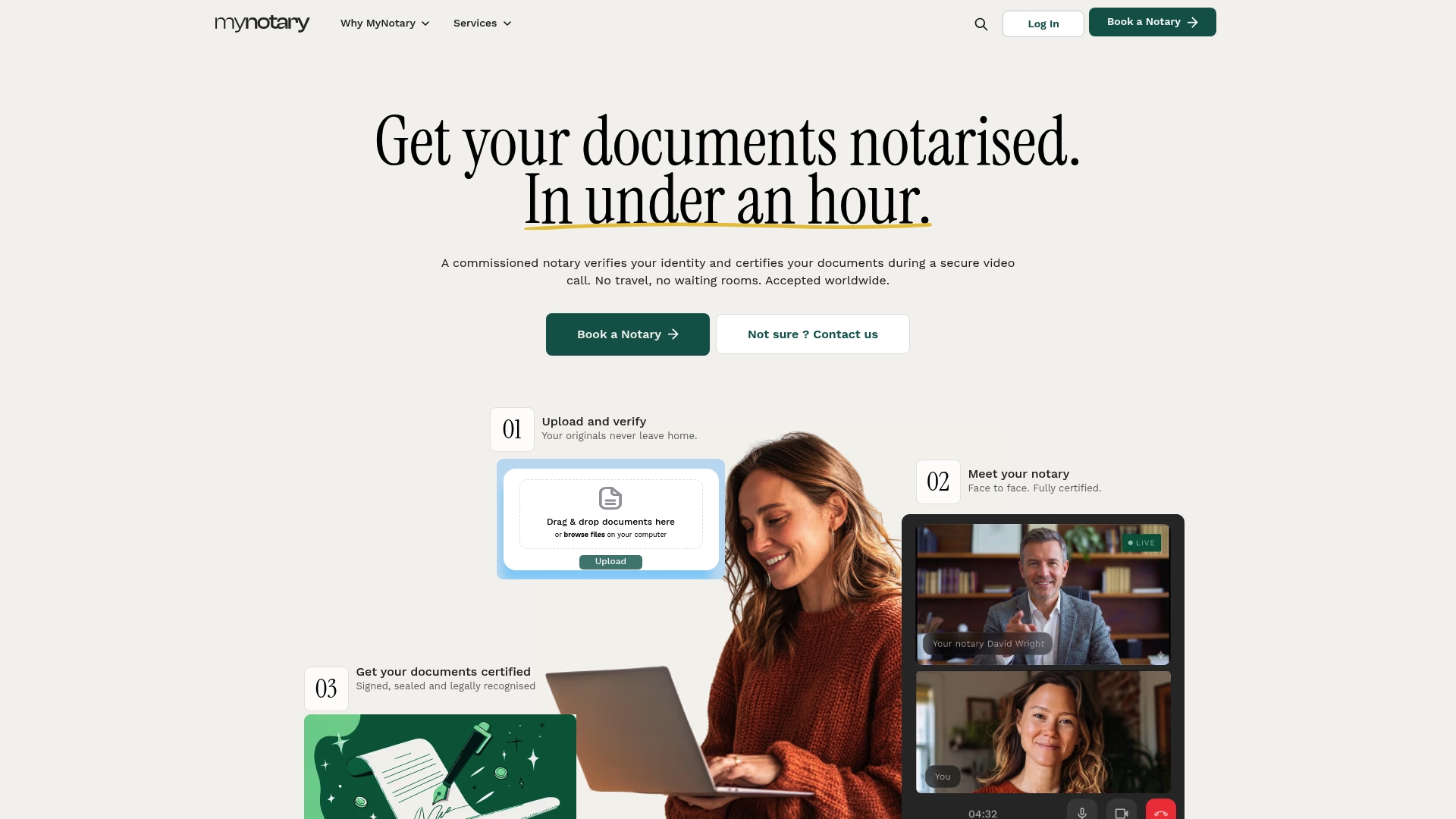
Every appointment includes biometric identity verification and a recorded video-witnessed notarisation, with electronically signed documents recognised in more than 180 countries. Where your destination requires an apostille, My Notary can help coordinate that next stage so you're not left managing separate providers. One honest caveat: if your recipient explicitly demands a physical, wet-ink original or a university-sealed transcript rather than a certified copy, you'll still need to obtain that document from your registry directly, no online notary can substitute for it. For everything else, you can book a degree certification appointment or browse the full range of notary services online to see which route fits your situation.
Where to check the rules before you start
- Gov
- HEDD – Higher Education Degree Datacheck
- Document legalisation – Registry Services, University of Edinburgh
- Certification of documents – University Secretary's Office, University of Bristol
Sources
- Gov
- HEDD - Higher Education Degree Datacheck
- Legalisation of documents - Registry Services (University of Edinburgh)
- Certification of documents | University Secretary's Office (University of Bristol)
FAQ
Who can notarise documents in the UK?
A commissioned notary can notarise your university documents; solicitors can certify copies in some contexts, but only a notary can issue a full notarial certificate that most overseas recipients specifically require.
Can any solicitor arrange an apostille?
No. A solicitor can certify a copy of your document, but only the Legalisation Office issues the apostille itself, checking the certifying official's signature and seal before attaching it.
Can I get an apostille in one day?
Standard apostille processing usually takes longer than a day once postal or verification time is included, though expedited services exist for an additional fee if your deadline is tight.
How much does it cost to get a university document notarised?
Costs vary by provider and destination, typically combining a notary fee, a possible university verification charge, and separate apostille or embassy fees, so it's worth getting a full breakdown before you start rather than assuming one flat price.
Do I need HEDD verification for every university document?
Not always. Some receiving authorities accept a notarised copy alone, but many now expect HEDD verification or direct university confirmation, particularly for visa and employment applications, so check the recipient's exact requirement first.
Recommended
Got questions? We’re on it.
Most questions are answered here, drawn from what people actually ask before booking. If yours isn’t, our team is in chat.
A commissioned notary can notarise your university documents; solicitors can certify copies in some contexts, but only a notary can issue a full notarial certificate that most overseas recipients specifically require.
Last updated: