Are electronic signatures legally valid? What you need to know
By Jeremy Arhab, Founder · Published 16 August 2026 · Updated 16 August 2026
Discover the legality of electronic signatures and how they can be effectively used in both personal and commercial documents.

Electronic signatures are legally recognised and admissible in evidence when the signatory intends to authenticate the document. That single principle, established under section 7 of the Electronic Communications Act 2000, is the foundation on which most electronic signing in commercial and personal practice rests.
Three things follow from that:
- Statutory basis: s.7 of the Electronic Communications Act 2000 (ECA 2000) and the principles derived from eIDAS give electronic signatures admissibility and legal effect. Admissibility is not the same as guaranteed evidential weight — courts assess each case on its facts.
- Risk-based choice: not every document needs the same signature type. Simple, advanced, and qualified electronic signatures carry different levels of assurance, and matching the right level to the document's risk is the practical task.
- Immediate action: before relying on an electronic signature, confirm whether the document requires special formalities (witnessing, deed execution), verify the signer's identity, and preserve an audit trail. The checklist in the practical section below sets out each step.
Key takeaways
Electronic signatures are legally valid when the signatory intends to authenticate the document, the appropriate signature level matches the document's risk, and identity, intent, and integrity are supported by a clear audit trail.
| Point | Details |
|---|---|
| Legal verdict | Electronic signatures are admissible under s.7 ECA 2000 and can execute most documents, including deeds, when intent and formalities are met. |
| Match level to risk | Use simple signatures for low-risk transactions, advanced for medium risk, and qualified or certified notarisation for high-risk or international documents. |
| Identity and audit trail | Verify identity beyond email alone and export the platform's audit log; these are the two most important evidential controls. |
| Check formalities first | Deeds, wills, and certain statutory forms carry additional requirements; confirm these before relying on an electronic signature. |
| My Notary | For certified, internationally recognised execution, My Notary provides biometric verification, video-attested witnessing, and a full audit trail in around one hour. |
Table of Contents
- Is an electronic signature legal? The statutory framework explained
- The three levels of electronic signature and when to use each
- When does an electronic signature satisfy formal legal requirements?
- How courts assess the evidential weight of an electronic signature
- A practical, risk-based checklist for choosing and strengthening your signature
- Common pitfalls that weaken an electronic signature's legal position
- A practitioner's perspective on certified signatures and online notarisation
- How My Notary strengthens your electronic signature's legal standing
- Sources
- FAQ
Is an electronic signature legal? The statutory framework explained
An electronic signature is, in legal terms, data in electronic form that is attached to or logically associated with other electronic data and that is used by the signatory to sign. That definition comes directly from s.7 ECA 2000, which makes such signatures admissible in evidence in legal proceedings where questions of authenticity or integrity arise.
The ECA 2000 sits alongside the framework derived from eIDAS (Regulation (EU) No 910/2014), which the UK retained and adapted after 2021 through its own trust services regulations. Together, these instruments create a tiered system: they confirm that electronic signatures can have legal effect and establish the categories (simple, advanced, qualified) that determine how much assurance a signature carries.
Admissibility and validity are related but distinct. A court will admit an electronic signature as evidence; whether it carries enough weight to prove the point in dispute depends on the surrounding circumstances, the technology used, and the evidence available to support it.
**The Law Commission's 2019 report confirmed that an electronic signature is capable of executing a document, including a deed, provided the signatory intends to authenticate it and any required formalities are satisfied.**
The Law Society's practice note reinforces this: most commercial contracts can be executed electronically, and an electronic signature can satisfy requirements for writing, signing, and execution "under hand" when intent and formalities are met.
The three levels of electronic signature and when to use each
BEIS guidance on electronic signatures and trust services and the eIDAS framework both distinguish three practical levels.
| Level | How it works | Typical examples | Best suited for |
|---|---|---|---|
| Simple (basic) | Any electronic data used to sign; no specific technical requirement | Typing a name in an email, clicking "I accept", a scanned signature image | Low-risk contracts, routine correspondence, internal approvals |
| Advanced (AES) | Uniquely linked to the signer; capable of detecting subsequent changes; created using data under the signer's sole control | Platform-generated signatures with email/SMS authentication, PKI-backed signatures without a qualified certificate | Medium-risk commercial contracts, NDAs, employment agreements |
| Qualified (QES) | Created by a qualified signature-creation device; backed by a qualified certificate issued by a trust service provider | Signatures issued via an accredited trust service provider with biometric or in-person identity verification | High-risk transactions, cross-border agreements, registry-sensitive documents, powers of attorney |
Simple signatures are the most common in everyday practice. Their legal standing depends almost entirely on the surrounding evidence: who sent the email, what the context was, whether there was any prior negotiation. Advanced signatures shift that burden considerably, because the technical controls make it harder to argue the signature was not the signer's act. Qualified electronic signatures carry the highest assurance under the eIDAS framework and are generally preferred for international use or where a document may need to be registered or relied upon in a foreign jurisdiction.
When does an electronic signature satisfy formal legal requirements?
Many contracts require no particular form and can be signed electronically without further steps. The Law Society's practice note confirms that electronic signatures are capable of satisfying "writing", "signature", and "under hand" requirements in most commercial contexts.
Certain documents carry additional formalities that need careful attention:
- Deeds require the signature to be witnessed. The Law Commission has noted that remote witnessing remains legally sensitive: a witness must be physically present when the deed is signed, and video witnessing has not been universally accepted for all deed types. For companies, using two authorised signatories to execute a deed electronically is a pragmatic approach that can avoid witnessing difficulties while meeting Companies Act formalities.
- Wills must comply with the Wills Act 1837, which requires physical presence of witnesses. Electronic execution of wills is not currently permitted in standard practice.
- Land registration documents and certain statutory forms may require specific execution methods; always check the relevant registrar's current requirements before relying on an electronic signature.
- Consumer credit agreements and some regulated financial documents have their own statutory execution requirements that may not be satisfied by a simple electronic signature alone.
Pro Tip: Before signing any document electronically, ask one question: does this document require a witness or a specific form of execution? If yes, take advice before proceeding — the cost of getting it wrong is almost always higher than the cost of checking first.
How courts assess the evidential weight of an electronic signature
Admissibility under s.7 ECA 2000 is the starting point, not the finish line. Once admitted, a court weighs the signature's probative value by examining the evidence around it. Commentary on the ECA 2000 and practitioner analysis both confirm that courts look at four main factors.
Identity: can the signature be linked to a specific person? Email address alone is weak. Multi-factor authentication (email plus SMS code, or biometric verification) is considerably stronger.

Intention: did the signer intend to authenticate the document? A declaration clause within the document that confirms intent is simple to add and materially increases evidential weight, according to the Law Society's guidance.
Integrity: has the document been altered since it was signed? Cryptographic hashing, used in advanced and qualified signatures, provides objective evidence that the document is unchanged.
Audit trail: what does the platform's log show? Timestamps, IP addresses, device data, and the sequence of authentication steps are routinely relied on as objective evidence linking a person to an action in an electronic system. In disputes, technical expert evidence about a signing platform's logs and cryptographic properties is often decisive. Maintaining exported audit records and certificate chains is practical insurance.
Third-party certification adds a further layer: a certificate issued by an accredited trust service provider is independent evidence that the signature was created at a specific time using specific credentials.
A practical, risk-based checklist for choosing and strengthening your signature
Match the signature level to the document's risk, then apply the controls below.
Risk matrix:
- Low risk (routine commercial correspondence, internal approvals, low-value contracts): a simple electronic signature is sufficient. Preserve the email chain and any click-to-accept logs.
- Medium risk (employment contracts, NDAs, supplier agreements, mid-value commercial deals): use an advanced electronic signature from a reputable platform. Verify identity via email and phone, and export the audit trail.
- High risk (powers of attorney, high-value commercial agreements, cross-border transactions, documents for foreign registration): use a qualified electronic signature or a certified notarisation workflow. Biometric identity verification and a third-party certificate are advisable.
Checklist for every electronic signing:
- Confirm the document type and check whether any formality (witnessing, deed execution, statutory form) applies before choosing a signature method.
- Verify the signer's identity: at minimum, email plus phone confirmation; for higher-risk documents, government-issued ID and biometric verification via a service such as My Notary's KYC identity verification.
- Add a declaration or attestation clause near the signature block confirming the signer's intent to authenticate the document.
- Use a platform that generates a timestamped audit trail recording who signed, when, from which device, and how they authenticated.
- Apply a qualified timestamp or certificate where the document may be relied upon in a foreign jurisdiction or before a registry.
- For corporate signings, confirm board authorisation and record the resolution; retain the signing platform's audit export alongside the executed document.
- For international use, check mutual recognition: eIDAS-derived rules apply within the UK framework, but other jurisdictions have their own requirements. A qualified certificate or notarised execution generally travels better than a simple signature.
See the My Notary guide to electronic notarisation for a detailed walkthrough of how these steps apply in practice.
Common pitfalls that weaken an electronic signature's legal position
Most problems with electronic signatures are avoidable. The following mistakes appear repeatedly in disputes.
- Using a scanned image for a high-risk document. A scanned signature image is a simple electronic signature with no cryptographic link to the signer. For anything beyond a low-risk transaction, it provides almost no technical evidence of authenticity.
- Skipping identity checks. An email address is not proof of identity. If the signer's identity is later disputed, the absence of any verification step leaves the signing party with little to rely on beyond circumstantial evidence.
- Failing to preserve the audit trail. Signing platforms generate logs automatically, but those logs need to be exported and stored with the executed document. A log that no longer exists cannot be produced in evidence.
- Assuming automatic mutual recognition internationally. eIDAS-derived rules govern recognition within the UK framework. Other countries have their own requirements, and a signature that is perfectly valid domestically may not be accepted by a foreign registry or court without additional certification.
- No declaration of intent in the document. Omitting an attestation line near the signature block is a frequent, avoidable failure. A short statement confirming the signer's intent to be bound can materially strengthen the evidential position.
Pro Tip: Add a one-sentence attestation clause immediately above the signature field: "By signing below, I confirm my intention to authenticate and be bound by this document." It takes ten seconds to add and can be the difference between a clear record and a contested one.
A practitioner's perspective on certified signatures and online notarisation
The legal framework for electronic signatures is, by now, well settled. What practitioners still underestimate is the gap between a signature that is technically admissible and one that will actually hold up when challenged.
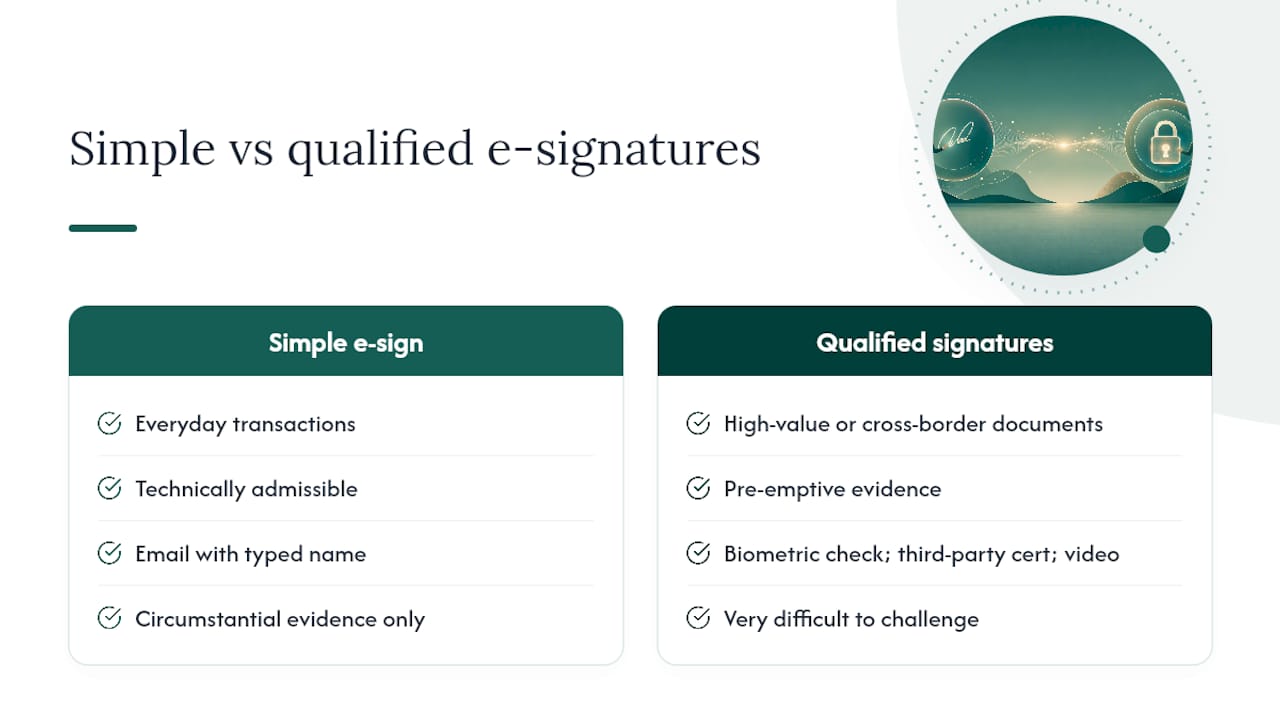
Simple electronic signatures work perfectly well for the vast majority of everyday transactions. The problem arises when a dispute occurs and the only evidence available is an email with a typed name. At that point, the party relying on the signature has to reconstruct intent, identity, and integrity from circumstantial evidence alone, which is an uncomfortable position to be in for a high-value or time-sensitive matter.
Qualified signatures and certified notarisation workflows exist precisely to close that gap. They are not bureaucratic formalities; they are pre-emptive evidence. A biometric identity check, a third-party certificate, and a video-attested signing session produce a record that is very difficult to challenge credibly. For powers of attorney, international commercial agreements, or any document that may need to be relied upon before a foreign authority, that level of assurance is worth the modest additional effort.
The practical question is not whether to use electronic signatures — the answer to that is almost always yes. The question is whether the evidence supporting the signature is proportionate to what is at stake.
How My Notary strengthens your electronic signature's legal standing
For documents where a simple or advanced signature is not enough, My Notary offers a certified online notarisation workflow that addresses the three factors courts care about most: identity, intent, and integrity.

The platform combines biometric identity verification, a certified audit trail, and video-attested witnessing by a commissioned notary, producing a signed and certified document that carries independent third-party evidence of who signed, when, and under what conditions. That record is recognised in over 180 countries. Typical use cases include powers of attorney, high-value commercial agreements, and corporate document notarisation where a clear chain of evidence matters.
To get a certified signature with a full audit trail, book an online signature certification session with My Notary. The average turnaround is one hour.
Sources
The following primary sources and practitioner guidance underpin the legal position set out in this article.
This article is general information, not a substitute for advice from a qualified lawyer. Consult a qualified legal professional about your own circumstances before acting on anything here.
FAQ
Is it legal to use an electronic signature?
Yes. Under s.7 of the Electronic Communications Act 2000, electronic signatures are admissible in evidence and can have legal effect, provided the signatory intends to authenticate the document and any required formalities are satisfied.
Can you use an electronic signature on a legal document?
Most legal documents can be signed electronically, including commercial contracts and many deeds. Exceptions include wills and certain documents requiring physical witnessing; always check the specific formality requirements before signing.
What are the four requirements for an electronic signature to be valid?
Courts assess identity (can the signature be linked to a specific person?), intention (did the signer mean to authenticate the document?), integrity (has the document been altered since signing?), and the audit trail (what objective evidence supports the signing event?).
Does a digital signature hold up in court?
Yes, when supported by sufficient evidence. Advanced and qualified digital signatures, backed by cryptographic certificates and a timestamped audit trail, carry considerably more evidential weight than a simple scanned image. My Notary's certified workflow provides biometric verification and a full audit record that is recognised in over 180 countries.
Recommended
Got questions? We’re on it.
Most questions are answered here, drawn from what people actually ask before booking. If yours isn’t, our team is in chat.
Yes. Under s.7 of the Electronic Communications Act 2000, electronic signatures are admissible in evidence and can have legal effect, provided the signatory intends to authenticate the document and any required formalities are satisfied.
Last updated: